# Is IRISnet (IRIS) a Good Investment? A Comprehensive Analysis of Market Potential, Technology, and Risk Factors in 2024
## Article Overview
This comprehensive investment analysis examines IRISnet (IRIS), a self-evolving BPoS cross-chain service hub positioned as a bridge between digital and real economies. The report evaluates IRIS's investment viability through market data, technical architecture, tokenomics, and risk assessment. Currently trading at $0.0005125 with an $833,332 market cap and declining 86.86% annually, IRIS presents high-risk opportunities for experienced investors. The analysis covers historical price performance, supply dynamics with unlimited maximum tokens, liquidity constraints, competitive positioning, and three-tier price forecasts through 2030. Designed for investors researching early-stage blockchain infrastructure, this guide provides essential insights on whether IRIS aligns with individual risk tolerance and investment objectives through Gate trading platforms and analysis to
Introduction: IRISnet (IRIS) Investment Position and Market Prospects
IRIS is an important asset in the cryptocurrency field. Since its launch in April 2021, it has been developed as a self-evolving BPoS cross-chain service hub designed to bridge the digital economy and the real economy. As of December 28, 2025, IRIS maintains a market capitalization of approximately $833,332 USD, with a circulating supply of approximately 1.626 billion tokens at a current price of around $0.0005125. Given its positioning as a "bridge" connecting heterogeneous networks and enabling cross-chain service invocation, IRIS has gradually become a focal point when investors discuss whether IRISnet represents a viable investment opportunity. This article provides a comprehensive analysis of IRIS's investment value, historical price trends, future price forecasts, and investment risks to serve as a reference for investors.
IRISnet (IRIS) Research Report: Market Analysis and Current Status
I. IRIS Price History Review and Current Investment Value
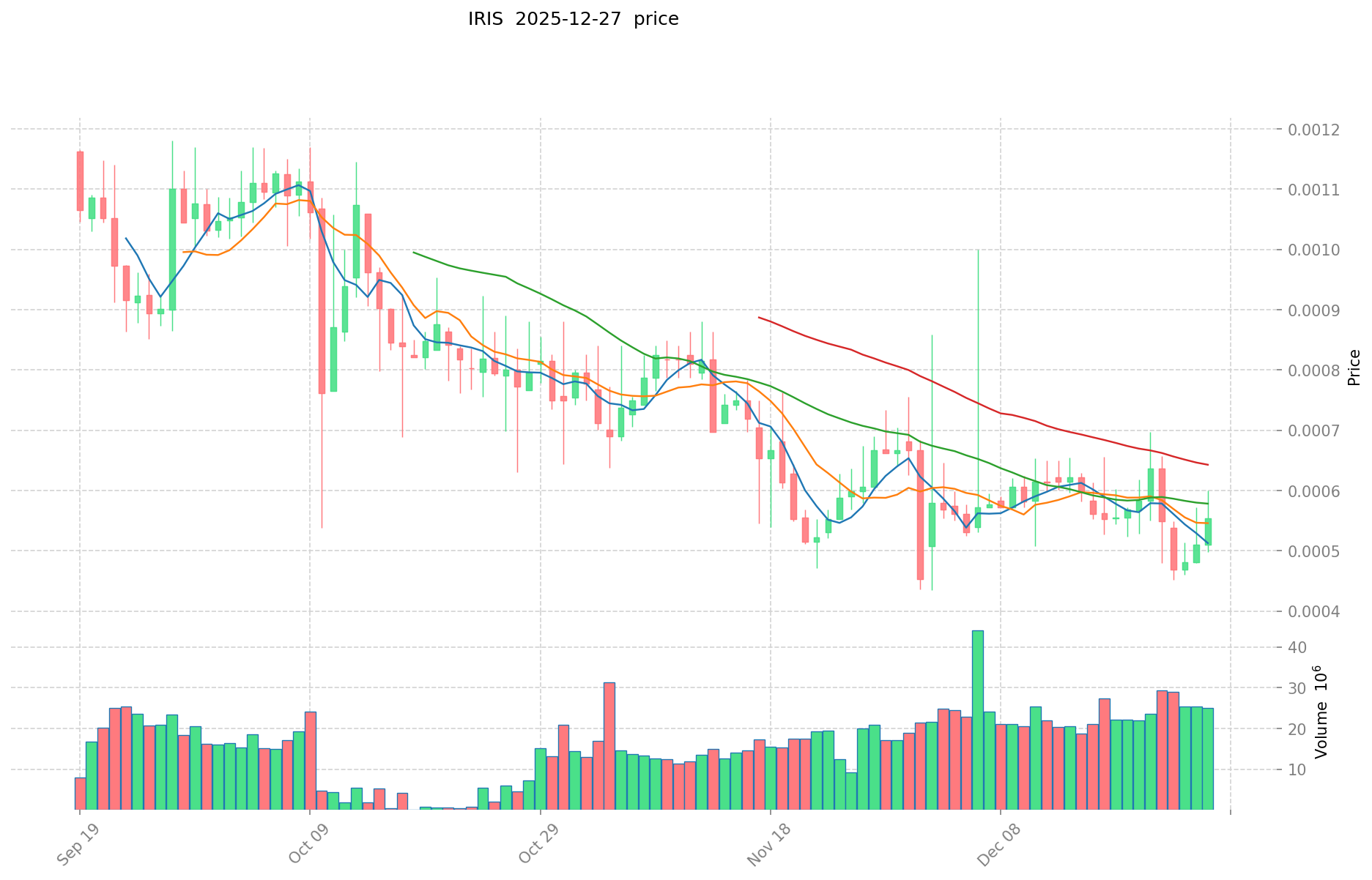
Based on available market data, IRIS has experienced significant price volatility since its public launch:
- All-Time High (ATH): USD 0.299467 (April 12, 2021)
- All-Time Low (ATL): USD 0.00044927 (December 2, 2025)
- Current Price: USD 0.0005125 (as of December 28, 2025)
- One-Year Performance: -86.86% decline
The token has experienced substantial depreciation from its peak in 2021, reflecting broader market conditions and competitive pressures within the cross-chain infrastructure sector.
Current IRIS Market Status (December 28, 2025)
| Metric |
Value |
| Current Price |
USD 0.0005125 |
| 24-Hour Trading Volume |
USD 12,445.53 |
| Market Capitalization |
USD 833,332.28 |
| Fully Diluted Valuation |
USD 1,021,903.00 |
| Circulating Supply |
1,626,014,205.67 IRIS |
| Total Supply |
1,993,957,077 IRIS |
| Maximum Supply |
Unlimited |
| Market Dominance |
0.000032% |
| Circulating Supply Ratio |
81.55% |
| 24H Price Change |
0% |
| 7D Price Change |
-6.1% |
| 30D Price Change |
-23.95% |
Market sentiment indicators show neutral positioning in current market conditions.
II. Project Overview and Technical Architecture
Project Vision and Positioning
IRISnet is named after Iris, the Greek goddess of the rainbow, symbolizing a messenger between heaven and earth. The project positions itself as a self-evolving BPoS cross-chain service hub with the following core objectives:
- Serve as a credible bridge linking the digital economy and real economy
- Provide next-generation public blockchain infrastructure for complex distributed business applications
- Enable seamless integration between public chains, alliance chains, and traditional business systems
- Facilitate cross-chain service invocation and heterogeneous network interoperability
Development Team and Partnerships
IRISnet was jointly developed by Boundary Intelligence and the Tendermint team, combining expertise in distributed systems and blockchain infrastructure.
Technical Capabilities
The platform emphasizes:
- Cross-chain Integration: Support for seamless communication between diverse blockchain networks
- Data Interoperability: Enable data and complex computational processes to interconnect across heterogeneous networks
- Service Invocation: Enable cross-chain service calls and execution
- Self-Evolution: Adaptive protocol mechanisms for ongoing improvement
III. Tokenomics and Supply Dynamics
Token Supply Structure
| Parameter |
Details |
| Circulating Supply |
1,626,014,205.67 IRIS |
| Total Supply |
1,993,957,077 IRIS |
| Maximum Supply |
Unlimited (∞) |
| Distribution Ratio |
81.55% of total circulating |
The unlimited maximum supply represents a significant consideration for long-term token economics and potential inflationary pressure.
Market Capitalization Metrics
- Current Market Cap: USD 833,332.28
- Fully Diluted Valuation (FDV): USD 1,021,903.00
- FDV to Market Cap Ratio: 81.55%
Recent Price Trends
| Time Period |
Change |
Absolute Movement |
| 1 Hour |
+1.21% |
+0.000006127 |
| 24 Hours |
0% |
0 |
| 7 Days |
-6.1% |
-0.000033 |
| 30 Days |
-23.95% |
-0.000161 |
| 1 Year |
-86.86% |
-0.003388 |
The extended downward trend over the 12-month period reflects challenging market conditions for cross-chain infrastructure projects.
Trading Activity
- 24-Hour Volume: USD 12,445.53
- 24-Hour High: USD 0.00058
- 24-Hour Low: USD 0.0004977
- Volume-to-Market Cap Ratio: Approximately 1.49%
V. Project Resources and Community Engagement
Official Channels
The project maintains active development repositories and technical documentation, enabling community review of protocol specifications and ongoing development efforts.
VI. Key Observations and Considerations
Market Position
IRIS maintains a rank of 2,764 by market capitalization among tracked digital assets, indicating a relatively small market position within the broader cryptocurrency ecosystem.
Liquidity Characteristics
The relatively low 24-hour trading volume compared to market capitalization suggests limited liquidity, which may impact entry and exit execution for larger positions.
Price Volatility
The significant percentage declines across multiple timeframes indicate high volatility and market uncertainty regarding the project's value proposition and adoption prospects.
Disclaimer
This report is prepared for informational purposes based on available market data as of December 28, 2025. The analysis reflects factual market conditions and does not constitute investment advice, recommendations, or forecasts. Cryptocurrency markets exhibit high volatility and risk. Prospective participants should conduct independent research and consult qualified financial advisors before making any investment decisions. Past performance does not guarantee future results.
IRISnet (IRIS) Investment Analysis Report
Report Date: December 28, 2025
I. Executive Summary
IRISnet (IRIS) is a self-evolving BPoS cross-chain service hub designed to serve as a bridge between the digital economy and the real economy. As of December 28, 2025, IRIS is trading at $0.0005125 with a market capitalization of approximately $833,332, ranking 2,764 in the overall cryptocurrency market. The token demonstrates significant downward pressure, having declined 86.86% over the past year and 23.95% over the past month.
II. Core Factors Affecting Whether IRISnet (IRIS) is a Good Investment
Supply Mechanism and Scarcity
- Current Supply Structure: IRISnet has a circulating supply of 1,626,014,205.67 IRIS tokens out of a total supply of 1,993,957,077 tokens, representing approximately 81.55% circulation. The maximum supply is unlimited, which may present challenges for long-term scarcity narratives.
- Circulation Ratio Impact: With 81.55% of total supply already in circulation, the token faces potential dilution risks from future emission schedules. The unlimited maximum supply distinguishes IRIS from tokens with hard caps, potentially affecting its store-of-value proposition.
- Investment Implications: The absence of a fixed maximum supply limit may constrain long-term price appreciation potential compared to cryptocurrencies with explicit supply caps.
- Historical Price Movement: IRIS reached an all-time high of $0.299467 on April 12, 2021, and has since experienced substantial depreciation. The recent all-time low of $0.00044927 was recorded on December 2, 2025.
- Short-Term Volatility: Over the past hour, IRIS gained 1.21%, while the 24-hour change showed no movement. However, the 7-day decline of 6.1% and 30-day decline of 23.95% indicate persistent downward pressure.
- One-Year Performance: The 86.86% decline over the past year reflects significant erosion in investor confidence and value retention.
Market Position and Liquidity
- Market Capitalization: With a fully diluted valuation of $1,021,903 and a market dominance of 0.000032%, IRIS holds a minimal share of the overall cryptocurrency market.
- Trading Volume: The 24-hour trading volume of $12,445.53 is relatively low compared to the market capitalization, indicating limited liquidity and potential challenges in executing large positions.
- Market Sentiment: Current market emotion indicators suggest bearish conditions in the broader market context.
Technology and Ecosystem Development
- Core Infrastructure: IRISnet is jointly developed by Boundary Intelligence and the Tendermint team, positioning it as a blockchain infrastructure project focused on interoperability.
- Cross-Chain Capabilities: The platform aims to enable seamless integration between public chains, private/alliance chains, and traditional business systems, supporting cross-chain service invocation and complex computation across heterogeneous networks.
- Infrastructure Value: As a cross-chain service hub, IRISnet's investment value depends on adoption of its interoperability solutions and integration into enterprise and blockchain ecosystems.
Macroeconomic and Market Conditions
- Broader Market Headwinds: The extreme depreciation (86.86% annually) suggests that IRIS has underperformed broader market trends, indicating either project-specific challenges or failure to capture market interest during cryptocurrency cycles.
- Risk Profile: Multiple market analysis sources characterize IRIS as a high-risk investment with a bearish outlook for 2025, suggesting structural challenges beyond temporary market conditions.
III. Investment Risk Assessment
Primary Risk Factors
- Extreme Valuation Decline: The 86.86% one-year decline and descent to near all-time lows indicate fundamental challenges in maintaining investor interest and value proposition.
- Limited Market Liquidity: Trading volume of $12,445.53 relative to market capitalization creates execution risk for investors seeking to enter or exit positions.
- Minimal Market Dominance: A market dominance of 0.000032% suggests minimal integration into the broader cryptocurrency ecosystem and limited network effects.
- Unlimited Supply Structure: The absence of a maximum supply cap introduces perpetual dilution risk and complicates long-term value projections.
Official Channels:
Data as of: December 28, 2025
Disclaimer
This analysis is based solely on publicly available data current as of December 28, 2025. This report does not constitute investment advice, recommendation, or endorsement. Cryptocurrency investments carry substantial risk, including potential total loss of capital. Investors should conduct independent research and consult professional advisors before making investment decisions.
III. IRISnet (IRIS) Future Investment Prediction and Price Outlook (2025-2030)
Short-term Investment Prediction (2025, short-term IRIS investment outlook)
- Conservative forecast: $0.000292 - $0.0005125
- Neutral forecast: $0.0005125
- Optimistic forecast: $0.000615
Mid-term Investment Outlook (2026-2027, mid-term IRISnet(IRIS) investment forecast)
- Market phase expectation: Consolidation phase with moderate volatility, potential recovery trajectory from recent lows as network adoption initiatives progress.
- Investment return predictions:
- 2026: $0.000536 - $0.000637
- 2027: $0.000468 - $0.000630
- Key catalysts: Cross-chain service hub adoption, enterprise integration partnerships, interoperability improvements, and ecosystem expansion initiatives.
Long-term Investment Outlook (Is IRIS a good long-term investment?)
- Base case scenario: $0.000500 - $0.000861 (assuming steady network development and moderate market conditions)
- Optimistic scenario: $0.000732 - $0.000908 (assuming significant enterprise adoption and broader blockchain integration)
- Risk scenario: $0.000468 - $0.000586 (assuming market headwinds and slower adoption rates)
View IRIS long-term investment and price predictions: Price Prediction
2025-12-28 to 2030 Long-term Outlook
- Base scenario: $0.000500 - $0.000861 USD (corresponding to steady network growth and mainstream application expansion)
- Optimistic scenario: $0.000732 - $0.000908 USD (corresponding to large-scale adoption and favorable market conditions)
- Transformative scenario: $0.000908 USD and above (as ecosystem achieves breakthrough progress and mainstream adoption)
- 2030-12-31 predicted high: $0.000861 USD (based on optimistic development assumptions)
Disclaimer: This analysis is for informational purposes only and does not constitute investment advice. Cryptocurrency markets are highly volatile and involve substantial risk. Past price performance does not guarantee future results. Investors should conduct independent research and consult with financial advisors before making investment decisions.
| 年份 |
预测最高价 |
预测平均价格 |
预测最低价 |
涨跌幅 |
| 2025 |
0.000615 |
0.0005125 |
0.000292125 |
0 |
| 2026 |
0.0006370375 |
0.00056375 |
0.0005355625 |
10 |
| 2027 |
0.0006304134375 |
0.00060039375 |
0.000468307125 |
17 |
| 2028 |
0.000849256959375 |
0.00061540359375 |
0.00059078745 |
20 |
| 2029 |
0.000908089542937 |
0.000732330276562 |
0.00058586422125 |
42 |
| 2030 |
0.000861220405237 |
0.00082020990975 |
0.000500328044947 |
60 |
IRISnet (IRIS) Research Report
I. Project Overview
IRISnet is named after Iris, the Greek goddess of the rainbow, who serves as a loyal messenger transmitting information between the mortal world and heaven. The project positions itself as a self-evolving BPoS (Bonded Proof of Stake) cross-chain service hub.
Core Objectives:
- Serve as a credible "bridge" linking the digital economy and the real economy
- Provide next-generation public chain infrastructure for building complex distributed business applications
- Enable seamless integration between public chains, consortium chains, and traditional business systems
- Facilitate cross-network interoperability for data and complex computation across heterogeneous networks
Development Team:
IRISnet is jointly developed by Boundary Intelligence and the Tendermint team, combining expertise in distributed systems and blockchain consensus mechanisms.
Key Features
- Cross-chain Service Hub: Supports service invocation across different blockchain networks
- BPoS Consensus: Self-evolving Bonded Proof of Stake mechanism
- Heterogeneous Network Integration: Enables seamless data flow between diverse systems
- Enterprise Focus: Designed for complex distributed business applications
II. Token Economics & Market Data
Current Market Metrics (as of December 28, 2025)
| Metric |
Value |
| Current Price |
$0.0005125 |
| Market Capitalization |
$833,332.28 |
| Fully Diluted Valuation (FDV) |
$1,021,903.00 |
| Circulating Supply |
1,626,014,205.67 IRIS |
| Total Supply |
1,993,957,077 IRIS |
| Max Supply |
Unlimited (∞) |
| 24H Trading Volume |
$12,445.53 |
| Market Dominance |
0.000032% |
| Circulating Supply Ratio |
81.55% |
| Time Period |
Change |
Amount |
| 1 Hour |
+1.21% |
+$0.000006127 |
| 24 Hours |
0% |
$0.000000 |
| 7 Days |
-6.1% |
-$0.000033293 |
| 30 Days |
-23.95% |
-$0.000161399 |
| 1 Year |
-86.86% |
-$0.003387804 |
Historical Price Extremes
- All-Time High: $0.299467 (April 12, 2021)
- All-Time Low: $0.00044927 (December 2, 2025)
- 24H Range: $0.0004977 - $0.00058
III. Fundamental Analysis
Market Position & Ranking
IRIS ranks 2,764th by market capitalization among cryptocurrencies, indicating a relatively small-cap position within the broader crypto ecosystem. The project maintains minimal market share (0.000032%) and shows limited trading liquidity with moderate daily volume.
Supply Dynamics
The token features an unlimited maximum supply, which distinguishes it from many capped-supply cryptocurrencies. With 81.55% of tokens already circulating, the remaining 367.9 million tokens represent potential future dilution. The unlimited supply structure may impact long-term price dynamics and token scarcity value.
Network Activity
Current metrics indicate relatively modest on-chain activity, reflected in the low 24-hour trading volume of approximately $12,445. This suggests limited market depth and potentially higher slippage for larger trades.
IV. Investment Strategy and Risk Management
Investment Methodology
Long-term Holding (HODL IRIS): Suitable for risk-tolerant investors with conviction in cross-chain infrastructure development and enterprise blockchain adoption. This approach aligns with the project's focus on long-term ecosystem development.
Active Trading: Technical analysis-based strategies may face limitations due to low liquidity and thin order books, making reliable entry and exit execution challenging.
Risk Management Considerations
Asset Allocation Recommendations:
- Conservative investors: Allocate no more than 0.5-1% of portfolio to early-stage cross-chain infrastructure projects
- Aggressive investors: May consider up to 3-5% allocation, given experimental nature and small market cap
- Institutional investors: Typically require higher trading liquidity and clearer fundamental metrics before consideration
Risk Mitigation:
- Diversification across multiple blockchain infrastructure protocols
- Combination with established Layer 1 tokens to balance risk
- Position sizing appropriate to individual risk tolerance
Secure Storage:
- Hot wallets: Exchange accounts for active trading (minimal amounts)
- Cold storage: Hardware wallets (Ledger, Trezor) for long-term holdings
- Self-custody via native wallet or Cosmos ecosystem-compatible solutions
V. Investment Risks and Challenges
Market Risks
Extreme Volatility: IRIS has experienced -86.86% depreciation over the past year, with a peak-to-current decline of 99.83% from all-time highs. This volatility significantly exceeds broader market movements.
Low Liquidity: Daily trading volume of approximately $12,445 is minimal, creating substantial slippage for medium to large orders and making the token vulnerable to price manipulation.
Limited Market Depth: Small market capitalization (rank 2,764) provides minimal institutional interest and limited price discovery mechanisms.
Regulatory Risks
As with most cryptocurrencies, IRIS faces potential regulatory headwinds in various jurisdictions. Different countries maintain divergent approaches to cryptocurrency classification and regulation, creating uncertainty for cross-border adoption and enterprise use cases.
Technology Risks
Cross-chain Security: Interoperability protocols introduce additional attack surfaces and technical risks compared to single-chain solutions.
Consensus Mechanism: BPoS and other proof-of-stake variants carry risks related to validator concentration and economic security assumptions.
Adoption Challenges: Competition from established cross-chain solutions may limit ecosystem growth and network effects.
Execution Risks
- Uncertain adoption trajectory for enterprise blockchain use cases
- Dependency on ecosystem partnerships and developer engagement
- Risk of obsolescence if alternative cross-chain solutions prove superior
VI. Conclusion: Is IRIS a Good Investment?
Investment Value Summary
IRISnet operates in the promising cross-chain infrastructure segment, addressing legitimate technical challenges in blockchain interoperability. However, the project currently exhibits limited market traction, reflected in minimal trading volume, small market capitalization, and severe price depreciation.
Key observations:
- The unlimited token supply creates ongoing dilution concerns
- The 81.55% circulating supply ratio suggests limited scarcity dynamics
- Year-over-year decline of -86.86% indicates market skepticism regarding current execution or competitive positioning
Investor Recommendations
✅ Beginners:
- Not recommended for novice investors due to high risk profile, low liquidity, and unproven commercial adoption
- If considering participation, limit exposure to experimental allocation (under 1% portfolio)
- Utilize dollar-cost averaging and secure self-custody solutions
✅ Experienced Investors:
- May evaluate for speculative positioning within dedicated research and early-stage allocation bucket
- Technical analysis limited by illiquid order books; fundamental thesis should drive decision-making
- Position sizing critical; expect high volatility and potential total loss scenarios
✅ Institutional Investors:
- Current liquidity insufficient for meaningful institutional allocation
- Monitor for improvements in trading infrastructure and adoption metrics before consideration
- Enterprise blockchain adoption timeline remains uncertain
Important Disclaimer
⚠️ Risk Warning: Cryptocurrency investments, particularly in early-stage infrastructure projects, carry substantial risk of financial loss. IRIS exhibits extreme volatility and limited liquidity. This report is provided for informational purposes only and does not constitute investment advice. Conduct independent research and consult qualified financial advisors before making investment decisions. Only invest capital you can afford to lose completely.
Report Date: December 28, 2025
Data Source: Real-time market data as of 00:20 UTC
Disclaimer: This analysis is based on available market data and publicly disclosed information. Past performance does not guarantee future results.
IRISnet (IRIS) Frequently Asked Questions (FAQ)
I. What is IRISnet (IRIS) and what problem does it solve?
Q: What is IRISnet (IRIS) and what problem does it solve?
A: IRISnet is a self-evolving BPoS (Bonded Proof of Stake) cross-chain service hub designed to serve as a bridge connecting the digital economy and the real economy. The project addresses the critical challenge of blockchain interoperability by enabling seamless integration between public chains, consortium chains, and traditional business systems. IRISnet allows cross-chain service invocation and facilitates data flow and complex computation across heterogeneous networks, positioning itself as infrastructure for next-generation distributed business applications.
II. What is the current price and market position of IRIS?
Q: What is the current price and market position of IRIS?
A: As of December 28, 2025, IRIS is trading at $0.0005125 with a market capitalization of approximately $833,332 USD. The token ranks 2,764th among cryptocurrencies by market cap and maintains a market dominance of only 0.000032%. The circulating supply stands at 1,626,014,205.67 IRIS tokens out of a total supply of 1,993,957,077 tokens (81.55% circulation ratio). However, IRIS has experienced severe depreciation, declining 86.86% over the past year and currently trading near its all-time low of $0.00044927 (recorded December 2, 2025), down from an all-time high of $0.299467 in April 2021.
III. What are the main risks associated with investing in IRIS?
Q: What are the main risks associated with investing in IRIS?
A: IRIS presents multiple substantial risks for investors: (1) Extreme price volatility with an 86.86% one-year decline and 99.83% decline from all-time highs; (2) Very low trading liquidity with only $12,445.53 in 24-hour volume, creating significant slippage for medium to large orders; (3) Unlimited maximum token supply, which introduces perpetual dilution concerns unlike capped-supply cryptocurrencies; (4) Minimal market position and network effects as indicated by 0.000032% market dominance; (5) Technology risks inherent to cross-chain protocols, which present additional attack surfaces compared to single-chain solutions; (6) Uncertain adoption trajectory for enterprise blockchain use cases and competitive pressures from established interoperability solutions.
IV. What is the token supply structure and what are the implications?
Q: What is the token supply structure and what are the implications?
A: IRIS has a circulating supply of 1,626,014,205.67 tokens and a total supply of 1,993,957,077 tokens, with an unlimited maximum supply. This represents an 81.55% circulation ratio, meaning most tokens are already in circulation. The unlimited maximum supply is a significant consideration that distinguishes IRIS from cryptocurrencies with hard supply caps. This structure creates ongoing dilution risk and complicates long-term scarcity narratives essential for value appreciation. The absence of a fixed maximum supply cap may constrain the token's store-of-value proposition and limit long-term price appreciation potential compared to supply-capped alternatives.
V. What is the price forecast for IRIS through 2030?
Q: What is the price forecast for IRIS through 2030?
A: Price forecasts for IRIS through 2030 vary by scenario: Short-term (2025) predictions range from $0.000292 (conservative) to $0.000615 (optimistic), with neutral forecast at $0.0005125. Mid-term (2026-2027) base case predicts $0.000536-$0.000637 (2026) and $0.000468-$0.000630 (2027), assuming consolidation and moderate network adoption. Long-term (2030) forecasts include base case of $0.000500-$0.000861, optimistic scenario of $0.000732-$0.000908, and transformative scenario exceeding $0.000908. Key catalysts driving positive scenarios include cross-chain service hub adoption, enterprise integration partnerships, and ecosystem expansion. However, these forecasts carry substantial uncertainty and should not be considered investment recommendations.
VI. Is IRIS suitable for beginner investors?
Q: Is IRIS suitable for beginner investors?
A: IRIS is generally not recommended for beginner investors due to its high-risk profile, extreme volatility, and low trading liquidity. The token has declined 86.86% year-over-year and ranks outside the top 2,700 cryptocurrencies by market capitalization. If beginner investors choose to participate, allocation should be strictly limited to experimental portfolio allocations under 1% and approached with dollar-cost averaging strategies. Positions should be stored in secure self-custody solutions rather than exchange wallets. Beginners should first establish foundational knowledge of blockchain technology and conduct independent research before considering any allocation to early-stage infrastructure projects like IRIS.
VII. What liquidity concerns exist with IRIS trading?
Q: What liquidity concerns exist with IRIS trading?
A: IRIS exhibits significant liquidity constraints that impact trading execution: 24-hour trading volume is approximately $12,445.53, which is extremely low relative to the $833,332 market capitalization, creating a volume-to-market-cap ratio of only 1.49%. This minimal trading activity means larger orders face substantial slippage and price impact. The thin order books make reliable entry and exit execution challenging, particularly for medium to large positions. These liquidity constraints effectively limit IRIS to small retail traders and make the token unsuitable for institutional allocation or active trading strategies. Investors should exercise caution regarding position sizing and exit strategies given the illiquid market environment.
VIII. What distinguishes IRISnet from other cross-chain projects?
Q: What distinguishes IRISnet from other cross-chain projects?
A: IRISnet was jointly developed by Boundary Intelligence and the Tendermint team, combining expertise in distributed systems and advanced consensus mechanisms. The project employs a self-evolving BPoS consensus model designed for adaptive protocol improvements. IRISnet specifically emphasizes enterprise-focused applications, targeting integration with traditional business systems alongside blockchain networks, rather than focusing solely on cross-chain cryptocurrency operations. The platform supports complex computation and data flow across heterogeneous networks, positioning itself as infrastructure for sophisticated distributed business applications. However, competitive pressures from established cross-chain solutions and uncertain enterprise adoption timelines represent significant challenges to differentiation and market penetration in an increasingly crowded interoperability sector.
* The information is not intended to be and does not constitute financial advice or any other recommendation of any sort offered or endorsed by Gate.