This comprehensive guide analyzes whether Kaia (KAIA) represents a viable investment opportunity in 2026. As an EVM-compatible Layer 1 blockchain platform, KAIA currently trades at $0.0618 with a $361.94 million market capitalization and 64 million holders across 35 exchanges including Gate. The article examines KAIA's price history, technical fundamentals, and ecosystem development potential while evaluating critical investment risks including market volatility (-71.13% yearly decline), regulatory uncertainty, and competitive pressures from other Layer 1 solutions. Investment forecasts range from conservative ($0.0564-$0.062) to optimistic ($0.078-$0.0954) scenarios through 2026, with long-term projections extending to 2031. The analysis provides tailored recommendations for beginners, experienced traders, and institutional investors, emphasizing risk management, diversification strategies, and secure token storage solutions. Ultimately, KAIA suitability depends on individual risk tolerance and belief in Web
Introduction: Kaia (KAIA) Investment Position and Market Outlook
Kaia (KAIA) represents a notable asset in the cryptocurrency sector, serving as the native token of Kaia Blockchain, an EVM-compatible Layer 1 blockchain platform launched in 2019. As of January 15, 2026, KAIA has established a market capitalization of approximately $361.94 million, with a circulating supply of around 5.86 billion tokens and a current trading price near $0.0618. The project positions itself within the Web 3.0 infrastructure space, focusing on scalability, convenience, and reliability to facilitate broader blockchain adoption. With over 64 million holders and trading availability across 35 exchanges, KAIA has attracted attention from investors exploring "Is Kaia (KAIA) a good investment?" This article provides a comprehensive analysis of KAIA's investment characteristics, historical price movements, future price projections, and associated investment risks to offer reference points for potential investors.
I. Kaia (KAIA) Price History Review and Current Investment Value
- 2021: Launched as Klaytn mainnet in August 2019, the token began trading with initial price discovery phases.
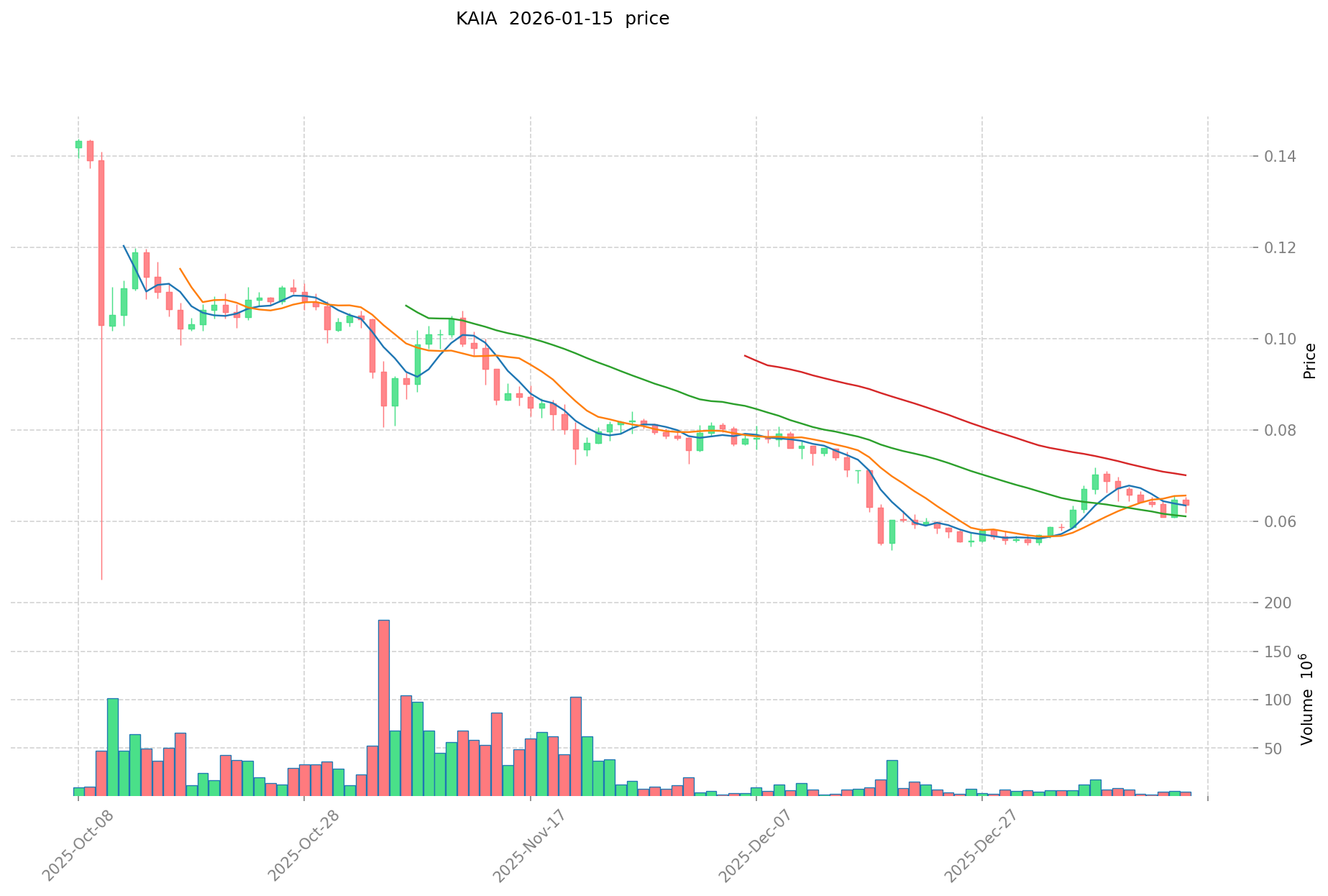
- 2024: Token experienced notable volatility, reaching a significant price level of $0.406698 on December 3, 2024, before entering a correction phase.
- 2025: Market experienced downward pressure, with price declining to levels around $0.053969 in December 2025.
Current KAIA Investment Market Status (January 2026)
- KAIA current price: $0.0618
- Market sentiment (Fear & Greed Index): Data not available in provided materials
- 24-hour trading volume: $449,278.18
- Institutional investor holdings: Total holders recorded at 64,045,004 addresses
- Market capitalization: $361.94 million
- Circulating supply: 5.857 billion KAIA tokens
- Circulation ratio: 100.01%
Click to view real-time KAIA market price
- 1-hour change: -0.61%
- 24-hour change: -5.03%
- 7-day change: -9.24%
- 30-day change: -11.81%
- 1-year change: -71.13%
The token is currently listed on 35 exchanges globally, with a fully diluted valuation matching its market capitalization, indicating complete token circulation in the market.
II. Core Factors Influencing Whether KAIA is a Good Investment
Supply Mechanism and Scarcity (KAIA Investment Scarcity)
- Circulating Supply: As of January 15, 2026, KAIA has a circulating supply of approximately 5.86 billion tokens, with a total supply of 5.86 billion tokens and a maximum supply of approximately 5.86 billion tokens. The circulating supply represents over 100% of the total supply, indicating full token circulation in the market.
- Market Capitalization: KAIA's current market capitalization stands at approximately $361.94 million, with a fully diluted valuation (FDV) matching this figure at 100% market cap to FDV ratio, suggesting no additional supply overhang.
- Investment Implications: The high circulation rate and alignment between market cap and FDV may indicate limited supply-driven scarcity dynamics compared to tokens with lower circulation ratios. This full circulation structure could reduce potential upward pressure from supply constraints.
Institutional Investment and Mainstream Adoption (Institutional Investment in KAIA)
- Holder Distribution: KAIA has attracted approximately 64.05 million holders as of January 2026, demonstrating relatively broad distribution across the user base.
- Exchange Presence: The token is listed on 35 exchanges, including major platforms, which enhances liquidity and accessibility for institutional and retail investors.
- Ecosystem Integration: As an EVM-compatible Layer 1 blockchain, KAIA's infrastructure design prioritizes scalability, convenience, and reliability, positioning it for potential adoption by developers and enterprises seeking Web 3.0 solutions. The Kaia Foundation's efforts to improve blockchain accessibility may support broader ecosystem participation.
Macroeconomic Environment's Impact on KAIA Investment
- Market Performance Context: KAIA's price has experienced notable volatility, with a 1-year decline of approximately 71.13% as of January 15, 2026. Short-term metrics show a 24-hour decrease of 5.03%, a 7-day decline of 9.24%, and a 30-day decrease of 11.81%.
- Price Range: The token has traded between historical levels, with the current price at $0.0618, compared to a recorded level of $0.406698 in December 2024 and $0.053969 in December 2025.
- Market Dynamics: The broader cryptocurrency market environment, influenced by global monetary policies, interest rate adjustments, and macroeconomic conditions, continues to impact investor sentiment toward Layer 1 blockchain tokens like KAIA.
Technology and Ecosystem Development (Technology & Ecosystem for KAIA Investment)
- EVM Compatibility: KAIA Blockchain operates as an EVM-based Layer 1 solution, designed with emphasis on scalability, convenience, and reliability. This compatibility facilitates interoperability with Ethereum-based applications and smart contracts.
- Web 3.0 Focus: The Kaia Foundation's mission centers on enabling broader participation in the Web 3.0 ecosystem by improving blockchain technology accessibility. This strategic direction aims to attract developers, businesses, and individual users to build and engage with decentralized applications.
- Ecosystem Applications: As a Layer 1 blockchain infrastructure, KAIA provides a foundation for various decentralized applications, potentially spanning DeFi, NFT platforms, and other Web 3.0 use cases. The network's design prioritizes connecting diverse global communities through trusted blockchain infrastructure.
- Documentation and Resources: Technical documentation, including the Kaia White Paper, is available for developers and stakeholders seeking to understand the network's architecture and capabilities.
III. KAIA Future Investment Forecast and Price Outlook (Is Kaia(KAIA) worth investing in 2026-2031)
Short-term Investment Forecast (2026, short-term KAIA investment outlook)
- Conservative forecast: $0.0564 - $0.062
- Neutral forecast: $0.062 - $0.0657
- Optimistic forecast: $0.078 - $0.0954
Mid-term Investment Outlook (2027-2029, mid-term Kaia(KAIA) investment forecast)
- Market stage expectation: KAIA may experience gradual growth influenced by broader crypto market trends and developments in blockchain technology accessibility.
- Investment return forecast:
- 2027: $0.0466 - $0.0792
- 2028: $0.0601 - $0.0923
- 2029: $0.0451 - $0.1204
- Key catalysts: Global digital currency regulatory dynamics, technological advancements in the Web 3.0 space, and ecosystem adoption rates.
Long-term Investment Outlook (Is KAIA a good long-term investment?)
- Base scenario: $0.0526 - $0.1387 (assuming steady ecosystem development and moderate market conditions through 2030)
- Optimistic scenario: $0.1199 - $0.1727 (assuming accelerated adoption and favorable regulatory environment by 2031)
- Risk scenario: Below $0.0451 (under conditions of significant market downturns or adverse regulatory changes)
Click to view KAIA long-term investment and price prediction: Price Prediction
2026-01-15 to 2031 Long-term Outlook
- Base scenario: $0.0564 - $0.1387 (corresponding to steady progress and gradual mainstream application growth)
- Optimistic scenario: $0.0792 - $0.1727 (corresponding to large-scale adoption and favorable market conditions)
- Transformative scenario: Above $0.20 (if ecosystem achieves breakthrough developments and mainstream popularization)
- 2031-12-31 forecast high: $0.1727 (based on optimistic development assumptions)
Disclaimer: Price predictions are based on historical data patterns and current market analysis. Future market dynamics may vary significantly due to regulatory changes, technological developments, and broader cryptocurrency market conditions. These forecasts should not be considered as investment advice.
| Year |
Predicted High Price |
Predicted Average Price |
Predicted Low Price |
Price Change |
| 2026 |
0.0657518 |
0.06203 |
0.0564473 |
0 |
| 2027 |
0.079224716 |
0.0638909 |
0.046640357 |
3 |
| 2028 |
0.09230957232 |
0.071557808 |
0.06010855872 |
15 |
| 2029 |
0.1204425245352 |
0.08193369016 |
0.045063529588 |
32 |
| 2030 |
0.138627707066212 |
0.1011881073476 |
0.052617815820752 |
63 |
| 2031 |
0.172667386377944 |
0.119907907206906 |
0.076741060612419 |
94 |
IV. Kaia Investment Strategy and Risk Management (How to invest in Kaia)
Investment Methodology (Kaia investment strategy)
Investors considering Kaia (KAIA) exposure may adopt different approaches based on their risk tolerance and investment horizons:
-
Long-term Holding (HODL Kaia): This approach may suit investors who believe in the long-term development potential of the Kaia ecosystem. Given Kaia's focus on scalability and Web 3.0 accessibility, some market participants view it as a strategic asset for blockchain infrastructure growth. However, investors should note that KAIA has experienced significant price fluctuations, with the current price at $0.0618 representing a substantial decline from previous levels.
-
Active Trading: This strategy involves utilizing technical analysis and momentum-based approaches to capture short-term price movements. Kaia's 24-hour trading volume of approximately $449,278 indicates moderate market liquidity. Traders should be aware of the asset's volatility, as evidenced by recent price changes: -0.61% (1H), -5.03% (24H), -9.24% (7D), and -11.81% (30D).
Risk Management (Risk management for Kaia investment)
Effective risk management is essential when investing in Kaia:
-
Asset Allocation Ratios: Investment allocation should reflect individual risk profiles:
- Conservative investors: May consider limiting Kaia exposure to 1-3% of their cryptocurrency portfolio
- Moderate investors: Might allocate 3-7% depending on their overall digital asset strategy
- Experienced investors: Could consider higher allocations based on comprehensive market analysis and risk assessment
-
Risk Hedging Approaches: Diversification remains a fundamental principle. Investors may consider:
- Multi-asset portfolio construction across different blockchain ecosystems
- Correlation analysis with other Layer 1 platforms
- Position sizing based on volatility metrics
-
Secure Storage: Proper custody solutions are critical:
- Cold wallets for long-term holdings to minimize online exposure
- Hot wallets for active trading with limited balances
- Hardware wallet solutions from established providers for enhanced security
- Multi-signature configurations for institutional holdings
V. Kaia Investment Risks and Challenges (Risks of investing in Kaia)
Potential investors should carefully evaluate multiple risk dimensions:
-
Market Risks: Kaia exhibits high price volatility characteristic of cryptocurrency markets. The asset has experienced significant price movements, with the current price of $0.0618 substantially below previous levels. Trading volume of $449,278 suggests moderate liquidity, which may impact execution during periods of market stress. Price discovery in smaller-cap digital assets can be influenced by various market dynamics.
-
Regulatory Risks: Blockchain platforms face evolving regulatory frameworks across different jurisdictions. Policy developments regarding Layer 1 platforms, EVM-compatible networks, and Web 3.0 infrastructure may impact Kaia's operational environment. Regulatory uncertainty remains a consideration for investors across all cryptocurrency assets.
-
Technical Risks: As an EVM-based Layer 1 blockchain, Kaia is subject to various technical considerations:
- Network security considerations inherent to blockchain infrastructure
- Smart contract vulnerabilities that may affect ecosystem applications
- Protocol upgrade coordination and implementation challenges
- Scalability testing under varying network load conditions
- Competition from other Layer 1 and Layer 2 solutions
VI. Conclusion: Is Kaia a Good Investment?
-
Investment Value Summary: Kaia represents an EVM-compatible Layer 1 blockchain project focused on scalability, convenience, and Web 3.0 accessibility. The project's emphasis on making blockchain technology more accessible may appeal to investors seeking exposure to emerging blockchain infrastructure. However, significant price volatility and market dynamics characteristic of the cryptocurrency sector warrant careful consideration.
-
Investor Recommendations:
✅ Beginners: Consider learning about blockchain fundamentals before investing. If proceeding, dollar-cost averaging (DCA) combined with secure wallet storage may help manage exposure to price volatility.
✅ Experienced Investors: May evaluate Kaia within a diversified cryptocurrency portfolio, utilizing technical analysis for position management and maintaining appropriate risk controls.
✅ Institutional Participants: Should conduct comprehensive due diligence on the Kaia ecosystem, including technical architecture, governance structure, and competitive positioning within the Layer 1 landscape.
⚠️ Disclaimer: Cryptocurrency investments involve substantial risk and high volatility. This content is for informational purposes only and does not constitute investment advice. Investors should conduct their own research and consult with qualified financial advisors before making investment decisions. Past performance does not guarantee future results.
VII. FAQ
Q1: Is Kaia (KAIA) a good investment for beginners in 2026?
Kaia may present challenges for beginners due to its high volatility and technical complexity. As a Layer 1 blockchain infrastructure token, KAIA has experienced significant price fluctuations, with a 71.13% decline over the past year and current trading at $0.0618. For beginners considering KAIA, starting with small allocations (1-3% of portfolio), employing dollar-cost averaging strategies, and utilizing secure cold wallet storage are recommended approaches. Understanding blockchain fundamentals and the Web 3.0 ecosystem before investing is essential, as this asset requires awareness of both technical developments and market dynamics.
Q2: What makes Kaia different from other Layer 1 blockchain investments?
Kaia distinguishes itself through its EVM compatibility and focus on accessibility within the Web 3.0 ecosystem. Unlike some competing Layer 1 platforms, Kaia emphasizes scalability, convenience, and reliability as core design principles, aiming to lower barriers for blockchain adoption. The project has achieved notable network effects with approximately 64.05 million holders and availability across 35 exchanges. However, investors should note that Kaia operates in a highly competitive landscape alongside established Layer 1 solutions, and its relatively lower market capitalization of $361.94 million reflects its positioning as an emerging infrastructure project rather than a dominant platform.
Q3: What is the realistic price target for KAIA by the end of 2026?
Based on current market analysis, KAIA price forecasts for 2026 range across three scenarios: conservative ($0.0564 - $0.062), neutral ($0.062 - $0.0657), and optimistic ($0.078 - $0.0954). The predicted average price for 2026 stands at approximately $0.06203, with a high of $0.0657. These projections consider factors including current market capitalization, trading volume patterns, and broader cryptocurrency market conditions. However, actual performance may deviate significantly from these estimates due to regulatory developments, technological advancements, competitive dynamics, and macroeconomic factors affecting the digital asset sector.
Q4: What are the main risks associated with investing in Kaia?
Kaia investment carries multiple risk categories that require careful consideration. Market risk is substantial, evidenced by recent performance showing -5.03% (24H), -9.24% (7D), and -71.13% (1Y) changes, with moderate liquidity at $449,278 daily trading volume. Technical risks include network security considerations, smart contract vulnerabilities in ecosystem applications, and competition from other Layer 1 and Layer 2 solutions. Regulatory uncertainty remains significant as blockchain infrastructure faces evolving policy frameworks across jurisdictions. Additionally, the complete token circulation (100.01% circulation ratio) means limited supply-driven scarcity dynamics compared to projects with lower circulation rates.
Q5: How should I store KAIA tokens securely for long-term investment?
Secure storage of KAIA tokens depends on your investment horizon and activity level. For long-term holders ("HODLers"), cold wallet solutions provide optimal security by keeping private keys offline, minimizing exposure to online threats and hacking attempts. Hardware wallets from established providers offer enhanced security features including multi-signature configurations for larger holdings. Active traders may utilize hot wallets with limited balances for immediate access, while maintaining the majority of holdings in cold storage. Institutional investors should consider multi-signature wallet configurations and custody solutions that provide additional security layers. Always verify wallet compatibility with EVM-based tokens and maintain secure backup procedures for recovery phrases.
Q6: What factors could drive KAIA price growth in the next 2-3 years?
Several catalysts may influence KAIA's mid-term price trajectory through 2027-2029. Ecosystem development and increased adoption of Kaia's Layer 1 infrastructure by developers and enterprises could enhance network utility and demand. Technological advancements improving scalability, convenience, and reliability may attract more Web 3.0 projects to the platform. Favorable regulatory developments for blockchain infrastructure and EVM-compatible networks could reduce uncertainty and encourage institutional participation. Broader cryptocurrency market conditions, including potential bullish cycles and increased mainstream acceptance of digital assets, may provide supportive tailwinds. However, competitive pressure from other Layer 1 solutions, macroeconomic headwinds, and execution challenges in ecosystem expansion represent countervailing factors.
Q7: Is KAIA suitable for portfolio diversification in cryptocurrency investments?
KAIA may serve as a diversification component within cryptocurrency portfolios focused on blockchain infrastructure exposure. As an EVM-compatible Layer 1 platform, KAIA provides differentiated characteristics from Bitcoin, Ethereum, and other major cryptocurrencies. The project's emphasis on Web 3.0 accessibility and scalability offers thematic exposure distinct from DeFi-focused or payment-oriented tokens. However, investors should consider KAIA's correlation with broader crypto market movements and its relatively smaller market capitalization ($361.94 million) compared to established platforms. Appropriate allocation depends on individual risk tolerance: conservative investors might limit exposure to 1-3%, moderate investors to 3-7%, while experienced participants may adjust based on comprehensive analysis and portfolio construction objectives.
Q8: What is the difference between short-term trading and long-term holding strategies for KAIA?
Short-term trading of KAIA involves utilizing technical analysis and momentum indicators to capture price movements within compressed timeframes, leveraging the token's volatility (recent changes: -0.61% 1H, -5.03% 24H). This approach requires active monitoring, risk management through stop-losses, and understanding of liquidity conditions given the $449,278 daily trading volume. Long-term holding ("HODLing") focuses on KAIA's fundamental value proposition as blockchain infrastructure, betting on ecosystem growth and Web 3.0 adoption over extended periods. This strategy reduces exposure to short-term volatility and transaction costs but requires conviction in the project's long-term viability despite significant price drawdowns (currently -71.13% from one year ago). Both approaches require different risk management frameworks and psychological preparation for market fluctuations.
* The information is not intended to be and does not constitute financial advice or any other recommendation of any sort offered or endorsed by Gate.