Naoris Protocol (NAORIS) is a decentralized post-quantum infrastructure project operating at the Sub-Zero Layer with institutional backing from Tim Draper and Holdun Family Office. As of January 2026, NAORIS trades at $0.02597 with a market capitalization of $15.56 million, having experienced significant volatility since its July 2025 peak of $0.2238. This comprehensive analysis examines NAORIS investment viability by evaluating token supply dynamics, institutional adoption potential, and post-quantum security technology positioning. The article addresses core investment considerations including 85% uncirculated supply overhang, liquidity constraints across 10 trading venues, and technical differentiation from competing blockchain security solutions. Long-term price forecasts range from $0.0222 to $0.0611 through 2031 under various scenarios, while risk management strategies accommodate conservative, aggressive, and institutional investor profiles. The analysis concludes that NAORIS represents a specialized h
Introduction: Naoris Protocol (NAORIS) Investment Position and Market Outlook
Naoris Protocol (NAORIS) represents a notable asset in the cryptocurrency sector, positioning itself as a decentralized post-quantum infrastructure operating at the Sub-Zero Layer beneath L0 to L3 blockchain layers. As of January 24, 2026, NAORIS holds a market capitalization of approximately $15.56 million with a circulating supply of 599.26 million tokens, currently trading at around $0.02597. The project operates on Ethereum as an ERC-20 token and integrates with EVM blockchains without requiring hard forks, while also connecting with various Web2 and Web3 infrastructure components including nodes, validators, bridges, and IoT devices. With backing from Tim Draper and the Holdun Family Office, along with advisory support from industry figures such as Michael Terpin and David Holtzman, the protocol has attracted attention within the blockchain security infrastructure space. Trading on 10 exchanges and maintaining 1,927 holders, NAORIS presents a market dominance of 0.0032%. This analysis examines NAORIS's investment characteristics, historical performance, future outlook, and associated risks to provide reference information for those evaluating "Is Naoris Protocol (NAORIS) a good investment?"
I. Token (NAORIS) Price History Review and Current Investment Value Status
- 2025: Token deployment and initial market entry → Price ranged from $0.00613 to $0.2238 during initial trading period
- July 2025: Reached peak valuation → NAORIS price recorded $0.2238 before experiencing market correction
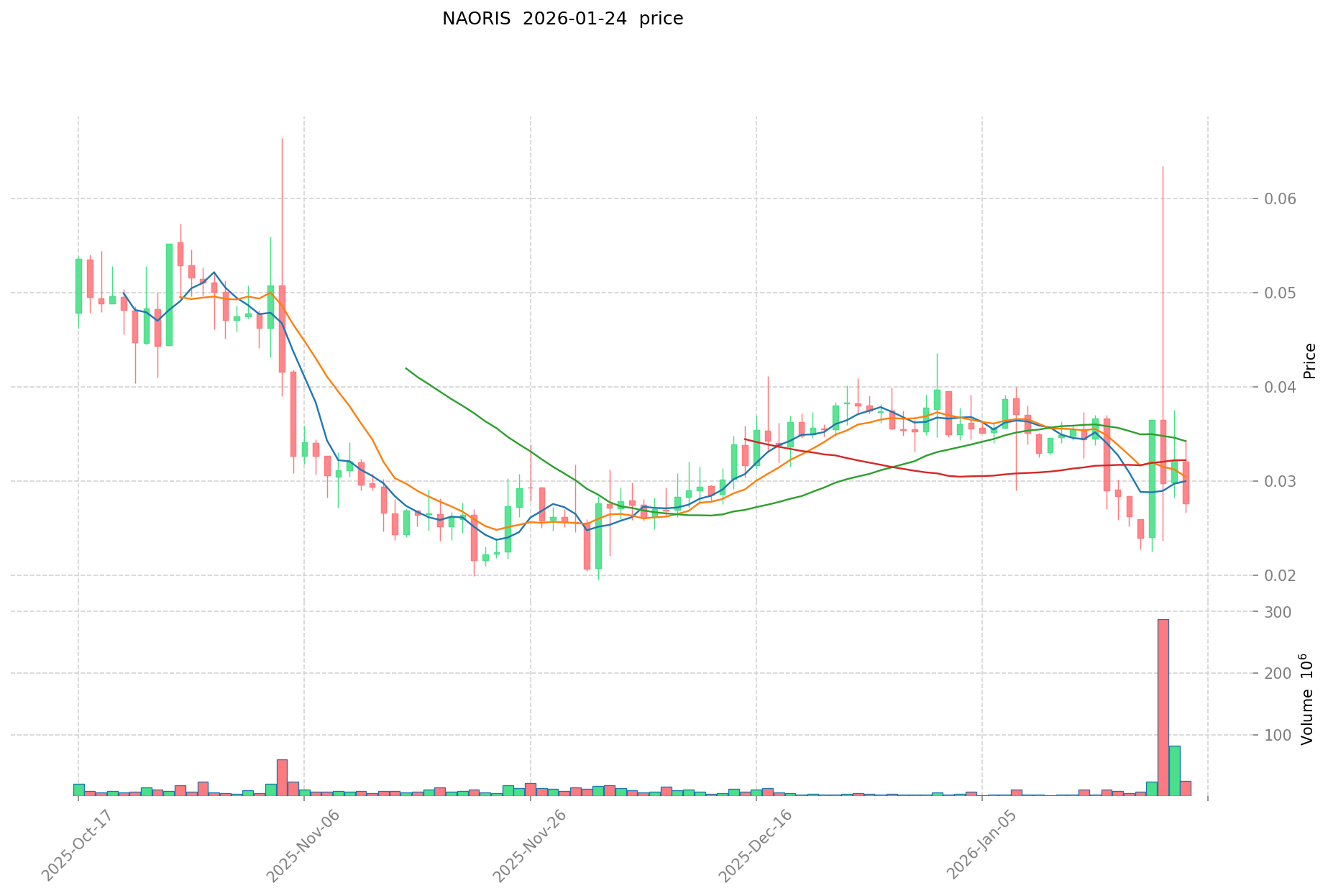
- October 2025 to January 2026: Market adjustment phase → Price declined from higher levels to $0.02597
Current NAORIS Investment Market Status (January 2026)
- NAORIS current price: $0.02597
- Market sentiment (Fear & Greed Index): Data not available in provided materials
- 24-hour trading volume: $364,848.04
- Institutional investor holdings: Venture capital backed by Tim Draper and Holdun Family Office
- Token holders: 1,927 addresses
- Market capitalization: $15,562,782.2
- Fully diluted market cap: $103,880,000
- Circulating supply: 599,260,000 NAORIS (14.98% of total supply)
Click to view real-time NAORIS market price
II. Core Factors Affecting Whether NAORIS is a Good Investment
Supply Mechanism and Scarcity (NAORIS Investment Scarcity)
- Maximum Supply: 4,000,000,000 NAORIS tokens with a current circulating supply of 599,260,000 tokens (approximately 14.98% of total supply)
- The limited circulation relative to maximum supply suggests potential scarcity dynamics as adoption increases
- Current market capitalization stands at $15,562,782.2 with a fully diluted valuation of $103,880,000, indicating significant room for supply expansion
- Investment significance: The controlled token release mechanism may support long-term value preservation as the project develops
Institutional Investment and Mainstream Adoption (Institutional Investment in NAORIS)
- Venture capital backing: Supported by Tim Draper and Holdun Family Office, providing credibility to the project
- Advisory team includes Michael Terpin (referred to as "the godfather of crypto" by CNBC), David Holtzman (Architect of DNS), former White House Chief of Staff Mick Mulvaney, and former Microsoft Southeast Asia CEO Ahmed Chami
- The project's integration capability with existing EVM blockchains without requiring hard forks may facilitate institutional adoption
- Current holder base: 1,927 addresses holding NAORIS tokens, indicating early-stage adoption
Technology and Ecosystem Development (Technology & Ecosystem for NAORIS Investment)
- Unique positioning: Operating at the Sub-Zero Layer beneath L0 to L3 blockchain layers as a trust and security infrastructure
- Post-quantum security architecture: Addressing future cryptographic threats may provide long-term competitive advantages
- Integration capabilities: Seamless compatibility with Web3 infrastructure (nodes, validators, bridges, DEXs, dApps) and Web2 systems (enterprise platforms, cloud infrastructure, IoT devices)
- Cross-chain functionality: Works with existing EVM blockchains, expanding potential use cases and ecosystem applications
- The project's focus on security infrastructure positions it as foundational technology for both Web3 and traditional internet applications
III. NAORIS Future Investment Forecast and Price Outlook (Is Naoris Protocol(NAORIS) worth investing in 2026-2031)
Short-term Investment Forecast (2026, short-term NAORIS investment outlook)
- Conservative forecast: $0.0222 - $0.0261
- Neutral forecast: $0.0261 - $0.0290
- Optimistic forecast: $0.0290 - $0.0319
Mid-term Investment Outlook (2027-2029, mid-term Naoris Protocol(NAORIS) investment forecast)
-
Market stage expectation: The project may enter a gradual development phase as its post-quantum infrastructure framework continues integration with Web3 and Web2 systems. Market performance could be influenced by broader adoption of decentralized security solutions and the evolution of quantum-resistant technologies.
-
Investment return forecast:
- 2027: $0.0180 - $0.0348
- 2028: $0.0303 - $0.0460
- 2029: $0.0249 - $0.0483
-
Key catalysts: Potential factors include expansion of partnerships with enterprise systems and cloud platforms, technical advancements in the Sub-Zero Layer architecture, growing demand for quantum-resistant security infrastructure, and broader integration with EVM-compatible blockchains.
Long-term Investment Outlook (Is NAORIS a good long-term investment?)
- Base scenario: $0.0317 - $0.0511 (assuming continued technical development and moderate adoption of decentralized security infrastructure)
- Optimistic scenario: $0.0437 - $0.0611 (assuming accelerated adoption across Web3 and enterprise environments, along with favorable market conditions for cybersecurity-focused projects)
- Risk scenario: Below $0.0222 (in cases of extreme market downturns, technical setbacks, or significant competitive pressure in the quantum-resistant infrastructure space)
View NAORIS long-term investment and price forecast: Price Prediction
2026-2031 Long-term Outlook
- Base scenario: $0.0222 - $0.0511 (corresponding to steady progress and gradual mainstream application uptake)
- Optimistic scenario: $0.0437 - $0.0611 (corresponding to large-scale adoption and favorable market environment)
- Transformative scenario: Above $0.0611 (if the ecosystem achieves breakthrough developments and mainstream proliferation)
- 2031-12-31 forecast high: $0.0611 (based on optimistic development assumptions)
Disclaimer: The above forecasts are derived from historical data analysis and market trend modeling. Cryptocurrency markets are highly volatile and subject to regulatory, technical, and macroeconomic uncertainties. These projections do not constitute investment advice, and investors should conduct independent research and risk assessment before making any investment decisions.
| Year |
Predicted High Price |
Predicted Average Price |
Predicted Low Price |
Price Change |
| 2026 |
0.031903 |
0.02615 |
0.0222275 |
0 |
| 2027 |
0.0348318 |
0.0290265 |
0.01799643 |
11 |
| 2028 |
0.045977976 |
0.03192915 |
0.0303326925 |
22 |
| 2029 |
0.04830241812 |
0.038953563 |
0.02493028032 |
49 |
| 2030 |
0.0510447489552 |
0.04362799056 |
0.0388289115984 |
67 |
| 2031 |
0.061063916987304 |
0.0473363697576 |
0.031715367737592 |
82 |
IV. NAORIS Investment Strategy and Risk Management (How to invest in Naoris Protocol)
Investment Methodology (NAORIS investment strategy)
Long-term Holding (HODL NAORIS): Suitable for Conservative Investors
For investors with a long-term perspective, holding NAORIS tokens may align with the project's positioning in decentralized cybersecurity infrastructure. The protocol operates at the Sub-Zero Layer beneath traditional blockchain layers, providing security fabric for Web3 and Web2 infrastructure. Long-term holders should monitor the project's technical development progress and ecosystem adoption rate, particularly its integration with EVM-compatible blockchains and enterprise systems.
Given the current circulation ratio of approximately 14.98% (599,260,000 tokens out of 4,000,000,000 maximum supply), future token unlocks may impact price dynamics. Long-term investors should factor in potential dilution effects as more tokens enter circulation.
Active Trading: Relying on Technical Analysis and Swing Trading
For active traders, NAORIS has demonstrated notable price volatility. The token has experienced a 24-hour trading volume of approximately $364,848 as of January 24, 2026, with recent price movements showing a 24-hour decline of approximately 9.97%, 7-day decline of approximately 11.12%, and 30-day decline of approximately 33.09%. The intraday range between $0.0258 (low) and $0.02946 (high) suggests opportunities for swing trading strategies.
Traders should utilize technical indicators while remaining aware of the token's historical price range. Since its listing, NAORIS has traded between approximately $0.00613 (recorded around October 2025) and approximately $0.2238 (recorded around July 2025).
Risk Management (Risk management for NAORIS investment)
Asset Allocation Ratio: Conservative / Aggressive / Professional Investors
Conservative Investors: Given NAORIS's market capitalization of approximately $15.56 million and ranking around #991, conservative portfolios might limit exposure to 1-3% of total crypto allocation. This approach accounts for the token's relatively early stage and market position.
Aggressive Investors: Those with higher risk tolerance might allocate 5-10% of their crypto portfolio, based on conviction in the post-quantum security narrative and the project's backing by notable investors including Tim Draper and Holdun Family Office.
Professional Investors: Institutional participants should conduct comprehensive due diligence on the technical architecture, tokenomics structure, and vesting schedules before determining allocation percentages based on their investment mandates.
Investors can consider diversifying across different sectors within cryptocurrency markets to offset NAORIS-specific risks. Pairing NAORIS exposure with more established assets or stablecoins can help balance portfolio volatility. Additionally, setting stop-loss orders and regularly rebalancing positions can serve as practical risk management techniques.
Given the dominance of approximately 0.0032% in the total crypto market, NAORIS represents a micro-cap position that should be balanced with larger-cap assets.
Secure Storage: Hot and Cold Wallets + Hardware Wallet Recommendations
NAORIS is an ERC-20 token deployed on the Ethereum network (contract address: 0x1b379a79c91a540b2bcd612b4d713f31de1b80cc). For security:
- Cold Storage: Hardware wallets supporting Ethereum and ERC-20 tokens (such as Ledger or Trezor devices) provide optimal security for long-term holdings
- Hot Wallets: For active trading, reputable software wallets with ERC-20 support can be used, but only for amounts needed for immediate transactions
- Exchange Storage: While convenient for trading, keeping large amounts on exchanges carries counterparty risk
Investors should verify contract addresses through official channels (Etherscan: https://etherscan.io/token/0x1b379a79c91a540b2bcd612b4d713f31de1b80cc) before any transactions.
V. NAORIS Investment Risks and Challenges (Risks of investing in Naoris Protocol)
Market Risk: High Volatility and Price Manipulation Concerns
NAORIS has demonstrated substantial price volatility. The year-over-year decline of approximately 82.72% reflects significant downward pressure from peak levels. The 24-hour trading volume of approximately $364,848 relative to its market capitalization suggests lower liquidity compared to major cryptocurrencies, which may amplify price swings and potential slippage during larger transactions.
The token is currently listed on 10 exchanges, with limited trading venues potentially contributing to liquidity constraints. The relatively small holder base of approximately 1,927 addresses may indicate concentrated ownership patterns.
Regulatory Risk: Policy Uncertainty Across Different Jurisdictions
As a cybersecurity infrastructure project operating across Web3 and Web2 environments, NAORIS may face evolving regulatory frameworks affecting:
- Classification of security infrastructure tokens under various jurisdictions
- Cross-border data security and privacy regulations
- Compliance requirements for enterprise system integration
- Post-quantum cryptography standards that may emerge from governmental bodies
The involvement of advisors with government backgrounds (including a former White House Chief of Staff) suggests awareness of regulatory landscapes, though this does not eliminate regulatory uncertainties.
Technical Risk: Network Security Vulnerabilities and Upgrade Failures
While Naoris Protocol positions itself as a post-quantum security infrastructure, the project itself faces technical risks:
- Smart Contract Risk: As an ERC-20 token, vulnerabilities in the token contract or associated protocol smart contracts could pose security concerns
- Integration Complexity: The protocol's integration with existing EVM blockchains and various infrastructure types introduces technical complexity that may encounter implementation challenges
- Developmental Risks: The claim of being the "world's first in production Decentralized Post-Quantum Infrastructure" suggests cutting-edge technology that may face unforeseen technical hurdles
The absence of a publicly listed GitHub repository in the provided materials limits transparency regarding code audits and development activity.
VI. Conclusion: Is Naoris Protocol a Good Investment?
Investment Value Summary
Naoris Protocol presents a specialized investment thesis centered on decentralized post-quantum cybersecurity infrastructure. The project operates in a niche sector addressing potential future threats to blockchain security. The involvement of notable venture capital backing and experienced advisors adds credibility to the project's foundation.
However, the token has experienced significant price declines over various timeframes, with substantial downward movement from historical peaks. The fully diluted valuation of approximately $103.88 million versus the current market capitalization of approximately $15.56 million indicates that approximately 85% of tokens remain to be circulated, representing a considerable future supply overhang.
Investor Recommendations
✅ Beginners: If considering exposure to NAORIS, employ dollar-cost averaging strategies with very small position sizes (under 1% of crypto portfolio). Prioritize secure storage using hardware wallets supporting ERC-20 tokens. Thoroughly research the project's technical documentation and track ecosystem development milestones before committing funds.
✅ Experienced Investors: May consider swing trading opportunities based on technical analysis, given the token's volatility patterns. Position sizing should account for liquidity constraints and concentration risks. Monitor token unlock schedules and circulating supply changes that may impact price dynamics. Consider NAORIS as a satellite position within a diversified crypto portfolio rather than a core holding.
✅ Institutional Investors: Conduct comprehensive due diligence on the technical architecture, tokenomics structure, competitive landscape in decentralized security solutions, and partnership development. Evaluate whether the post-quantum security narrative aligns with long-term infrastructure investment theses. Consider the token's current market position and liquidity profile relative to institutional allocation requirements.
⚠️ Notice: Cryptocurrency investments carry substantial risk, including the potential loss of principal. This content is for informational purposes only and does not constitute investment advice. Investors should conduct independent research and consult with financial professionals before making investment decisions.
VII. FAQ
Q1: What is Naoris Protocol and how does it differ from other blockchain security projects?
Naoris Protocol is a decentralized post-quantum infrastructure operating at the Sub-Zero Layer beneath L0 to L3 blockchain layers. Unlike traditional blockchain security solutions, NAORIS functions as foundational trust and security fabric that integrates seamlessly with existing EVM blockchains without requiring hard forks. The protocol distinguishes itself through its post-quantum cryptographic architecture designed to address future quantum computing threats, while simultaneously supporting both Web3 infrastructure (nodes, validators, bridges, DEXs, dApps) and Web2 systems (enterprise platforms, cloud infrastructure, IoT devices). As an ERC-20 token on Ethereum with a contract address of 0x1b379a79c91a540b2bcd612b4d713f31de1b80cc, NAORIS positions itself as infrastructure-layer security rather than application-layer solutions.
Q2: What are the main risks associated with investing in NAORIS tokens?
The primary risks include significant price volatility, with NAORIS experiencing an 82.72% year-over-year decline as of January 24, 2026, and substantial drawdown from its peak of approximately $0.2238 in July 2025 to the current price of approximately $0.02597. Liquidity concerns arise from relatively low 24-hour trading volume of approximately $364,848 across 10 exchanges and a small holder base of 1,927 addresses. Additionally, approximately 85% of the total supply (3.4 billion tokens out of 4 billion maximum supply) remains to be circulated, representing considerable future dilution risk. Technical risks involve smart contract vulnerabilities, integration complexity across multiple blockchain and traditional systems, and the cutting-edge nature of post-quantum cryptography implementation. Regulatory uncertainty surrounding security infrastructure tokens and compliance requirements across jurisdictions also presents ongoing risk factors.
Q3: How should different investor types approach NAORIS allocation in their portfolios?
Conservative investors should limit NAORIS exposure to 1-3% of their total cryptocurrency allocation, utilizing dollar-cost averaging strategies and prioritizing secure cold storage through hardware wallets supporting ERC-20 tokens. This approach accounts for NAORIS's micro-cap status with a market capitalization of approximately $15.56 million and ranking around #991. Aggressive investors with higher risk tolerance might allocate 5-10% of their crypto portfolio based on conviction in the post-quantum security narrative and institutional backing from Tim Draper and Holdun Family Office. Professional institutional investors should conduct comprehensive due diligence on technical architecture, tokenomics structure, vesting schedules, and competitive landscape before determining allocation percentages aligned with their investment mandates. All investor categories should balance NAORIS exposure with more established assets or stablecoins to offset concentration risk.
Q4: What factors could drive NAORIS price appreciation in the future?
Key catalysts include expansion of partnerships with enterprise systems and cloud platforms, technical advancements in the Sub-Zero Layer architecture, and growing demand for quantum-resistant security infrastructure across both Web3 and traditional sectors. The project's unique positioning addressing future quantum computing threats may attract attention as quantum computing development accelerates. Broader integration with EVM-compatible blockchains and increased adoption by decentralized applications requiring foundational security infrastructure could expand use cases. The involvement of experienced advisors including Michael Terpin, David Holtzman (Architect of DNS), and former government officials may facilitate institutional and enterprise adoption. However, investors should note that price forecasts range conservatively from $0.0222 to $0.0511 by 2030-2031 under base scenarios, with optimistic projections reaching $0.0611, reflecting moderate growth expectations rather than exponential returns.
Q5: Where can I trade NAORIS tokens and what security measures should I implement?
NAORIS is available on 10 cryptocurrency exchanges as of January 24, 2026, though specific exchange names were not detailed in the provided materials. For secure storage, hardware wallets supporting Ethereum and ERC-20 tokens (such as Ledger or Trezor devices) provide optimal security for long-term holdings. Investors should verify the official contract address (0x1b379a79c91a540b2bcd612b4d713f31de1b80cc) through Etherscan (https://etherscan.io/token/0x1b379a79c91a540b2bcd612b4d713f31de1b80cc) before any transactions. Hot wallets with ERC-20 support can be used for active trading, but only for amounts needed for immediate transactions. Keeping large amounts on exchanges carries counterparty risk and should be avoided. Given the relatively low liquidity with $364,848 in 24-hour trading volume, investors should use limit orders and be mindful of potential slippage during larger transactions.
Q6: What is the token supply structure and how might it impact future price dynamics?
NAORIS has a maximum supply of 4,000,000,000 tokens with a current circulating supply of 599,260,000 tokens, representing approximately 14.98% of total supply as of January 24, 2026. This indicates that approximately 85% of tokens (3.4 billion) remain to be circulated, which presents significant future supply overhang that could create downward price pressure as tokens unlock and enter circulation. The current market capitalization of approximately $15.56 million compared to a fully diluted valuation of approximately $103.88 million illustrates this substantial gap. Investors should monitor token unlock schedules and vesting periods, particularly for venture capital and team allocations, as these releases may impact market dynamics. The controlled token release mechanism aims to support long-term value preservation, but the large proportion of uncirculated supply represents a material consideration for investment timing and position sizing decisions.
Q7: What are the projected price ranges for NAORIS through 2031?
Based on historical data analysis and market trend modeling, short-term forecasts for 2026 range from $0.0222 (conservative low) to $0.0319 (optimistic high), with a neutral average around $0.0261-$0.0290. Mid-term projections show gradual progression: 2027 ($0.0180-$0.0348), 2028 ($0.0303-$0.0460), and 2029 ($0.0249-$0.0483). Long-term base scenario forecasts for 2030-2031 range from $0.0317 to $0.0511, while optimistic scenarios project $0.0437 to $0.0611, with the highest 2031 projection at approximately $0.0611. These forecasts assume continued technical development and varying degrees of adoption for decentralized security infrastructure. However, cryptocurrency markets exhibit high volatility subject to regulatory, technical, and macroeconomic uncertainties. Risk scenarios project prices below $0.0222 in cases of extreme market downturns, technical setbacks, or significant competitive pressure. These projections do not constitute investment advice, and investors should conduct independent research and risk assessment before making decisions.
Q8: Who are the key backers and advisors supporting Naoris Protocol?
Naoris Protocol has secured venture capital backing from notable investors including Tim Draper and the Holdun Family Office, providing institutional credibility to the project. The advisory team comprises distinguished industry figures: Michael Terpin (referred to as "the godfather of crypto" by CNBC), David Holtzman (Architect of DNS), Mick Mulvaney (former White House Chief of Staff), and Ahmed Chami (former Microsoft Southeast Asia CEO). This combination of experienced venture capitalists and advisors with backgrounds spanning cryptocurrency, internet infrastructure, government, and enterprise technology suggests a well-connected network that may facilitate adoption across both Web3 and traditional enterprise environments. The involvement of individuals with governmental and enterprise backgrounds may particularly benefit the project's positioning for institutional and regulatory engagement, though such affiliations do not eliminate execution risks or guarantee commercial success.
* The information is not intended to be and does not constitute financial advice or any other recommendation of any sort offered or endorsed by Gate.