This comprehensive guide evaluates whether Owlto Finance (OWL) represents a sound investment opportunity within the cross-chain infrastructure sector. The analysis examines OWL's tokenomics, featuring 330 million circulating tokens (16.5% of 2 billion total supply) and a market cap of $26.93 million. Key strengths include 3+ million users across 200+ countries, 13+ million completed transactions, and institutional backing from Matrixport and Bixin Ventures. Price forecasts range from $0.0542–$0.1932 through 2031 depending on adoption scenarios. The article addresses critical investment considerations: supply dynamics, institutional adoption metrics, technological capabilities, and market positioning. Essential risk factors examined include price volatility, regulatory uncertainty, technical challenges, and liquidity constraints. Detailed investment strategies accommodate conservative to aggressive investor profiles, with allocation recommendations from 1–15% portfolio exposure. Readers gain actionable insight
Introduction: Owlto Finance (OWL)'s Investment Position and Market Outlook
Owlto Finance (OWL) represents an emerging asset in the cryptocurrency sector, having been introduced in 2026 as an AI-powered interoperability protocol. The project focuses on scaling liquidity and adoption of native tokens, stablecoins, and real-world assets (RWA) across ecosystems through fast, low-cost, and secure cross-chain transfers and execution. As of January 22, 2026, OWL maintains a market capitalization of approximately $26.93 million with a circulating supply of 330 million tokens, while its current price stands around $0.0816. The project has demonstrated notable on-chain traction, reaching over 3 million users across more than 200 countries and regions, and completing more than 13 million transactions. With backing from investors including Matrixport, Bixin Ventures, CEIC, Presto Labs, Skyland, Blocore, and SNZ, OWL has positioned itself within the cross-chain infrastructure and interoperability segment. The token currently ranks #749 by market capitalization, holding approximately 0.0052% market dominance in the broader cryptocurrency market. This article provides a comprehensive analysis of OWL's investment characteristics, historical price movements, future price projections, and associated investment risks, offering reference points for those evaluating "Is Owlto Finance (OWL) a good investment?"
I. Historical Price Review and Current Investment Value of OWL
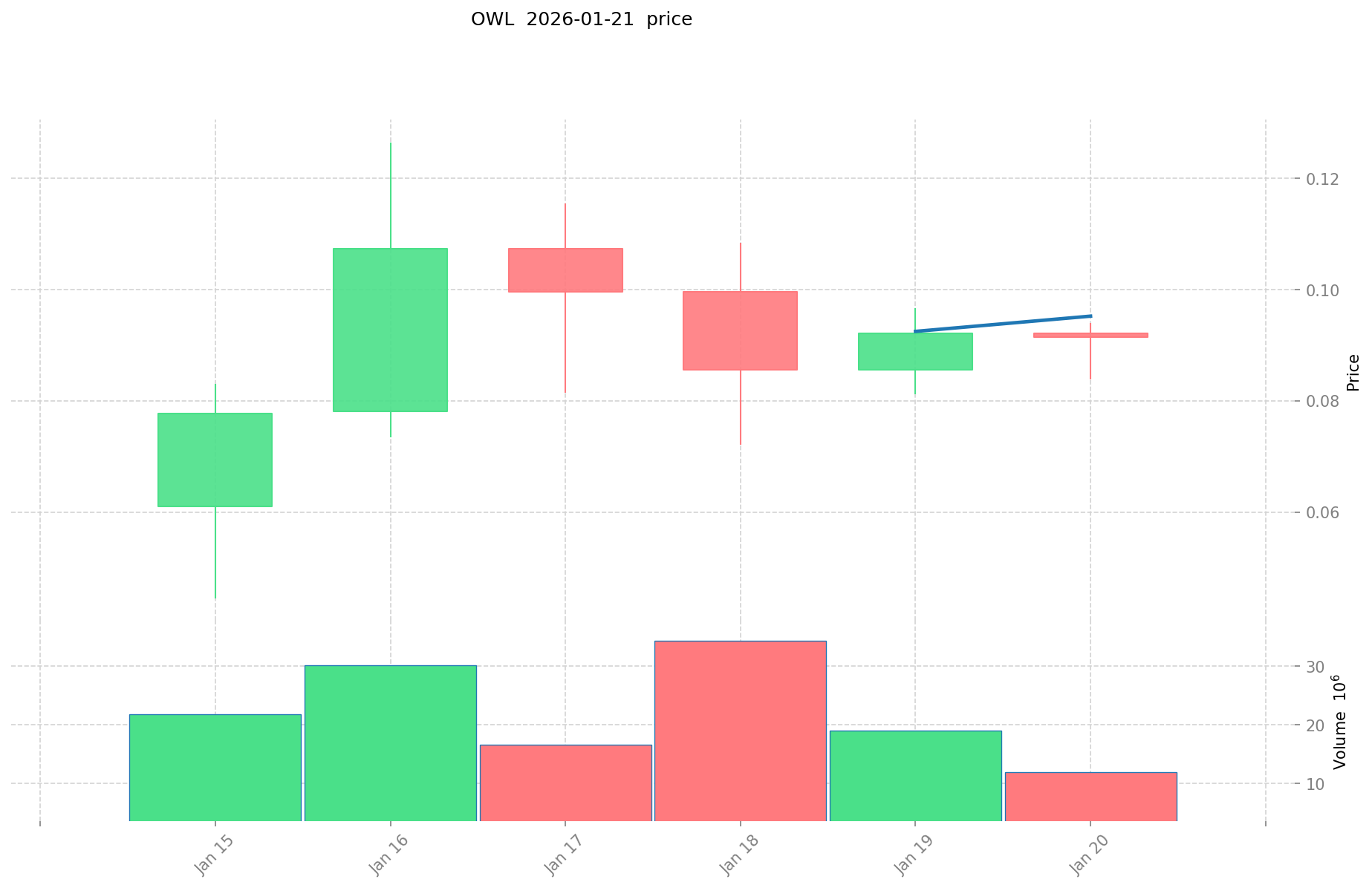
- 2026: Token launched in January with initial market activity → OWL traded between $0.04452 and $0.12642 during early trading period
- 2026: Platform recorded over 13 million transactions with 3+ million users across 200+ countries → Price experienced volatility with movements from $0.12642 to current levels around $0.0816
Current OWL Investment Market Status (January 2026)
- OWL current price: $0.0816
- 24-hour trading volume: $1,700,156.37
- Market capitalization: $26,928,000
- Circulating supply: 330,000,000 OWL (16.5% of total supply)
- Token holders: 81,966 addresses
Click to view real-time OWL market price
II. Core Factors Affecting Whether OWL is a Good Investment (Is Owlto Finance(OWL) a Good Investment)
Supply Mechanism and Scarcity (OWL investment scarcity)
-
Supply Structure → Impacts Price and Investment Value
OWL has a maximum supply of 2,000,000,000 tokens, with a current circulating supply of 330,000,000 tokens, representing approximately 16.5% of the total supply. The controlled release mechanism may create potential scarcity effects as adoption increases.
-
Historical Price Performance
Since its launch on January 14, 2026, OWL has experienced price fluctuations, with recorded price movements between $0.04452 and $0.12642. The current circulating market cap stands at approximately $26.93 million, with a fully diluted market cap of $163.2 million.
-
Investment Implications
The relatively low circulation ratio suggests that a significant portion of tokens remains to be released, which may affect future supply dynamics and long-term investment considerations.
Institutional Investment and Mainstream Adoption (Institutional investment in OWL)
-
Institutional Backing
Owlto Finance has secured investment from recognized institutional players including Matrixport, Bixin Ventures, CEIC, Presto Labs, Skyland, Blocore, and SNZ, which may contribute to credibility and development support.
-
User Adoption Metrics
The protocol has attracted over 3 million on-chain users across more than 200 countries and regions, with more than 13 million transactions completed. The holder count of approximately 81,966 addresses indicates a growing user base.
-
Exchange Presence
OWL is currently listed on 11 exchanges, with 24-hour trading volume reaching approximately $1.7 million, suggesting moderate liquidity levels in the market.
Macroeconomic Environment's Impact on OWL Investment
-
Market Positioning
As an interoperability protocol focused on cross-chain liquidity solutions, OWL's investment appeal may be influenced by broader trends in blockchain infrastructure development and demand for cross-chain services.
-
Digital Asset Market Conditions
The performance of OWL may correlate with overall sentiment in the cryptocurrency market, particularly regarding infrastructure projects and Layer-2 solutions. Market conditions, regulatory developments, and technological advancement trends in the blockchain space may affect investment considerations.
-
Sector-Specific Dynamics
Growing interest in cross-chain solutions, stablecoin infrastructure, and real-world asset (RWA) tokenization may influence the demand for protocols like Owlto Finance, potentially impacting its investment outlook.
Technology and Ecosystem Development (Technology & Ecosystem for OWL investment)
-
AI-Powered Interoperability Protocol
Owlto Finance leverages AI technology to enable fast, low-cost, and secure cross-chain transfers and execution. The protocol aims to scale liquidity and adoption of native tokens, stablecoins, and RWA across different blockchain ecosystems.
-
Cross-Chain Infrastructure
The platform's focus on interoperability solutions addresses the technical challenge of asset movement across different blockchain networks, which may support long-term ecosystem development.
-
Ecosystem Applications
Owlto Finance's infrastructure supports various use cases including native token transfers, stablecoin movements, and RWA applications. The protocol's ability to facilitate cross-ecosystem liquidity may contribute to its utility and potential adoption across decentralized finance (DeFi) and other blockchain applications.
III. OWL Future Investment Forecast and Price Outlook (Is Owlto Finance(OWL) worth investing in 2026-2031)
Short-term Investment Forecast (2026, short-term OWL investment outlook)
- Conservative forecast: $0.0542 - $0.0816
- Neutral forecast: $0.0816 - $0.0847
- Optimistic forecast: $0.0847 - $0.0873
Mid-term Investment Outlook (2027-2029, mid-term Owlto Finance(OWL) investment forecast)
-
Market stage expectation: OWL may experience moderate growth as the interoperability protocol continues to expand its cross-chain capabilities and user base. The project's AI-powered infrastructure could attract increased adoption across multiple blockchain ecosystems.
-
Investment return forecast:
- 2027: $0.0585 - $0.0895
- 2028: $0.0544 - $0.1141
- 2029: $0.0928 - $0.1392
-
Key catalysts: Protocol upgrades enhancing cross-chain transaction efficiency, partnerships with additional blockchain networks, expansion of RWA tokenization capabilities, and continued growth in user adoption metrics.
Long-term Investment Outlook (Is OWL a good long-term investment?)
- Base scenario: $0.0817 - $0.1201 (assuming steady protocol development and consistent market conditions)
- Optimistic scenario: $0.1056 - $0.1932 (assuming accelerated adoption and favorable regulatory environment)
- Risk scenario: $0.0544 - $0.0817 (under challenging market conditions or increased competition)
Click to view OWL long-term investment and price forecast: Price Prediction
2026-01-22 - 2031 Long-term Outlook
- Base scenario: $0.0817 - $0.1297 USD (corresponding to steady progress and mainstream application growth)
- Optimistic scenario: $0.1201 - $0.1932 USD (corresponding to large-scale adoption and favorable market conditions)
- Transformative scenario: Above $0.1932 USD (in case of breakthrough ecosystem developments and mainstream adoption)
- 2031-12-31 predicted high: $0.1932 USD (based on optimistic development assumptions)
Disclaimer: This price forecast is for reference purposes only and does not constitute investment advice. Cryptocurrency markets are highly volatile and subject to numerous unpredictable factors. Past performance does not guarantee future results. Investors should conduct thorough research and consider their risk tolerance before making investment decisions.
| Year |
Predicted High Price |
Predicted Average Price |
Predicted Low Price |
Price Change |
| 2026 |
0.0872822 |
0.08474 |
0.0542336 |
3 |
| 2027 |
0.089451544 |
0.0860111 |
0.058487548 |
5 |
| 2028 |
0.1140507186 |
0.087731322 |
0.05439341964 |
7 |
| 2029 |
0.139229608014 |
0.1008910203 |
0.092819738676 |
23 |
| 2030 |
0.13926996442212 |
0.120060314157 |
0.10565307645816 |
47 |
| 2031 |
0.193201057541444 |
0.12966513928956 |
0.081689037752422 |
58 |
IV. OWL Investment Strategy and Risk Management (How to invest in Owlto Finance)
Investment Methodology (OWL investment strategy)
-
Long-term Holding (HODL OWL): Suitable for conservative investors who believe in the protocol's vision of AI-powered cross-chain interoperability. Given Owlto Finance's growing user base of over 3 million users across 200+ countries and 13 million completed transactions, long-term holders may benefit from the protocol's adoption trajectory in native tokens, stablecoins, and RWA liquidity scaling.
-
Active Trading: Traders may leverage technical analysis and momentum strategies, particularly given OWL's recent price volatility. With a 24-hour trading volume of approximately $1.7 million and notable price swings (24H high: $0.10027, 24H low: $0.07388), short-term traders can capitalize on intraday movements. However, liquidity considerations and exchange availability (listed on 11 exchanges) should be factored into execution strategies.
Risk Management (Risk management for OWL investment)
-
Asset Allocation Ratios:
- Conservative investors: 1-3% of crypto portfolio allocation to OWL
- Moderate investors: 3-7% allocation, balancing growth potential with volatility exposure
- Aggressive investors: Up to 10-15% for those with higher risk tolerance and conviction in cross-chain infrastructure protocols
-
Risk Hedging Strategies: Diversify across multiple crypto assets including established Layer 1 protocols, stablecoins, and other DeFi infrastructure projects. Consider correlation analysis with broader market movements, as OWL may exhibit sensitivity to cross-chain activity trends and general crypto market sentiment.
-
Secure Storage Solutions:
- Cold Storage: Hardware wallets (Ledger, Trezor) recommended for long-term holdings
- Hot Wallets: Use reputable software wallets for active trading amounts only
- Contract Address Verification: OWL operates on BSC (BEP-20 standard) at contract address 0x51e667e91b4b8cb8e6e0528757f248406bd34b57. Always verify through official sources (https://bscscan.com/token/0x51e667e91b4b8cb8e6e0528757f248406bd34b57) before transactions.
V. OWL Investment Risks and Challenges (Risks of investing in Owlto Finance)
-
Market Risks: OWL exhibits significant price volatility, with a 24-hour change of -10.37% as of January 22, 2026. The token reached a historical high of $0.12642 on January 16, 2026, and a low of $0.04452 on January 15, 2026, demonstrating sharp price swings. The relatively low market capitalization of approximately $26.9 million and circulating supply of 330 million tokens (16.5% of max supply) may contribute to price susceptibility to large trades or market sentiment shifts.
-
Regulatory Risks: As a cross-chain protocol facilitating transfers across multiple ecosystems, Owlto Finance may face evolving regulatory scrutiny in different jurisdictions. Changes in crypto asset classification, cross-border transaction regulations, or DeFi protocol oversight could impact operational capacity and token utility. Investors should monitor regulatory developments in key markets where the protocol's 3+ million users operate.
-
Technical Risks: Cross-chain infrastructure protocols face inherent technical complexities including:
- Smart contract vulnerabilities in bridge mechanisms
- Interoperability challenges across supported blockchains
- Potential network congestion or security incidents on connected chains
- Protocol upgrade execution risks that could temporarily affect service availability
While Owlto Finance has processed over 13 million transactions, the protocol's AI-powered infrastructure and multi-chain architecture require ongoing maintenance and security auditing.
-
Competition Risk: The cross-chain interoperability sector includes numerous established protocols. Owlto Finance's market position depends on continued technological innovation, user adoption rates, and competitive advantages in transaction speed and cost efficiency.
-
Liquidity Risk: With trading volume of approximately $1.7 million over 24 hours and availability on 11 exchanges, OWL may experience liquidity constraints during high-volatility periods, potentially impacting order execution and price stability.
VI. Conclusion: Is Owlto Finance a Good Investment?
-
Investment Value Summary: OWL represents an emerging cross-chain infrastructure play with demonstrated user adoption (3+ million users, 13+ million transactions) and institutional backing from investors including Matrixport, Bixin Ventures, CEIC, and others. The protocol's focus on AI-powered interoperability for native tokens, stablecoins, and RWA positions it within growing sectors of crypto infrastructure. However, the token exhibits considerable price volatility and maintains a relatively early-stage market presence with 16.5% circulating supply.
-
Investor Recommendations:
✅ Beginners: Consider dollar-cost averaging (DCA) to mitigate timing risk. Store assets securely in hardware wallets. Start with small allocations (1-2% of crypto portfolio) to understand protocol dynamics and price behavior.
✅ Experienced Investors: May employ tactical trading strategies based on technical analysis and cross-chain activity metrics. Implement position sizing and stop-loss disciplines. Monitor protocol development milestones and user growth metrics for fundamental assessment.
✅ Institutional Investors: Evaluate OWL within broader cross-chain infrastructure thesis. Consider strategic allocation as part of diversified DeFi protocol exposure. Conduct thorough due diligence on protocol architecture, security audits, and competitive positioning.
⚠️ Disclaimer: Cryptocurrency investments carry substantial risk including potential complete loss of capital. This analysis is for informational purposes only and does not constitute financial advice. Investors should conduct independent research and consult qualified financial advisors before making investment decisions.
VII. FAQ
Q1: What is the current circulating supply of Owlto Finance (OWL) tokens?
The circulating supply of OWL is currently 330,000,000 tokens, representing approximately 16.5% of the maximum total supply of 2,000,000,000 tokens. This relatively low circulation ratio indicates that a significant portion of tokens (approximately 83.5%) remains to be released into the market. The controlled release mechanism may create potential supply dynamics that could affect future price movements as the protocol continues its development roadmap. With over 81,966 token holders currently recorded, the distribution pattern suggests growing adoption while maintaining substantial supply reserves for future ecosystem incentives and development initiatives.
Q2: How does Owlto Finance differentiate itself in the competitive cross-chain protocol landscape?
Owlto Finance distinguishes itself through its AI-powered interoperability infrastructure that focuses specifically on scaling liquidity for native tokens, stablecoins, and real-world assets (RWA) across multiple blockchain ecosystems. Unlike traditional bridge protocols, Owlto emphasizes fast execution speeds, low transaction costs, and enhanced security features. The protocol has demonstrated practical market traction with over 13 million transactions completed and 3+ million users across 200+ countries and regions. This operational track record, combined with institutional backing from investors including Matrixport, Bixin Ventures, and CEIC, positions OWL within a competitive but growing cross-chain infrastructure sector that addresses fundamental blockchain interoperability challenges.
Q3: What are the primary risk factors investors should consider before investing in OWL?
Investors should evaluate several key risk factors: (1) Price Volatility - OWL has exhibited significant price swings between $0.04452 and $0.12642 since its January 2026 launch, with a -10.37% 24-hour change as of January 22, 2026; (2) Market Capitalization Risk - the relatively modest market cap of approximately $26.9 million may result in susceptibility to large trades and market sentiment shifts; (3) Technical Risks - cross-chain protocols face inherent smart contract vulnerabilities, interoperability challenges, and potential security incidents on connected networks; (4) Liquidity Constraints - with trading volume around $1.7 million and availability on 11 exchanges, order execution during high-volatility periods may be impacted; (5) Regulatory Uncertainty - evolving regulations around cross-chain transfers and DeFi protocols across multiple jurisdictions could affect operational capacity.
Q4: What is the recommended investment allocation strategy for different investor profiles?
Investment allocation recommendations vary based on risk tolerance and experience level: Conservative investors should consider 1-3% of their crypto portfolio allocation to OWL, utilizing dollar-cost averaging (DCA) strategies to mitigate timing risk and storing assets in hardware wallets for security. Moderate investors may allocate 3-7% of their portfolio, balancing growth potential with volatility exposure while diversifying across established Layer 1 protocols and other DeFi infrastructure projects. Aggressive investors with higher risk tolerance and strong conviction in cross-chain infrastructure may allocate up to 10-15% of their portfolio, potentially employing tactical trading strategies based on technical analysis and cross-chain activity metrics. All investor types should implement appropriate risk management through position sizing, stop-loss disciplines, and regular portfolio rebalancing.
Q5: What are the key price prediction forecasts for OWL through 2031?
Price forecasts for OWL suggest varied scenarios depending on market conditions and protocol adoption: Short-term (2026) - Conservative: $0.0542-$0.0816; Neutral: $0.0816-$0.0847; Optimistic: $0.0847-$0.0873. Mid-term outlook projects 2027: $0.0585-$0.0895; 2028: $0.0544-$0.1141; 2029: $0.0928-$0.1392, with key catalysts including protocol upgrades, blockchain network partnerships, and RWA tokenization expansion. Long-term (2030-2031) - Base scenario: $0.0817-$0.1297; Optimistic scenario: $0.1201-$0.1932; with the predicted high for 2031 reaching $0.1932 under favorable adoption conditions. These forecasts assume steady protocol development, growing mainstream application, and favorable market conditions, though actual results may vary significantly due to market volatility and unpredictable factors in the cryptocurrency sector.
Q6: How can investors securely store and verify their OWL tokens?
Secure OWL token storage requires following best practices: Cold Storage - Hardware wallets such as Ledger or Trezor are recommended for long-term holdings to minimize exposure to online threats. Hot Wallets - Use reputable software wallets for active trading amounts only, never storing significant holdings in exchange accounts or hot wallets. Contract Address Verification - OWL operates on the BSC (BEP-20 standard) at contract address 0x51e667e91b4b8cb8e6e0528757f248406bd34b57. Always verify this address through official sources at https://bscscan.com/token/0x51e667e91b4b8cb8e6e0528757f248406bd34b57 before conducting any transactions to prevent phishing or fraudulent contract interactions. Investors should never share private keys, use two-factor authentication where available, and maintain separate wallets for different risk levels (long-term holdings vs. active trading).
Q7: What metrics indicate Owlto Finance's current market adoption and user growth?
Owlto Finance demonstrates measurable adoption metrics as of January 2026: The protocol has attracted over 3 million on-chain users distributed across more than 200 countries and regions, indicating global reach and diverse user base penetration. Transaction volume has exceeded 13 million completed transfers, suggesting active protocol utilization beyond speculative interest. The token holder count stands at approximately 81,966 addresses, providing insight into distribution patterns. Market metrics include a 24-hour trading volume of approximately $1.7 million across 11 exchanges, indicating moderate liquidity levels. The protocol's institutional backing from recognized investors including Matrixport, Bixin Ventures, CEIC, Presto Labs, Skyland, Blocore, and SNZ provides additional credibility indicators. These metrics collectively suggest early-stage but growing adoption within the cross-chain infrastructure sector, though continued monitoring of user growth trends and transaction velocity will be important for assessing sustained protocol development.
* The information is not intended to be and does not constitute financial advice or any other recommendation of any sort offered or endorsed by Gate.