The article provides a comprehensive analysis of the PUSH token, focusing on its investment potential, risks, and market prospects as of 2025. It evaluates the token's price history, token economics, governance roles, and the decentralized notification service it operates within. The article addresses the needs of crypto investors looking to diversify portfolios, emphasizing the token's severe volatility, governance rewards, and liquidity concerns. Readers will find structured insights into market dynamics, future price forecasts, and risk mitigation strategies, making it suitable for both novice and seasoned investors interested in blockchain infrastructure tokens.
Introduction: PUSH (Ethereum Push Notification Service) Investment Position and Market Prospects
PUSH is an important asset in the cryptocurrency domain. As the native governance token of the Ethereum Push Notification Service (EPNS), a decentralized notification protocol, PUSH has established itself as a critical infrastructure component for enabling platform-agnostic notifications across the blockchain ecosystem. As of December 26, 2025, PUSH maintains a market capitalization of $1,671,000 with a circulating supply of approximately 90,236,482 tokens against a total supply of 100,000,000. The token is currently trading at $0.01671 per unit.
PUSH token holders enjoy dual utility: governance rights and reward collection mechanisms. The protocol allocates 70% of network fees to PUSH holders, with the remaining 30% directed to ecosystem development. This economic model positions PUSH holders as direct beneficiaries of network activity and growth. Since its launch in April 2021 at an initial price of $3.97, PUSH has experienced substantial market cycles, reaching an all-time high of $8.73 in April 2021 and recent lows near $0.01168.
With a market ranking of 2,326 and a market dominance of 0.000052%, PUSH represents a specialized infrastructure play within the broader decentralized application ecosystem. This comprehensive analysis examines PUSH's investment value proposition, historical price dynamics, forward-looking projections, and inherent risks to assist investors in evaluating its potential role within diversified cryptocurrency portfolios.
PUSH (Ethereum Push Notification Service) Research Report
I. Price History Review and Current Investment Status of PUSH
- 2021: Token launch on April 14 → All-time high of USD 8.73 achieved
- 2022-2024: Influenced by overall crypto market downturn → Continuous price decline
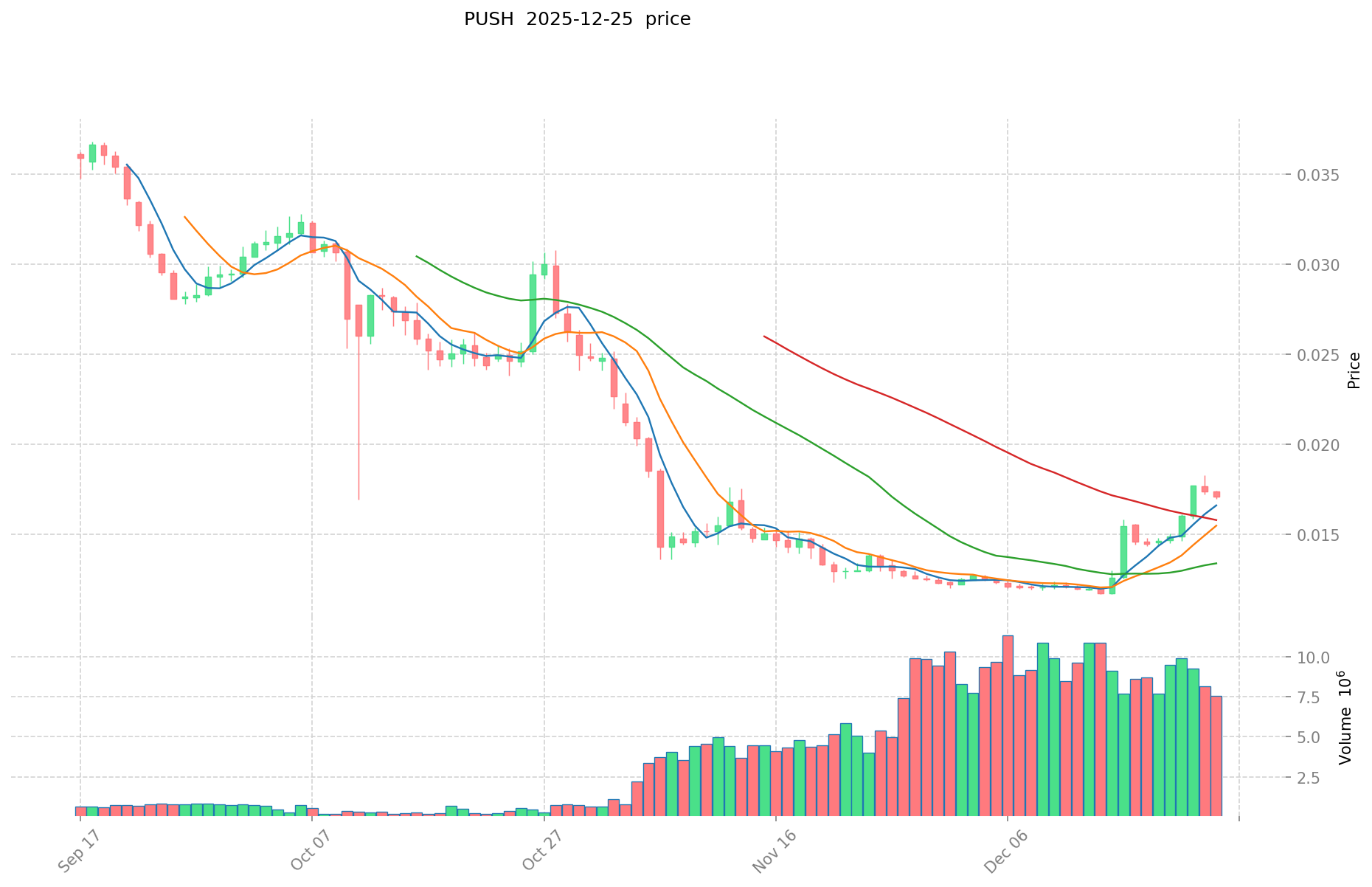
- 2025: Bear market continuation → Price declined to USD 0.01671 (as of December 26, 2025)
Current PUSH Market Status (December 26, 2025)
- Current Price: USD 0.01671
- Market Sentiment: Neutral (value: 1)
- 24-Hour Trading Volume: USD 159,949.29
- 24-Hour Price Change: -2.73%
- 7-Day Price Change: +15.17%
- 30-Day Price Change: +25.75%
- 1-Year Price Change: -85.46%
All-Time High: USD 8.73 (April 14, 2021)
All-Time Low: USD 0.0116806 (December 15, 2025)
II. Token Economics and Market Metrics
Supply Metrics
| Metric |
Value |
| Circulating Supply |
90,236,482 PUSH |
| Total Supply |
100,000,000 PUSH |
| Circulating Ratio |
90.24% |
| Market Capitalization |
USD 1,507,851.61 |
| Fully Diluted Valuation |
USD 1,671,000.00 |
| Market Dominance |
0.000052% |
Holder Distribution
- Active Token Holders: 5,557
- Listed on Exchanges: 1
III. Protocol Overview and Utility
Protocol Architecture
EPNS (Ethereum Push Notification Service) is a decentralized notification protocol that enables users (wallet addresses) to receive notifications. The protocol allows any dApp, service, or smart contract to send notifications to users through platform-independent channels including mobile devices, tablets, web interfaces, and user wallets.
PUSH Token Function and Benefits
PUSH serves as the native governance token of the EPNS protocol and provides token holders with two primary benefits:
- Governance Rights: Token holders can participate in the development and evolution of the EPNS protocol
- Fee Rewards: PUSH holders receive rewards from network fees (70% allocation), with the remaining 30% directed to the ecosystem development fund
Note on Fee Structure: The fee pool reward mechanism is not activated at mainnet launch but is scheduled to activate approximately one year following protocol deployment.
Blockchain Deployment
- Chain: Ethereum (ETH)
- Contract Address: 0xf418588522d5dd018b425e472991e52ebbeeeeee
- Explorer Link: Etherscan Token Page
Official Resources
V. Risk Assessment
Key Risk Factors
- Extreme Price Volatility: Token has declined 85.46% over the past year, with recent all-time low reached on December 15, 2025
- Low Market Liquidity: 24-hour trading volume of approximately USD 159,949 indicates limited market depth
- Market Position: Ranked #2,326 by market capitalization, indicating limited mainstream adoption
- Regulatory Uncertainty: Governance and notification service protocols face evolving regulatory landscapes
VI. Conclusion
PUSH has experienced significant price erosion since its launch in 2021, declining from USD 8.73 to USD 0.01671 as of December 26, 2025. While the protocol addresses a legitimate use case in decentralized notifications, the token currently exhibits characteristics of a distressed asset with minimal market capitalization and limited trading liquidity. The delayed activation of fee-reward mechanisms and modest holder base suggest the project remains in early or stalled development phases.
Push Protocol (PUSH) Investment Analysis Report
Report Date: December 26, 2025
I. Executive Summary
Push Protocol (PUSH) is a decentralized notification protocol operating on the Ethereum blockchain. As of December 26, 2025, PUSH is trading at $0.01671 with a market capitalization of approximately $1.67 million USD and a 24-hour trading volume of $159,949.29. The token has experienced significant volatility since its launch, with a historical high of $8.73 (April 14, 2021) and a recent low of $0.0116806 (December 15, 2025), representing an 85.46% decline over the past year.
II. Core Factors Influencing PUSH Investment Outlook
Supply Mechanism and Scarcity (PUSH Investment Scarcity)
The PUSH token operates with a fixed supply structure:
- Total Supply: 100,000,000 PUSH tokens
- Circulating Supply: 90,236,482 PUSH tokens (90.24% of total supply)
- Circulation Ratio: 90.24%
The near-complete circulation of tokens (90.24% already distributed) limits the scarcity factor that typically supports long-term price appreciation. The protocol's fee distribution mechanism allocates 70% of network fees to PUSH token holders, with 30% directed to ecosystem development. However, this fee pool was not activated at mainnet launch and was projected to activate approximately one year after protocol launch.
Token Economics and Holder Distribution
- Active Holders: 5,557 addresses
- Market Share: 0.000052% of total cryptocurrency market capitalization
The relatively small holder base suggests limited mainstream adoption and concentration risk.
Technical and Ecosystem Development (Technology & Ecosystem for PUSH Investment)
Push Protocol's core functionality centers on decentralized notifications:
- Protocol Function: Enables dApps, services, and smart contracts to send platform-independent notifications to users across multiple channels (mobile devices, tablets, web, user wallets)
- Primary Use Case: DeFi protocol notifications ensuring users receive timely information and can benefit from notification rewards
- Governance Rights: PUSH token holders maintain governance participation in protocol development
The protocol's integration potential spans DeFi ecosystems and Web3 applications, with adoption driven by continued demand for decentralized communication infrastructure.
Recent Price Movements
| Time Period |
Price Change |
Amount |
| 1 Hour |
-0.3% |
-$0.00005028 |
| 24 Hours |
-2.73% |
-$0.00046899 |
| 7 Days |
+15.17% |
+$0.00220101 |
| 30 Days |
+25.75% |
+$0.00342173 |
| 1 Year |
-85.46% |
-$0.09821435 |
Key Observations:
- Short-term volatility (hourly and daily) shows downward pressure
- Medium-term trend (7-30 days) demonstrates recovery momentum of 15-26%
- Year-over-year performance remains severely depressed, indicating structural challenges
Valuation Metrics
- Price as % of All-Time High: 0.19% ($0.01671 vs. $8.73)
- Market Cap to Fully Diluted Valuation: 90.24% (concentrated market cap distribution)
- 24-Hour Trading Range: $0.01669 - $0.01725
IV. Investment Outlook and Risk Assessment
Mixed Market Sentiment
Available market analyses present divergent forecasts:
- Bearish Forecast: Technical quantitative indicators suggest cautious outlook (CoinCodex analysis)
- Moderate Growth Scenario: Some analyses project 15-26% appreciation by end of 2025, driven by Web3 adoption and regulatory clarity (Mudrex)
- Optimistic Scenarios: Certain simulations project growth to $0.0540084 (representing 92.15% appreciation) under favorable conditions
Key Investment Risks
- Severe Long-Term Underperformance: 85.46% annual decline indicates sustained investor pessimism
- Limited Mainstream Adoption: Only 5,557 active holders suggests niche market positioning
- Minimal Market Share: 0.000052% dominance reflects marginal position in broader cryptocurrency ecosystem
- Fee Pool Activation Uncertainty: Delayed activation of reward mechanisms removes a key incentive mechanism for token holders
- Market Depth Constraints: Daily volume of ~$160,000 indicates limited liquidity
V. Protocol Fundamentals
Purpose: Push Protocol (EPNS) addresses a legitimate infrastructure need—decentralized, user-controlled notifications for Web3 applications.
Tokenomics Benefits for Holders:
- Governance participation in protocol evolution
- 70% allocation of network fees to token holders (upon fee pool activation)
- Potential reward generation from network usage
Challenges:
- Fee pool activation timeline remains uncertain
- Competition from alternative notification services
- Limited demonstrable dApp integration and organic usage metrics
VI. Conclusion
Push Protocol presents characteristics of a speculative infrastructure token with legitimate utility but significantly diminished market confidence. The 85.46% annual price decline, small holder base, and minimal market share suggest the market has repriced PUSH substantially below its launch valuation. While recent medium-term technical performance shows recovery momentum and some analysts project moderate appreciation, these gains must be contextualized against severe long-term underperformance and execution uncertainties regarding fee pool activation and ecosystem adoption.
Current Market Position: PUSH operates as a micro-cap cryptocurrency (market cap rank: 2,326) with limited liquidity and adoption metrics that do not justify its historical valuations.
References
III. PUSH Future Investment Forecast and Price Outlook (Is PUSH worth investing in 2025-2030)
Short-term Investment Forecast (2025, Short-term PUSH Investment Outlook)
- Conservative Forecast: $0.0137 - $0.0167
- Neutral Forecast: $0.0167 - $0.0207
- Optimistic Forecast: $0.0207 - $0.0210
Mid-term Investment Outlook (2026-2028, Mid-term PUSH Investment Forecast)
-
Market Phase Expectations: PUSH is positioned within the decentralized notification infrastructure space. The protocol aims to establish itself as a foundational layer for cross-platform notifications, with gradual ecosystem expansion and adoption integration.
-
Investment Return Projections:
- 2027: $0.0137 - $0.0217 (approximately 16% growth)
- 2028: $0.0155 - $0.0305 (approximately 23% growth)
-
Key Catalysts: Protocol governance maturation, fee pool activation mechanisms, ecosystem developer adoption rates, DeFi integration expansion, and cross-chain notification service development.
Long-term Investment Outlook (Is PUSH a good long-term investment?)
-
Base Case Scenario: $0.0200 - $0.0359 (assumes steady protocol adoption, gradual market penetration, and moderate ecosystem growth through 2030)
-
Optimistic Scenario: $0.0359 - $0.0932 (assumes significant DeFi ecosystem integration, mainstream notification service adoption, and network effects maturation)
-
Risk Scenario: $0.0136 - $0.0180 (reflects potential protocol adoption challenges, competitive pressures from alternative notification services, and broader market headwinds)
View PUSH long-term investment and price forecast: Price Prediction
2025-12-31 through 2030 Long-term Outlook
-
Base Case: $0.0200 - $0.0286 USD (corresponding to stable protocol development and steady mainstream application advancement)
-
Optimistic Case: $0.0286 - $0.0932 USD (corresponding to large-scale ecosystem adoption and favorable market environment)
-
Transformative Case: $0.0932 USD and above (in scenarios of breakthrough ecological progress and mainstream adoption milestones)
-
2030-12-31 Projected Peak: $0.0359 USD (based on optimistic development assumptions)
Disclaimer
This analysis is provided for informational purposes only and does not constitute investment advice, financial recommendation, or solicitation to trade. Cryptocurrency markets remain highly volatile and speculative. Price predictions involve substantial uncertainty and may not materialize. Past performance does not guarantee future results. Investors should conduct independent research and consult with qualified financial advisors before making investment decisions. All forecasts are subject to revision based on market conditions and new information.
| 年份 |
预测最高价 |
预测平均价格 |
预测最低价 |
涨跌幅 |
| 2025 |
0.0206956 |
0.01669 |
0.0136858 |
0 |
| 2026 |
0.020375152 |
0.0186928 |
0.013271888 |
11 |
| 2027 |
0.02168271336 |
0.019533976 |
0.0136737832 |
16 |
| 2028 |
0.0305003501264 |
0.02060834468 |
0.01545625851 |
23 |
| 2029 |
0.030920760357872 |
0.0255543474032 |
0.01788804318224 |
52 |
| 2030 |
0.03586169342828 |
0.028237553880536 |
0.02004866325518 |
68 |
PUSH Token Research Report
IV. PUSH Investment Strategy and Risk Management
Investment Methodology (PUSH investment strategy)
- Long-term holding (HODL PUSH): Suitable for risk-averse investors seeking governance participation and fee rewards once the fee pool activates post-mainnet launch.
- Active trading: Dependent on technical analysis and swing trading strategies, given the token's high volatility profile.
Risk Management (Risk management for PUSH investment)
V. PUSH Investment Risks and Challenges
-
Market risk: Extreme price volatility (trading at $0.01671 as of December 26, 2025, down 85.46% year-over-year from historical highs of $8.73 in April 2021); susceptibility to market manipulation given low trading volume ($159,949.29 in 24-hour volume).
-
Regulatory risk: Uncertainty regarding token classification and regulatory treatment across different jurisdictions; potential impact on protocol operations and token utility.
-
Technology risk: Dependency on successful mainnet activation and fee pool implementation (scheduled approximately one year post-mainnet launch); potential smart contract vulnerabilities or protocol upgrade failures; reliance on Ethereum network security.
VI. Conclusion: Is PUSH a Good Investment?
-
Investment value summary: PUSH represents a governance and fee-sharing mechanism within a decentralized notification infrastructure protocol. Long-term investment potential depends on EPNS protocol adoption and successful fee pool activation; however, the token currently exhibits characteristics of a speculative, high-risk asset with substantial downside history.
-
Investor recommendations:
- ✅ Beginners: Dollar-cost averaging (DCA) strategy with secure hardware wallet storage; minimal allocation exposure
- ✅ Experienced investors: Technical analysis-based swing trading combined with small long-term governance position; implement strict stop-loss discipline
- ✅ Institutional investors: Strategic allocation contingent upon protocol milestone achievement and fee generation verification
⚠️ Disclaimer: Cryptocurrency investment carries substantial risk. This report is provided for informational purposes only and does not constitute investment advice, financial recommendation, or encouragement to buy or sell PUSH tokens. Conduct independent research and consult with qualified financial advisors before making investment decisions.
PUSH (Ethereum Push Notification Service) - Frequently Asked Questions
I. FAQ
Q1: What is PUSH token and what is its primary utility?
A: PUSH is the native governance token of the Ethereum Push Notification Service (EPNS), a decentralized notification protocol deployed on the Ethereum blockchain. PUSH token holders enjoy dual utility: governance rights allowing participation in protocol development decisions, and fee rewards where 70% of network fees are allocated to token holders, with the remaining 30% directed to ecosystem development. The protocol enables dApps, services, and smart contracts to send platform-independent notifications to users across multiple channels including mobile devices, tablets, web interfaces, and user wallets.
Q2: What is the current price and market position of PUSH as of December 26, 2025?
A: As of December 26, 2025, PUSH is trading at $0.01671 per token with a market capitalization of approximately $1.67 million USD. The token maintains a circulating supply of 90,236,482 PUSH tokens against a total supply of 100,000,000, representing a 90.24% circulation ratio. PUSH ranks #2,326 by market capitalization with a market dominance of 0.000052%. The 24-hour trading volume stands at $159,949.29, indicating limited market liquidity.
Q3: How has PUSH performed historically, and what is its current price outlook?
A: PUSH launched on April 14, 2021, at an initial price of $3.97 and reached an all-time high of $8.73 in April 2021. However, the token has experienced severe depreciation, reaching an all-time low of $0.0116806 on December 15, 2025, representing an 85.46% decline over the past year. Recent medium-term performance shows recovery momentum with a 15.17% gain over 7 days and 25.75% gain over 30 days. Price forecasts for 2025-2030 vary significantly: conservative estimates suggest $0.0137-$0.0167, while optimistic scenarios project $0.0932 by 2030 under favorable conditions.
Q4: What are the main investment risks associated with PUSH?
A: Key investment risks include extreme price volatility with an 85.46% annual decline, low market liquidity with daily trading volumes around $160,000 limiting exit opportunities, minimal mainstream adoption with only 5,557 active token holders, delayed activation of the fee pool reward mechanism which was scheduled approximately one year post-mainnet launch creating uncertainty regarding income generation, regulatory uncertainty surrounding notification service protocols, and the token's micro-cap status (#2,326 ranking) indicating limited institutional adoption and price discovery mechanisms.
Q5: When will the PUSH fee pool activation occur, and how will it benefit token holders?
A: The fee pool reward mechanism was not activated at EPNS mainnet launch and was scheduled to activate approximately one year following protocol deployment. Once activated, the fee pool will distribute 70% of network fees directly to PUSH token holders, providing a passive income mechanism tied to protocol usage. However, the exact activation timeline remains uncertain, which introduces execution risk for investors counting on this revenue stream. Protocol governance maturation and increased ecosystem adoption are necessary preconditions for meaningful fee generation.
Q6: What investment strategies are recommended for PUSH based on different investor profiles?
A: For conservative investors seeking governance participation and fee rewards, dollar-cost averaging (DCA) with a 1-3% portfolio allocation combined with hardware wallet storage is recommended. Experienced investors can employ technical analysis-based swing trading strategies given PUSH's high volatility, combined with a small long-term governance position and strict stop-loss discipline. Beginner investors should prioritize secure storage using hardware wallets (Ledger, Trezor) and minimal allocation exposure. Institutional investors should consider strategic position sizing contingent upon verified protocol milestone achievements and demonstrated fee generation.
Q7: Is PUSH suitable for long-term investment, and what are the key catalysts for price appreciation?
A: PUSH presents mixed long-term investment prospects. Base case scenarios project $0.0200-$0.0359 by 2030 assuming steady protocol adoption and gradual market penetration, while optimistic scenarios forecast $0.0359-$0.0932 under significant DeFi ecosystem integration and mainstream adoption. Key catalysts for appreciation include successful protocol governance maturation, confirmed fee pool activation mechanisms, increased dApp and DeFi ecosystem integration, cross-chain notification service development, and favorable regulatory clarity. However, long-term success depends heavily on achieving meaningful network effects and organic protocol adoption, which remain unproven at the current 5,557 active holder base.
Q8: What distinguishes PUSH from competing notification services, and what is the competitive landscape?
A: Push Protocol addresses a legitimate infrastructure need for decentralized, user-controlled notifications across the Web3 ecosystem. However, specific competitive advantages over alternative notification services are not detailed in available analyses. The protocol's strengths include Ethereum-based deployment ensuring security inheritance, governance participation rights, and fee-sharing mechanisms. Weaknesses include modest adoption metrics (5,557 active holders), delayed fee pool activation, and limited publicly documented dApp integration benchmarks. Success will depend on establishing network effects through widespread ecosystem adoption and demonstrating clear advantages over both centralized notification services and potential alternative decentralized solutions.
Disclaimer: This FAQ is provided for informational purposes only and does not constitute investment advice, financial recommendation, or solicitation to trade. Cryptocurrency investments carry substantial risk. Past performance does not guarantee future results. Investors should conduct independent research and consult with qualified financial advisors before making investment decisions. All price forecasts and projections are subject to revision based on market conditions and new information.
* The information is not intended to be and does not constitute financial advice or any other recommendation of any sort offered or endorsed by Gate.