This article provides an in-depth analysis of Ren (REN) as a potential investment for 2024, focusing on its price performance, use cases, and market outlook. It explores REN's role as a distributed dark pool trading protocol for crypto assets, assessing its historical price data, technical architecture, and tokenomics. The article evaluates the risks associated with REN, including market volatility and regulatory challenges, and offers investment strategies for different investor profiles. Additionally, it examines REN's ecosystem applications and future projections, providing valuable insights for investors considering REN as part of their portfolio. For real-time market pricing, visit the Gate REN Market Page.
Introduction: Ren (REN) Investment Position and Market Prospects
REN is an important asset in the cryptocurrency field. Since its launch in February 2018, it has achieved significant accomplishments in distributed dark pool trading for crypto assets. As of December 2025, REN's market capitalization stands at $5,714,000 USD, with a circulating supply of approximately 1 billion tokens and a current price maintained around $0.005714. Leveraging its positioning as a "distributed dark pool trading protocol for crypto assets," REN has gradually become a focal point when investors discuss "Is Ren (REN) a good investment?" This article will provide a comprehensive analysis of REN's investment value, historical performance, price trajectory, and investment risks to serve as a reference for investors.
Key Context: The Republic Protocol underpinning REN enables institutional-scale encrypted asset trading between BTC/ETH, BTC/ERC20, and ETH/ERC20 pairs through a distributed dark pool mechanism. The protocol's infrastructure relies on a well-designed incentive system and Dark Nodes (network validators) that require a 100,000 REN stake to prevent malicious attacks and ensure compliance with trading rules. Multiple dark pools within the ecosystem aim to reduce counterparty risk while offering institutional traders the ability to execute large block trades without market exposure.
Ren (REN) Cryptocurrency Research Report
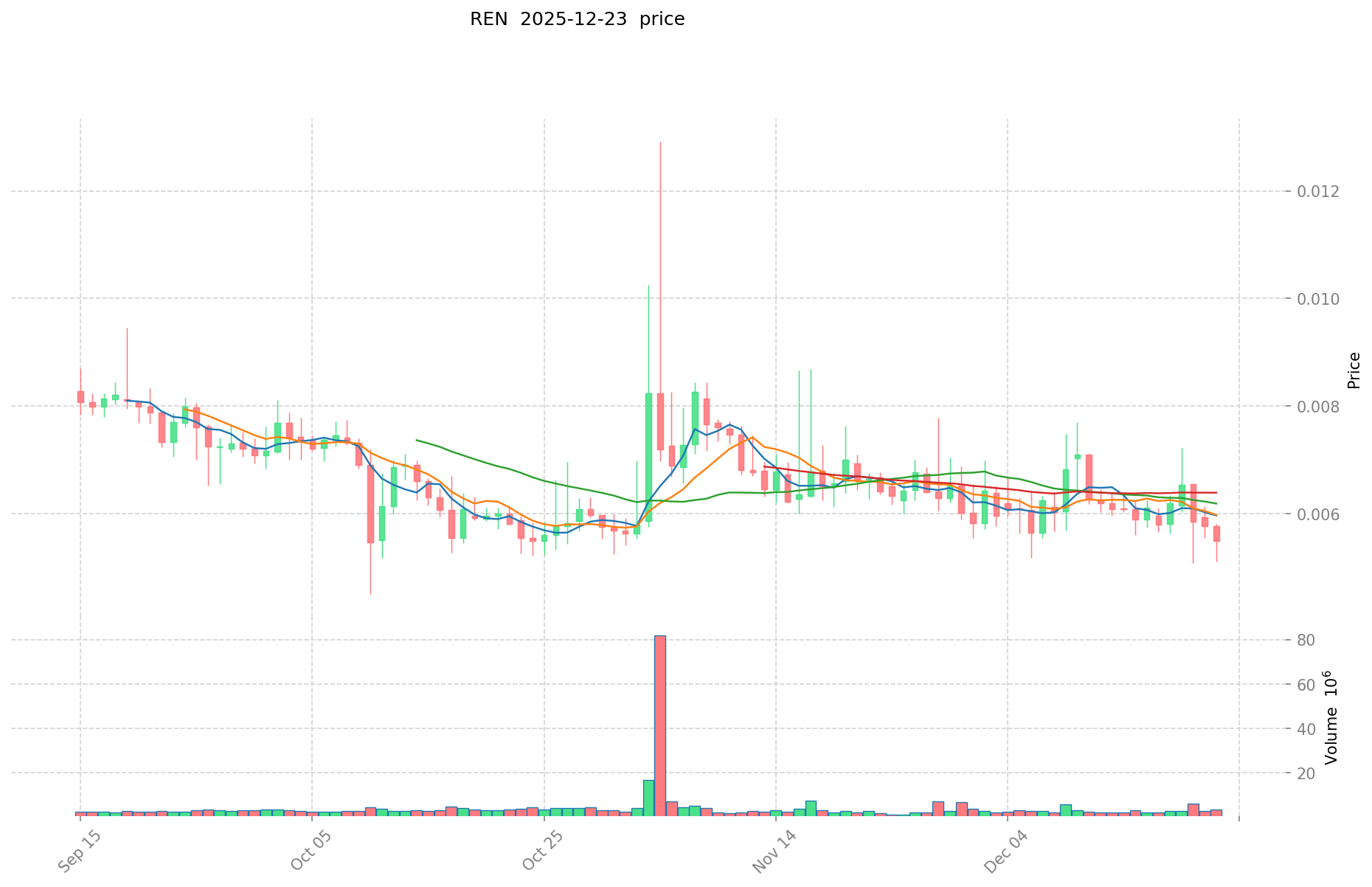
I. Price History Review and Current Investment Status of REN
- February 2021: All-Time High (ATH) reached $1.8 USD — peak valuation period during the 2021 bull market
- December 2025: All-Time Low (ATL) reached $0.00526239 USD — significant drawdown from historical peak
- Year-to-Date Performance (2025): Token declined -80.03% over the past 12 months, reflecting substantial downward pressure
Current REN Market Status (December 23, 2025)
- Current REN Price: $0.005714 USD
- 24-Hour Trading Volume: $21,348.11 USD
- Total Market Capitalization: $5,714,000 USD
- Circulating Supply: 1,000,000,000 REN tokens (100% of total supply)
- Market Dominance: 0.00017%
- Price Performance:
- 1-Hour Change: -0.33%
- 24-Hour Change: +0.12%
- 7-Day Change: -3.61%
- 30-Day Change: -13.38%
- 1-Year Change: -80.03%
For real-time REN market pricing, visit the Gate REN Market Page
II. Project Overview and Technical Architecture
Protocol Foundation and Core Functionality
Republic Protocol (REN) is a blockchain-based protocol designed to facilitate distributed dark pool trading for encrypted assets across multiple blockchain networks, specifically enabling trading between BTC/ETH, BTC/ERC20, and ETH/ERC20 asset pairs.
The protocol represents the only known blockchain enterprise to implement such distributed dark pool trading technology for cryptocurrency assets. In traditional American and European equity markets, dark pool trading accounts for approximately 10-30% of total industry trading volume, with prominent brokers including JPMorgan Chase, Goldman Sachs, Fidelity, Deutsche Bank, and Morgan Stanley operating such facilities.
Dark Pool Trading Mechanism
"Dark pool" trading functions as a critical form of "alternative trading system." While normal exchange trading displays all buy and sell orders publicly, institutional investors utilizing dark pools execute transactions through trader-operated high-frequency operations. These dark pool transactions communicate buy or sell "intentions" to specific investors, with the original purpose being to test whether instructions can find matches among limited investor groups. However, in practice, most "executable" intentions conclude transactions without public knowledge.
Primary Advantages of Dark Pool Trading Structure
The fundamental advantage of dark pool trading for institutional investors conducting block trades is the ability to locate buyers and sellers without public exposure. This mechanism prevents adverse market impact and protects against asset depreciation caused by large order visibility.
Network Architecture and Security Framework
The Republic Protocol system relies on a carefully designed incentive mechanism to ensure participant compliance with protocol rules. RenEx "Dark Nodes" operate the matching engine to ensure dark pool functionality. The presence of multiple dark pools simultaneously reduces counterparty risk. To prevent malicious attacks, the protocol requires that network nodes (Darknodes) maintain a security deposit of 100,000 REN tokens, which serves as the protocol's native token.
III. Tokenomics and Supply Metrics
- Total Supply: 1,000,000,000 REN
- Circulating Supply: 1,000,000,000 REN (100% circulation ratio)
- Maximum Supply: 1,000,000,000 REN
- Token Release Schedule: Fully diluted at launch; no additional emission mechanism documented
- Active Token Holders: 60,955 addresses
IV. Market Trading Data
- Number of Trading Pairs: Listed on 8 exchanges
- 24-Hour High: $0.005837 USD
- 24-Hour Low: $0.0051 USD
- Publication/Launch Price (2018): $0.0561 USD
- Price Discovery Status: Token available for trading on multiple cryptocurrency platforms
V. Primary Use Cases and Ecosystem Applications
Core Protocol Applications
The REN token functions as a security deposit mechanism for Darknodes operating within the Republic Protocol ecosystem. Operators must stake 100,000 REN tokens to participate in the distributed matching engine infrastructure that powers the dark pool trading system.
Market Structure and Participant Incentives
The protocol's incentive system is structured to ensure compliance from all ecosystem participants. The economic requirement for Dark Node operators to maintain substantial token holdings aligns their interests with protocol integrity and successful market operation.
VI. Risk Considerations
- Extreme Price Volatility: Historical range from $1.8 to $0.00526239 represents 99.7% decline from ATH, indicating severe market risk
- Very Low Trading Volume: 24-hour volume of $21,348 USD represents minimal liquidity for position entry/exit
- Minimal Market Presence: Market cap of $5.7 million and 0.00017% dominance indicate marginal market significance
- Prolonged Downtrend: -80.03% annual decline reflects sustained negative market sentiment
- Regulatory Uncertainty: Dark pool trading applications in cryptocurrency remain subject to evolving regulatory frameworks
VII. Official Resources and Community Channels
Disclaimer: This report is for informational purposes only and does not constitute investment advice, financial recommendation, or encouragement to trade. Cryptocurrency markets involve substantial risk including potential total loss of capital. Past performance does not guarantee future results. Investors should conduct independent research and consult qualified financial advisors before making investment decisions.
Ren (REN) Crypto Asset Research Report
Report Date: December 23, 2025
I. Executive Summary
Ren (REN) is a blockchain protocol designed to enable distributed dark pool trading for encrypted assets across BTC/ETH, BTC/ERC20, and ETH/ERC20 trading pairs. As of the report date, REN is ranked 1,460 by market capitalization, with a current price of $0.005714 and a total market cap of $5,714,000. The token has experienced significant downward pressure over the past year, declining 80.03%.
II. Core Factors Affecting Whether Ren (REN) is a Good Investment
Supply Mechanism and Scarcity
The REN token operates with a fixed maximum supply of 1,000,000,000 tokens, with all tokens currently in circulation (100% circulation ratio). This complete supply availability differs from deflationary mechanisms found in other projects. The token's scarcity profile is static, providing no ongoing reduction mechanism to support price appreciation through supply constraints alone.
Historical Price Context:
- All-Time High (ATH): $1.80 (February 20, 2021)
- All-Time Low (ATL): $0.00526239 (December 20, 2025)
- Current Price: $0.005714
- Decline from ATH: -99.68%
Institutional Investment and Mainstream Adoption
The reference materials do not provide specific data regarding current institutional investment positions or mainstream adoption metrics for REN. The protocol's theoretical positioning in distributed dark pool trading parallels traditional financial dark pool mechanisms used by major institutions (JPMorgan Chase, Goldman Sachs, Fidelity, Deutsche Bank, Morgan Stanley), but current adoption status remains unspecified in the available data.
Network Activity Indicators:
- Total Holders: 60,955
- Trading Pairs Available: 8 exchanges
- 24-Hour Trading Volume: $21,348.11
Macroeconomic Environment Impact on REN Investment
Market sentiment indicators suggest challenging conditions for REN investment. The token's performance reflects broader market dynamics affecting lower-ranked altcoins and DeFi-adjacent projects. The significant year-to-date decline (-80.03%) indicates substantial headwinds in market valuation for this asset class.
Technology and Ecosystem Development
The Republic Protocol system incorporates a designed incentive structure with the following technical framework:
- Dark Nodes Infrastructure: RenEx operates a matching engine to facilitate dark pool operations
- Network Security: Darknodes require a 100,000 REN collateral deposit to prevent malicious attacks and ensure protocol compliance
- Multi-Pool Risk Management: Multiple dark pool instances reduce counterparty risk concentration
However, specific information regarding recent technology upgrades, ecosystem expansion metrics, or DeFi integration developments is not provided in the available reference materials.
Recent Price Movements
| Time Period |
Change Percentage |
Price Change |
| 1 Hour |
-0.33% |
-$0.000018918 |
| 24 Hours |
+0.12% |
+$0.000006849 |
| 7 Days |
-3.61% |
-$0.000214001 |
| 30 Days |
-13.38% |
-$0.000882629 |
| 1 Year |
-80.03% |
-$0.022898919 |
The token demonstrates significant downward momentum across medium to long-term timeframes, with only marginal 24-hour gains unable to offset broader negative trends.
IV. Market Position Indicators
| Metric |
Value |
| Market Cap Rank |
1,460 |
| Total Market Capitalization |
$5,714,000 |
| Market Dominance |
0.00017% |
| Fully Diluted Valuation |
$5,714,000 |
| FDV/Market Cap Ratio |
100% |
The low market dominance and ranking position reflect limited capital concentration and reduced market influence relative to larger cryptocurrency assets.
V. Protocol Function and Value Proposition
Republic Protocol addresses institutional trading requirements through distributed dark pool infrastructure. The protocol's core advantages include:
- Transaction Privacy: Large institutional traders can execute block trades without public exposure
- Market Impact Mitigation: Prevents price slippage and market depreciation from large orders
- Distributed Architecture: Multiple dark pool instances reduce counterparty concentration risk
- Incentive Alignment: Token-based collateral requirements align node operator interests with protocol security
VI. Available Resources
- Last Updated: December 23, 2025, 12:21:22 UTC
- Data Provider: Gate
- Current Price (as of report date): $0.005714
Disclaimer: This report presents factual data regarding REN token characteristics, market metrics, and protocol function. The report does not constitute investment advice, and readers should conduct independent analysis before making financial decisions.
III. REN Future Investment Forecast and Price Outlook (Is Ren(REN) worth investing in 2025-2030)
Short-term Investment Forecast (2025, Short-term REN Investment Outlook)
- Conservative Forecast: $0.00445 - $0.00588
- Neutral Forecast: $0.00570 - $0.00620
- Optimistic Forecast: $0.00620 - $0.00750
Mid-term Investment Outlook (2026-2028, Mid-term Ren(REN) Investment Forecast)
-
Market Phase Expectation: Recovery and consolidation phase with gradual price stabilization and potential modest appreciation driven by protocol adoption and ecosystem development.
-
Investment Return Forecast:
- 2026: $0.00347 - $0.00619
- 2027: $0.00401 - $0.00629
- 2028: $0.00540 - $0.00847
-
Key Catalysts: Increased institutional adoption of privacy-focused trading protocols; expansion of dark pool functionality across multiple blockchain networks; integration with major DeFi platforms; regulatory clarity around decentralized trading systems.
Long-term Investment Outlook (Is REN a Good Long-term Investment?)
-
Base Case Scenario: $0.00550 - $0.01280 (Assumes steady adoption of the Republic Protocol's distributed dark pool technology and moderate market expansion in privacy-preserving trading solutions)
-
Optimistic Scenario: $0.01280 - $0.02000 (Assumes widespread institutional adoption of decentralized dark pools, significant growth in cross-chain trading volumes, and favorable regulatory environment for privacy-preserving DeFi protocols)
-
Risk Scenario: $0.00300 - $0.00450 (Assumes regulatory headwinds against privacy features, shift in market preference toward transparent trading, and limited adoption by institutional players)
View REN Long-term Investment and Price Forecast: Price Prediction
2025-12-23 to 2030 Long-term Outlook
-
Base Case Scenario: $0.00550 - $0.01000 (Corresponds to steady protocol development and moderate dark pool trading volume growth)
-
Optimistic Scenario: $0.01000 - $0.02000 (Corresponds to large-scale institutional adoption and favorable market conditions for privacy-focused trading infrastructure)
-
Transformative Scenario: $0.02000+ (Should breakthrough developments occur in ecosystem adoption and mainstream institutional integration)
-
2030-12-31 Forecast High: $0.01278 (Based on optimistic development assumptions)
Disclaimer: These forecasts are based on available market data and historical analysis. Cryptocurrency markets are highly volatile and unpredictable. Past performance does not guarantee future results. Investors should conduct thorough research and consider their risk tolerance before making investment decisions. This analysis is for informational purposes only and does not constitute investment advice.
| 年份 |
预测最高价 |
预测平均价格 |
预测最低价 |
涨跌幅 |
| 2025 |
0.00587306 |
0.005702 |
0.00444756 |
0 |
| 2026 |
0.0061926571 |
0.00578753 |
0.003472518 |
1 |
| 2027 |
0.0062895982275 |
0.00599009355 |
0.0040133626785 |
4 |
| 2028 |
0.008472987326475 |
0.00613984588875 |
0.0054030643821 |
7 |
| 2029 |
0.010448175748885 |
0.007306416607612 |
0.005699004953937 |
27 |
| 2030 |
0.012783306496678 |
0.008877296178249 |
0.005503923630514 |
55 |
REN (Ren) Investment Strategy and Risk Analysis Report
I. Investment Methodology for REN
REN Investment Strategy
Long-term Holding (HODL REN)
- Suitable for conservative investors seeking exposure to decentralized dark pool trading infrastructure
- Aligns with the protocol's long-term development potential in institutional-grade trading mechanisms
- Current valuation at $0.005714 represents a significant discount from all-time high of $1.8 (reached February 20, 2021)
Active Trading
- Short-term traders may utilize technical analysis given the asset's high volatility
- 24-hour price range: $0.0051 to $0.005837
- Recent price trends show -0.33% (1H), +0.12% (24H), -3.61% (7D), and -13.38% (30D)
II. Risk Management for REN Investment
Asset Allocation Recommendations
Conservative Investors
- Allocate no more than 1-2% of portfolio to REN due to low market capitalization ($5.71M) and limited trading volume ($21,348.11 in 24H volume)
Active Investors
- May consider 3-5% allocation if comfortable with high-volatility micro-cap assets
Professional Investors
- Conduct thorough due diligence on protocol adoption, Darknode validator activity, and competitive positioning before any allocation
Risk Mitigation Strategies
- Portfolio Diversification: Combine REN exposure with established cryptocurrencies and non-correlated assets
- Position Sizing: Start with small positions given the asset's rank (#1,460) and thin liquidity
- Stop-Loss Orders: Implement predetermined exit points given the 80.03% year-over-year decline
Secure Storage
- Hot Wallets: Use only for active trading amounts on reputable exchanges (REN trades on 8 exchanges)
- Cold Storage: Hardware wallets recommended for long-term holdings
- Token Address: ERC-20 contract address on Ethereum: 0x408e41876cCCDC0F92210600ef50372656052a38
III. Investment Risks and Challenges for REN
Market Risk
- High Volatility: All-time high of $1.8 versus current price of $0.005714 represents 99.7% decline from peak
- Extreme Illiquidity: 24-hour volume of $21,348 is minimal relative to $5.71M market cap
- Price Manipulation Risk: Low trading volume creates potential for manipulation in thin markets
Regulatory Risk
- Compliance Uncertainty: Dark pool trading mechanisms operate in evolving regulatory frameworks across jurisdictions
- Institutional Adoption Barriers: Regulatory constraints may limit protocol uptake by traditional financial institutions
- Cross-chain Asset Regulation: Trading between BTC/ETH and ERC-20 tokens faces varying legal treatment globally
Technology Risk
- Protocol Adoption: Limited visibility into active Darknode validator count and network security metrics
- Smart Contract Vulnerability: ERC-20 implementation requires ongoing security audits
- Competitive Displacement: Alternative decentralized trading solutions may outcompete the protocol
IV. Conclusion: Is REN a Good Investment?
Investment Value Summary
REN's positioning as a distributed dark pool protocol addresses a legitimate institutional trading need observed in traditional financial markets. However, the protocol faces significant headwinds: the token has declined 80.03% over the past year, market capitalization remains minimal at $5.71M, and trading liquidity is critically constrained at $21,348 per day. The project's long-term viability depends on meaningful institutional adoption of its Darknode infrastructure and sustained demand for privacy-preserving cross-chain asset trading.
Investor Recommendations
✅ Beginners
- If considering exposure, allocate minimal amounts (<1% of portfolio) through dollar-cost averaging
- Utilize secure hardware wallet storage for extended holding periods
✅ Experienced Investors
- Conduct detailed analysis of Darknode validator metrics and RenEx exchange trading volumes before entry
- Implement strict risk management with predetermined stop-losses
- Consider this a speculative position within a diversified portfolio
✅ Institutional Investors
- Evaluate protocol adoption metrics, regulatory compliance frameworks, and competitive positioning before any strategic allocation
- Assess technological differentiation versus emerging decentralized trading alternatives
⚠️ Disclaimer: Cryptocurrency investments carry substantial risk including potential total loss of capital. Price volatility, market illiquidity, regulatory uncertainty, and technology risk are material considerations. This report is provided for informational purposes only and does not constitute investment advice. Conduct independent research and consult qualified financial advisors before making investment decisions.
Ren (REN) Cryptocurrency Investment Analysis - FAQ
I. FAQ - Frequently Asked Questions About REN Investment
Q1: What is Ren (REN) and what problem does it solve in the cryptocurrency market?
A: Ren (REN) is a blockchain protocol that enables distributed dark pool trading for encrypted assets across BTC/ETH, BTC/ERC20, and ETH/ERC20 trading pairs. It addresses the institutional trader's need for executing large block trades without public exposure, thereby preventing adverse market impact and price depreciation. The protocol operates similarly to dark pool mechanisms in traditional equity markets (used by JPMorgan Chase, Goldman Sachs, and others), which account for 10-30% of equity trading volume. REN token serves as a security deposit mechanism, requiring Dark Node operators to stake 100,000 REN tokens to participate in the distributed matching engine infrastructure.
Q2: What is the current market status and price performance of REN as of December 2025?
A: As of December 23, 2025, REN trades at $0.005714 USD with a total market capitalization of $5,714,000 and a market dominance of 0.00017%. The token has experienced severe downward pressure: it declined from an all-time high of $1.80 (February 2021) to an all-time low of $0.00526239, representing a 99.7% decline. Over the past 12 months, REN has declined -80.03%. Current 24-hour trading volume stands at only $21,348.11 USD across 8 trading pairs, indicating minimal liquidity. The token ranks #1,460 by market capitalization with 1 billion tokens in full circulation.
Q3: Is REN a good investment for different investor profiles in 2025-2026?
A: Investment suitability depends on risk tolerance and portfolio strategy. Conservative investors should allocate no more than 1-2% of their portfolio to REN due to its low market capitalization and critical liquidity constraints. Active traders may allocate 3-5% if comfortable with micro-cap assets exhibiting extreme volatility. The token's current valuation of $0.005714 represents a significant discount from its all-time high, which appeals to contrarian investors, but the protocol's uncertain adoption trajectory and regulatory environment present substantial risks. Long-term investors should assess whether they believe dark pool trading will achieve mainstream institutional adoption in decentralized finance. Most conservative analysts recommend treating REN as a speculative position within a diversified portfolio.
Q4: What are the primary risks associated with investing in REN?
A: REN faces multiple material risks: (1) Extreme Price Volatility—the 99.7% decline from all-time high demonstrates severe market risk; (2) Critical Illiquidity—24-hour volume of $21,348 USD creates significant challenges for position entry and exit; (3) Regulatory Uncertainty—dark pool trading mechanisms and privacy-focused protocols face evolving regulatory frameworks across jurisdictions; (4) Limited Adoption Visibility—the project provides minimal transparency regarding active Darknode validator count and actual trading volumes; (5) Competitive Displacement—alternative decentralized trading solutions may outcompete the protocol; (6) Market Manipulation Risk—thin trading volumes create potential for price manipulation in illiquid markets.
Q5: What price targets and investment forecasts exist for REN through 2030?
A: Multiple forecast scenarios exist based on adoption assumptions. Short-term (2025): Conservative range $0.00445-$0.00588; Neutral range $0.00570-$0.00620; Optimistic range $0.00620-$0.00750. Mid-term (2026-2028): forecasts range from $0.00347 (bearish 2026) to $0.00847 (optimistic 2028). Long-term (through 2030): Base case scenario projects $0.00550-$0.01000 assuming steady protocol development; Optimistic scenario projects $0.01000-$0.02000 assuming widespread institutional adoption; Transformative scenario exceeds $0.02000 pending breakthrough ecosystem developments. December 2030 high forecast: $0.01278. These forecasts assume increasing institutional adoption of privacy-focused trading infrastructure but carry substantial uncertainty given cryptocurrency market volatility.
Q6: What investment strategies are most appropriate for REN given its current market conditions?
A: Two primary strategies apply: (1) Long-term Holding (HODL)—suitable for investors believing in dark pool protocol adoption and willing to tolerate extended downside risk in exchange for potential long-term appreciation; this approach aligns with the protocol's development trajectory if institutional adoption materializes. (2) Active Trading—suitable for technical traders exploiting the asset's high volatility; recent 24-hour price range of $0.0051-$0.005837 permits swing trading approaches. Both strategies require strict risk management: implement portfolio diversification, position sizing (1-2% maximum for most investors), predetermined stop-loss orders given the 80.03% annual decline, and secure storage solutions using hardware wallets for extended holdings. Dollar-cost averaging approach recommended given the asset's volatility and current valuation uncertainty.
Q7: What resources and official channels should investors use to conduct REN research and monitor the protocol?
A: Official sources include: (1) Website—renproject.io provides protocol documentation and project updates; (2) Smart Contract Address (Ethereum)—0x408e41876cCCDC0F92210600ef50372656052a38 enables token verification and transaction monitoring; (3) Block Explorer—etherscan.io/token/0x408e41876cCCDC0F92210600ef50372656052a38 displays token transfer history, holder distribution (currently 60,955 addresses), and contract activity; (4) Social Media—@renprotocol on Twitter provides project announcements and community engagement; (5) Market Data—Gate REN Market Page provides real-time pricing, 24-hour high/low data ($0.005837/$0.0051 as of report date), and trading volume information. Investors should monitor these sources for Darknode network statistics, trading volume metrics, and protocol development updates when evaluating investment thesis progression.
Q8: What is the disclaimer and final investment recommendation regarding REN?
A: Cryptocurrency investments carry substantial risk including potential total loss of capital. REN's extreme price volatility (99.7% decline from peak), minimal trading volume ($21,348 daily), low market capitalization ($5.71M), regulatory uncertainty surrounding dark pool mechanisms, and uncertain protocol adoption present material investment risks. Past performance does not guarantee future results. Price forecasts reflect speculative projections based on adoption assumptions and carry substantial uncertainty. This analysis is provided for informational purposes only and does not constitute investment advice, financial recommendation, or encouragement to trade. Investors must conduct independent research, thoroughly evaluate their risk tolerance, and consult qualified financial advisors before making investment decisions. Beginners should allocate minimal amounts (<1%) if entering positions. Experienced investors should implement strict risk management protocols. Institutional investors should evaluate protocol adoption metrics, regulatory compliance frameworks, and competitive positioning before strategic allocation consideration.
* The information is not intended to be and does not constitute financial advice or any other recommendation of any sort offered or endorsed by Gate.