# Article Introduction: ITGR vs LRC Comprehensive Comparison
This comprehensive analysis compares two leading blockchain governance tokens—Integral (ITGR) and Loopring (LRC)—to help investors identify superior investment opportunities. The article examines historical price performance, tokenomics, market applications, and technology ecosystems across both assets. Through detailed price forecasts spanning 2026-2031, risk assessments, and tailored investment strategies on Gate, the guide addresses critical investor concerns about volatility, liquidity, and long-term growth potential. Designed for beginner to institutional investors, this comparison provides actionable insights for portfolio allocation decisions in the evolving DeFi landscape.
Introduction: ITGR vs LRC Investment Comparison
In the cryptocurrency market, the comparison between Integral (ITGR) and Loopring (LRC) is a topic that investors cannot ignore. The two assets differ significantly in market capitalization ranking, application scenarios, and price performance, representing distinct positioning within the crypto ecosystem.
Integral (ITGR): An exchange built to access liquidity from other trading platforms, Integral allows token holders to reduce transaction costs through staking and distributes all governance rights among $ITGR token holders.
Loopring (LRC): Since its launch in 2017, Loopring has established itself as an open, multi-token transaction protocol based on ERC20 and smart contracts. It enables the creation of decentralized exchange applications without asset custody requirements. LRC holders can access the lowest transaction fees and benefit from all network activities.
This article will provide a comprehensive analysis of the investment value comparison between ITGR and LRC across historical price trends, supply mechanisms, token holder distribution, and technical ecosystems, helping investors address their primary concern:
"Which is the better investment opportunity?"
Crypto Asset Analysis: Integral (ITGR) vs Loopring (LRC)
I. Historical Price Comparison and Current Market Status
Integral (ITGR) and Loopring (LRC) Historical Price Trends
- 2021: ITGR reached its all-time high of $3.45 on September 16, 2021, reflecting early market enthusiasm for decentralized exchange infrastructure.
- 2021: LRC achieved its all-time high of $3.75 on November 10, 2021, driven by strong adoption of Ethereum Layer 2 scaling solutions and market momentum.
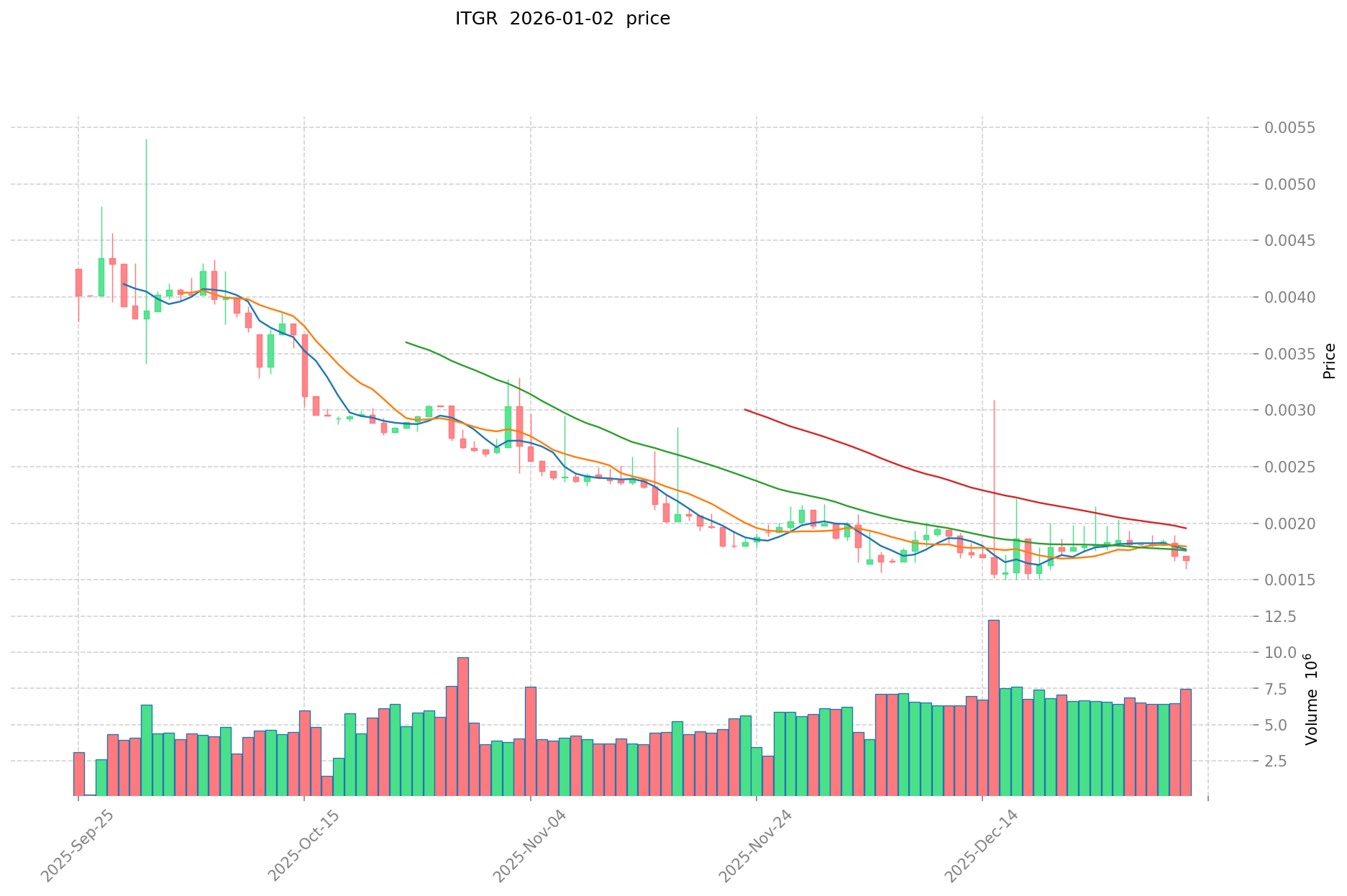
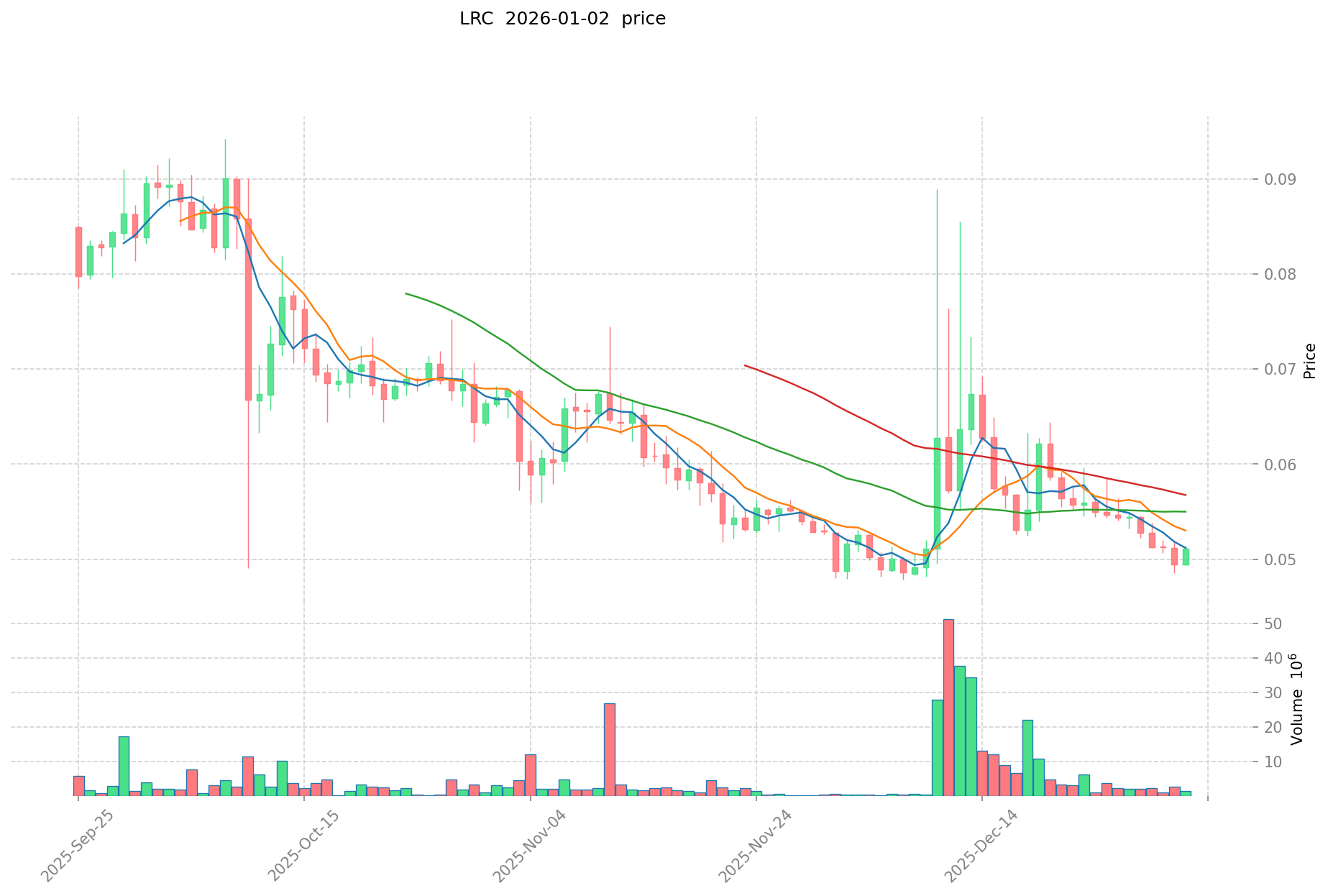
- Comparative analysis: From peak to present, ITGR has declined from $3.45 to $0.001675, representing a 99.95% decline over the period. LRC has similarly declined from $3.75 to $0.05179, representing a 98.62% decline. Both tokens have experienced significant bearish pressure, though LRC has maintained relatively higher price resilience compared to ITGR.
Current Market Status (January 2, 2026)
- ITGR current price: $0.001675.
- LRC current price: $0.05179.
- 24-hour trading volume: ITGR $12,633.02 vs LRC $93,700.56.
- Market sentiment index (Fear & Greed Index): 28 (Fear).
Click to view real-time prices:
II. Core Factors Influencing ITGR vs LRC Investment Value
Tokenomics and Supply Mechanisms
- ITGR: Supply mechanism details unavailable in reference materials.
- LRC: Supply mechanism details unavailable in reference materials.
- 📌 Historical Pattern: The reference materials do not provide specific information regarding how supply mechanisms drive price cycle changes for these assets.
Institutional Adoption and Market Applications
- Institutional Holdings: Comparative data on institutional preference between ITGR and LRC is not available in the provided materials.
- Enterprise Adoption: Information regarding ITGR and LRC applications in cross-border payments, settlement, and investment portfolio composition is not available.
- National Policy: Regulatory attitudes of different countries toward ITGR and LRC are not specified in the reference materials.
Technology Development and Ecosystem Construction
- ITGR Technology Upgrades: Specific upgrade details and potential impacts are not provided in the available sources.
- LRC Technology Development: Technical advancement information is not available in the reference materials.
- Ecosystem Comparison: Data on DeFi, NFT, payment, and smart contract implementation across both platforms is not available.
Macroeconomic Environment and Market Cycles
- Performance Under Inflation: Comparative analysis of anti-inflation attributes between ITGR and LRC cannot be determined from the provided materials.
- Macroeconomic Monetary Policy: Impact of interest rates and US dollar index on both assets is not specified in the reference sources.
- Geopolitical Factors: Information regarding cross-border transaction demand and international situation effects on ITGR and LRC is not available.
III. 2026-2031 Price Forecast: ITGR vs LRC
Short-term Forecast (2026)
- ITGR: Conservative $0.001459 - $0.001717 | Bullish $0.001717 - $0.002335
- LRC: Conservative $0.045575 - $0.051790 | Bullish $0.051790 - $0.066291
Medium-term Forecast (2028-2029)
- ITGR could enter growth consolidation phase, with expected price range of $0.001600 - $0.003870
- LRC could enter expansion phase, with expected price range of $0.043557 - $0.096871
- Key drivers: Institutional capital inflows, ETF adoption, ecosystem development
Long-term Forecast (2030-2031)
- ITGR: Base case $0.001972 - $0.003718 | Bullish case $0.003607 - $0.005243
- LRC: Base case $0.059463 - $0.084947 | Bullish case $0.076619 - $0.095990
View ITGR and LRC Detailed Price Predictions
ITGR:
| 年份 |
预测最高价 |
预测平均价格 |
预测最低价 |
涨跌幅 |
| 2026 |
0.00233512 |
0.001717 |
0.00145945 |
2 |
| 2027 |
0.0028972658 |
0.00202606 |
0.001722151 |
20 |
| 2028 |
0.002732445819 |
0.0024616629 |
0.001600080885 |
46 |
| 2029 |
0.003869610995655 |
0.0025970543595 |
0.00233734892355 |
55 |
| 2030 |
0.00420333248085 |
0.003233332677577 |
0.001972332933322 |
93 |
| 2031 |
0.005242848936691 |
0.003718332579214 |
0.003606782601837 |
121 |
LRC:
| 年份 |
预测最高价 |
预测平均价格 |
预测最低价 |
涨跌幅 |
| 2026 |
0.0662912 |
0.05179 |
0.0455752 |
0 |
| 2027 |
0.074981562 |
0.0590406 |
0.050774916 |
14 |
| 2028 |
0.07237196748 |
0.067011081 |
0.04355720265 |
29 |
| 2029 |
0.0968712186936 |
0.06969152424 |
0.0473902364832 |
34 |
| 2030 |
0.086612626325472 |
0.0832813714668 |
0.076618861749456 |
60 |
| 2031 |
0.095990108752633 |
0.084946998896136 |
0.059462899227295 |
64 |
IV. Investment Strategy Comparison: ITGR vs LRC
Long-term vs Short-term Investment Strategy
- ITGR: Suitable for investors seeking exposure to decentralized exchange infrastructure with high risk tolerance, willing to hold through extended consolidation periods for potential recovery in ecosystem adoption
- LRC: Suitable for investors prioritizing established Layer 2 scaling protocol adoption with relatively more stable performance history, seeking exposure to Ethereum ecosystem development
Risk Management and Asset Allocation
- Conservative investors: ITGR 10% vs LRC 90%
- Aggressive investors: ITGR 40% vs LRC 60%
- Hedging tools: Stablecoin allocation, options strategies, cross-asset diversification
V. Potential Risk Comparison
Market Risk
- ITGR: Extreme price volatility with 99.95% decline from all-time high, significantly lower trading volume ($12,633.02 daily), elevated liquidity risk
- LRC: High price volatility with 98.62% decline from all-time high, relatively higher trading volume ($93,700.56 daily), established market presence
Technology Risk
- ITGR: Scalability and network stability dependent on liquidity access from integrated trading platforms
- LRC: Protocol security and smart contract reliability on Ethereum network, potential ERC20 standard vulnerabilities
Regulatory Risk
- Global regulatory policies toward decentralized exchanges and Layer 2 solutions remain uncertain; both assets subject to evolving cryptocurrency regulations across jurisdictions
VI. Conclusion: Which Is the Better Buy?
📌 Investment Value Summary
- ITGR Advantages: Access to multi-platform liquidity, cost reduction through staking, full governance distribution to token holders
- LRC Advantages: Established protocol since 2017, multi-token transaction capability, reduced transaction fees for holders, proven Ethereum Layer 2 positioning
✅ Investment Recommendations
- Beginner investors: Prioritize LRC due to longer operational history, higher trading volume, and established market recognition; approach ITGR with caution given extreme volatility
- Experienced investors: Consider portfolio allocation combining both assets; monitor ecosystem developments and institutional adoption metrics for tactical adjustments
- Institutional investors: LRC presents lower implementation risk with demonstrated Layer 2 protocol maturity; ITGR requires deeper due diligence on liquidity sustainability
⚠️ Risk Disclaimer: The cryptocurrency market exhibits extreme volatility. Both ITGR and LRC have experienced significant price declines from historical peaks. This analysis does not constitute investment advice. Investors should conduct independent research and assess personal risk tolerance before making investment decisions.
FAQ
ITGR和LRC分别是什么?它们各自的主要用途和应用场景是什么?
ITGR是集成测试指南,用于确保软件组件协同工作。LRC是负载运行控制器,用于管理和执行负载测试。两者主要应用于软件测试和性能评估领域。
ITGR与LRC在技术架构和性能上有什么区别?
ITGR和LRC在技术设计上差异较大。ITGR侧重高保真图形渲染优化,提升视觉质量;LRC采用低分辨率压缩策略,降低文件体积和带宽消耗。两者在架构理念和性能指标上各具特色。
ITGR和LRC哪个更适合投资?风险和收益潜力对比如何?
ITGR成长潜力更高但波动性较大,LRC相对稳定收益温和。ITGR适合风险偏好者追求高回报,LRC适合保守投资者。选择需根据个人风险承受能力决定。
ITGR和LRC的市场流动性、交易对和支持交易所有什么区别?
ITGR和LRC在流动性方面存在差异,ITGR通常市场流动性较强,交易对数量更丰富。LRC作为知名DeFi代币,流动性相对稳定但交易对较少。两者支持的交易所覆盖范围不同,ITGR生态支持力度各异,LRC在主流交易所支持度更广。
ITGR和LRC的团队背景、项目进展和生态发展现状如何对比?
ITGR与LRC团队背景不同,项目进展各异。ITGR专注于技术创新与开发,LRC则在市场应用与生态扩展方面表现突出。生态发展中,两者均有独特定位,形成差异化竞争格局。
* The information is not intended to be and does not constitute financial advice or any other recommendation of any sort offered or endorsed by Gate.