# Article Overview: KOS vs ETC Comprehensive Comparison
This comprehensive guide compares Kontos (KOS), an emerging zero-knowledge infrastructure platform launched in 2024, with Ethereum Classic (ETC), an established blockchain since 2016, to help investors determine which asset better suits their portfolio. The article addresses key investment questions by analyzing price trajectories, tokenomics, technological ecosystems, and market positioning across both cryptocurrencies. Structured through price history analysis, core value factors, predictive modeling through 2031, and risk assessment, this comparison serves beginner, experienced, and institutional investors seeking informed allocation strategies. Real-time pricing data from Gate enables accurate market evaluation, while diversified investment recommendations accommodate varying risk tolerances and investment horizons in today's volatile crypto market.
**Ideal for:** Cryptocurrency investors evaluating emerging vs. established blockchain platforms for
Introduction: KOS vs ETC Investment Comparison
In the cryptocurrency market, the comparison between Kontos (KOS) and Ethereum Classic (ETC) represents a compelling contrast between emerging infrastructure innovations and established blockchain platforms. Two assets exhibit striking differences not only in market capitalization rankings, application scenarios, and price performance, but also embody distinct positioning within the crypto ecosystem.
Kontos (KOS): Launched in 2024, KOS has gained market recognition through its zero-knowledge technology and AI-enhanced chain-abstraction infrastructure, offering innovative features such as gas-less transactions, asset-less operations, and enhanced security mechanisms that simplify multi-chain interactions.
Ethereum Classic (ETC): Since its inception in 2016 as the continuation of the original Ethereum chain, ETC has been recognized as a decentralized platform for executing smart contracts, upholding the "code is law" principle and establishing itself as an established player in the blockchain ecosystem.
This article will provide a comprehensive analysis of the investment value proposition of KOS vs ETC across historical price trajectories, supply mechanisms, technological ecosystems, and market positioning, addressing the key question investors frequently ask:
"Which is the better buy right now?"
Kontos (KOS) vs Ethereum Classic (ETC): Price History and Market Analysis
I. Price History Comparison and Current Market Status
Kontos (KOS) and Ethereum Classic (ETC) Historical Price Trends
- 2024: Kontos reached its all-time high of $0.208 on December 20, 2024, reflecting early market enthusiasm for the zk-powered chain abstraction infrastructure.
- 2016: Ethereum Classic emerged as the original Ethereum chain following the DAO hack, establishing itself as the continuation of the unforked blockchain with the "code is law" principle.
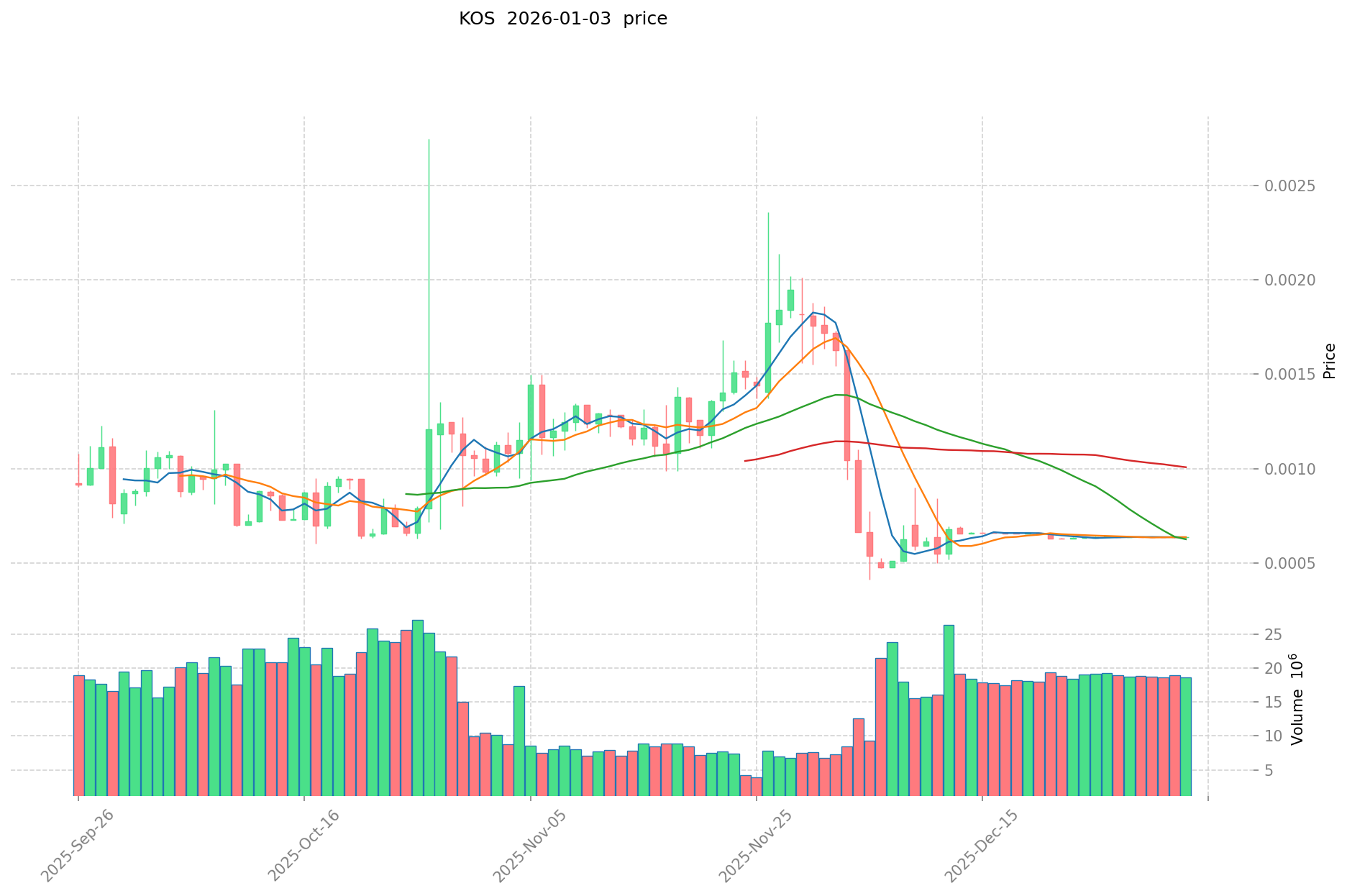
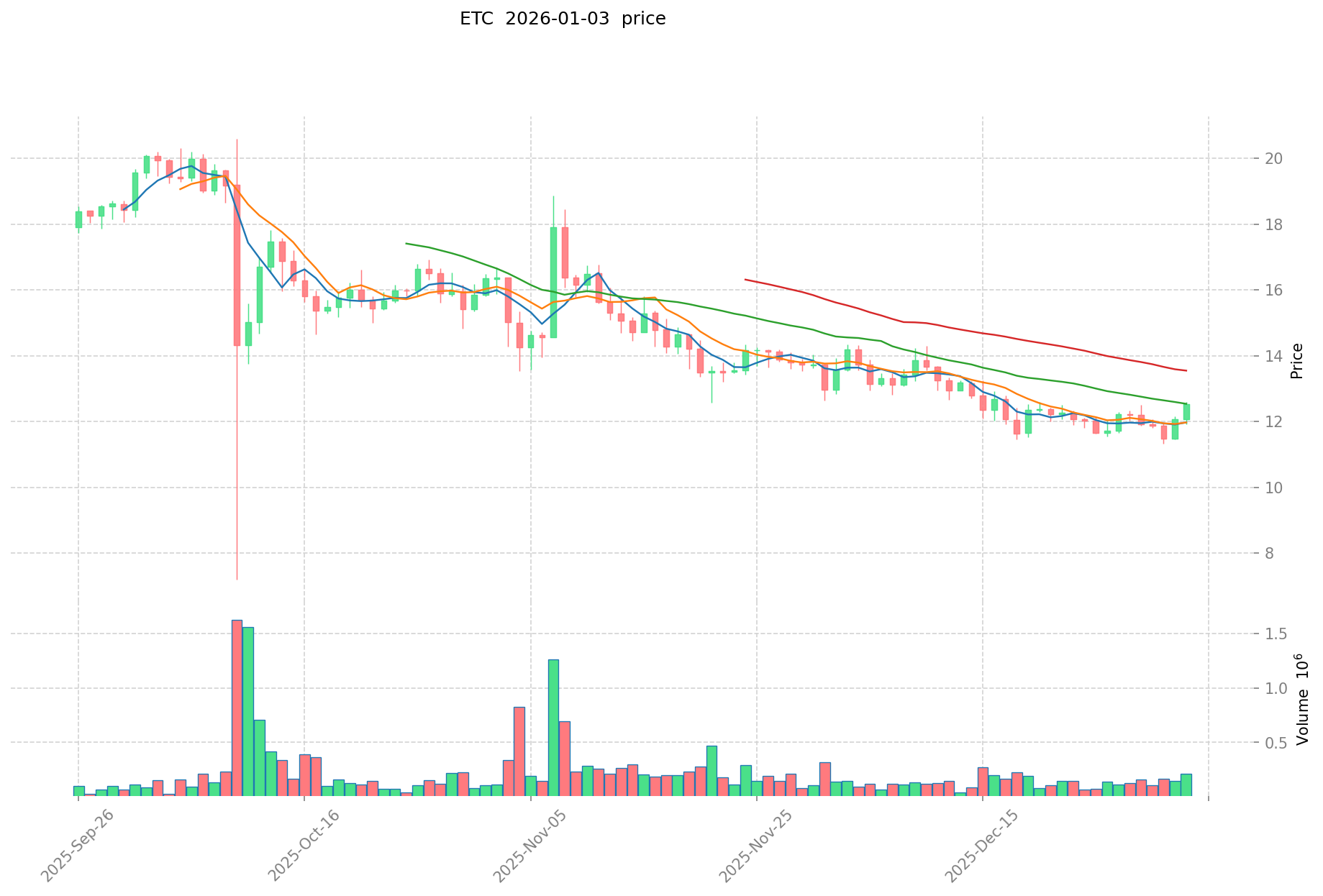
- Comparative Analysis: Over the past year, KOS declined 98.8% from its historical high, while ETC experienced a 53.84% decline over the same period. Both tokens have faced significant market headwinds, though ETC maintains a substantially larger market capitalization and established position in the market.
Current Market Status (January 4, 2026)
- KOS current price: $0.0006311
- ETC current price: $12.437
- 24-hour trading volume: KOS recorded $12,108.75 in volume versus ETC's $3,112,649.59, indicating significantly higher trading activity for Ethereum Classic.
- Market Emotion Index (Fear & Greed Index): 29 (Fear)
Click to view real-time prices:
Investment Analysis: KOS vs ETC Core Value Factors
II. Core Factors Affecting KOS vs ETC Investment Value
Supply Mechanism Comparison (Tokenomics)
Information regarding the specific tokenomics, supply mechanisms, and historical price cycle patterns for KOS and ETC is not available in the provided reference materials.
Institutional Adoption and Market Application
Information regarding institutional holdings, enterprise adoption across cross-border payments, settlement, investment portfolios, and national regulatory policies for KOS and ETC is not available in the provided reference materials.
Technology Development and Ecosystem Construction
Information regarding technology upgrades, ecosystem development including DeFi, NFT, payment systems, and smart contract implementations for KOS and ETC is not available in the provided reference materials.
Macroeconomic Environment and Market Cycles
Macroeconomic External Factors:
Macroeconomic external factors influence investment value and consumer demand. External factors such as interest rate policies and currency valuations affect asset performance in different market environments.
Inflation Environment:
Information regarding inflation resistance properties and comparative performance of KOS and ETC is not available in the provided reference materials.
Geopolitical Factors:
Information regarding geopolitical impacts, cross-border transaction demand, and international situation effects on KOS and ETC is not available in the provided reference materials.
III. 2026-2031 Price Prediction: KOS vs ETC
Short-term Prediction (2026)
- KOS: Conservative $0.000535-$0.0006297 | Optimistic $0.000887877
- ETC: Conservative $6.46984-$12.442 | Optimistic $15.42808
Mid-term Prediction (2027-2029)
- KOS may enter growth consolidation phase, with projected price range of $0.000607-$0.001226
- ETC may enter stable appreciation phase, with projected price range of $9.75-$27.07
- Key drivers: institutional capital inflows, ETF adoption, ecosystem development
Long-term Prediction (2030-2031)
- KOS: Base scenario $0.000551-$0.001267 | Optimistic scenario $0.001473-$0.001571
- ETC: Base scenario $13.78-$23.77 | Optimistic scenario $24.79-$25.43
View detailed KOS and ETC price predictions
KOS:
| 年份 |
预测最高价 |
预测平均价格 |
预测最低价 |
涨跌幅 |
| 2026 |
0.000887877 |
0.0006297 |
0.000535245 |
0 |
| 2027 |
0.000978837165 |
0.0007587885 |
0.0006070308 |
20 |
| 2028 |
0.00092094160245 |
0.0008688128325 |
0.000443094544575 |
37 |
| 2029 |
0.00122598178794 |
0.000894877217475 |
0.00051008001396 |
41 |
| 2030 |
0.001473997008763 |
0.001060429502707 |
0.000551423341408 |
68 |
| 2031 |
0.001571344437112 |
0.001267213255735 |
0.000658950892982 |
100 |
ETC:
| 年份 |
预测最高价 |
预测平均价格 |
预测最低价 |
涨跌幅 |
| 2026 |
15.42808 |
12.442 |
6.46984 |
0 |
| 2027 |
15.8859456 |
13.93504 |
9.754528 |
12 |
| 2028 |
21.918424416 |
14.9104928 |
12.972128736 |
20 |
| 2029 |
27.06925415376 |
18.414458608 |
17.67788026368 |
48 |
| 2030 |
24.7886234551592 |
22.74185638088 |
19.330577923748 |
83 |
| 2031 |
25.428806712280972 |
23.7652399180196 |
13.783839152451368 |
91 |
IV. Investment Strategy Comparison: KOS vs ETC
Long-term vs Short-term Investment Strategy
- KOS: Suitable for investors focused on emerging zero-knowledge technology infrastructure and multi-chain abstraction innovations with high risk tolerance for early-stage projects
- ETC: Suitable for investors seeking established blockchain platforms with proven track records, stability, and adherence to decentralized principles
Risk Management and Asset Allocation
- Conservative investors: KOS 0% vs ETC 100%
- Aggressive investors: KOS 30% vs ETC 70%
- Hedging tools: Stablecoin allocation, options strategies, cross-asset diversification portfolios
V. Potential Risk Comparison
Market Risk
- KOS: High volatility with 98.8% decline from all-time high; limited trading volume ($12,108.75 in 24-hour volume) indicates lower liquidity and higher price impact from individual trades
- ETC: Market decline of 53.84% over the past year; despite established status, still subject to broader cryptocurrency market cycles and sentiment fluctuations
Technology Risk
- KOS: Early-stage project launched in 2024 with unproven long-term stability of zero-knowledge and chain-abstraction mechanisms; limited operational history in varying market conditions
- ETC: Established since 2016 with proven network stability; however, faces ongoing competition from more advanced blockchain platforms and evolving security landscapes
Regulatory Risk
- Global regulatory policies remain uncertain for both assets; KOS as an emerging infrastructure project may face heightened scrutiny; ETC, established since 2016, has navigated multiple regulatory environments but remains subject to evolving compliance frameworks across jurisdictions
VI. Conclusion: Which Is the Better Buy?
📌 Investment Value Summary:
- KOS Advantages: Innovative zero-knowledge technology infrastructure, gas-less transactions and asset-less operations offer potential for simplified multi-chain interactions; early-stage project with significant growth potential if ecosystem adoption accelerates
- ETC Advantages: Established blockchain platform since 2016 with proven operational stability; larger market capitalization and substantially higher trading volume ($3,112,649.59) provide better liquidity; adherence to "code is law" principle attracts decentralization-focused participants
✅ Investment Recommendations:
- Beginner Investors: Allocate toward ETC for its established track record, larger liquidity pool, and lower execution risk in volatile market conditions
- Experienced Investors: Consider diversified allocation combining ETC core position with selective KOS exposure for potential upside from emerging technology adoption
- Institutional Investors: ETC presents a more suitable option given established market infrastructure, regulatory clarity, and adequate trading volumes for significant capital deployment
⚠️ Risk Disclaimer: The cryptocurrency market exhibits extreme volatility. This article does not constitute investment advice. Investors should conduct independent research and consult financial advisors before making investment decisions.
FAQ
KOS和ETC分别是什么?有什么区别?
KOS是基于区块链的去中心化服务协议,专注于跨链互操作性;ETC(以太经典)是以太坊分叉产生的独立公链。主要区别在于:KOS强调服务互联互通,ETC保持原始以太坊理念。两者生态应用场景不同。
KOS和ETC的技术架构有什么不同?
KOS是浪潮信息自主研发的服务器操作系统,基于Linux内核,支持x86、ARM等架构。ETC是分布式协调数据库,主要用于Kubernetes集群管理。两者属于不同技术层级,KOS偏向基础设施,ETC偏向应用协调。
KOS和ETC的共识机制分别是什么?
KOS采用Proof of Stake(权益证明)共识机制,ETC采用Proof of Work(工作量证明)共识机制。PoS能源效率更高,PoW安全性更成熟。
KOS和ETC在生态应用方面各有什么优势?
KOS在生态应用中具有广泛的硬件兼容性和强大的应用支持,ETC则以其高效的资源管理和灵活的定制化能力在生态应用中表现出色。
KOS和ETC的安全性和去中心化程度如何比较?
ETC采用完全去中心化的区块链架构,安全性由分布式共识机制保障。KOS的具体设计取决于其实现方式,但通常ETC在去中心化和抗审查能力上表现更强,安全性更优。
从投资角度看,KOS和ETC哪个更有潜力?
KOS在技术创新和应用拓展方面潜力更大,增长空间相对更广。ETC作为经典公链,生态相对稳定但创新受限。从长期发展看,KOS的潜力更值得关注。
KOS和ETC的交易费用、交易速度分别如何?
ETC采用PoW共识机制,平均出块时间约15秒,交易费用较低。KOS作为新兴公链,交易速度更快,费用更优惠,具有更高的可扩展性和更好的用户体验。
* The information is not intended to be and does not constitute financial advice or any other recommendation of any sort offered or endorsed by Gate.