This comprehensive guide compares LOFI and VET as investment approaches in the modern cryptocurrency market. LOFI, launched in 2023 on the Sui blockchain, represents an emerging DeFi-focused token with higher volatility and lower market cap ($5.23M), while VET, established since 2015, offers enterprise-grade blockchain solutions for supply chain transparency with $877.82M market capitalization. The analysis examines historical price movements, tokenomics mechanisms, institutional adoption, and technological ecosystems, providing price forecasts through 2031 and tailored investment strategies for conservative and aggressive investors. Current market conditions show LOFI trading at $0.005225 versus VET at $0.010209, reflecting distinct risk-return profiles suitable for different investor profiles seeking exposure to cryptocurrency markets.
Introduction: Investment Comparison Between LOFI and VET
In the cryptocurrency market, the comparison between LOFI vs VET remains a topic investors cannot overlook. Both tokens demonstrate notable differences in market capitalization ranking, application scenarios, and price performance, representing distinct positioning within the crypto asset landscape.
LOFI: Launched in 2023, this token positions itself as a movement embodying optimism and vision for decentralized finance, aiming to build a forward-thinking ecosystem on the Sui blockchain.
VET (Vechain): Since its inception in 2015, VET has established itself as an enterprise-grade blockchain solution focused on supply chain transparency and real-world business applications, ranking among the more established cryptocurrencies by market capitalization.
This article will provide a comprehensive analysis of the LOFI vs VET investment value comparison through examining historical price movements, supply mechanisms, institutional adoption, technological ecosystems, and future outlook, attempting to address the question investors care about most:
"Which is the better buy right now?"
I. Historical Price Comparison and Current Market Status
LOFI (Coin A) and VET (Coin B) Historical Price Trends
- 2025: LOFI experienced significant volatility, reaching its historical high of $0.1845 on January 1, 2025, before declining sharply.
- 2021: VET achieved its all-time high of $0.280991 on April 19, 2021, during a period of broader market expansion.
- 2026: LOFI recorded its historical low of $0.004693 on January 1, 2026, reflecting substantial downward pressure.
- 2020: VET reached its all-time low of $0.00191713 on March 13, 2020, during a market downturn.
- Comparative Analysis: During recent market cycles, LOFI declined from its high of $0.1845 to $0.004693, representing a steep correction, while VET has shown a decline from $0.280991 to current levels, demonstrating similar but less extreme volatility patterns.
Current Market Conditions (January 29, 2026)
- LOFI Current Price: $0.005225
- VET Current Price: $0.010209
- 24-Hour Trading Volume: LOFI $23,356.88 vs VET $172,042.88
- Market Capitalization: LOFI $5.23M vs VET $877.82M
- 24-Hour Price Change: LOFI -3.7% vs VET -0.65%
- Market Sentiment Index (Fear & Greed Index): 29 (Fear)
View real-time prices:
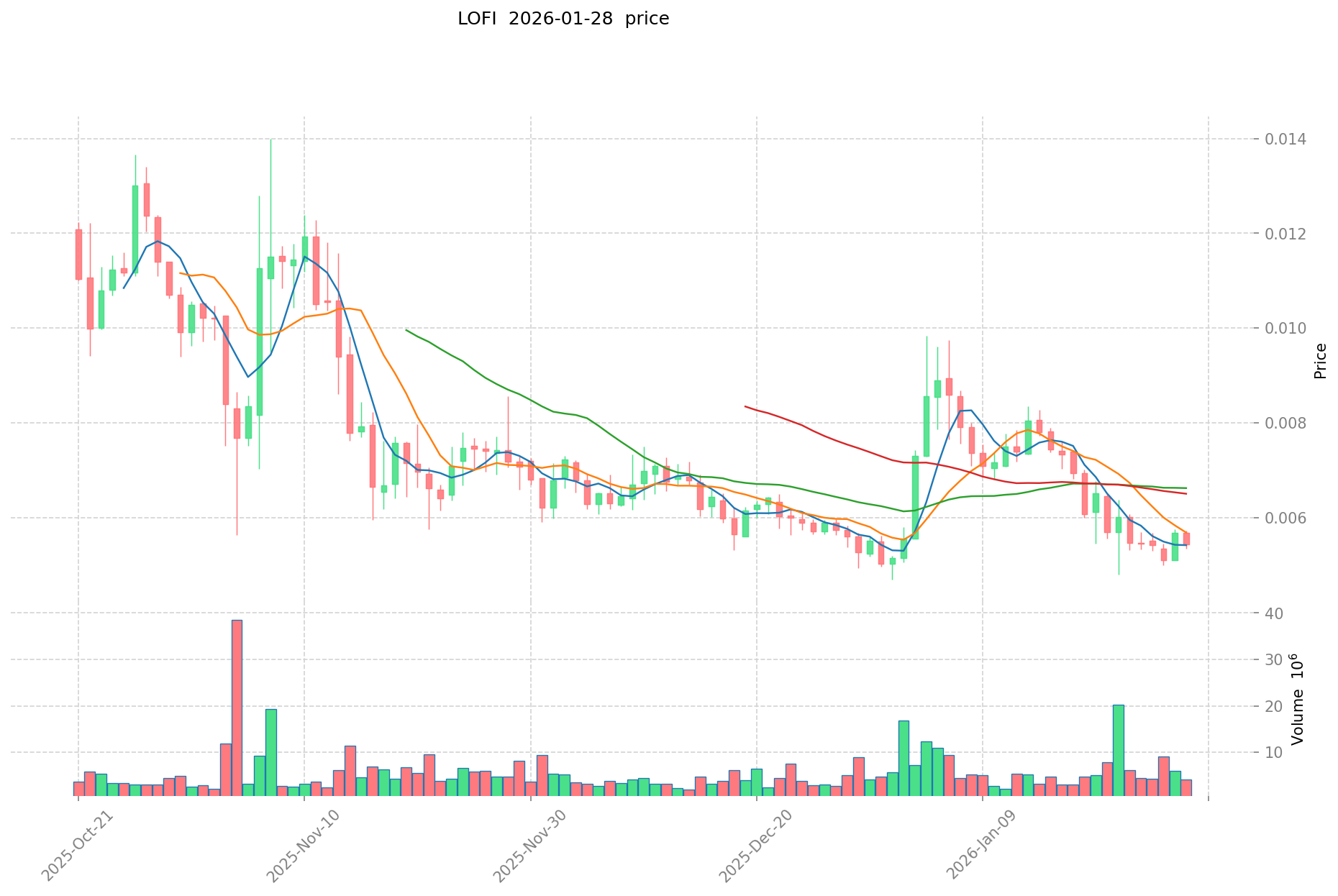
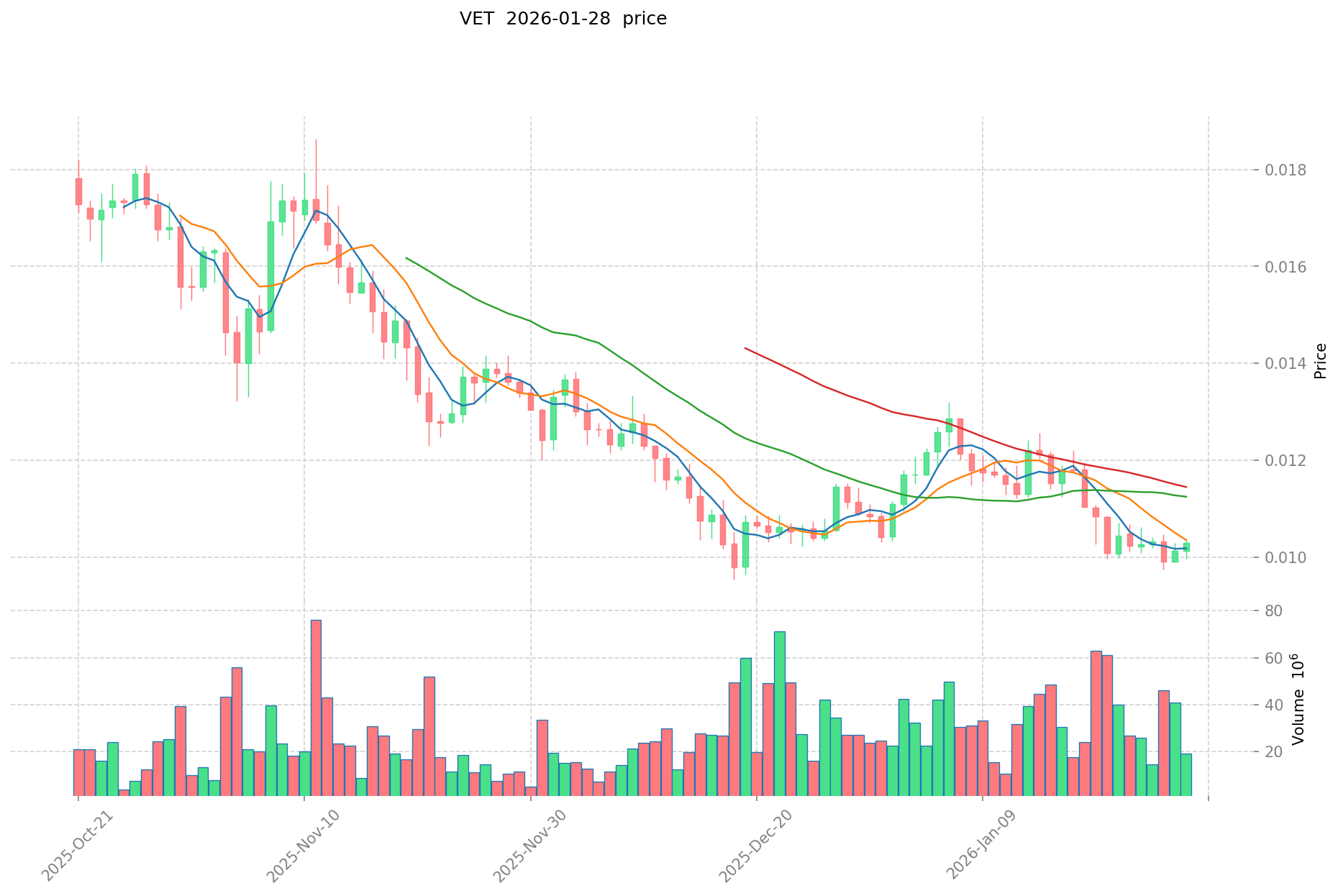
II. Core Factors Influencing LOFI vs VET Investment Value
Supply Mechanism Comparison (Tokenomics)
- LOFI: The reference materials mention LOFI's presence on the Sui blockchain ecosystem, though specific supply mechanism details were not elaborated in the available sources.
- VET: VeChain operates with a dual-token model, where VET serves value transfer functions while VTHO handles transaction costs, creating a predictable enterprise-grade blockchain infrastructure.
- 📌 Historical Pattern: Dual-token mechanisms like VET's design can provide more stable transaction cost predictability for enterprise applications, potentially affecting long-term adoption dynamics.
Institutional Adoption and Market Applications
- Institutional Holdings: The available materials do not provide comparative data on institutional holdings between LOFI and VET.
- Enterprise Adoption: VET demonstrates applications across logistics, food safety, pharmaceutical sectors, and ESG reporting. VeChain's dual-token structure supports enterprise-level implementations with predictable cost frameworks.
- Regulatory Stance: The reference materials do not contain information regarding specific national policies toward either token.
Technological Development and Ecosystem Building
- LOFI Technology: LOFI positions itself within the Sui blockchain ecosystem with a focus on decentralized finance concepts, though detailed technical specifications were not provided in the materials.
- VET Technology: VeChain's technological framework centers on its dual-token architecture designed to serve enterprise needs with cost-predictable blockchain infrastructure.
- Ecosystem Comparison: VET shows documented applications in supply chain, logistics, and enterprise reporting systems. LOFI's ecosystem development within Sui blockchain focuses on DeFi positioning, though specific DeFi, NFT, or smart contract implementations were not detailed in the available materials.
Macroeconomic Context and Market Cycles
- Inflation Environment Performance: The reference materials do not contain comparative analysis of either token's performance characteristics during inflationary periods.
- Macroeconomic Monetary Policy: Information regarding how interest rates, dollar index movements, or other macroeconomic factors specifically impact LOFI or VET was not available in the provided materials.
- Geopolitical Factors: While VET's enterprise applications in logistics and supply chain suggest potential relevance to cross-border trade scenarios, specific geopolitical impact analysis was not included in the reference materials.
III. 2026-2031 Price Prediction: LOFI vs VET
Short-term Forecast (2026)
- LOFI: Conservative $0.00403416 - $0.005172 | Optimistic $0.005172 - $0.00584436
- VET: Conservative $0.00846932 - $0.010204 | Optimistic $0.010204 - $0.01448968
Mid-term Forecast (2028-2029)
- LOFI may enter a growth phase, with estimated price range of $0.003304908 - $0.0109129163796
- VET may enter a consolidation phase, with estimated price range of $0.0090131932 - $0.0182883863448
- Key drivers: institutional capital inflows, ETF adoption, ecosystem development
Long-term Forecast (2030-2031)
- LOFI: Baseline scenario $0.006527568407058 - $0.0091937583198 | Optimistic scenario $0.01103250998376 - $0.011630104274547
- VET: Baseline scenario $0.010914442538404 - $0.017892528751482 | Optimistic scenario $0.018825314610564 - $0.022544586226867
View detailed price predictions for LOFI and VET
Disclaimer
LOFI:
| Year |
Predicted High Price |
Predicted Average Price |
Predicted Low Price |
Price Change |
| 2026 |
0.00584436 |
0.005172 |
0.00403416 |
-1 |
| 2027 |
0.0074911248 |
0.00550818 |
0.003304908 |
5 |
| 2028 |
0.00844954812 |
0.0064996524 |
0.006109673256 |
24 |
| 2029 |
0.0109129163796 |
0.00747460026 |
0.0038120461326 |
43 |
| 2030 |
0.01103250998376 |
0.0091937583198 |
0.006527568407058 |
75 |
| 2031 |
0.011630104274547 |
0.01011313415178 |
0.007888244638388 |
93 |
VET:
| Year |
Predicted High Price |
Predicted Average Price |
Predicted Low Price |
Price Change |
| 2026 |
0.01448968 |
0.010204 |
0.00846932 |
0 |
| 2027 |
0.0137049924 |
0.01234684 |
0.0090131932 |
20 |
| 2028 |
0.01823628268 |
0.0130259162 |
0.01237462039 |
27 |
| 2029 |
0.0182883863448 |
0.01563109944 |
0.0115670135856 |
53 |
| 2030 |
0.018825314610564 |
0.0169597428924 |
0.015094171174236 |
66 |
| 2031 |
0.022544586226867 |
0.017892528751482 |
0.010914442538404 |
75 |
IV. Investment Strategy Comparison: LOFI vs VET
Long-term vs Short-term Investment Strategies
- LOFI: May align with investors focused on emerging DeFi ecosystems and higher-risk growth potential within newer blockchain infrastructures like Sui
- VET: May suit investors seeking exposure to established enterprise blockchain applications with documented use cases in supply chain and logistics sectors
Risk Management and Asset Allocation
- Conservative Investors: LOFI 20% vs VET 80%
- Aggressive Investors: LOFI 50% vs VET 50%
- Hedging Tools: stablecoin allocation, options strategies, cross-asset portfolio diversification
V. Potential Risk Comparison
Market Risk
- LOFI: Higher volatility exposure reflected in substantial price fluctuations from $0.1845 to $0.004693, alongside lower market capitalization ($5.23M) and trading volume ($23,356.88)
- VET: Moderate volatility with larger market capitalization ($877.82M) providing relatively greater liquidity, though still subject to broader cryptocurrency market cycles
Technical Risk
- LOFI: Scalability and network stability considerations within the Sui blockchain ecosystem, with limited documented technical infrastructure details
- VET: Enterprise-grade dual-token architecture introduces complexity in network coordination, while established infrastructure suggests operational track record
Regulatory Risk
- Global regulatory developments may affect both tokens differently: LOFI's DeFi positioning may face evolving DeFi-specific regulations, while VET's enterprise applications in logistics and supply chain may encounter sector-specific compliance frameworks across different jurisdictions
VI. Conclusion: Which Is the Better Buy?
📌 Investment Value Summary:
- LOFI Characteristics: Positioning within emerging Sui blockchain ecosystem, higher volatility profile, lower market capitalization suggesting early-stage development phase
- VET Characteristics: Established enterprise blockchain infrastructure with documented applications across logistics, supply chain, and business reporting sectors, dual-token mechanism designed for predictable transaction costs
✅ Investment Considerations:
- Novice Investors: Consider prioritizing established assets with documented use cases and greater market capitalization for initial exposure to cryptocurrency markets
- Experienced Investors: Evaluate portfolio allocation based on risk tolerance, potentially incorporating both tokens with appropriate position sizing reflecting their distinct market characteristics
- Institutional Investors: Assess alignment with enterprise blockchain adoption strategies, regulatory compliance frameworks, and operational use case requirements
⚠️ Risk Disclosure: Cryptocurrency markets exhibit high volatility. This content does not constitute investment advice.
VII. FAQ
Q1: What are the main differences between LOFI and VET in terms of market positioning?
LOFI is an emerging DeFi-focused token on the Sui blockchain with a market capitalization of $5.23M, while VET is an established enterprise blockchain solution with $877.82M market cap focused on supply chain and logistics applications. LOFI represents a higher-risk, early-stage project targeting decentralized finance optimism and innovation within a newer blockchain ecosystem. VET, launched in 2015, has developed documented enterprise use cases across food safety, pharmaceutical tracking, and ESG reporting, utilizing a dual-token mechanism (VET for value transfer, VTHO for transaction costs) designed to provide predictable costs for business implementations.
Q2: How do the price volatility profiles of LOFI and VET compare?
LOFI exhibits significantly higher volatility, declining from $0.1845 (January 2025) to $0.004693 (January 2026) — a 97.5% correction — while VET shows more moderate fluctuations, having declined from its $0.280991 all-time high (April 2021) to current levels around $0.010209. LOFI's 24-hour price change of -3.7% versus VET's -0.65% reflects this volatility difference. The substantial gap in trading volume ($23,356.88 for LOFI vs $172,042.88 for VET) further indicates VET's greater market liquidity and potentially lower slippage for larger transactions.
Q3: What are the projected price ranges for LOFI and VET through 2031?
For 2026, LOFI's conservative forecast ranges $0.00403416-$0.005172 with optimistic scenarios reaching $0.00584436, while VET's conservative range is $0.00846932-$0.010204 with optimistic projections to $0.01448968. Long-term forecasts for 2031 suggest LOFI could reach $0.011630104274547 in optimistic scenarios with baseline projections around $0.006527568407058-$0.0091937583198, while VET's 2031 optimistic scenario projects $0.022544586226867 with baseline estimates of $0.010914442538404-$0.017892528751482. These projections assume varying adoption rates and market cycle dynamics but carry inherent uncertainty given cryptocurrency market volatility.
Q4: Which token is more suitable for conservative versus aggressive investors?
Conservative investors may consider an 80% VET / 20% LOFI allocation, prioritizing VET's established enterprise applications, larger market capitalization, and documented use cases that provide relative stability compared to emerging projects. Aggressive investors seeking higher growth potential with corresponding higher risk tolerance might consider a 50% VET / 50% LOFI allocation, balancing VET's established infrastructure with LOFI's early-stage positioning in the Sui ecosystem. Risk management should incorporate stablecoin allocations, options strategies, and diversification across multiple crypto assets regardless of investor profile, with position sizing reflecting individual risk tolerance and investment timeframes.
Q5: What technological advantages does VET's dual-token mechanism provide?
VET's dual-token architecture separates value transfer (VET) from transaction execution costs (VTHO), creating predictable cost structures for enterprise implementations. This design allows businesses to forecast blockchain operational expenses more accurately, addressing a key concern for corporate adoption where budget predictability matters. The mechanism enables VET holders to generate VTHO passively, while enterprises can acquire VTHO separately for transaction needs without direct VET exposure, reducing friction for business integration. This architecture contrasts with single-token systems where transaction costs fluctuate directly with token price volatility, potentially complicating enterprise budget planning.
Q6: What are the primary risk factors investors should consider for each token?
LOFI faces higher market risk due to lower liquidity ($23,356.88 daily volume), smaller market cap ($5.23M), and extreme historical volatility (97.5% decline from peak), alongside technical risks associated with scalability within the newer Sui blockchain ecosystem. VET's risks include regulatory frameworks affecting enterprise blockchain applications across different jurisdictions, technical complexity in coordinating its dual-token mechanism, and exposure to supply chain industry adoption rates. Both tokens face broader cryptocurrency market cycle risks, regulatory uncertainty around digital assets, and competition from alternative blockchain solutions in their respective sectors.
Q7: How does the current market sentiment affect LOFI and VET investment decisions?
The current Fear & Greed Index reading of 29 (Fear) indicates overall market caution, which historically presents accumulation opportunities for longer-term investors but also reflects heightened downside risk for shorter timeframes. In this environment, VET's established infrastructure and larger market cap may provide relative resilience compared to LOFI's smaller market presence and higher volatility profile. Fearful market conditions often disproportionately impact lower-liquidity assets like LOFI through wider bid-ask spreads and reduced trading volume, while established assets like VET may maintain more stable liquidity profiles. Investors should consider whether current market sentiment aligns with their entry timing strategy and risk tolerance levels.
Q8: What role do enterprise adoption trends play in VET's investment thesis?
VET's investment case centers significantly on enterprise blockchain adoption across logistics, supply chain transparency, pharmaceutical tracking, and ESG reporting sectors. Documented implementations provide evidence of real-world utility beyond speculative trading, potentially supporting longer-term value propositions as businesses increasingly seek supply chain digitization solutions. The dual-token mechanism specifically addresses enterprise needs for cost predictability, suggesting design alignment with corporate requirements. However, enterprise adoption timelines typically extend over multiple years, creating longer investment horizons compared to speculative cryptocurrency trading. VET's performance may correlate with broader enterprise blockchain sector growth rather than pure cryptocurrency market cycles, introducing different analytical considerations for valuation.
* The information is not intended to be and does not constitute financial advice or any other recommendation of any sort offered or endorsed by Gate.