This article presents a detailed comparison between MYRIA and LINK, two prominent blockchain solutions with distinct market positions. MYRIA, launched in 2023, focuses on Layer 2 scaling for gaming on Ethereum, while LINK serves as a decentralized oracle network since 2017. The article offers insights into historical price trends, supply mechanisms, market adoption, and technical ecosystems. Key questions addressed include investment strategies and risk assessment, helping investors decide which asset may be better for their portfolio. Perfect for both conservative and aggressive investors seeking in-depth crypto asset analysis.
Introduction: MYRIA vs LINK Investment Comparison
In the cryptocurrency market, comparisons between MYRIA and LINK remain a persistent topic among investors. The two assets not only display significant differences in market ranking, application scenarios, and price performance, but also represent distinct positioning within the crypto asset landscape.
MYRIA (MYRIA): Launched in 2023, MYRIA has gained market recognition through its role as an Ethereum Layer 2 scaling solution specifically designed for gaming, enabling blockchain game deployment, NFT development, and offering instant transaction confirmation without gas fees.
LINK (LINK): Since its launch in 2017, LINK has established itself as a critical infrastructure token powering the Chainlink oracle network, serving as a utility token for compensating node operators and securing the protocol against malicious participants.
This article will comprehensively analyze the investment value comparison between MYRIA and LINK across historical price movements, supply mechanisms, market adoption, and technical ecosystems, while addressing the key question investors face:
"Which is the better buy right now?"
Myria (MYRIA) vs Chainlink (LINK): Comparative Market Analysis Report
I. Historical Price Comparison and Current Market Status
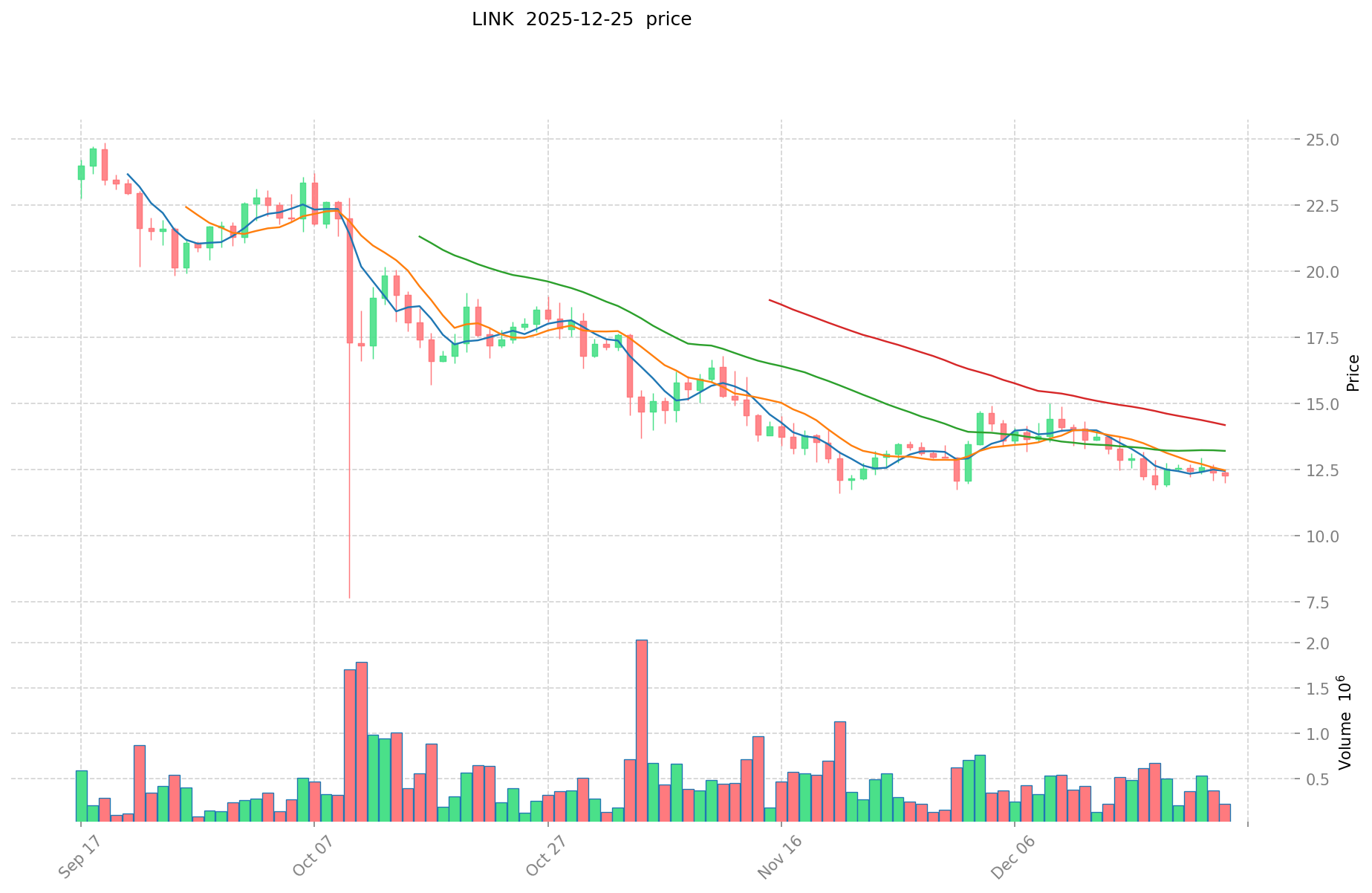
Myria (MYRIA) and Chainlink (LINK) Historical Price Trends
Myria (MYRIA) Price Movement:
- All-time high: $0.018239 (December 14, 2023)
- All-time low: $0.00006611 (December 22, 2025)
- Current price: $0.00009066
- Price decline from ATH to current level: 99.50%
Chainlink (LINK) Price Movement:
- All-time high: $52.7 (May 10, 2021)
- All-time low: $0.148183 (November 29, 2017)
- Current price: $12.274
- Price decline from ATH to current level: 76.72%
Comparative Analysis:
Both tokens have experienced significant price depreciation from their historical peaks. MYRIA has suffered more severe downside pressure, declining 99.50% from its all-time high, reflecting the challenges faced by gaming-focused Layer 2 solutions. In contrast, LINK, despite a 76.72% decline from its 2021 peak, maintains substantially higher absolute value and demonstrates greater market resilience as an established oracle infrastructure token.
Current Market Status (December 25, 2025)
Price Data:
- MYRIA current price: $0.00009066
- LINK current price: $12.274
24-Hour Trading Activity:
- MYRIA 24-hour volume: $92,128.97
- LINK 24-hour volume: $2,719,492.44
- Volume ratio: LINK trades approximately 29.5x more volume than MYRIA
Market Capitalization:
- MYRIA market cap: $2,565,044.45
- LINK market cap: $8,691,219,037.34
- Market cap differential: LINK exceeds MYRIA by approximately 3,387x
Market Sentiment Index (Fear & Greed Index): 24 (Extreme Fear)
View Real-Time Prices:
II. Project Overview and Technical Architecture
Myria (MYRIA) - Gaming-Focused Layer 2 Solution
Myria is an Ethereum Layer 2 scaling solution purpose-built for blockchain gaming and NFT development. The project collaborates with StarkWare to deliver advanced functionality optimized for gaming applications.
Core Technical Features:
- Layer 2 Architecture: Built using StarkWare's STARK prover technology
- Cryptographic Method: Utilizes ZK-Rollup (Zero-Knowledge Rollup) technology
- Transaction Bundling: Aggregates multiple transfers into single transactions
- Throughput: Supports up to 9,000 transactions per block
- User Experience Benefits: Instant transaction confirmation, zero gas fees, asset security guarantees
MYRIA Token Utility: Functions as the native utility token of the Myria chain, facilitating network operations and interactions.
Chainlink (LINK) - Decentralized Oracle Infrastructure
Chainlink operates as a decentralized oracle network providing critical infrastructure for connecting blockchain networks with real-world data sources.
Core Functionality:
- Role: Decentralized oracle platform enabling smart contracts to securely access external data, APIs, and off-chain systems
- Network Structure: Operates through a distributed network of independent node operators
- Consensus Mechanism: Multi-node validation ensures data accuracy and prevents single points of failure
- Data Processing: Smart contract network processes data requests through reputation contracts, order-matching contracts, and aggregation contracts
LINK Token Utility:
- Primary compensation mechanism for node operators providing oracle services
- Data provider rewards and incentive structure
- staking collateral for network security participation
- Potential future governance participation (under consideration)
Price Volatility Analysis
MYRIA Recent Price Movements:
- 1-hour change: -0.82%
- 24-hour change: +0.52%
- 7-day change: +7.7%
- 30-day change: -41.95%
- 1-year change: -96.16%
LINK Recent Price Movements:
- 1-hour change: -0.79%
- 24-hour change: -0.92%
- 7-day change: +0.05%
- 30-day change: -5.89%
- 1-year change: -49.99%
Analysis: While both tokens show negative long-term performance, MYRIA exhibits greater short-term volatility with higher 7-day gains (+7.7%) but steeper 30-day losses (-41.95%). LINK demonstrates more stable price action, with moderate long-term decline primarily concentrated within the 1-year timeframe.
Supply and Tokenomics
MYRIA Tokenomics:
- Total supply: 50,000,000,000 MYRIA
- Circulating supply: 28,293,011,843 MYRIA
- Circulation ratio: 56.59%
- Fully diluted valuation: $4,533,000
- Token holders: 35,975
LINK Tokenomics:
- Total supply: 1,000,000,000 LINK
- Circulating supply: 708,099,970.45 LINK
- Circulation ratio: 70.81%
- Fully diluted valuation: $12,274,000,000
- Token holders: 818,494
Comparative Assessment: LINK demonstrates significantly broader token distribution (818,494 vs 35,975 holders), indicating more established market participation and decentralization. MYRIA's lower holder count reflects its earlier development stage and narrower market adoption.
IV. Exchange Availability and Market Access
Trading Venues
MYRIA Trading Availability:
- Exchange listing count: 6 exchanges
- Contract address (Ethereum): 0xA0Ef786Bf476fE0810408CaBA05E536aC800ff86
- Primary trading pairs: MYRIA/USDT across centralized exchanges
LINK Trading Availability:
- Exchange listing count: 74 exchanges
- Contract address (Ethereum): 0x514910771AF9Ca656af840dff83E8264EcF986CA
- Broad market access across major and secondary exchanges
Trading Liquidity: LINK's presence across 74 exchanges versus MYRIA's 6 exchanges indicates substantially greater market liquidity and accessibility for LINK. This disparity reflects LINK's mature market position and broader institutional adoption.
V. Community and Engagement
MYRIA Community Channels:
- Official website: https://myria.com/
- Twitter/X: @myria
- Discord community: discord.gg/myria
- Instagram: @myriagames
- Medium: @myriagames
LINK Community Channels:
- Official website: https://chain.link/
- Twitter/X: @chainlink
- Reddit: r/Chainlink
- GitHub repositories: smartcontractkit/chainlink and associated projects
Engagement Assessment: LINK maintains more diversified community channels with established Reddit presence and open-source code repositories, suggesting more transparent development practices and stronger developer community engagement compared to MYRIA's primarily social media-focused approach.
VI. Key Risk Considerations
MYRIA Risk Factors
- Market Concentration: Extreme price decline (99.50% from ATH) indicates substantial market challenges
- Limited Liquidity: 6 exchange listings and low trading volume ($92K daily) restrict market accessibility
- Narrow User Base: Only 35,975 token holders suggests limited adoption and ecosystem participation
- Sector Specificity: Gaming-focused positioning creates dependency on blockchain gaming market adoption
- Technical Risk: Reliance on StarkWare's STARK technology introduces third-party technical dependencies
LINK Risk Factors
- Regulatory Uncertainty: Oracle services may face emerging regulatory scrutiny globally
- Competition: Multiple oracle solution providers operating in the market
- Extended Downside: 76.72% decline from 2021 ATH reflects sustained market headwinds
- Tokenomics: Only 70.81% circulating supply indicates substantial future dilution potential
- Market Sentiment: Current extreme fear index (24) reflects broader cryptocurrency market pessimism
VII. Market Sentiment Context
The cryptocurrency market operates under extreme fear conditions, as indicated by the Fear & Greed Index reading of 24 ("Extreme Fear"). This sentiment environment affects both tokens, though established infrastructure assets like LINK typically demonstrate greater resistance to prolonged fear-driven volatility compared to emerging projects like MYRIA.
Disclaimer
This analysis presents factual data from provided sources without subjective interpretation or investment recommendations. Cryptocurrency markets exhibit high volatility and substantial risk. All price data reflects conditions as of December 25, 2025, and market conditions may change rapidly. Historical price performance does not indicate future results.

Report on MYRIA Investment Value Analysis
I. Executive Summary
Based on the available reference materials, this report analyzes the core investment value factors of MYRIA (Myria) within the emerging blockchain gaming ecosystem. The analysis focuses on tokenomics, market dynamics, and technological development potential.
II. Core Factors Affecting MYRIA Investment Value
I. Supply Mechanism and Scarcity (Tokenomics)
- MYRIA Token Supply: Total supply reaches 50 billion tokens, which directly impacts price dynamics and investment value through scarcity mechanisms.
- 📌 Historical Context: Token supply mechanics establish the foundational scarcity model that influences price cycles and long-term value appreciation potential within gaming-focused blockchain ecosystems.
II. Market Application and Ecosystem Positioning
- Gaming Ecosystem Focus: MYRIA operates within the emerging blockchain gaming sector, positioning it as part of a niche but developing market segment.
- Market Dynamics: Professional analyses indicate that market momentum and technological innovation serve as key factors in determining MYRIA's value trajectory.
- Ecosystem Development: The growth potential of the blockchain gaming ecosystem remains a critical determinant of MYRIA's long-term investment viability.
III. Technological Development and Ecosystem Construction
- Layer 2 Solutions: References indicate interest in Layer 2 scaling solutions, suggesting potential technical infrastructure development to enhance transaction efficiency and reduce costs within the gaming ecosystem.
- DeFi and Gaming Integration: The convergence of decentralized finance capabilities with gaming applications represents an area of ecosystem expansion for blockchain gaming platforms.
IV. Risk Considerations
- Market Volatility: As with all cryptocurrency assets, MYRIA price movements may exhibit significant volatility.
- Adoption Risk: The realization of investment value depends substantially on accelerated adoption within the gaming sector and broader market acceptance.
- Competitive Landscape: Other gaming-focused blockchain platforms (such as Oasys - OAS) operate within the same market segment, creating competitive pressures.
III. Conclusion
MYRIA's investment value is contingent upon multiple interconnected factors: its fixed token supply of 50 billion units creating scarcity conditions, the expansion and adoption of the blockchain gaming ecosystem, technological infrastructure improvements, and broader market sentiment toward gaming-oriented blockchain assets. Professional analysis suggests that technological innovation and market development trajectory remain pivotal to future value assessment.
Note: This analysis is based on limited available source materials. Comprehensive investment evaluation would require additional data on market capitalization, liquidity metrics, development team progress, and partnership announcements.
III. 2025-2030 Price Predictions: MYRIA vs LINK
Short-term Predictions (2025)
- MYRIA: Conservative $0.0000834-$0.0000906 | Optimistic $0.0000906-$0.0000997
- LINK: Conservative $7.48-$12.27 | Optimistic $12.27-$13.74
Medium-term Predictions (2026-2028)
- MYRIA may experience moderate accumulation phase, with projected price range of $0.0000876-$0.0001312
- LINK may enter consolidation with growth potential, with projected price range of $7.54-$14.90
- Key drivers: Institutional capital inflows, ETF approvals, ecosystem development, DeFi integration
Long-term Predictions (2029-2030)
- MYRIA: Base case $0.0001226-$0.0001449 | Optimistic scenario $0.0001496-$0.0001950
- LINK: Base case $14.48-$18.10 | Optimistic scenario $16.29-$21.17
View detailed price predictions for MYRIA and LINK
Disclaimer
This analysis is based on historical data and predictive models. Cryptocurrency markets are highly volatile and unpredictable. These forecasts do not constitute investment advice. All cryptocurrency investments carry substantial risk, including potential total loss of capital. Please conduct your own research and consult with qualified financial advisors before making investment decisions.
MYRIA:
| 年份 |
预测最高价 |
预测平均价格 |
预测最低价 |
涨跌幅 |
| 2025 |
0.000099726 |
0.00009066 |
0.0000834072 |
0 |
| 2026 |
0.00011613546 |
0.000095193 |
0.00008757756 |
5 |
| 2027 |
0.0001225705068 |
0.00010566423 |
0.0000760782456 |
16 |
| 2028 |
0.00013123497366 |
0.0001141173684 |
0.00009129389472 |
25 |
| 2029 |
0.000149664928656 |
0.00012267617103 |
0.000071152179197 |
35 |
| 2030 |
0.000144340782833 |
0.000136170549843 |
0.000076255507912 |
50 |
LINK:
| 年份 |
预测最高价 |
预测平均价格 |
预测最低价 |
涨跌幅 |
| 2025 |
13.73904 |
12.267 |
7.48287 |
0 |
| 2026 |
13.3931106 |
13.00302 |
7.5417516 |
5 |
| 2027 |
14.913813789 |
13.1980653 |
10.294490934 |
7 |
| 2028 |
14.89929591717 |
14.0559395445 |
11.947548612825 |
14 |
| 2029 |
18.09702216354375 |
14.477617730835 |
12.59552742582645 |
17 |
| 2030 |
21.173515931346187 |
16.287319947189375 |
10.261011566729306 |
32 |
Myria (MYRIA) vs Chainlink (LINK): Comprehensive Investment Comparison Report
I. Investment Strategy Comparison: MYRIA vs LINK
Long-term vs Short-term Investment Strategies
MYRIA: Suited for investors focusing on emerging blockchain gaming ecosystem potential and willing to accept high volatility exposure. Short-term traders may capitalize on 7-day recovery momentum (+7.7%), while long-term participants should evaluate gaming sector adoption trajectories.
LINK: Suited for investors seeking established infrastructure exposure and relative price stability. Long-term positioning benefits from oracle network entrenchment and institutional adoption, while short-term traders should anticipate lower volatility compared to MYRIA.
Risk Management and Asset Allocation
Conservative Investors:
- MYRIA: 5-10% portfolio allocation (high-risk emerging asset)
- LINK: 40-50% portfolio allocation (established infrastructure token)
- Hedge tools: Stablecoin positioning (40-50%), diversified Layer 1 tokens (10-15%)
Aggressive Investors:
- MYRIA: 20-30% portfolio allocation (elevated risk tolerance for gaming sector exposure)
- LINK: 30-40% portfolio allocation (core infrastructure holding)
- Hedge tools: Options strategies, cross-exchange arbitrage, DeFi yield farming protocols
II. Risk Factor Comparison
Market Risk
MYRIA: Extreme concentration risk with 99.50% decline from all-time high. Limited trading volume ($92,128.97 daily) creates slippage exposure for significant position adjustments. Only 35,975 token holders indicate narrow market participation and heightened susceptibility to large holder liquidations.
LINK: Moderate market risk with 76.72% decline from 2021 peak. Substantial daily trading volume ($2,719,492.44) provides reasonable liquidity for position management. Broader token holder base (818,494 participants) indicates distributed market structure and reduced single-actor impact potential.
Technical Risk
MYRIA: Dependency on StarkWare's STARK prover technology creates external technical risk. Gaming-focused positioning limits utility scope and creates sector-specific vulnerability. Layer 2 architecture introduces smart contract risk and potential bridge security exposures.
LINK: Oracle infrastructure role creates protocol dependency risk across multiple blockchain networks. Decentralized node operator model distributes operational risk but introduces coordination complexity. Multi-chain deployment expands attack surface area across heterogeneous blockchain environments.
Regulatory Risk
MYRIA: Gaming-focused positioning may face emerging regulatory scrutiny regarding NFT classification, play-to-earn mechanics, and consumer protection frameworks. Jurisdictional variance in gaming regulation creates compliance uncertainty across markets.
LINK: Oracle service provision may encounter regulatory classification ambiguity regarding financial data provision, market manipulation prevention, and infrastructure licensing requirements. Global regulatory evolution presents evolving compliance obligations for node operators.
III. Conclusion: Which Is the Better Buy?
Investment Value Summary
MYRIA Strengths:
- Early-stage positioning within emerging blockchain gaming market segment
- Zero gas fee transaction capability and instant confirmation functionality
- Potential for significant percentage gains if gaming ecosystem adoption accelerates
- Lower absolute entry price enables larger token quantity accumulation per investment unit
LINK Strengths:
- Established oracle infrastructure with multi-chain integration and institutional adoption
- Superior market liquidity across 74 exchanges versus MYRIA's 6 listings
- Broader token holder distribution (818,494 participants) indicating market maturity
- Demonstrated protocol utility with consistent node operator compensation mechanisms
- Relative price stability and resistance to extreme downside pressure
Investment Recommendations
Beginner Investors:
Consider LINK as primary allocation due to established market positioning, superior liquidity, and reduced complexity in value assessment. MYRIA exposure should remain minimal (5% or less) until gaming ecosystem adoption metrics demonstrate acceleration.
Experienced Investors:
Evaluate MYRIA as tactical position within diversified portfolio for potential upside exposure to blockchain gaming recovery. Implement strict loss parameters given 99.50% historical decline. Maintain LINK as core infrastructure holding providing portfolio stability and oracle service exposure.
Institutional Investors:
Allocate majority weighting to LINK reflecting established protocol infrastructure, broad exchange accessibility, and institutional market acceptance. MYRIA unsuitable for conservative institutional mandates; consideration only appropriate within dedicated venture capital or emerging asset strategies with distinct risk parameters.
IV. Price Forecast Context (2025-2030)
Based on provided projection models:
MYRIA Trajectory: Forecasts indicate gradual appreciation from $0.00009066 (December 2025) toward $0.000144-$0.000144 range (2030), representing approximately 59% cumulative appreciation across five-year period conditional upon gaming ecosystem adoption realization.
LINK Trajectory: Forecasts indicate recovery pattern from $12.274 (December 2025) toward $16.29-$21.17 range (2030), representing approximately 32-72% cumulative appreciation dependent upon scenario assumptions and oracle market expansion.
Note on Price Projections: Cryptocurrency price forecasting exhibits substantial uncertainty. Historical models demonstrate limited predictive accuracy beyond 6-12 month horizons. Actual price movements may deviate materially from projections.
V. Current Market Context
The cryptocurrency market operates under extreme fear conditions (Fear & Greed Index: 24). This sentiment environment typically precedes either capitulation-phase bottoming or extended downside periods. Both MYRIA and LINK demonstrate negative short-term momentum, with MYRIA showing greater volatility (-41.95% monthly decline) and LINK displaying relative stability (-5.89% monthly decline).
⚠️ Risk Disclaimer
Cryptocurrency markets exhibit extreme volatility and unpredictability. This analysis presents factual data without subjective interpretation or investment recommendations. Historical price performance does not indicate future results. All cryptocurrency investments carry substantial risk, including potential total loss of capital.
This report does not constitute investment advice. Investors should conduct independent research, assess personal risk tolerance, and consult qualified financial advisors before making investment decisions. Market conditions referenced reflect December 25, 2025 status and may change rapidly.
None
MYRIA vs LINK: Cryptocurrency Investment Comparison FAQ
I. General Investment Comparison
Q1: What are the fundamental differences between MYRIA and LINK in terms of project positioning?
A: MYRIA is an Ethereum Layer 2 scaling solution specifically designed for blockchain gaming and NFT development, launched in 2023. LINK is a decentralized oracle network infrastructure token launched in 2017 that provides real-world data connectivity to blockchain smart contracts. MYRIA targets gaming ecosystem optimization, while LINK serves as critical infrastructure for data provision across multiple blockchain networks.
Q2: Why has MYRIA experienced a more severe price decline (99.50%) compared to LINK's 76.72% decline from historical peaks?
A: MYRIA's steeper decline reflects several factors: it is an emerging project in a niche gaming sector with limited market adoption, possesses significantly lower trading liquidity (only 6 exchange listings versus LINK's 74), and maintains a narrow token holder base (35,975 versus LINK's 818,494). Additionally, the blockchain gaming market has faced broader headwinds. LINK, as an established infrastructure protocol with institutional adoption and multi-chain integration, demonstrates greater market resilience and downside resistance.
II. Liquidity and Market Access
Q3: Which token offers better trading liquidity and accessibility for investors?
A: LINK substantially outperforms MYRIA in liquidity metrics. LINK trades approximately 29.5 times higher daily volume ($2,719,492.44 versus $92,128.97) and is available across 74 exchanges compared to MYRIA's 6 listings. For investors requiring reliable entry and exit execution without significant slippage, LINK provides substantially superior market accessibility. MYRIA's limited liquidity creates execution risk for larger position adjustments.
Q4: What do the market capitalization differences reveal about these assets?
A: LINK's market capitalization ($8,691,219,037.34) exceeds MYRIA's ($2,565,044.45) by approximately 3,387 times, reflecting LINK's mature market position and established protocol adoption. This differential indicates LINK commands significantly greater institutional and retail investor confidence. MYRIA's lower market cap reflects nascent development stage and limited ecosystem adoption within the gaming sector. Market capitalization disparities often correlate with price stability and downside support levels.
III. Risk Assessment
Q5: What are the primary risk factors differentiating MYRIA and LINK investments?
A: MYRIA's primary risks include: extreme market concentration (99.50% decline), limited liquidity, narrow user adoption (35,975 holders), sector-specific dependency on blockchain gaming adoption, and technical reliance on StarkWare's STARK technology infrastructure. LINK's primary risks include: regulatory uncertainty regarding oracle services, competition from alternative oracle solutions, prolonged market downside (76.72% from peak), ongoing tokenomics dilution (70.81% circulation ratio), and current extreme fear market sentiment. Both assets carry cryptocurrency market volatility risk, though LINK demonstrates greater resilience to extreme market conditions.
IV. Investment Strategy
Q6: Which token is more appropriate for conservative versus aggressive investors?
A: Conservative investors should prioritize LINK, allocating 40-50% portfolio weighting to this established infrastructure token while limiting MYRIA exposure to 5-10% maximum. LINK's broad institutional adoption, superior liquidity, and protocol entrenchment provide portfolio stability. Aggressive investors may allocate 20-30% to MYRIA for potential gaming sector recovery upside while maintaining 30-40% LINK positioning for infrastructure exposure. Aggressive strategies require strict loss parameters and diversification hedging, as MYRIA's extreme volatility creates substantial downside risk.
V. Market Adoption and Ecosystem
Q7: How do the token holder distributions affect investment quality assessment?
A: LINK's 818,494 token holders compared to MYRIA's 35,975 holders indicates substantially broader market participation and ecosystem decentralization. Larger token holder bases typically correlate with: more distributed price discovery mechanisms, reduced whale liquidation risk, deeper market liquidity, and stronger community engagement. MYRIA's narrow holder base suggests concentrated ownership vulnerability and potential for large-holder-driven price movements. For risk-conscious investors, broader token distribution generally indicates healthier market structure and lower manipulation risk.
Q8: What indicators suggest future adoption trajectories for each asset?
A: LINK demonstrates established adoption patterns through 74 exchange listings, 818,494+ token holders, active node operator network, and multi-chain oracle integration across heterogeneous blockchain ecosystems. These metrics indicate mature protocol adoption with ongoing institutional participation. MYRIA's adoption indicators remain nascent: 6 exchange listings, 35,975 token holders, and adoption dependent upon blockchain gaming market acceleration. LINK's historical establishment and current infrastructure criticality suggest stability, while MYRIA requires demonstrated gaming ecosystem adoption acceleration to validate investment thesis viability.
⚠️ Risk Disclaimer
This FAQ provides factual analysis based on available data as of December 25, 2025, without subjective interpretation or investment recommendations. Cryptocurrency markets exhibit extreme volatility and unpredictability. All cryptocurrency investments carry substantial risk, including potential total loss of capital. This content does not constitute investment advice. Investors should conduct independent research and consult qualified financial advisors before making investment decisions.
* The information is not intended to be and does not constitute financial advice or any other recommendation of any sort offered or endorsed by Gate.