This comprehensive investment guide compares ORAI and QNT, two distinct blockchain solutions addressing oracle and interoperability challenges in cryptocurrency. ORAI operates as an AI-powered oracle platform enabling smart contract connectivity through yAI.Finance, featuring validator staking and governance mechanisms. QNT functions as an enterprise blockchain interoperability provider via its Overledger operating system, serving enterprises, regulators, and governments since 2018. The analysis examines historical price trends revealing ORAI's 99.6% decline from $105.76 peak versus QNT's more moderate 82.5% correction from $427.42, current market status showing QNT's superior $707k trading volume, and tokenomics dynamics. Investment strategies differentiate between conservative QNT-weighted allocations and aggressive ORAI-heavy portfolios. Price predictions through 2031 suggest distinct growth trajectories for both assets, with detailed risk assessments covering market, technical, and regulatory factors to g
Introduction: Comparing ORAI and QNT Investment Opportunities
In the cryptocurrency market, the comparison between ORAI vs QNT continues to be a topic of interest for investors. These two assets exhibit notable differences in market capitalization ranking, application scenarios, and price performance, representing distinct positions within the crypto asset landscape.
ORAI (Oraichain Token): Launched as a data oracle platform, ORAI has gained recognition for aggregating and connecting AI APIs to smart contracts and conventional applications. The platform leverages Oracle AI technology and currently operates through the yAI.Finance platform, with ORAI tokens serving functions including validator staking, transaction fees, and governance participation.
QNT (Quant): Since its launch in 2018, QNT has been positioned as an interoperability solution provider through its Overledger operating system, enabling trusted digital interactions for enterprises, regulators, governments, and individuals. Headquartered in London, Quant Network focuses on creating secure digital infrastructure.
This article will provide a comprehensive analysis of ORAI vs QNT investment comparison, examining historical price trends, supply mechanisms, institutional adoption, technological ecosystems, and future outlook to address investors' key concerns:
"Which represents a more suitable investment opportunity based on current market conditions?"
I. Historical Price Comparison and Current Market Status
Historical Price Trends of ORAI (Coin A) and QNT (Coin B)
- 2021: ORAI experienced notable price volatility, reaching an all-time high of $105.76 in February 2021, driven by increased interest in AI-powered oracle solutions and early adoption momentum.
- 2021: QNT recorded significant appreciation, achieving an all-time high of $427.42 in September 2021, influenced by growing enterprise adoption of its Overledger blockchain interoperability platform.
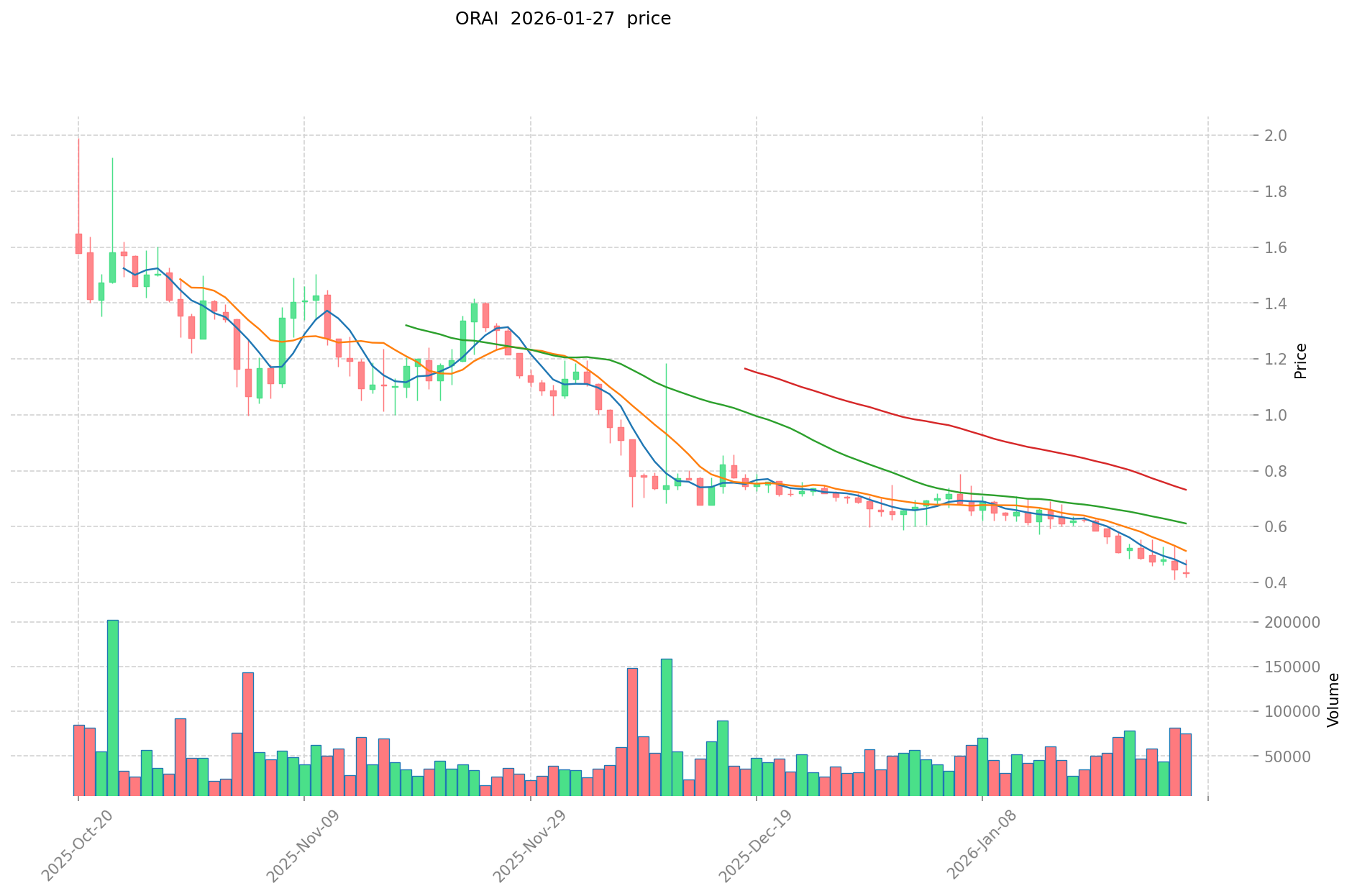
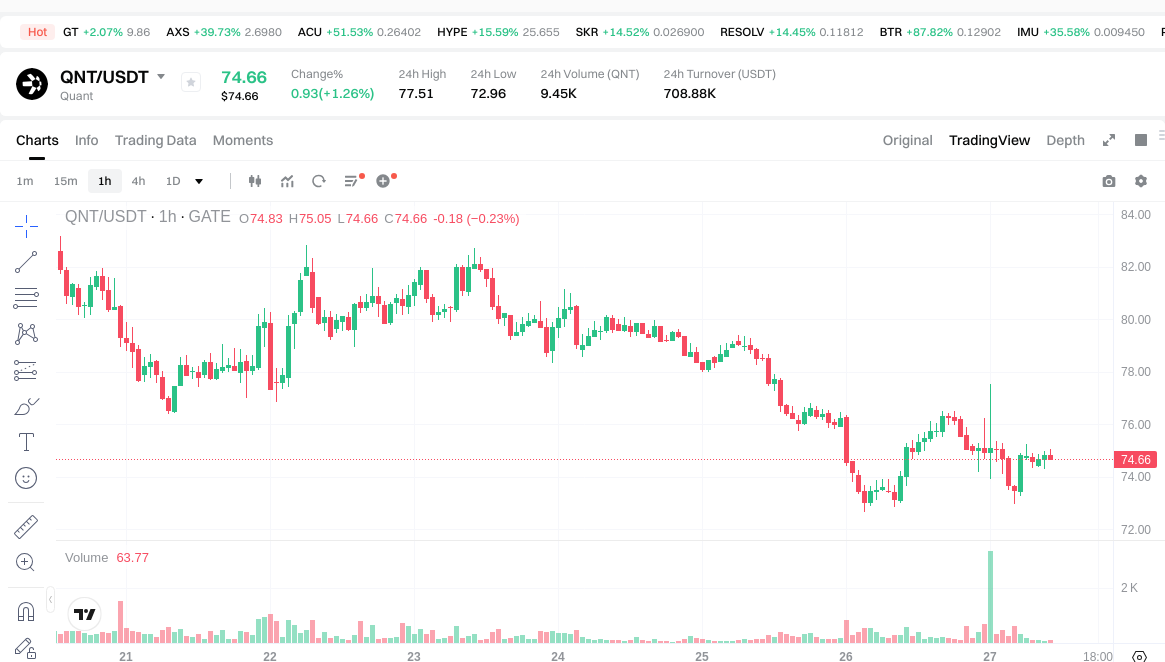
- Comparative Analysis: During the subsequent market correction phase, ORAI declined from its peak of $105.76 to a low of approximately $0.43 in January 2026, while QNT experienced a comparatively smaller correction from $427.42 to around $72.96 during the same period.
Current Market Status (January 27, 2026)
- ORAI current price: $0.4175
- QNT current price: $74.88
- 24-hour trading volume: ORAI recorded $33,945.02 compared to QNT's $707,156.26
- Market Sentiment Index (Fear & Greed Index): 29 (Fear)
View real-time prices:
II. Core Factors Influencing ORAI vs QNT Investment Value
Tokenomics Comparison
The supply mechanisms of digital assets play a significant role in shaping their value trajectories. Understanding how token distribution, emission schedules, and supply dynamics interact with market demand provides insights into potential price movements over different market cycles.
📌 Historical patterns suggest that supply-side economics, combined with adoption rates and network effects, contribute to cyclical price behavior in cryptocurrency markets.
Institutional Adoption and Market Applications
Institutional participation and real-world utility represent important considerations for evaluating long-term investment potential. The degree to which institutional investors allocate capital to specific assets, alongside enterprise-level adoption for various use cases, may influence market positioning and liquidity dynamics.
Regulatory frameworks across different jurisdictions continue to evolve, potentially affecting the operational landscape for various digital assets and their respective adoption trajectories.
Technology Development and Ecosystem Building
Technological advancement and ecosystem expansion form critical components of project sustainability. Ongoing development efforts, protocol upgrades, and integration capabilities may contribute to network utility and competitive positioning within the broader blockchain landscape.
Ecosystem maturity across sectors such as decentralized finance, digital collectibles, payment infrastructure, and programmable contract platforms reflects the breadth of potential use cases and community engagement.
Macroeconomic Environment and Market Cycles
Broader economic conditions, including inflation dynamics, monetary policy adjustments, and currency valuations, create contextual factors that may influence investment flows into digital assets. Different assets may exhibit varying sensitivities to macroeconomic variables based on their positioning, use cases, and market perception.
Geopolitical developments and cross-border transaction demands represent additional variables that can affect market sentiment and adoption patterns across different regions and regulatory environments.
III. 2026-2031 Price Prediction: ORAI vs QNT
Short-term Prediction (2026)
- ORAI: Conservative $0.38-$0.42 | Optimistic $0.42-$0.55
- QNT: Conservative $49.37-$74.81 | Optimistic $74.81-$104.73
Mid-term Prediction (2028-2029)
- ORAI may enter a growth phase with projected price range of $0.39-$0.77, showing potential upward momentum through 2029
- QNT may experience consolidation with estimated range of $71.07-$121.78, reflecting market maturation
- Key drivers: institutional capital inflows, ETF developments, ecosystem expansion
Long-term Prediction (2030-2031)
- ORAI: Baseline scenario $0.36-$0.69 | Optimistic scenario $0.77-$0.96
- QNT: Baseline scenario $71.07-$119.18 | Optimistic scenario $119.18-$135.87
View detailed price predictions for ORAI and QNT
Disclaimer
ORAI:
| Year |
Predicted High Price |
Predicted Average Price |
Predicted Low Price |
Price Change |
| 2026 |
0.55151 |
0.421 |
0.38311 |
0 |
| 2027 |
0.5348805 |
0.486255 |
0.4473546 |
16 |
| 2028 |
0.7301118825 |
0.51056775 |
0.3931371675 |
22 |
| 2029 |
0.76922137215 |
0.62033981625 |
0.3908140842375 |
48 |
| 2030 |
0.958797219996 |
0.6947805942 |
0.361285908984 |
66 |
| 2031 |
0.85159257431094 |
0.826788907098 |
0.76891368360114 |
98 |
QNT:
| Year |
Predicted High Price |
Predicted Average Price |
Predicted Low Price |
Price Change |
| 2026 |
104.734 |
74.81 |
49.3746 |
0 |
| 2027 |
93.36288 |
89.772 |
72.71532 |
19 |
| 2028 |
121.7846952 |
91.56744 |
86.989068 |
22 |
| 2029 |
112.00987098 |
106.6760676 |
102.409024896 |
42 |
| 2030 |
129.0247037622 |
109.34296929 |
71.0729300385 |
46 |
| 2031 |
135.869573639754 |
119.1838365261 |
79.853170472487 |
59 |
IV. Investment Strategy Comparison: ORAI vs QNT
Long-term vs Short-term Investment Strategies
- ORAI: May be considered by investors interested in AI-powered oracle infrastructure and data connectivity solutions, with recognition that the asset has experienced substantial price volatility from historical peaks
- QNT: May appeal to investors focused on enterprise blockchain interoperability and institutional adoption, given its established presence since 2018 and positioning in cross-chain infrastructure
Risk Management and Asset Allocation
- Conservative investors: ORAI 20-30% vs QNT 70-80%, reflecting QNT's comparatively larger market capitalization and institutional positioning
- Aggressive investors: ORAI 50-60% vs QNT 40-50%, acknowledging higher volatility characteristics and growth potential associated with smaller market cap assets
- Hedging instruments: stablecoin allocation, derivatives strategies, cross-asset portfolio diversification
V. Potential Risk Comparison
Market Risk
- ORAI: Exhibited significant price drawdown from February 2021 peak of $105.76 to current levels around $0.42, with 24-hour trading volume of $33,945.02 reflecting liquidity considerations
- QNT: Experienced price correction from September 2021 high of $427.42 to current range near $74.88, with comparatively higher 24-hour trading volume of $707,156.26
Technical Risk
- ORAI: Considerations related to oracle network reliability, AI API integration stability, and validator infrastructure sustainability
- QNT: Factors including cross-chain protocol security, enterprise integration complexity, and Overledger operating system maintenance requirements
Regulatory Risk
- Evolving regulatory frameworks across jurisdictions may affect both assets differently based on their respective use cases: ORAI's data oracle functionality and QNT's enterprise interoperability solutions may face distinct compliance requirements depending on regional regulatory approaches to blockchain infrastructure and data handling protocols
VI. Conclusion: Which Is the Better Buy?
📌 Investment Value Summary:
- ORAI advantages: Positioned in AI-powered oracle infrastructure sector with validator staking mechanisms and governance participation features through yAI.Finance platform
- QNT advantages: Established enterprise blockchain interoperability provider since 2018 with Overledger operating system, serving enterprises, regulators, and governmental entities
✅ Investment Considerations:
- New investors: May consider diversified exposure to both assets while maintaining significant stablecoin reserves, recognizing current market sentiment index of 29 (Fear) and substantial historical volatility patterns
- Experienced investors: Could evaluate portfolio allocation based on risk tolerance, with consideration for QNT's institutional positioning versus ORAI's emerging AI-oracle sector exposure
- Institutional investors: May assess integration requirements, regulatory alignment, and enterprise adoption trajectories relevant to specific use cases within blockchain infrastructure deployment strategies
⚠️ Risk Disclosure: Cryptocurrency markets exhibit considerable volatility. This content does not constitute investment advice.
VII. FAQ
Q1: What are the main differences between ORAI and QNT in terms of their core functionality?
ORAI focuses on AI-powered oracle solutions connecting AI APIs to smart contracts, while QNT specializes in enterprise blockchain interoperability through its Overledger operating system. ORAI operates through the yAI.Finance platform with tokens used for validator staking, transaction fees, and governance. QNT, launched in 2018, provides infrastructure enabling trusted digital interactions for enterprises, regulators, and governments, positioning itself as a cross-chain interoperability solution rather than an oracle-focused platform.
Q2: How do the trading volumes compare between ORAI and QNT, and what does this indicate?
As of January 27, 2026, QNT demonstrates significantly higher 24-hour trading volume at $707,156.26 compared to ORAI's $33,945.02. This substantial difference suggests that QNT maintains greater market liquidity and trading activity, potentially reflecting broader institutional participation and market confidence. Higher trading volumes typically correlate with easier entry and exit positions, reduced slippage, and more efficient price discovery mechanisms for investors.
Q3: What price volatility patterns have ORAI and QNT exhibited since their respective peaks?
ORAI experienced dramatic volatility, declining approximately 99.6% from its February 2021 all-time high of $105.76 to around $0.42 in January 2026. QNT showed comparatively more moderate price correction, declining roughly 82.5% from its September 2021 peak of $427.42 to approximately $74.88 during the same period. These distinct volatility profiles reflect differences in market capitalization, liquidity depth, and investor base characteristics between the two assets.
Q4: How should portfolio allocation differ between ORAI and QNT based on risk tolerance?
Conservative investors may consider a 20-30% ORAI and 70-80% QNT allocation, reflecting QNT's larger market capitalization and institutional positioning. Aggressive investors might pursue a 50-60% ORAI and 40-50% QNT split, acknowledging the higher volatility and potential growth opportunities associated with smaller market cap assets. Both strategies should incorporate stablecoin reserves and implement hedging instruments such as derivatives strategies and cross-asset diversification to manage downside risk exposure.
Q5: What are the key technological risks associated with each platform?
ORAI faces considerations related to oracle network reliability, AI API integration stability, and validator infrastructure sustainability. These factors affect the platform's ability to deliver accurate data feeds to smart contracts consistently. QNT confronts challenges including cross-chain protocol security, enterprise integration complexity, and ongoing maintenance requirements for its Overledger operating system. Both platforms must navigate evolving technical landscapes while maintaining security standards and operational efficiency.
Q6: What regulatory considerations should investors be aware of for ORAI vs QNT?
Regulatory frameworks across jurisdictions may affect ORAI and QNT differently based on their distinct use cases. ORAI's data oracle functionality involving AI API integration may face specific compliance requirements related to data handling protocols and oracle network governance. QNT's enterprise interoperability solutions serving governmental entities and regulators may encounter distinct regulatory scrutiny regarding cross-border data transfers, institutional compliance standards, and blockchain infrastructure deployment regulations that vary by regional jurisdiction.
Q7: What do the 2026-2031 price predictions suggest about growth potential?
ORAI projections indicate a conservative 2026 range of $0.38-$0.42 with potential growth to $0.77 by 2029, representing possible appreciation from current levels. QNT shows a conservative 2026 range of $49.37-$74.81 with mid-term consolidation toward $121.78 by 2029. The predictions suggest ORAI may offer higher percentage growth potential from its significantly lower price base, while QNT demonstrates more stable absolute price ranges reflecting its established market position, though all cryptocurrency predictions remain subject to substantial uncertainty and market cycle dynamics.
Q8: Which asset may be more suitable for institutional versus retail investors?
QNT may appeal more to institutional investors given its established presence since 2018, enterprise-focused positioning, higher trading volumes ($707,156.26 vs $33,945.02), and infrastructure serving regulatory and governmental entities. The platform's focus on trusted digital interactions and cross-chain interoperability aligns with institutional requirements for compliance and operational stability. ORAI may attract retail investors interested in emerging AI-oracle sector exposure with higher risk-reward profiles, though both investor categories should evaluate allocation decisions based on specific risk tolerance, liquidity requirements, and portfolio diversification objectives.
* The information is not intended to be and does not constitute financial advice or any other recommendation of any sort offered or endorsed by Gate.