The article "POLYX vs FIL: Comparing Two Blockchain Projects Revolutionizing Data Storage and Security" offers a comprehensive analysis of Polymesh (POLYX) and Filecoin (FIL), highlighting their investment potential in the cryptocurrency market. Covering key aspects such as historical price trends, supply mechanisms, institutional adoption, and technological ecosystems, the article guides readers to decide which asset is a better buy. It addresses queries like price performance differences, institutional appeal, and long-term value factors, targeting investors seeking insights into regulated securities and decentralized storage. The structure progresses logically, ensuring readers receive thorough comparisons and strategic investment advice.
Introduction: Investment Comparison of POLYX vs FIL
In the cryptocurrency market, the comparison between Polymesh (POLYX) vs Filecoin (FIL) has been an unavoidable topic for investors. The two not only show significant differences in market cap ranking, application scenarios, and price performance but also represent different positioning in the crypto asset space.
Polymesh (POLYX): Since its launch, it has gained market recognition for its focus on regulated assets and institutional-grade blockchain solutions.
Filecoin (FIL): Introduced in 2017, it has been hailed as a decentralized storage network, becoming one of the cryptocurrencies with significant global trading volume and market capitalization.
This article will comprehensively analyze the investment value comparison between POLYX vs FIL, focusing on historical price trends, supply mechanisms, institutional adoption, technological ecosystems, and future predictions, attempting to answer the question most concerning to investors:
"Which is the better buy right now?"
I. Price History Comparison and Current Market Status
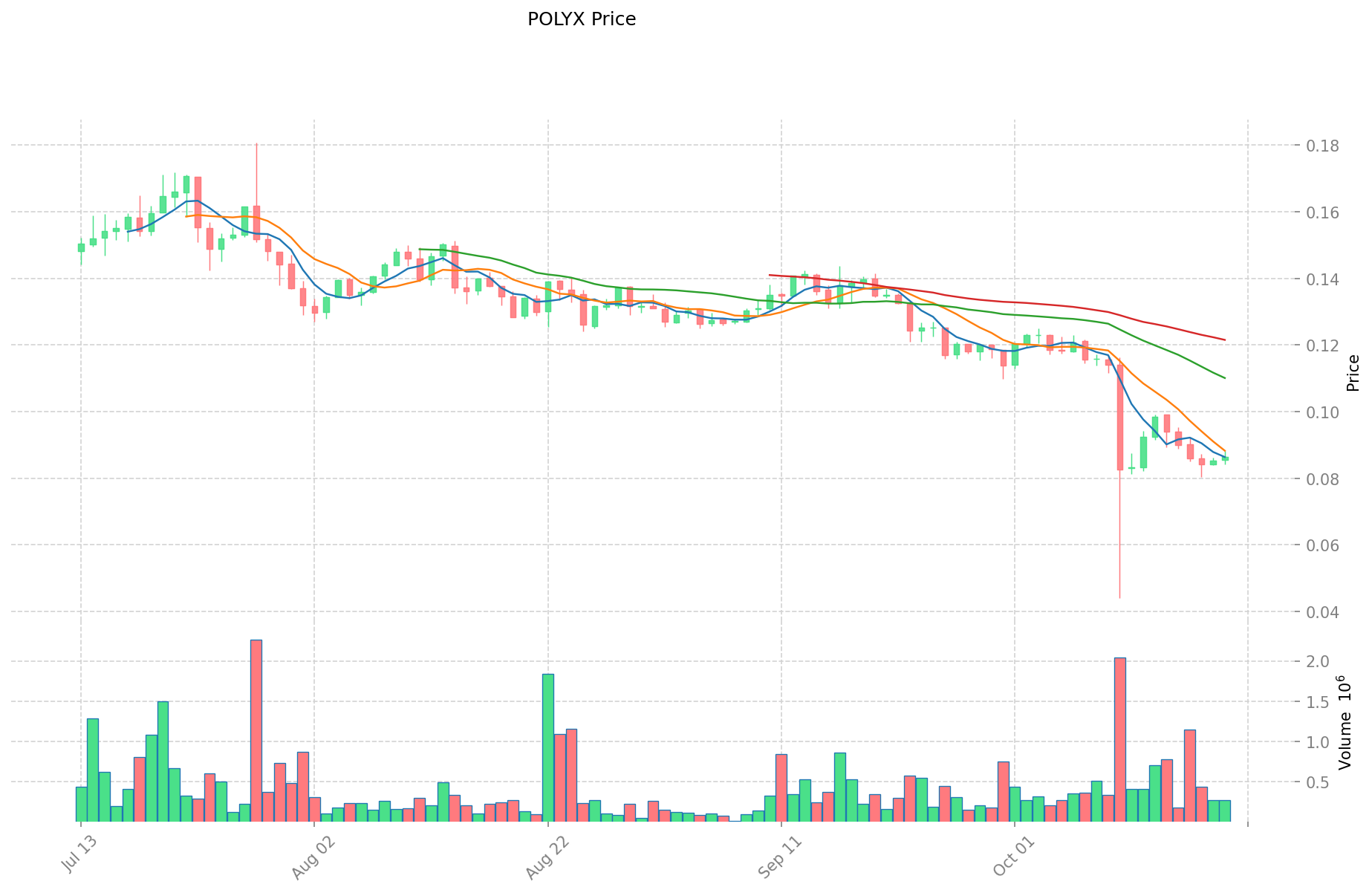
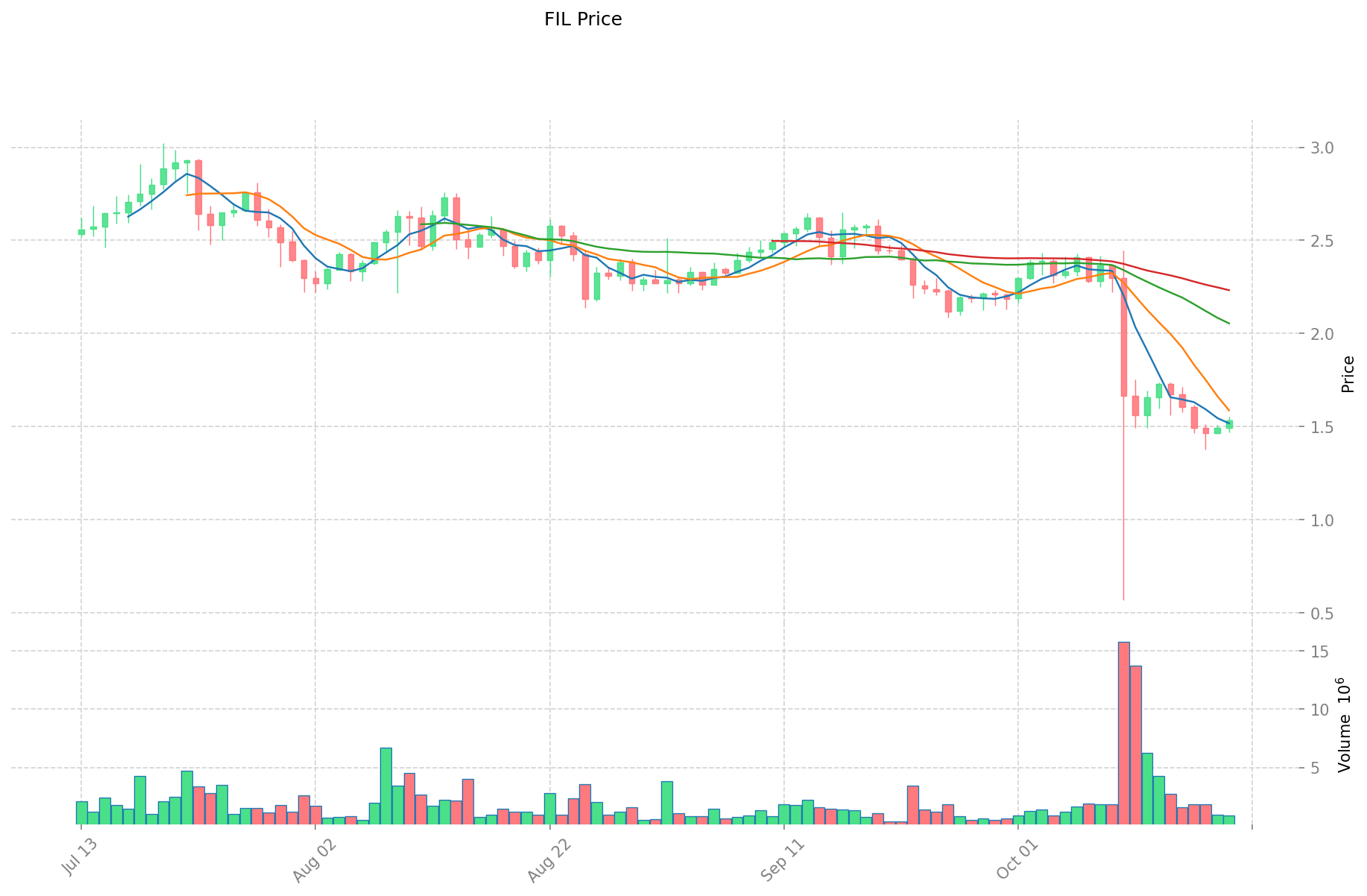
POLYX (Coin A) and FIL (Coin B) Historical Price Trends
- 2023: POLYX reached its all-time high of $0.95 on February 15, 2023.
- 2025: FIL hit its all-time low of $0.848008 on October 11, 2025.
- Comparative analysis: In the current market cycle, POLYX has dropped from its high of $0.95 to a current price of $0.085, while FIL has fallen from its all-time high of $236.84 to $1.506.
Current Market Situation (2025-10-20)
- POLYX current price: $0.085
- FIL current price: $1.506
- 24-hour trading volume: POLYX $23,387.58 vs FIL $1,359,384.80
- Market Sentiment Index (Fear & Greed Index): 29 (Fear)
Click to view real-time prices:
- View POLYX current price Market Price
- View FIL current price Market Price
II. Core Factors Affecting POLYX vs FIL Investment Value
Supply Mechanism Comparison (Tokenomics)
- POLYX: Polymesh's native token with a capped supply, designed specifically for security token operations on the Polymesh blockchain.
- FIL: Deflationary model with block rewards that follow a halving schedule, similar to Bitcoin. New tokens are minted as mining rewards, while tokens are burned during storage operations.
- 📌 Historical pattern: FIL's deflationary mechanism tends to create supply constraints when network usage increases, potentially driving price appreciation during high demand periods.
Institutional Adoption and Market Applications
- Institutional holdings: POLYX has stronger institutional appeal due to its compliance-focused design for regulated securities, attracting traditional financial institutions seeking blockchain solutions.
- Enterprise adoption: POLYX is being implemented in regulated securities issuance and management, while FIL is primarily used for decentralized storage infrastructure by data-centric organizations.
- Regulatory attitudes: POLYX benefits from clearer regulatory positioning as it's specifically designed to comply with securities regulations, while FIL faces varying regulatory approaches as a utility token for storage services.
Technical Development and Ecosystem Building
- POLYX technical upgrades: Purpose-built for regulated markets with compliance features including KYC, AML capabilities, and confidential identity verification.
- FIL technical development: Continuous improvements to storage efficiency, retrieval speed, and network reliability with focus on Web3 infrastructure.
- Ecosystem comparison: POLYX ecosystem is centered around security token operations and regulatory compliance, while FIL has broader applications in decentralized storage, content delivery, and data preservation.
Macroeconomic Environment and Market Cycles
- Performance in inflationary environments: FIL potentially offers stronger inflation resistance due to its utility value in storage markets and deflationary tokenomics.
- Macroeconomic monetary policy: Both tokens are affected by broader crypto market sentiment in response to interest rate changes, though POLYX may demonstrate greater correlation with traditional securities markets.
- Geopolitical factors: FIL benefits from increased data sovereignty concerns and censorship-resistant storage demand, while POLYX benefits from global regulatory harmonization efforts in securities markets.
III. 2025-2030 Price Prediction: POLYX vs FIL
Short-term Prediction (2025)
- POLYX: Conservative $0.066 - $0.085 | Optimistic $0.085 - $0.119
- FIL: Conservative $1.265 - $1.506 | Optimistic $1.506 - $2.199
Mid-term Prediction (2027)
- POLYX may enter a growth phase, with prices expected in the range of $0.093 - $0.169
- FIL may enter a consolidation phase, with prices expected in the range of $1.214 - $2.365
- Key drivers: Institutional fund inflows, ETFs, ecosystem development
Long-term Prediction (2030)
- POLYX: Base scenario $0.157 - $0.169 | Optimistic scenario $0.169 - $0.202
- FIL: Base scenario $2.220 - $2.612 | Optimistic scenario $2.612 - $3.396
View detailed price predictions for POLYX and FIL
Disclaimer: The above predictions are based on historical data and market analysis. Cryptocurrency markets are highly volatile and subject to rapid changes. These projections should not be considered as financial advice or guarantees of future performance.
POLYX:
| 年份 |
预测最高价 |
预测平均价格 |
预测最低价 |
涨跌幅 |
| 2025 |
0.1194975 |
0.08475 |
0.066105 |
0 |
| 2026 |
0.124590975 |
0.10212375 |
0.091911375 |
20 |
| 2027 |
0.168902470125 |
0.1133573625 |
0.09295303725 |
33 |
| 2028 |
0.148186412128125 |
0.1411299163125 |
0.09314574476625 |
66 |
| 2029 |
0.192395358413015 |
0.144658164220312 |
0.107047041523031 |
70 |
| 2030 |
0.202232113579996 |
0.168526761316664 |
0.156729888024497 |
98 |
FIL:
| 年份 |
预测最高价 |
预测平均价格 |
预测最低价 |
涨跌幅 |
| 2025 |
2.19876 |
1.506 |
1.26504 |
0 |
| 2026 |
2.3339988 |
1.85238 |
1.5004278 |
23 |
| 2027 |
2.365304022 |
2.0931894 |
1.214049852 |
38 |
| 2028 |
2.58592618476 |
2.229246711 |
1.91715217146 |
48 |
| 2029 |
2.8168761440196 |
2.40758644788 |
2.1427519386132 |
59 |
| 2030 |
3.39590068473474 |
2.6122312959498 |
2.22039660155733 |
73 |
IV. Investment Strategy Comparison: POLYX vs FIL
Long-term vs Short-term Investment Strategies
- POLYX: Suitable for investors focused on regulated securities and institutional blockchain solutions
- FIL: Suitable for investors interested in decentralized storage infrastructure and Web3 development
Risk Management and Asset Allocation
- Conservative investors: POLYX: 30% vs FIL: 70%
- Aggressive investors: POLYX: 60% vs FIL: 40%
- Hedging tools: Stablecoin allocation, options, cross-currency portfolios
V. Potential Risk Comparison
Market Risks
- POLYX: Limited liquidity and market depth compared to more established cryptocurrencies
- FIL: Volatility due to fluctuations in demand for decentralized storage
Technical Risks
- POLYX: Scalability, network stability
- FIL: Mining power concentration, security vulnerabilities
Regulatory Risks
- Global regulatory policies may have differing impacts on both tokens, with POLYX potentially benefiting from its compliance-focused design
VI. Conclusion: Which Is the Better Buy?
📌 Investment Value Summary:
- POLYX advantages: Regulatory compliance, institutional focus, potential for adoption in traditional financial markets
- FIL advantages: Established decentralized storage network, deflationary tokenomics, broader Web3 applications
✅ Investment Advice:
- New investors: Consider a balanced approach with a slight preference towards FIL due to its more established market presence
- Experienced investors: Evaluate portfolio needs and consider POLYX for exposure to the security token sector
- Institutional investors: Explore POLYX for its regulatory-compliant blockchain solutions in the securities market
⚠️ Risk Warning: The cryptocurrency market is highly volatile. This article does not constitute investment advice.
None
VII. FAQ
Q1: What are the main differences between POLYX and FIL?
A: POLYX is focused on regulated securities and institutional-grade blockchain solutions, while FIL is a decentralized storage network. POLYX has a capped supply and is designed for security token operations, whereas FIL has a deflationary model with block rewards that follow a halving schedule.
Q2: Which token has shown better price performance recently?
A: Based on the current market data, FIL has shown better price performance. As of October 20, 2025, FIL is trading at $1.506, while POLYX is at $0.085. However, it's important to note that past performance doesn't guarantee future results.
Q3: How do the supply mechanisms of POLYX and FIL differ?
A: POLYX has a capped supply specifically designed for security token operations. FIL, on the other hand, has a deflationary model where new tokens are minted as mining rewards, and tokens are burned during storage operations.
Q4: Which token is more likely to be adopted by institutional investors?
A: POLYX is more likely to be adopted by institutional investors due to its compliance-focused design for regulated securities, which attracts traditional financial institutions seeking blockchain solutions.
Q5: What are the key factors affecting the long-term value of POLYX and FIL?
A: Key factors include institutional adoption, regulatory attitudes, technical development, ecosystem building, and macroeconomic conditions. POLYX benefits from its focus on regulatory compliance, while FIL's value is driven by the demand for decentralized storage and Web3 infrastructure.
Q6: How do the 2030 price predictions for POLYX and FIL compare?
A: For 2030, POLYX's base scenario predicts a range of $0.157 - $0.169, with an optimistic scenario of $0.169 - $0.202. FIL's base scenario predicts $2.220 - $2.612, with an optimistic scenario of $2.612 - $3.396.
Q7: What are the main risks associated with investing in POLYX and FIL?
A: For POLYX, risks include limited liquidity, market depth, scalability, and network stability. For FIL, risks involve volatility due to fluctuations in storage demand, mining power concentration, and potential security vulnerabilities. Both face regulatory risks, although POLYX may have an advantage due to its compliance-focused design.
* The information is not intended to be and does not constitute financial advice or any other recommendation of any sort offered or endorsed by Gate.












