This comprehensive guide compares RFD and ZIL, two distinct cryptocurrency assets with different market positioning and investment profiles. RFD, a meme token launched in 2023, contrasts sharply with ZIL, an established high-throughput blockchain infrastructure platform operational since 2018. The analysis examines historical price performance, current market status as of February 2026, tokenomics, institutional adoption, technical ecosystem development, and macroeconomic influences affecting both assets. Price predictions through 2031 suggest varying growth trajectories, with ZIL showing stronger momentum potential alongside higher trading liquidity. Investment strategies differ significantly based on risk tolerance: conservative investors may favor ZIL's established presence, while aggressive investors might explore RFD's speculative opportunities. The article addresses market risks, regulatory considerations, and provides personalized allocation recommendations for different investor profiles on Gate platf
Introduction: Investment Comparison Between RFD and ZIL
In the cryptocurrency market, the comparison between RFD vs ZIL has become a topic that investors cannot avoid. The two not only show significant differences in market cap ranking, application scenarios, and price performance, but also represent different positioning in the crypto asset space.
RFD (Refund): Launched in 2023, it positions itself as a meme token in the cryptocurrency ecosystem.
ZIL (Zilliqa): Since its launch in 2018, it has been recognized in the market for its high-throughput blockchain platform capabilities, aiming to address transaction speed and scalability challenges.
This article will comprehensively analyze the investment value comparison between RFD vs ZIL from perspectives including historical price trends, supply mechanisms, institutional adoption, technical ecosystem, and future predictions, attempting to answer the question investors care about most:
"Which is the better buy right now?"
I. Historical Price Comparison and Current Market Status
- 2023: RFD reached its all-time high of $0.0001436 in May 2023, shortly after its launch in the cryptocurrency market.
- 2024: RFD experienced significant downward pressure, falling to its all-time low of $0.0000005 in November 2024, representing a substantial decline from its peak.
- 2021: ZIL achieved its all-time high of $0.255376 in May 2021, during a period of broader market momentum in the blockchain sector.
- 2020: ZIL recorded its all-time low of $0.00239616 in March 2020, coinciding with global market volatility.
- Comparative Analysis: During the recent market cycle, RFD declined from $0.0001436 to $0.000001528 as of February 2, 2026, while ZIL moved from $0.255376 to $0.004044 over a similar timeframe, both experiencing notable retracements from their respective peaks.
Current Market Status (February 2, 2026)
- RFD current price: $0.000001528
- ZIL current price: $0.004044
- 24-hour trading volume: RFD $11,361.33 vs ZIL $421,528.75
- Market sentiment index (Fear & Greed Index): 14 (Extreme Fear)
View real-time prices:
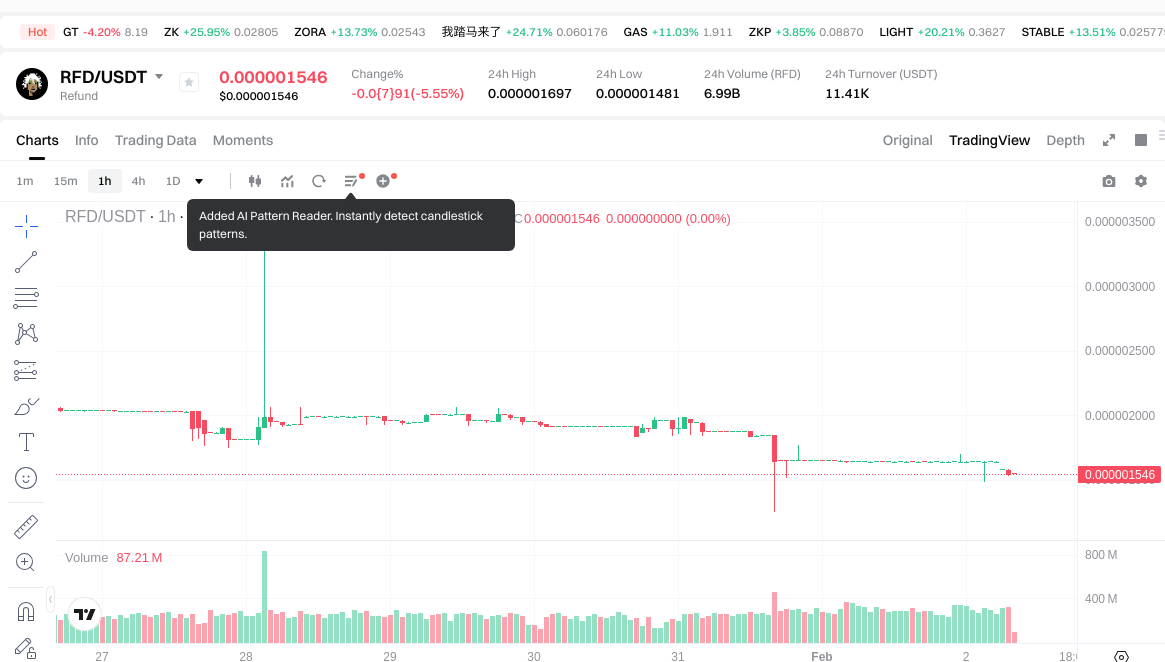
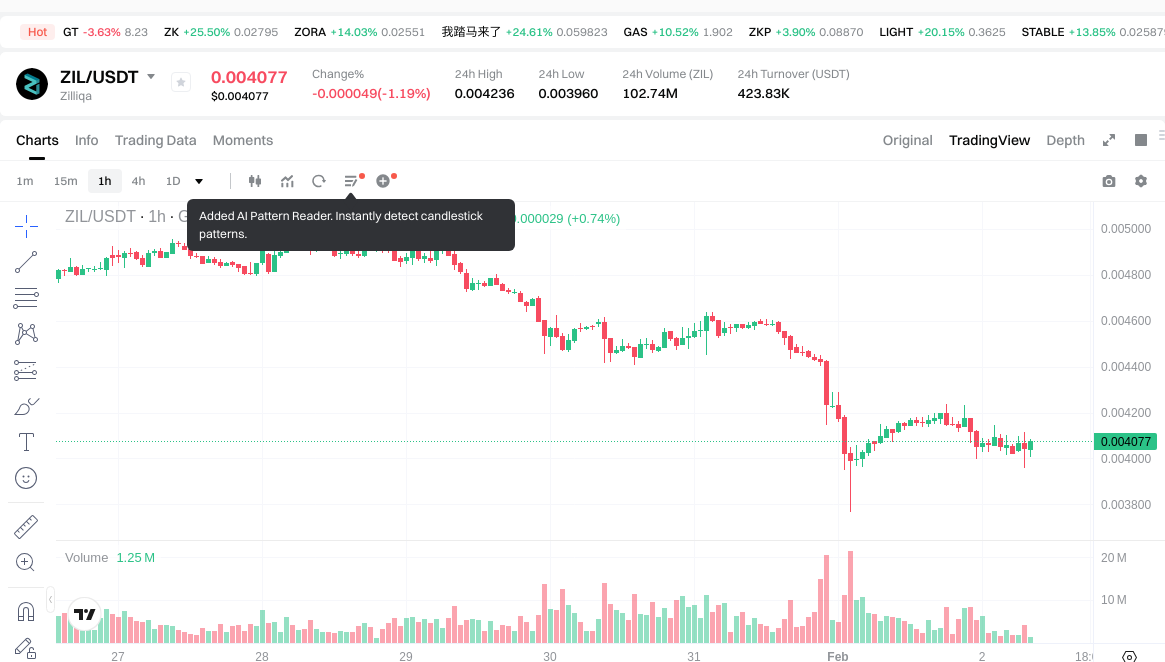
II. Core Factors Influencing RFD vs ZIL Investment Value
Supply Mechanism Comparison (Tokenomics)
- RFD: Information regarding the supply mechanism is not available in the provided materials.
- ZIL: Information regarding the supply mechanism is not available in the provided materials.
- 📌 Historical Pattern: Supply mechanisms may influence price cycle variations through factors such as scarcity dynamics and emission schedules, though specific historical data for these assets is not available in the reference materials.
Institutional Adoption and Market Application
- Institutional Holdings: Data on institutional preference between the two assets is not available in the provided materials.
- Enterprise Adoption: Information regarding RFD or ZIL applications in cross-border payments, settlements, or investment portfolios is not available in the reference materials.
- National Policies: Regulatory attitudes from different jurisdictions toward these assets are not documented in the provided materials.
Technical Development and Ecosystem Building
- RFD Technical Upgrades: Information on technical developments and their potential impacts is not available in the provided materials.
- ZIL Technical Development: Information on technical advancements and their potential implications is not available in the provided materials.
- Ecosystem Comparison: Details regarding DeFi, NFT, payment applications, and smart contract implementations for either asset are not documented in the reference materials.
Macroeconomic Environment and Market Cycles
- Performance Under Inflation: Comparative analysis of anti-inflation properties is not available in the provided materials.
- Macroeconomic Monetary Policy: The impacts of interest rates and dollar index movements on both assets are not documented in the reference materials.
- Geopolitical Factors: Information regarding cross-border transaction demand and international situation impacts is not available in the provided materials.
III. 2026-2031 Price Prediction: RFD vs ZIL
Short-term Prediction (2026)
- RFD: Conservative scenario suggests a range of $0.00000080392 to $0.000001546, with an optimistic outlook reaching up to $0.0000016233
- ZIL: Conservative scenario indicates a range of $0.0026928 to $0.00408, with an optimistic projection extending to $0.0059976
Mid-term Prediction (2028-2029)
- RFD may experience gradual development during 2028-2029, with projected ranges between $0.00000101259135 and $0.000001738281817 in 2028, potentially extending to $0.000001884263737 by 2029
- ZIL could show relatively stronger momentum during the same period, with estimated ranges from $0.00369822726 to $0.0070442424 in 2028, potentially reaching $0.007361233308 by 2029
- Key drivers may include institutional capital flows, ETF developments, and ecosystem expansion
Long-term Prediction (2030-2031)
- RFD: Baseline scenario suggests ranges between $0.000001187086154 and $0.000001798615385 in 2030, with optimistic projections reaching $0.000002399352924 by 2031
- ZIL: Baseline scenario indicates ranges from $0.00566556675828 to $0.006909227754 in 2030, with optimistic estimates extending to $0.008485568066075 by 2031
View detailed price predictions for RFD and ZIL
Disclaimer
RFD:
| Year |
Predicted High Price |
Predicted Average Price |
Predicted Low Price |
Price Change |
| 2026 |
0.0000016233 |
0.000001546 |
0.00000080392 |
1 |
| 2027 |
0.0000017906545 |
0.00000158465 |
0.0000012201805 |
3 |
| 2028 |
0.000001738281817 |
0.00000168765225 |
0.00000101259135 |
10 |
| 2029 |
0.000001884263737 |
0.000001712967033 |
0.000000890742857 |
12 |
| 2030 |
0.000002338200001 |
0.000001798615385 |
0.000001187086154 |
17 |
| 2031 |
0.000002399352924 |
0.000002068407693 |
0.000001054887923 |
35 |
ZIL:
| Year |
Predicted High Price |
Predicted Average Price |
Predicted Low Price |
Price Change |
| 2026 |
0.0059976 |
0.00408 |
0.0026928 |
0 |
| 2027 |
0.006701604 |
0.0050388 |
0.004383756 |
24 |
| 2028 |
0.0070442424 |
0.005870202 |
0.00369822726 |
45 |
| 2029 |
0.007361233308 |
0.0064572222 |
0.00613436109 |
59 |
| 2030 |
0.00711650458662 |
0.006909227754 |
0.00566556675828 |
70 |
| 2031 |
0.008485568066075 |
0.00701286617031 |
0.005259649627732 |
73 |
IV. Investment Strategy Comparison: RFD vs ZIL
Long-term vs Short-term Investment Strategies
- RFD: May be considered by investors with higher risk tolerance who are interested in emerging meme token market dynamics and speculative opportunities in the early-stage cryptocurrency space
- ZIL: May appeal to investors seeking exposure to blockchain infrastructure projects with established market presence and technical development history since 2018
Risk Management and Asset Allocation
- Conservative investors: RFD 5-10% vs ZIL 15-20% (within overall crypto portfolio allocation)
- Aggressive investors: RFD 15-25% vs ZIL 25-35% (within overall crypto portfolio allocation)
- Hedging tools: Stablecoin allocation, options strategies, cross-asset diversification approaches
V. Potential Risk Comparison
Market Risk
- RFD: Characterized by significant price volatility, having experienced movements from $0.0001436 in May 2023 to $0.000001528 as of February 2, 2026, with relatively limited trading volume of $11,361.33 in 24-hour periods
- ZIL: Subject to market cycle fluctuations, having moved from $0.255376 in May 2021 to $0.004044 as of February 2, 2026, with comparatively higher trading volume of $421,528.75 in 24-hour periods
Technical Risk
- RFD: Information regarding scalability and network stability considerations is not available in the provided materials
- ZIL: Information regarding computational resource distribution and security architecture is not available in the provided materials
Regulatory Risk
- Global regulatory developments may impact both assets differently based on their respective classifications, use cases, and jurisdictional considerations, though specific policy impacts are not documented in the provided materials
VI. Conclusion: Which Is the Better Buy?
📌 Investment Value Summary:
- RFD Characteristics: Represents an emerging meme token category with entry positioning in the cryptocurrency market since 2023, showing considerable price movement patterns
- ZIL Characteristics: Established blockchain infrastructure project with multi-year market presence dating back to 2018, positioned in the high-throughput blockchain platform space
✅ Investment Considerations:
- Beginner investors: May consider starting with established projects that have longer operational history and relatively higher trading volumes before exploring emerging tokens
- Experienced investors: Could evaluate portfolio diversification strategies incorporating both infrastructure-focused and emerging market segments based on individual risk assessment
- Institutional investors: May prioritize assets with documented institutional adoption data, regulatory clarity, and established market infrastructure, though specific information for these assets is limited in available materials
⚠️ Risk Disclaimer: The cryptocurrency market exhibits significant volatility characteristics. This analysis does not constitute investment advice. Investors should conduct independent research and consult qualified financial professionals before making investment decisions.
VII. FAQ
Q1: What are the main differences between RFD and ZIL in terms of market positioning?
RFD is an emerging meme token launched in 2023, while ZIL is an established high-throughput blockchain infrastructure platform operational since 2018. RFD represents the speculative meme token category with relatively limited trading volume ($11,361.33 in 24-hour periods as of February 2, 2026), whereas ZIL positions itself as a scalability-focused blockchain solution with comparatively higher market liquidity ($421,528.75 in 24-hour trading volume). The fundamental distinction lies in their core purposes: RFD operates primarily within meme token market dynamics, while ZIL addresses technical challenges in blockchain transaction speed and scalability.
Q2: How have RFD and ZIL performed historically in terms of price movements?
Both assets have experienced substantial retracements from their all-time highs. RFD reached its peak of $0.0001436 in May 2023 shortly after launch, declining to $0.000001528 by February 2, 2026—a significant decrease representing approximately 98.9% from its high. ZIL achieved its all-time high of $0.255376 in May 2021 during broader market momentum, falling to $0.004044 by February 2, 2026—approximately 98.4% below its peak. Both assets recorded their all-time lows during periods of market stress: RFD at $0.0000005 in November 2024, and ZIL at $0.00239616 in March 2020 during global market volatility.
Q3: What are the price predictions for RFD and ZIL through 2031?
Short-term predictions for 2026 suggest RFD may range between $0.00000080392 and $0.0000016233, while ZIL could range from $0.0026928 to $0.0059976. By 2031, baseline scenarios project RFD potentially reaching $0.000002068407693 (average prediction) with an optimistic high of $0.000002399352924, while ZIL may achieve $0.00701286617031 (average prediction) with an optimistic target of $0.008485568066075. These projections suggest ZIL could experience higher absolute price ranges, though both assets show potential for gradual development through the mid-to-long term period, subject to institutional capital flows, ETF developments, and ecosystem expansion dynamics.
Q4: What allocation strategies are suggested for conservative versus aggressive investors?
Conservative investors may consider allocating 5-10% to RFD and 15-20% to ZIL within their overall cryptocurrency portfolio, reflecting different risk-reward profiles. Aggressive investors might increase exposure to 15-25% for RFD and 25-35% for ZIL within their crypto allocation. These suggested ranges reflect RFD's positioning as a higher-risk emerging meme token suitable for speculation-focused strategies, while ZIL's established market presence may warrant higher allocation percentages. Risk management approaches should incorporate hedging tools including stablecoin allocation, options strategies, and cross-asset diversification to balance volatility exposure inherent in both assets.
Q5: What are the primary risk factors investors should consider when comparing RFD and ZIL?
Market risk represents a significant consideration for both assets, with RFD demonstrating extreme volatility and limited liquidity ($11,361.33 daily trading volume), while ZIL shows relatively higher but still modest trading activity ($421,528.75 daily volume). Both have experienced drawdowns exceeding 98% from their respective peaks. Regulatory risk affects both assets differently based on their classifications—RFD as a meme token and ZIL as an infrastructure platform—though specific policy impacts remain undocumented in available materials. Technical risks include considerations around network stability and scalability, though detailed information is not available. Current market sentiment reflects extreme fear (Fear & Greed Index: 14), suggesting heightened caution across the broader cryptocurrency market.
Q6: Which asset is more suitable for beginner investors?
Beginner investors may find established projects with longer operational histories and relatively higher trading volumes more appropriate starting points before exploring emerging tokens. ZIL, operational since 2018 with documented blockchain infrastructure positioning and comparatively higher liquidity, may present a more accessible entry point for those new to cryptocurrency investing. RFD, as an emerging meme token launched in 2023 with significantly lower trading volumes and higher volatility characteristics, requires greater risk tolerance and market understanding. Beginners should prioritize thorough independent research, start with smaller position sizes, and consult qualified financial professionals before making investment decisions in either asset.
Q7: How does the current market sentiment affect investment decisions for RFD versus ZIL?
The current market sentiment index stands at 14 (Extreme Fear as of February 2, 2026), indicating widespread caution across the cryptocurrency market. This environment typically suggests potential accumulation opportunities for long-term investors but requires careful risk assessment. RFD's limited trading volume and extreme price volatility make it particularly sensitive to sentiment shifts, potentially offering higher speculative returns but with correspondingly elevated risks during fearful market conditions. ZIL's relatively higher liquidity and established market presence may provide somewhat better price discovery and stability during extreme sentiment periods, though both assets remain subject to broader market cycle dynamics. Investors should consider dollar-cost averaging strategies and maintain adequate risk management protocols when entering positions during extreme fear conditions.
* The information is not intended to be and does not constitute financial advice or any other recommendation of any sort offered or endorsed by Gate.