The article "RUNE vs ZIL: A Comparative Analysis of Two Promising Blockchain Projects" offers a comprehensive evaluation of the investment potential of RUNE and ZIL, two notable cryptocurrencies in the market. It addresses critical questions such as price trends, supply mechanisms, institutional adoption, and technical developments, aiming to guide investors on which token might currently be the better buy. The structure includes historical price analysis, core investment factors, price predictions, investment strategies, and associated risks, providing insights suitable for novice, experienced, and institutional investors. With a focus on DeFi and enterprise solutions, it positions RUNE and ZIL within the broader crypto ecosystem. For real-time prices, readers are directed to Gate.
Introduction: Investment Comparison of RUNE vs ZIL
In the cryptocurrency market, the comparison between RUNE vs ZIL has always been an unavoidable topic for investors. The two not only have significant differences in market cap ranking, application scenarios, and price performance, but also represent different positioning in the crypto asset space.
RUNE (RUNE): Since its launch, it has gained market recognition for its role in the THORChain ecosystem.
Zilliqa (ZIL): Since its inception, it has been hailed as a high-throughput public blockchain platform, aiming to solve transaction speed and scalability issues.
This article will comprehensively analyze the investment value comparison between RUNE vs ZIL, focusing on historical price trends, supply mechanisms, institutional adoption, technical ecosystems, and future predictions, attempting to answer the question investors are most concerned about:
"Which is the better buy right now?"
I. Price History Comparison and Current Market Status
RUNE and ZIL Historical Price Trends
- 2021: RUNE reached its all-time high of $20.87 on May 19, 2021.
- 2021: ZIL hit its all-time high of $0.255376 on May 7, 2021.
- Comparative analysis: Since their respective all-time highs in 2021, RUNE has fallen from $20.87 to $0.8391, while ZIL has dropped from $0.255376 to $0.007884.
Current Market Situation (2025-10-18)
- RUNE current price: $0.8391
- ZIL current price: $0.007884
- 24-hour trading volume: RUNE $976,886.51 vs ZIL $475,695.80
- Market Sentiment Index (Fear & Greed Index): 22 (Extreme Fear)
Click to view real-time prices:
- View RUNE current price Market Price
- View ZIL current price Market Price
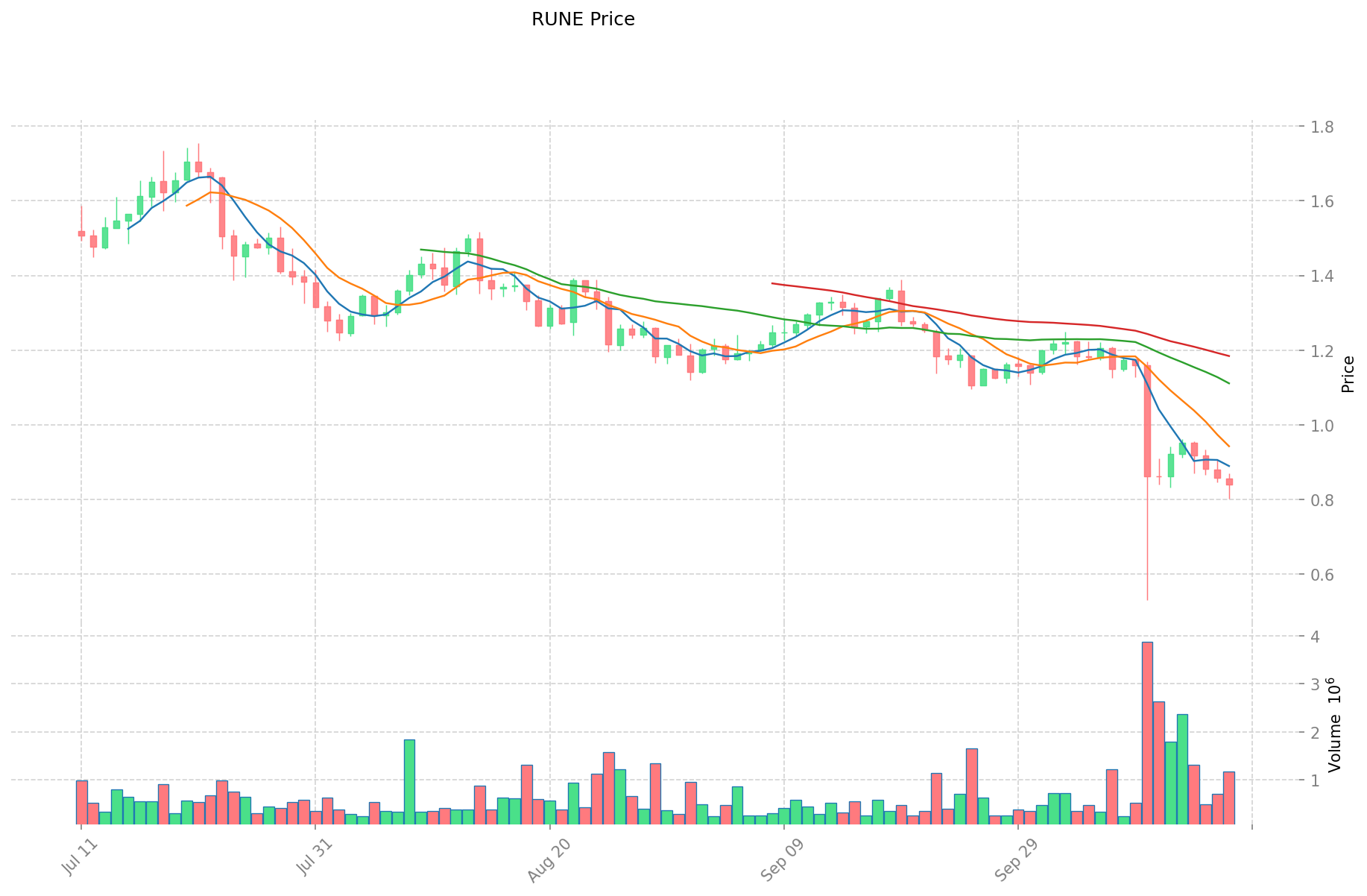
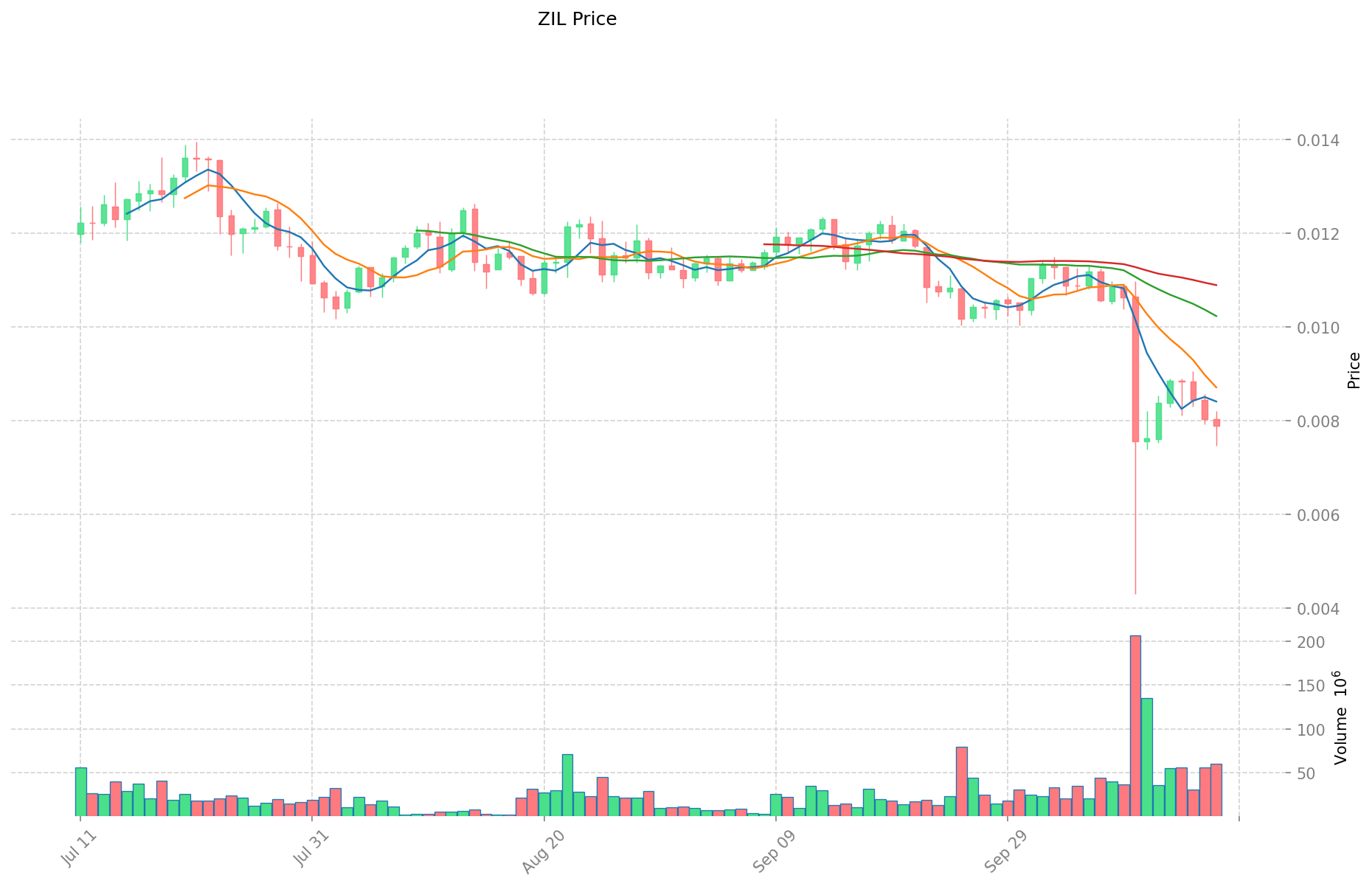
II. Core Factors Affecting Investment Value of RUNE vs ZIL
Supply Mechanism Comparison (Tokenomics)
- RUNE: Maximum supply capped at 500 million tokens, with over 60% already in circulation. Features a deflationary model where tokens are burned during network operations.
- ZIL: Maximum supply of 21 billion tokens with no halving mechanism. Approximately 14.3 billion tokens are currently in circulation.
- 📌 Historical pattern: RUNE's deflationary model has historically created more price pressure during bull markets, while ZIL's larger supply has resulted in less volatility but potentially lower upside.
Institutional Adoption and Market Applications
- Institutional holdings: RUNE has gained more institutional interest through THORChain's cross-chain liquidity protocol, attracting DeFi-focused investment funds.
- Enterprise adoption: ZIL has stronger enterprise partnerships in Southeast Asia, particularly in Singapore, while RUNE focuses more on decentralized exchange infrastructure.
- Regulatory stance: Singapore has taken a supportive approach toward ZIL development, while RUNE operates in a more globally distributed manner with less regulatory clarity.
Technical Development and Ecosystem Building
- RUNE technical upgrades: Recent implementation of synthetic assets and improved cross-chain swapping capabilities have strengthened THORChain's position as a decentralized liquidity provider.
- ZIL technical development: Focus on sharding technology and Scilla programming language for smart contracts, with recent improvements in transaction throughput.
- Ecosystem comparison: RUNE has stronger DeFi applications with its native DEX functionality, while ZIL has more diverse applications across NFTs and enterprise solutions, though with smaller TVL.
Macroeconomic Factors and Market Cycles
- Inflation environment performance: RUNE's deflationary mechanism positions it better as a potential inflation hedge compared to ZIL.
- Macroeconomic monetary policy: Both tokens show correlation to overall crypto market trends during Federal Reserve policy shifts, with RUNE demonstrating higher volatility.
- Geopolitical factors: ZIL's stronger presence in Asian markets makes it more susceptible to regulatory changes in Singapore and surrounding regions.
III. 2025-2030 Price Prediction: RUNE vs ZIL
Short-term Prediction (2025)
- RUNE: Conservative $0.469 - $0.838 | Optimistic $0.838 - $1.014
- ZIL: Conservative $0.00465 - $0.00789 | Optimistic $0.00789 - $0.00907
Mid-term Prediction (2027)
- RUNE may enter a growth phase, with prices estimated at $0.670 - $1.482
- ZIL may enter a moderate growth phase, with prices estimated at $0.00536 - $0.01133
- Key drivers: Institutional capital inflow, ETF, ecosystem development
Long-term Prediction (2030)
- RUNE: Base scenario $0.975 - $1.477 | Optimistic scenario $1.477 - $1.831
- ZIL: Base scenario $0.00939 - $0.01252 | Optimistic scenario $0.01252 - $0.01840
View detailed price predictions for RUNE and ZIL
Disclaimer
RUNE:
| 年份 |
预测最高价 |
预测平均价格 |
预测最低价 |
涨跌幅 |
| 2025 |
1.014343 |
0.8383 |
0.469448 |
0 |
| 2026 |
1.269060455 |
0.9263215 |
0.48168718 |
10 |
| 2027 |
1.481882819625 |
1.0976909775 |
0.669591496275 |
30 |
| 2028 |
1.44456132639 |
1.2897868985625 |
0.722280663195 |
53 |
| 2029 |
1.58592197047245 |
1.36717411247625 |
0.9843653609829 |
62 |
| 2030 |
1.830919571428194 |
1.47654804147435 |
0.974521707373071 |
75 |
ZIL:
| 年份 |
预测最高价 |
预测平均价格 |
预测最低价 |
涨跌幅 |
| 2025 |
0.0090712 |
0.007888 |
0.00465392 |
0 |
| 2026 |
0.008818784 |
0.0084796 |
0.00466378 |
7 |
| 2027 |
0.01133044152 |
0.008649192 |
0.00536249904 |
9 |
| 2028 |
0.0115881874416 |
0.00998981676 |
0.0072925662348 |
26 |
| 2029 |
0.014241482773056 |
0.0107890021008 |
0.006581291281488 |
36 |
| 2030 |
0.018397406382284 |
0.012515242436928 |
0.009386431827696 |
58 |
IV. Investment Strategy Comparison: RUNE vs ZIL
Long-term vs Short-term Investment Strategies
- RUNE: Suitable for investors focused on DeFi ecosystem potential and cross-chain liquidity
- ZIL: Suitable for investors interested in enterprise blockchain solutions and Asian market exposure
Risk Management and Asset Allocation
- Conservative investors: RUNE 30% vs ZIL 70%
- Aggressive investors: RUNE 60% vs ZIL 40%
- Hedging tools: Stablecoin allocation, options, cross-currency portfolio
V. Potential Risk Comparison
Market Risks
- RUNE: Higher volatility due to smaller market cap and DeFi sector exposure
- ZIL: Lower liquidity and potential for extended periods of price stagnation
Technical Risks
- RUNE: Scalability, network stability during high-volume cross-chain transactions
- ZIL: Smart contract vulnerabilities, sharding implementation challenges
Regulatory Risks
- Global regulatory policies may have different impacts on both tokens, with ZIL potentially facing more scrutiny in Asian markets
VI. Conclusion: Which Is the Better Buy?
📌 Investment Value Summary:
- RUNE advantages: Strong DeFi ecosystem, deflationary model, cross-chain liquidity protocol
- ZIL advantages: Enterprise partnerships, sharding technology, established presence in Southeast Asian markets
✅ Investment Advice:
- Novice investors: Consider a balanced approach with a slight preference for ZIL due to lower volatility
- Experienced investors: Explore RUNE for higher potential returns, but with increased risk
- Institutional investors: Evaluate RUNE for DeFi exposure and ZIL for enterprise blockchain applications
⚠️ Risk Warning: The cryptocurrency market is highly volatile. This article does not constitute investment advice.
None
VII. FAQ
Q1: What are the main differences between RUNE and ZIL?
A: RUNE is focused on cross-chain liquidity and DeFi applications through THORChain, while ZIL is a high-throughput blockchain platform aimed at enterprise solutions. RUNE has a capped supply of 500 million tokens with a deflationary model, whereas ZIL has a maximum supply of 21 billion tokens without a halving mechanism.
Q2: Which token has performed better historically?
A: Both tokens reached their all-time highs in May 2021, with RUNE hitting $20.87 and ZIL reaching $0.255376. Since then, RUNE has fallen to $0.8391, while ZIL has dropped to $0.007884, indicating a steeper decline for RUNE in percentage terms.
Q3: How do institutional adoption and market applications differ between RUNE and ZIL?
A: RUNE has gained more institutional interest through its DeFi-focused cross-chain liquidity protocol, attracting investment funds. ZIL has stronger enterprise partnerships in Southeast Asia, particularly in Singapore, and focuses more on enterprise blockchain solutions.
Q4: What are the key technical developments for each token?
A: RUNE has recently implemented synthetic assets and improved cross-chain swapping capabilities. ZIL focuses on sharding technology and the Scilla programming language for smart contracts, with recent improvements in transaction throughput.
Q5: How do the long-term price predictions compare for RUNE and ZIL?
A: For 2030, RUNE's base scenario predicts a range of $0.975 - $1.477, with an optimistic scenario of $1.477 - $1.831. ZIL's base scenario for 2030 is $0.00939 - $0.01252, with an optimistic scenario of $0.01252 - $0.01840.
Q6: What are the main risks associated with investing in RUNE and ZIL?
A: RUNE faces higher volatility due to its smaller market cap and DeFi sector exposure, as well as potential scalability issues. ZIL risks include lower liquidity, potential price stagnation, and challenges in implementing sharding technology. Both tokens are subject to regulatory risks, with ZIL potentially facing more scrutiny in Asian markets.
Q7: Which token might be more suitable for different types of investors?
A: Novice investors might consider a balanced approach with a slight preference for ZIL due to lower volatility. Experienced investors could explore RUNE for higher potential returns but with increased risk. Institutional investors may evaluate RUNE for DeFi exposure and ZIL for enterprise blockchain applications.
* The information is not intended to be and does not constitute financial advice or any other recommendation of any sort offered or endorsed by Gate.












