This comprehensive analysis compares SHDW and NEAR, two distinct blockchain assets with fundamentally different market positions and applications. SHDW is a decentralized storage application on Solana with a $6.52 million market cap, while NEAR is an established layer-1 blockchain protocol ranked 49th with $1.92 billion market cap. The article examines critical investment factors including historical price performance, market liquidity, technical architecture, and risk profiles. SHDW appeals to high-risk investors seeking emerging infrastructure opportunities, whereas NEAR suits those prioritizing market stability and established scalability features. Current price data, 2026-2031 forecasts, and strategic allocation recommendations are provided for conservative and aggressive investors. The analysis addresses regulatory considerations, technical risks specific to each protocol, and institutional adoption patterns. Whether you're new to crypto or managing institutional portfolios, this guide delivers actionabl
Introduction: SHDW vs NEAR Investment Comparison
In the cryptocurrency market, the comparison between SHDW and NEAR has consistently been a topic of interest for investors. Both assets differ significantly in market cap ranking, application scenarios, and price performance, representing distinct positioning within the crypto ecosystem.
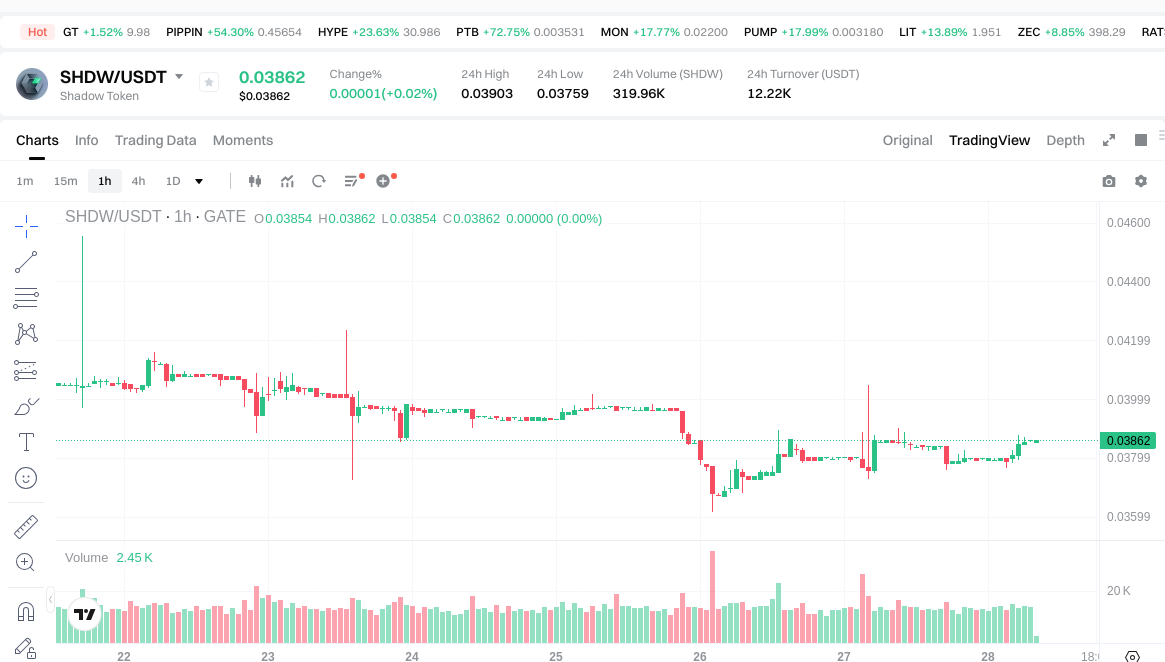
Shadow Token (SHDW): Launched in 2017, this decentralized storage application built and optimized on Solana serves both web2 and web3 users. As of January 28, 2026, SHDW holds a market ranking of 1402 with a market cap of approximately $6.52 million and a circulating supply of 169 million tokens, representing nearly 100% of its max supply.
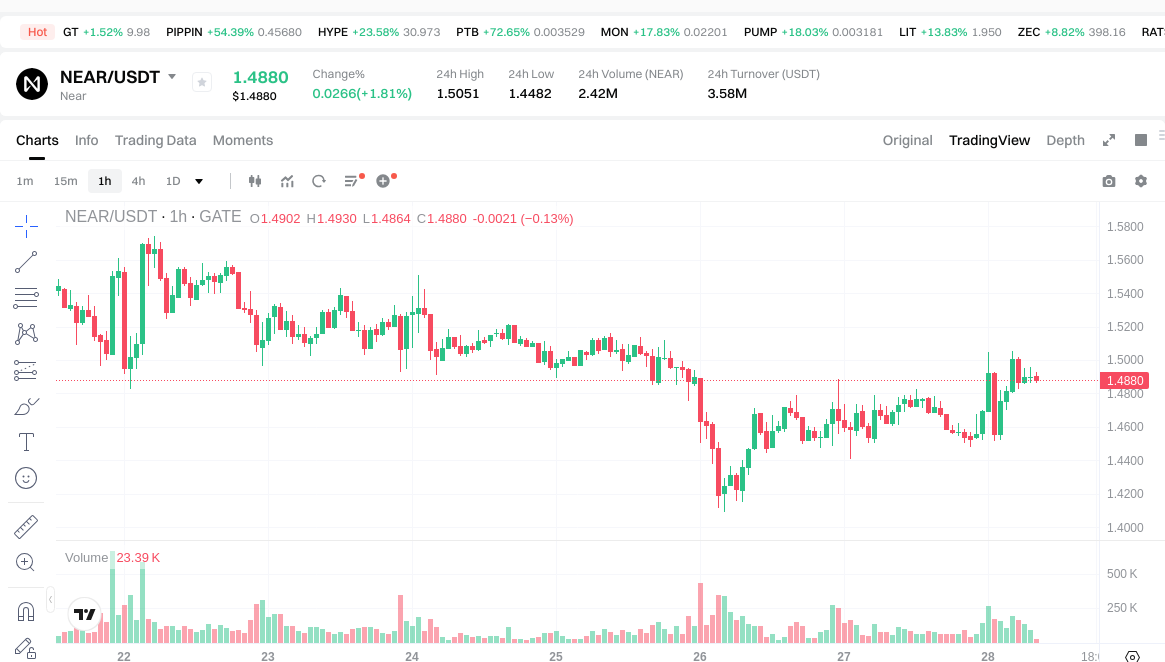
NEAR (NEAR): Since its launch in October 2020, NEAR Protocol has been recognized as a highly scalable layer-1 blockchain protocol. As of January 28, 2026, NEAR ranks 49th with a market cap of approximately $1.92 billion and a circulating supply of 1.29 billion tokens. The protocol enables developers to build mobile blockchain DApps while providing linear scalability through state sharding.
This article will provide a comprehensive analysis of SHDW vs NEAR investment value comparison, covering historical price trends, supply mechanisms, institutional adoption, technical ecosystem, and future predictions, attempting to address the question investors care about most:
"Which is the better buy right now?"
I. Historical Price Comparison and Market Status
SHDW (Coin A) and NEAR (Coin B) Historical Price Trends
- 2024: SHDW reached a historical high of $4 on March 27, 2024, before experiencing substantial downward pressure.
- 2022: NEAR recorded its all-time high of $20.44 on January 17, 2022, during the broader market expansion phase.
- Comparative Analysis: During the market cycle from 2024 to 2026, SHDW declined from $4 to $0.03103, while NEAR dropped from $20.44 to $0.526762 during its respective downturn phase.
Current Market Status (2026-01-28)
- SHDW Current Price: $0.03854
- NEAR Current Price: $1.4903
- 24-Hour Trading Volume: SHDW $12,213.0095388 vs NEAR $3,583,925.172245
- Market Sentiment Index (Fear & Greed Index): 29 (Fear)
View real-time prices:
II. Core Factors Influencing SHDW vs NEAR Investment Value
Supply Mechanism Comparison (Tokenomics)
- SHDW: Information regarding the specific supply mechanism was not available in the provided materials.
- NEAR: Information regarding the specific supply mechanism was not available in the provided materials.
- 📌 Historical Pattern: Supply mechanisms have historically influenced price cycle variations through factors such as scarcity dynamics and inflation control.
Institutional Adoption and Market Application
- Institutional Holdings: The provided materials did not contain specific data comparing institutional preference between SHDW and NEAR.
- Enterprise Adoption: Information regarding cross-border payment, settlement, or portfolio applications for SHDW and NEAR was not available in the provided materials.
- National Policy: The materials note that regulatory environments continue to evolve, with 2025-2026 showing increased clarity in crypto regulation. However, specific regulatory attitudes toward SHDW and NEAR by different countries were not detailed.
Technology Development and Ecosystem Building
- SHDW Technology Upgrades: Specific technical upgrade information was not available in the provided materials.
- NEAR Technology Development: Specific technical development information was not available in the provided materials.
- Ecosystem Comparison: The materials did not provide detailed comparisons of DeFi, NFT, payment systems, or smart contract implementation between SHDW and NEAR.
Macroeconomic and Market Cycles
- Performance in Inflationary Environments: The materials indicate that many emerging economies have implemented positive real policy rates and improved fiscal trajectories, creating a more supportive policy backdrop. However, specific anti-inflation characteristics of SHDW versus NEAR were not detailed.
- Macroeconomic Monetary Policy: The materials note that the relationship between U.S. monetary policy direction and risk assets remains significant. Macro drivers including geopolitical changes, demographic shifts, and rising capital costs continue to reshape global investment opportunities and risk patterns in 2026. The materials emphasize that investors should consider actively adjusting strategies to respond to policy changes.
- Geopolitical Factors: The materials reference geopolitical changes as key trends shaping the 2026 investment landscape, though specific impacts on SHDW and NEAR were not provided.
III. 2026-2031 Price Forecast: SHDW vs NEAR
Short-term Forecast (2026)
- SHDW: Conservative $0.0290 - $0.0387 | Optimistic $0.0387 - $0.0487
- NEAR: Conservative $1.06 - $1.49 | Optimistic $1.49 - $1.70
Mid-term Forecast (2028-2029)
- SHDW may enter a gradual accumulation phase, with estimated price range of $0.0257 - $0.0737
- NEAR may enter a moderate expansion phase, with estimated price range of $1.41 - $3.25
- Key drivers: institutional capital inflows, ETF developments, ecosystem growth
Long-term Forecast (2030-2031)
- SHDW: Baseline scenario $0.0522 - $0.0913 | Optimistic scenario $0.0690 - $0.1128
- NEAR: Baseline scenario $1.71 - $3.34 | Optimistic scenario $2.53 - $3.72
View detailed price predictions for SHDW and NEAR
Disclaimer
SHDW:
| Year |
Predicted High Price |
Predicted Average Price |
Predicted Low Price |
Price Change |
| 2026 |
0.0486612 |
0.03862 |
0.028965 |
0 |
| 2027 |
0.044949818 |
0.0436406 |
0.03273045 |
13 |
| 2028 |
0.05669786752 |
0.044295209 |
0.02569122122 |
14 |
| 2029 |
0.0737249458596 |
0.05049653826 |
0.0363575075472 |
31 |
| 2030 |
0.091302790827906 |
0.0621107420598 |
0.052173023330232 |
61 |
| 2031 |
0.112758946672463 |
0.076706766443853 |
0.069036089799467 |
99 |
NEAR:
| Year |
Predicted High Price |
Predicted Average Price |
Predicted Low Price |
Price Change |
| 2026 |
1.695636 |
1.4874 |
1.056054 |
0 |
| 2027 |
2.0689734 |
1.591518 |
1.52785728 |
6 |
| 2028 |
2.690461179 |
1.8302457 |
1.409289189 |
22 |
| 2029 |
3.25490895288 |
2.2603534395 |
1.966507492365 |
51 |
| 2030 |
3.3367337473899 |
2.75763119619 |
1.7097313416378 |
85 |
| 2031 |
3.717562615583739 |
3.04718247178995 |
2.529161451585658 |
104 |
IV. Investment Strategy Comparison: SHDW vs NEAR
Long-term vs Short-term Investment Strategies
-
SHDW: May be suitable for investors with higher risk tolerance who are interested in exploring emerging decentralized storage solutions and early-stage ecosystem opportunities. The asset's lower market capitalization and higher volatility profile suggest it may appeal to those seeking potential growth in niche infrastructure sectors.
-
NEAR: May be suitable for investors seeking exposure to established layer-1 blockchain protocols with demonstrated scalability features and broader developer adoption. The asset's higher market ranking and larger market capitalization suggest it may appeal to those prioritizing relative market stability within the crypto asset class.
Risk Management and Asset Allocation
-
Conservative Investors: Consider a potential allocation structure such as SHDW: 10-20% vs NEAR: 80-90%, emphasizing the more established asset while maintaining limited exposure to higher-risk opportunities.
-
Aggressive Investors: Consider a potential allocation structure such as SHDW: 30-40% vs NEAR: 60-70%, allowing for increased exposure to higher volatility assets while maintaining meaningful position in more established protocols.
-
Hedging Tools: Consider implementing stablecoin allocations for liquidity management, exploring options strategies where available, and employing cross-asset portfolio diversification to manage downside risk.
V. Potential Risk Comparison
Market Risk
-
SHDW: Lower market capitalization and trading volume may contribute to increased price volatility and liquidity constraints. The asset's concentration in decentralized storage applications may expose it to sector-specific market cycles and competitive pressures from alternative storage solutions.
-
NEAR: While benefiting from higher market capitalization, the asset remains subject to broader crypto market cycles and competitive dynamics within the layer-1 blockchain sector. Price movements may be influenced by developments in competing scalability solutions and shifts in developer ecosystem preferences.
Technical Risk
-
SHDW: Considerations may include the scalability characteristics of decentralized storage infrastructure and network stability under varying demand conditions.
-
NEAR: Considerations may include the ongoing development of state sharding mechanisms, network validator distribution patterns, and potential vulnerabilities in smart contract implementations.
Regulatory Risk
Evolving global regulatory frameworks continue to shape the operational landscape for crypto assets. Both SHDW and NEAR may be subject to jurisdiction-specific policy developments affecting decentralized infrastructure and blockchain protocols. The regulatory treatment of storage networks versus general-purpose blockchain platforms may differ across various jurisdictions.
VI. Conclusion: Which Is the Better Buy?
📌 Investment Value Summary:
-
SHDW Characteristics: Represents exposure to decentralized storage infrastructure with a focus on cross-platform compatibility. The asset's early-stage market position and near-complete circulating supply structure may present distinct risk-reward dynamics for investors willing to accept higher volatility in exchange for potential sector-specific growth opportunities.
-
NEAR Characteristics: Represents exposure to an established layer-1 blockchain protocol with demonstrated scalability features through state sharding technology. The asset's higher market capitalization and broader developer ecosystem may provide relatively greater market depth and institutional recognition within the crypto asset class.
✅ Investment Considerations:
-
New Investors: Consider prioritizing assets with higher market capitalization and greater liquidity, such as NEAR, while maintaining strict position sizing discipline. Focus on understanding fundamental protocol mechanics and market cycle dynamics before allocating capital.
-
Experienced Investors: Consider evaluating portfolio allocation based on individual risk tolerance, time horizon, and conviction regarding sector-specific developments. A diversified approach incorporating both established protocols and emerging infrastructure projects may be appropriate depending on overall portfolio construction.
-
Institutional Investors: Consider conducting comprehensive due diligence on protocol governance structures, validator economics, and ecosystem development trajectories. Evaluate both assets within the context of broader digital asset allocation strategies and regulatory compliance frameworks.
⚠️ Risk Disclosure: Cryptocurrency markets exhibit extreme volatility characteristics. This content does not constitute investment advice, financial guidance, or recommendations to buy or sell any assets. Investors should conduct independent research and consult qualified financial advisors before making investment decisions.
VII. FAQ
Q1: What are the main differences between SHDW and NEAR in terms of market positioning?
SHDW is a decentralized storage application built on Solana with a market cap of approximately $6.52 million (ranked 1402), while NEAR is an established layer-1 blockchain protocol with a market cap of approximately $1.92 billion (ranked 49th). SHDW focuses specifically on decentralized storage infrastructure serving both web2 and web3 users, whereas NEAR provides a scalable blockchain platform for developers to build mobile DApps with linear scalability through state sharding technology. The fundamental difference lies in their applications: SHDW targets the storage infrastructure sector, while NEAR operates as a general-purpose blockchain protocol with broader ecosystem capabilities.
Q2: Which asset offers better liquidity for trading purposes?
NEAR demonstrates significantly superior liquidity compared to SHDW. As of January 28, 2026, NEAR's 24-hour trading volume reached $3,583,925.17, while SHDW's volume was only $12,213.01. This substantial difference reflects NEAR's higher market capitalization ($1.92 billion vs $6.52 million) and broader market adoption. The liquidity gap means NEAR positions can be entered and exited with minimal slippage, while SHDW traders may experience higher transaction costs and price impact when executing larger orders. For investors prioritizing ease of trading and market depth, NEAR presents a more liquid option.
Q3: What is the current risk-reward profile for each asset in 2026?
Both assets present distinct risk-reward characteristics. SHDW, with its conservative 2026 forecast of $0.0290-$0.0387 and optimistic range of $0.0387-$0.0487, represents a higher-risk, potentially higher-reward opportunity suitable for investors with substantial risk tolerance. Its lower market capitalization and near-complete circulating supply create conditions for greater volatility. NEAR, with conservative projections of $1.06-$1.49 and optimistic estimates of $1.49-$1.70, offers relatively moderate growth potential with comparatively lower volatility due to its established market position. The current market sentiment index stands at 29 (Fear), suggesting both assets may face near-term headwinds, though their responses to market cycles differ based on their respective market positions.
Q4: How do institutional considerations differ between SHDW and NEAR?
Institutional investors typically prioritize assets with higher market capitalization, greater liquidity, and established governance frameworks. NEAR's 49th market ranking, $1.92 billion market cap, and demonstrated scalability features position it as a more accessible option for institutional allocation within digital asset portfolios. The protocol's broader developer ecosystem and layer-1 blockchain infrastructure align with institutional preferences for established protocols with measurable adoption metrics. SHDW, as an emerging decentralized storage application with significantly lower market capitalization, may appeal to institutional investors specifically focused on niche infrastructure sectors or venture-stage allocations, but faces higher barriers for mainstream institutional adoption due to liquidity constraints and limited market depth.
Q5: What allocation strategy should conservative investors consider?
Conservative investors should prioritize capital preservation and risk management through weighted allocation favoring more established assets. A suggested structure would allocate 10-20% to SHDW and 80-90% to NEAR, emphasizing the protocol with higher market capitalization, greater liquidity, and demonstrated ecosystem development. This approach provides limited exposure to potential growth in decentralized storage infrastructure while maintaining substantial position in a more stable layer-1 protocol. Additionally, conservative investors should implement hedging tools such as stablecoin allocations for liquidity management, maintain strict position sizing discipline, and conduct regular portfolio rebalancing to maintain target allocation ratios as market conditions evolve.
Q6: How do the long-term price forecasts (2030-2031) compare between SHDW and NEAR?
Long-term projections for 2030-2031 suggest different growth trajectories for each asset. SHDW's baseline scenario estimates $0.0522-$0.0913, with optimistic projections reaching $0.0690-$0.1128, representing potential cumulative growth based on decentralized storage sector adoption. NEAR's baseline scenario projects $1.71-$3.34, with optimistic estimates of $2.53-$3.72, reflecting potential expansion through layer-1 blockchain ecosystem development and institutional adoption. While both assets show projected growth through 2031, NEAR's higher absolute price levels reflect its established market position, whereas SHDW's percentage growth potential from its current low base may appear higher but carries correspondingly greater execution risk and market uncertainty.
Q7: What are the key technical risks specific to each protocol?
SHDW faces technical considerations related to decentralized storage infrastructure scalability and network stability under varying demand conditions. As a storage-focused application, its value proposition depends on competitive advantages relative to alternative storage solutions and successful integration across web2 and web3 environments. NEAR's technical risks center on the ongoing development and security of its state sharding mechanisms, network validator distribution patterns, and potential vulnerabilities in smart contract implementations. Both protocols face sector-specific technical challenges: SHDW must demonstrate storage efficiency and reliability advantages, while NEAR must maintain scalability performance and security as ecosystem complexity increases. Investors should monitor technical development progress and network performance metrics for both assets.
Q8: How might regulatory developments differently impact SHDW versus NEAR?
Regulatory frameworks continue evolving globally, with jurisdiction-specific approaches potentially affecting SHDW and NEAR differently based on their distinct functions. SHDW's focus on decentralized storage may face regulatory scrutiny related to data sovereignty, privacy regulations, and cross-border data transfer requirements, as storage networks intersect with existing data protection frameworks. NEAR, as a general-purpose blockchain protocol enabling smart contracts and DApps, may encounter regulatory considerations related to securities classification, DeFi applications built on the platform, and broader blockchain protocol governance. The regulatory treatment of storage networks versus general-purpose blockchain platforms may diverge across jurisdictions, with some regions potentially establishing more favorable frameworks for specific use cases. Investors should monitor regulatory developments in major markets and assess potential compliance implications for both protocols.
* The information is not intended to be and does not constitute financial advice or any other recommendation of any sort offered or endorsed by Gate.