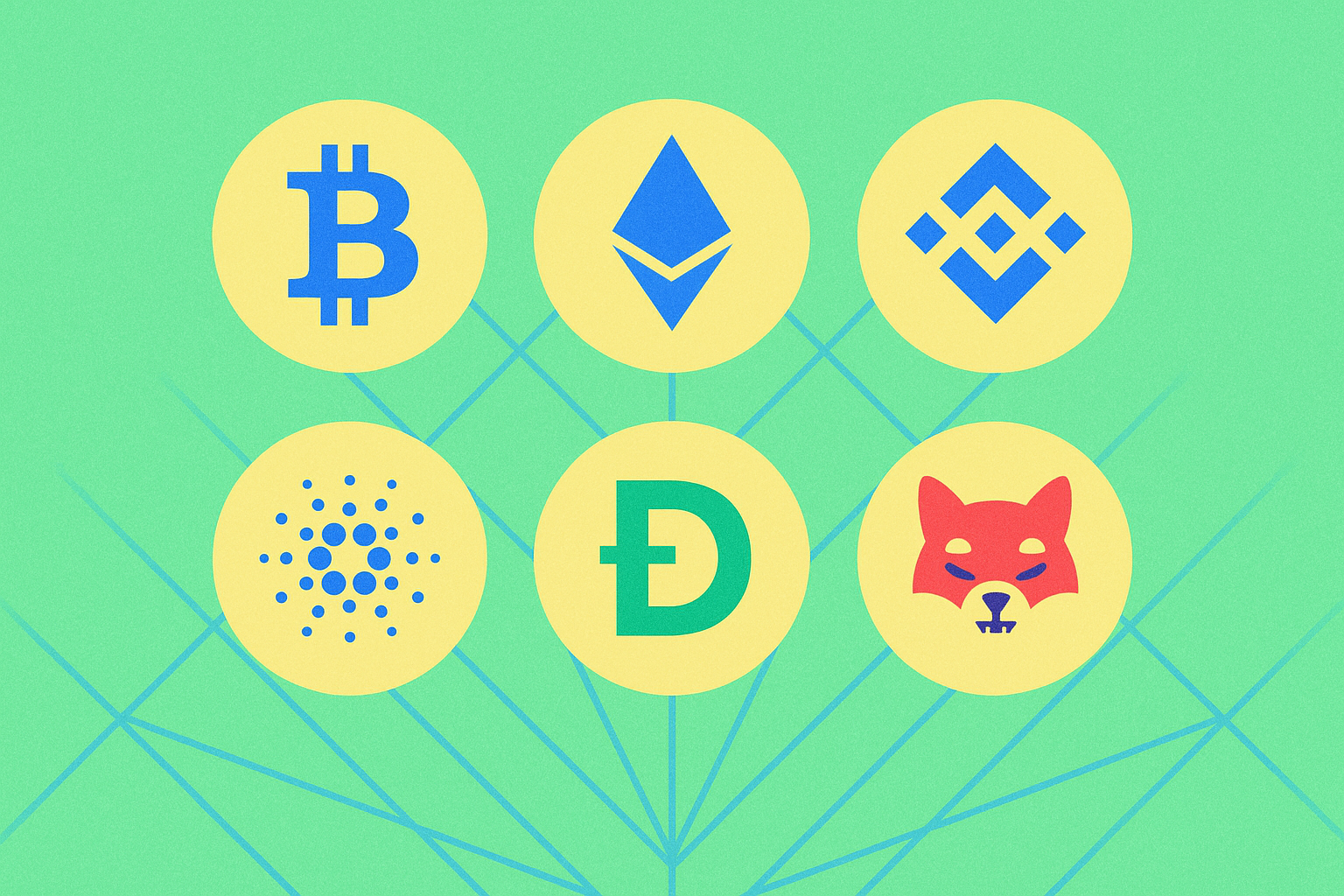
A comprehensive guide to six must-watch cryptocurrencies for 2024. This article explains how to select assets that have achieved over 1,000x growth—like Bitcoin, Ethereum, and BNB—and highlights essential criteria for picking high-potential tokens. Designed for beginners, it details how to identify promising cryptocurrencies, assess investment risks, and execute trades on Gate.
Introduction
Over the past decade, the cryptocurrency market has achieved extraordinary growth, with many tokens soaring hundreds or even thousands of times above their initial prices. Since the market’s inception, a combination of technological innovation, regulatory development, and shifts in investor psychology has fueled unprecedented asset expansion.
Bitcoin, in particular, has seen an unparalleled surge—rising at least 1,000,000 times from its initial value at the peak, and by some estimates, tens of millions of times. This remarkable trajectory reflects not just speculative bubbles, but also the promise of decentralized finance and the creation of new value as a digital asset.
But what other cryptocurrencies, beyond Bitcoin, have delivered more than 1,000-fold returns? In this article, we highlight six major tokens whose prices grew over 1,000x between 2009 and early 2025. We examine each project’s technical features, market positioning, and the key factors behind their growth.
Growth Overview of the Top 6 Tokens (Initial Price, All-Time High, Multiples)
The following table summarizes the launch year, initial price (the first traded price or ICO price), all-time high (up to early 2025), and approximate price multiple (all-time high divided by initial price) for the six tokens discussed in this article.
Initial prices are taken from either the ICO or the market price at the start of trading. All-time highs reflect the highest price as of early 2025, based on the latest data. Multiples are calculated by dividing the all-time high by the initial price. These figures highlight the explosive growth of the crypto market and demonstrate how each project’s unique value was embraced by the market.
| Token (Ticker) |
Year Launched |
Initial Price |
All-Time High (Date) |
Multiple (from Initial Price) |
| Bitcoin (BTC) |
2009 |
$0.0008 (2010 estimated value) |
$109,350 (Jan 20, 2025) |
Approx. 136,687,500x |
| Ethereum (ETH) |
2015 |
$0.31 (2014 ICO price) |
$4,878 (Nov 2021) |
Approx. 15,736x |
| Binance Coin (BNB) |
2017 |
$0.15 (2017 ICO price) |
$705 (Nov 2024) |
Approx. 7,016x |
| Cardano (ADA) |
2017 |
$0.0024 (2015–17 ICO price) |
$3.10 (Sep 2021) |
Approx. 1,291x |
| Dogecoin (DOGE) |
2013 |
$0.0004 (Dec 2013 at launch) |
$1.23 (Dec 2024) |
Approx. 3,075x |
| Shiba Inu (SHIB) |
2020 |
$0.00000000051 (Aug 2020 at launch) |
$0.0000885 (Oct 2021) |
Approx. 173,529x |
This table reveals distinct growth patterns for each token. These tokens fall into three main categories: innovation-driven (BTC, ETH), platform-based (BNB, ADA), and meme-driven (DOGE, SHIB). Each category achieved remarkable growth by meeting specific market needs.
Bitcoin (BTC)
Launched in January 2009 by Satoshi Nakamoto, Bitcoin is the world’s first cryptocurrency. It serves as the cornerstone of the crypto market and is often called “digital gold.” Its core innovation is the realization of a decentralized, peer-to-peer electronic payment system without a central administrator.
Bitcoin’s maximum supply is capped at 21 million, making its scarcity and decentralized network key to its appeal as a long-term store of value. As the first practical use case of blockchain, Bitcoin has advanced financial democratization and transparency, laying the foundation for thousands of subsequent crypto projects.
Price History (Initial Price, All-Time High, Multiples)
At launch, Bitcoin had essentially no value, with no exchanges and no established price in 2009. The first USD exchange rate was set in October 2009, when 5,050 BTC sold for about $5, or roughly $0.0009 per BTC.
Trading began in July 2010, with Bitcoin priced around $0.0008–$0.08. By the end of 2010, the price hovered near $0.5, broke $1 for the first time in 2011, and shot up to about $29.6 in June 2011 amid high volatility.
Bitcoin’s price has continued to rise in four-year cycles, breaking $1,000 in late 2013 and reaching about $19,000 in December 2017. The latest all-time high was $109,350 on January 20, 2025. From the initial trading price (around $0.0008–$0.08), Bitcoin achieved at least a million-fold increase, and by some measures, tens of millions of times.
This price trend reflects Bitcoin’s maturation as a financial asset, not just speculative bubbles. Each cycle has seen higher price floors, with institutional inflows and regulatory advances further developing the market.
Key Drivers of Bitcoin’s Growth
Market Maturity and Reserve Asset Status
As the first cryptocurrency, Bitcoin has consistently held a central market position. It’s the go-to asset for institutions and companies, anchoring crypto portfolios. For years, Bitcoin has represented more than half of the market cap, providing stability and liquidity unique in the space.
Supply Constraints and Halving-Induced Scarcity
Bitcoin’s four-year halving cycle reduces new issuance, increasing scarcity. Halvings in 2012, 2016, and 2020 have helped contain inflation. Following the third halving in 2020, and amid monetary easing, Bitcoin’s reputation as an “inflation hedge” soared. This predictable supply schedule supports investor confidence and long-term price growth.
Macro-Economic Factors and Safe-Haven Reassessment
Post-pandemic fiscal stimulus and quantitative easing raised concerns over fiat devaluation, driving capital into Bitcoin. In early 2021, Bitcoin was recognized alongside equities and real estate as a risk asset, surging from $29,000 at the end of 2020 to over $64,000 in a matter of months. This shift signaled that Bitcoin was being adopted as a portfolio diversification tool, not just a speculative asset.
Institutional and Corporate Adoption
MicroStrategy began accumulating BTC in 2020, and Tesla announced a $1.5 billion BTC purchase in 2021. Major financial players like PayPal and US banks entered crypto services, prompting a wave of institutional adoption. This legitimized Bitcoin and reassured individual investors.
Legal Tender Status at the National Level
In 2021, El Salvador recognized Bitcoin as legal tender, distributing wallets to all citizens—a historic national initiative. This move highlighted Bitcoin’s practical utility as a means of payment.
Recognition as Digital Gold
By 2021, Bitcoin’s status as “digital gold” was globally established. Its market cap briefly topped $1 trillion, rivaling the gold market. The fixed supply and decentralization have made it a compelling long-term store of value, recognized for wealth preservation across generations.
Strategic Accumulation by Governments
Some governments have recently considered holding BTC as part of their foreign reserves, motivated by maintaining dollar dominance and countering digital asset policies in other countries. Bitcoin reached fresh all-time highs following such announcements, reaffirming policy-price linkages.
Ethereum (ETH)
Launched in July 2015, Ethereum is a blockchain platform and the second largest crypto asset after Bitcoin. While Bitcoin is seen as “digital gold,” Ethereum is described as the “protocol for the decentralized internet,” and serves as the foundation for smart contracts and DApps.
Ethereum’s flexible architecture has made it central to DeFi and NFT trends, with countless projects and tokens launching on its platform. Its vibrant developer community and rapid innovation have set it far ahead of other blockchains.
Price History (Initial Price, All-Time High, Multiples)
Ethereum’s 2014 ICO sold ETH for about $0.31 each, raising $18 million. When the mainnet launched in July 2015, ETH started trading in the single-digit dollar range.
The 2017 ICO boom fueled massive demand, pushing ETH to around $1,400 by January 2018, before crashing to the $80s during the crypto winter. From 2020, renewed interest in DeFi and NFTs spurred a surge, with ETH hitting an all-time high of $4,878.26 on November 10, 2021. This delivered a more than 15,000x return from ICO price for early investors.
Key Drivers of Ethereum’s Growth
Smart Contracts and DApp Innovation
Ethereum’s defining feature is smart contracts, enabling anyone to create custom tokens and applications. Since 2016, thousands of projects have launched on Ethereum, powering the ICO boom and massively expanding blockchain’s real-world use cases.
Rise of DeFi (Decentralized Finance)
From around 2020, DeFi services built on Ethereum—like decentralized exchanges and lending protocols—grew rapidly. Yield farming locked up ETH, boosting prices. Ethereum became the backbone of DeFi, offering a compelling alternative to traditional finance.
NFT Boom and Surging Demand
In early 2021, the NFT market exploded, with ETH powering digital art and collectibles trading. This influx of new users and rising network usage—and gas fees—created a virtuous cycle for ETH prices.
Technical Evolution: Ethereum 2.0 Transition
The London upgrade in August 2021 introduced EIP-1559, burning a portion of transaction fees. The Merge in September 2022 shifted Ethereum from PoW to PoS, dramatically improving energy efficiency and investor confidence. These upgrades have enhanced Ethereum’s sustainability and long-term potential.
Enterprise Adoption and Ecosystem Expansion
As the second leading investment asset after Bitcoin, Ethereum saw the creation of the Enterprise Ethereum Alliance (EEA) in 2017, with major tech and financial firms participating. Since 2020, ETH futures and custody services have fueled institutional adoption and ecosystem growth.
Binance Coin (BNB)
Binance Coin is the native token of one of the world’s largest crypto exchanges. It launched in July 2017 with the exchange’s debut, initially as an ERC-20 token via ICO.
BNB migrated to its own blockchain (BNB Chain), expanding into a utility token for trading fee discounts, gas payments, and broader ecosystem use. The success of BNB set the standard for exchange tokens across the industry.
Price History (Initial Price, All-Time High, Multiples)
BNB was sold at $0.15 per token in its ICO, with about 100 million tokens issued. Trading began at a few dollars, but BNB surged in 2021, reaching $690.93 on May 10, 2021—about 4,605x the ICO price.
In November 2024, the token hit a new all-time high of $705 amid ecosystem expansion and favorable regulations, for a total return of around 7,016x from ICO. Recently, BNB has traded in the $500–$700 range as the market stabilized.
Key Drivers of BNB’s Growth
Exchange Expansion and User Growth
The exchange has led the world in trading volume since 2018. Users save on fees by using BNB, driving steady demand. Scandals at rival exchanges since 2019 have accelerated capital inflows to BNB.
Fee Discounts and Expanding Use Cases
BNB offers fee discounts for spot trading, and is also used for IEOs, staking, and lending. Launchpad IEOs require BNB holdings, fueling demand. As the user base expands, BNB’s utility continues to grow.
Success of the Proprietary Chain (BNB Chain)
The exchange launched its own chain in 2019, making BNB the native token. In 2020, it released an Ethereum-compatible smart chain, attracting DeFi and game developers with low gas fees. BNB Chain now hosts many dApps, establishing itself as a leading smart contract platform after Ethereum.
Deflationary Model Through Regular Burns
BNB’s supply will be reduced to 100 million tokens. The exchange buys back and burns BNB every quarter, decreasing circulating supply. This benefits long-term holders and supports price stability.
Brand Strength and Community Loyalty
Strong leadership and user-focused marketing have built global support. Frequent airdrops and IEOs drive long-term holding. Security measures—like hack compensation—have further strengthened trust in BNB.
Cardano (ADA)
Cardano is a third-generation blockchain platform launched in 2017 with the ticker ADA. It supports smart contracts and DApps as a platform-based cryptocurrency.
Led by former Ethereum co-founder Charles Hoskinson, Cardano emphasizes academic peer review and formal methods in its development. It uses the Ouroboros PoS consensus algorithm and has evolved through phases such as Byron, Shelley, and Goguen.
Price History (Initial Price, All-Time High, Multiples)
Cardano’s 2017 ICO—mainly in Japan and Korea—sold ADA at about $0.0024. After the mainnet launch in October 2017, the price jumped during the altcoin boom, at one point nearing $1.
After languishing during the 2018 crypto winter, ADA rebounded in 2020–2021. With the Shelley (staking) and Alonzo (smart contracts) upgrades, ADA hit an all-time high of $3.1 on September 2, 2021—yielding a 1,300x return from ICO.
Key Drivers of Cardano’s Growth
Catalyst Events from Major Upgrades
The 2020 Shelley upgrade enabled decentralization and staking, while Alonzo in 2021 added smart contracts—each a key price driver.
In 2023, the “Hydra” upgrade dramatically improved scalability, enabling thousands of transactions per second. DeFi and NFT adoption has accelerated as a result.
Academic Approach and Reliability
Cardano’s focus on peer review and theoretical rigor has built trust in its security and stability, attracting long-term supporters. This approach continues as Cardano integrates cutting-edge cryptography. A strong, united community supports long-term value.
“Ethereum Killer” Potential
Cardano touts lower energy use, lower fees, and higher security than Ethereum. During the 2021 gas fee spike, Cardano stood out as an alternative. With ongoing scaling challenges for Ethereum, Cardano’s Hydra upgrade and fast settlement have further reinforced its status as a competitor. ADA is widely recognized in Japan as “Eda Coin,” with local exchange listings providing additional momentum.
Emerging Real-World Use Cases
Cardano partnered with Ethiopia’s government to provide digital IDs and academic records for over five million students. By 2024, the project expanded nationwide, serving over 10 million users.
Other use cases include agricultural traceability (Tanzania), educational certification (Southeast Asia), and notary services (Europe), driving momentum toward national-level adoption.
Staking Incentives for Long-Term Holding
ADA holders earn annual staking rewards of several percent. Currently, about 75% of ADA supply is locked in staking, reducing market liquidity. This mechanism supports price stability and attracts long-term investors.
Dogecoin (DOGE)
Dogecoin, created in 2013 as a joke, is a meme-based cryptocurrency. Engineers Billy Markus and Jackson Palmer used the Shiba Inu “Kabosu” meme as inspiration. Designed as an “infinitely issued joke coin,” DOGE had no clear purpose or technical innovation at launch.
Yet its approachable logo and playful culture won over the community, and by 2021, Dogecoin had become a top-five coin by market cap—truly evolving “from meme to reality.”
Price History (Initial Price, All-Time High, Multiples)
DOGE debuted in December 2013 at about $0.0004. It quickly surged over 300% on Reddit-driven hype. After hitting an all-time low of $0.000086 in 2015, DOGE rebounded in the 2017–2018 altcoin boom.
In 2021, celebrity endorsements and retail excitement drove DOGE to $0.74 on May 8—about 1,850x the initial price (+185,000%).
In December 2024, speculation around a major corporate adoption fueled another rally, with DOGE hitting $1.23 (Dec 15, 2024)—a new all-time high and a 3,075x multiple. DOGE has since consolidated in the $0.80–$1.00 range.
Key Drivers of Dogecoin’s Growth
Meme Culture and Community Cohesion
The Shiba Inu logo and approachable style make DOGE popular with newcomers. Used for tips and donations on Reddit, DOGE carved out a niche as “the currency for fun.” The “No highs, no lows, only Doge” ethos remains widely embraced. Meme popularity continues to drive community strength and price support.
Celebrity and Influencer Endorsements
Prominent entrepreneurs—especially the self-styled “Dogefather”—drove major price surges, including payment adoption by a major company in 2024. Snoop Dogg and Mark Cuban have also voiced support for DOGE.
Social media hype fueled both the 2021 bubble and the $1.23 high in late 2024. ETF filings by investment funds, amplified by celebrity backing, have only heightened attention.
Alignment with Retail Investor Movements
The “WallStreetBets” movement in January 2021 galvanized retail investors, who rallied around DOGE under the “To the Moon” slogan, pushing DOGE to the top five by market cap on “Doge Day” (April 20). ETF optimism has kept retail interest and DOGE’s place among the top 10 coins.
Broader Exchange Access
Major US investment apps and exchanges listed DOGE, dramatically increasing access for younger users. Surges in trading sometimes caused outages. Recent ETF filings and listing expansion have encouraged institutional entry.
Branding Through Hype
Despite limited practical utility or technical progress, DOGE thrives on its “fun to own” appeal. In 2023, a major entrepreneur changed a social media logo to the Shiba Inu, reigniting interest. A payment pilot in December 2024 sent DOGE to $1.23, and ETF approvals have added to the buzz. Celebrity remarks about making DOGE the “currency of Mars” continue to fuel the speculative frenzy.
Shiba Inu (SHIB)
Launched in August 2020 by the anonymous “Ryoshi,” Shiba Inu is a meme coin inspired by Dogecoin and marketed as the “Dogecoin Killer.” Issued as an ERC-20 token on Ethereum, SHIB is notable for its extremely low price and massive supply, making large holdings accessible to anyone.
SHIB exploded onto the scene during the 2021 meme coin boom, becoming famous as a “dream coin” that minted many millionaires in a short time.
Price History (Initial Price, All-Time High, Multiples)
SHIB launched in 2020 on a decentralized exchange at $0.00000000051. It was initially obscure, but listings on major exchanges in May 2021 sent SHIB soaring to $0.00008845 in October 2021—a 500,000x gain from its initial price.
After a correction, SHIB has remained in the $0.00001–$0.00003 range, still far above its original value.
Key Drivers of SHIB’s Growth
Meme Hype and “Dogecoin Killer” Branding
SHIB’s use of the Shiba Inu breed positioned it as the “next Dogecoin.” Hype around the idea that “if SHIB hits one yen, you’re a millionaire” spread rapidly on social media, triggering rallies in spring and fall 2021. Meme activity remains robust, with annual returns of 150% fueling FOMO-driven speculation.
Active Community and Hype Cycles
The SHIB Army community played a central role in spreading the word. Celebrity tweets and Ethereum’s founder’s 90% SHIB burn attracted attention. Celebrity involvement drives price sensitivity, and a 410 trillion token burn has recently supported prices by reducing supply.
Rapid Major Exchange Listings
In 2021, SHIB was listed on several major exchanges, increasing liquidity and shifting its image from “fringe coin” to “mainstream.” Many investors joined, drawn by SHIB’s accessibility. With listings on over 100 exchanges, liquidity continues to grow.
Low-Cost Speculation
The ability to purchase millions or billions of SHIB for just a few hundred dollars is a powerful psychological driver. Dreams of “if it hits $1…” have motivated many, and stories of $1,000,000 turning into billions have gone viral, fueling FOMO. With SHIB at $0.00001252, $100 still buys about 8 million tokens, preserving its speculative allure.
Project Evolution and Expanding Utility
In 2021, SHIB launched ShibaSwap, a decentralized exchange, and since 2022 has announced development of its layer-2 network “Shibarium” and the metaverse project “SHIB: The Metaverse.” Expanding utility and token burns are now supporting prices.
Summary and Outlook
Looking back at the six major tokens (BTC, ETH, BNB, ADA, DOGE, SHIB) that grew more than 1,000-fold between 2009 and early 2025, it’s clear that innovation, macroeconomic factors, and social media have all been key growth drivers.
Bitcoin established decentralized digital money, while Ethereum unlocked the potential of smart contracts. Exchange tokens pioneered new value models based on utility, while academically grounded projects proved long-term reliability. Meme coins, meanwhile, have shown that community power and hype can move markets in unprecedented ways.
Similar trends may re-emerge, but past success is no guarantee of future results. Regulatory changes, technical hurdles, and market maturity all introduce uncertainty. Investors need clear-eyed analysis, a long-term perspective, and rigorous risk management.
The crypto market remains in development, and no one can predict where the next 1,000x token will come from. Still, understanding innovation, analyzing market trends, and monitoring community activity can help identify the next growth opportunity.
FAQ
What are the characteristics of cryptocurrencies that grew more than 1,000-fold?
These assets feature innovative technology, established market trust, sustained long-term demand, and rapidly rising adoption. Early visionary investors supported these projects, and their value gradually gained wider recognition.
What drove these tokens to rapid growth?
The main drivers were innovative blockchain applications, expanding institutional adoption, and growing utility. Accelerated global acceptance and increased demand in emerging markets also played key roles.
What are the risks of investing in cryptocurrencies that have multiplied 1,000-fold?
Major risks include extreme volatility, regulatory uncertainty, and market manipulation. Past results do not guarantee future performance, and project failure or technical issues could lead to loss of all value. Thorough due diligence is essential.
How should investors evaluate early-stage cryptocurrencies?
Carefully review the project’s white paper and development team, and check trading volume and market size. Examine real-world utility, community engagement, and security audit status. Always start with small investments and use only discretionary funds.
How do these high-growth tokens differ from mainstream assets like Bitcoin or Ethereum?
High-growth tokens are emerging projects aiming for rapid value increases, while Bitcoin serves as digital gold and Ethereum provides a smart contract platform. High-growth tokens are more volatile and may surge quickly due to innovation or ecosystem expansion.
* The information is not intended to be and does not constitute financial advice or any other recommendation of any sort offered or endorsed by Gate.