This comprehensive analysis examines TAG (Tagger) and STX (Stacks), two distinct blockchain platforms with contrasting market positions. TAG is an early-stage decentralized AI data solutions platform launched in December 2024, while STX is an established Bitcoin Layer 2 infrastructure project operating since October 2019. The comparison evaluates historical price trends, tokenomics, institutional adoption, technological ecosystems, and investment strategies. Current price levels show TAG at $0.0004165 and STX at $0.3247, with STX demonstrating significantly higher liquidity at $573,825.93 daily volume. Through 2031, TAG ranges from $0.000283-$0.001319 while STX ranges from $0.185-$0.611 across different scenarios. Conservative investors may favor STX's proven infrastructure, while aggressive portfolios might incorporate TAG's emerging AI data protocols alongside STX holdings. The analysis addresses market risk, technical risk, and regulatory considerations for both assets on Gate exchange.
Introduction: Investment Comparison Between TAG and STX
In the cryptocurrency market, the comparison between TAG and STX has consistently been a topic of interest for investors. The two assets exhibit notable differences in market capitalization rankings, application scenarios, and price performance, representing distinct positioning within the crypto asset landscape.
Tagger (TAG): Launched in December 2024, this decentralized AI data solutions platform has gained market attention through its focus on cross-border data authentication protocols and permissionless data labeling infrastructure.
Stacks (STX): Since its launch in October 2019, it has positioned itself as a decentralized application infrastructure layer, establishing a blockchain-based internet ecosystem that emphasizes user data ownership and privacy.
This article will provide a comprehensive analysis of the investment value comparison between TAG and STX, examining historical price trends, supply mechanisms, institutional adoption, technological ecosystems, and future outlooks, addressing the question investors care about most:
"Which is the better buy right now?"
I. Historical Price Comparison and Current Market Landscape
TAG (Tagger) and STX (Stacks) Historical Price Trends
-
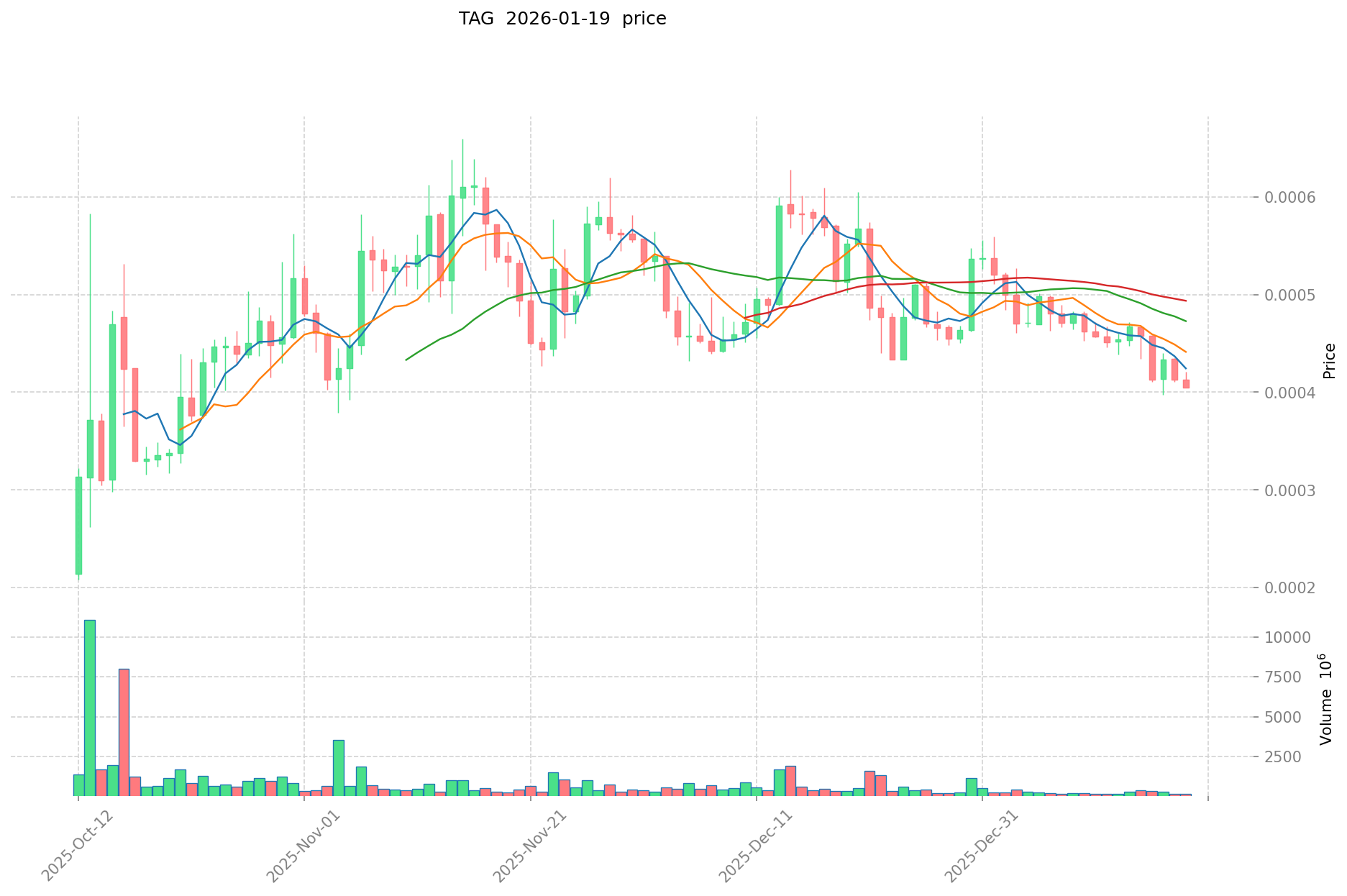
2025: Tagger experienced notable volatility following its market debut, with prices ranging from a low of $0.0001298 in October 2025 to a peak of $0.0012772 in August 2025. The token's early trading phase reflected substantial price discovery across decentralized AI data solutions markets.
-
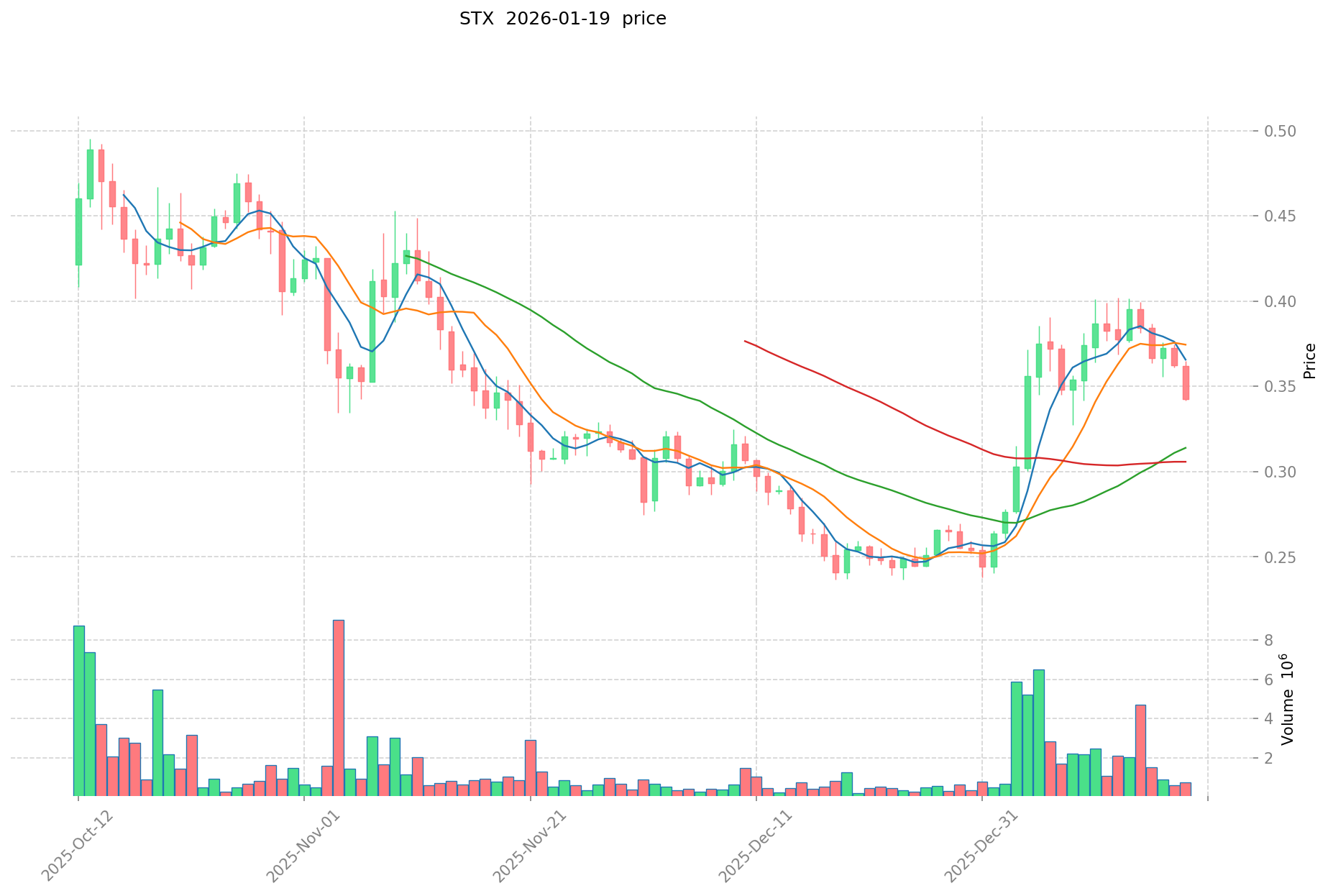
2024: Stacks witnessed significant market activity during this period, reaching its all-time high of $3.86 in April 2024 amid growing interest in Bitcoin layer-2 solutions and smart contract capabilities. The price trajectory demonstrated strong correlation with broader Bitcoin ecosystem developments.
-
Comparative Analysis: Throughout the recent market cycle, Tagger has navigated from its peak at $0.0012772 down to $0.0004165, representing substantial price adjustment. In contrast, Stacks has experienced a decline from $3.86 to $0.3247, reflecting different volatility patterns between emerging AI-focused tokens and established Bitcoin infrastructure projects.
Current Market Situation (2026-01-19)
- Tagger Current Price: $0.0004165
- Stacks Current Price: $0.3247
- 24-Hour Trading Volume: Tagger recorded $173,854.51 compared to Stacks' $573,825.93
- Market Sentiment Index (Fear & Greed Index): 44 (Fear)
View real-time prices:
- Check TAG current price Market Price
- Check STX current price Market Price
II. Core Factors Influencing TAG vs STX Investment Value
Supply Mechanism Comparison (Tokenomics)
- STX: The supply mechanism plays a significant role in shaping its market dynamics. Reference materials indicate that tokenomics structure influences investor assessment and long-term value positioning.
- Supply patterns and distribution models can affect price cycles, with historical data suggesting that well-designed token economics may support sustained ecosystem development.
- 📌 Historical Pattern: Supply mechanisms have demonstrated influence on price cycle fluctuations, with structured distribution models potentially contributing to market stability over time.
Institutional Adoption and Market Application
- Institutional Holdings: STX has shown potential appeal in decentralized market segments, with reference materials noting its positioning in the Bitcoin Layer 2 ecosystem.
- Market Application: STX's operational history and market liquidity characteristics have been highlighted in comparative analyses, suggesting established infrastructure development.
- Regulatory Positioning: Materials reference STX's regulatory status evolution, noting its progression toward greater decentralization, which may influence institutional consideration.
Technology Development and Ecosystem Building
- STX Technology Development: Positioned within the Bitcoin ecosystem infrastructure, STX represents efforts to enhance Bitcoin's programmability and capital efficiency.
- Ecosystem Comparison: Reference materials indicate STX's role in expanding Bitcoin's functional capabilities, with implications for decentralized applications and smart contract deployment.
- Market Infrastructure: STX has established presence on trading platforms, with materials noting potential for expanded exchange listings, which may enhance accessibility.
Macroeconomic Environment and Market Cycles
- Market Cycle Considerations: Reference materials discuss the influence of macroeconomic factors, including liquidity conditions and regulatory developments, on digital asset valuations.
- Institutional Sentiment: Materials indicate that institutional perspectives remain constructive for medium to long-term horizons, though caution increases at elevated valuation levels.
- Broader Economic Context: Factors such as monetary policy direction, compliance frameworks, and institutional allocation trends continue to shape market dynamics for digital assets including STX.
III. 2026-2031 Price Prediction: TAG vs STX
Short-term Prediction (2026)
- TAG: Conservative $0.000283 - $0.000417 | Optimistic $0.000417 - $0.000504
- STX: Conservative $0.185 - $0.324 | Optimistic $0.324 - $0.363
Medium-term Prediction (2028-2029)
- TAG may enter a gradual appreciation phase, with estimated price range of $0.000510 - $0.000923
- STX may enter a volatile expansion phase, with estimated price range of $0.188 - $0.493
- Key drivers: institutional capital inflows, ETF developments, ecosystem expansion
Long-term Prediction (2030-2031)
- TAG: Baseline scenario $0.000759 - $0.000942 | Optimistic scenario $0.000942 - $0.001319
- STX: Baseline scenario $0.333 - $0.459 | Optimistic scenario $0.459 - $0.611
View detailed price predictions for TAG and STX
Disclaimer
TAG:
| Year |
Predicted High Price |
Predicted Average Price |
Predicted Low Price |
Price Change |
| 2026 |
0.000504086 |
0.0004166 |
0.000283288 |
0 |
| 2027 |
0.00067210078 |
0.000460343 |
0.00039129155 |
10 |
| 2028 |
0.0007813862082 |
0.00056622189 |
0.000509599701 |
35 |
| 2029 |
0.000923111547267 |
0.0006738040491 |
0.00060642364419 |
61 |
| 2030 |
0.001085902605529 |
0.000798457798183 |
0.000758534908274 |
91 |
| 2031 |
0.001319052282599 |
0.000942180201856 |
0.000772587765522 |
126 |
STX:
| Year |
Predicted High Price |
Predicted Average Price |
Predicted Low Price |
Price Change |
| 2026 |
0.363216 |
0.3243 |
0.184851 |
0 |
| 2027 |
0.35407074 |
0.343758 |
0.2921943 |
5 |
| 2028 |
0.3977623818 |
0.34891437 |
0.1884137598 |
7 |
| 2029 |
0.492806656188 |
0.3733383759 |
0.216536258022 |
14 |
| 2030 |
0.48504121796928 |
0.433072516044 |
0.33346583735388 |
33 |
| 2031 |
0.610545633118831 |
0.45905686700664 |
0.376426630945444 |
41 |
IV. Investment Strategy Comparison: TAG vs STX
Long-term vs Short-term Investment Strategies
-
TAG: May appeal to investors focused on emerging AI data infrastructure opportunities, with positioning in decentralized data authentication protocols. The asset's early-stage characteristics suggest consideration for portfolios oriented toward speculative technology development in artificial intelligence sectors.
-
STX: May suit investors interested in established Bitcoin ecosystem infrastructure, with focus on smart contract capabilities and decentralized application development. The asset's operational history since 2019 suggests relevance for portfolios emphasizing Bitcoin layer-2 solutions and programmability expansion.
Risk Management and Asset Allocation
-
Conservative Investors: TAG 10-15% vs STX 85-90% - Conservative allocation may emphasize established infrastructure with documented operational history, limiting exposure to early-stage AI data protocols.
-
Aggressive Investors: TAG 30-40% vs STX 60-70% - More risk-tolerant approaches might incorporate higher allocation to emerging AI data solutions while maintaining substantial exposure to Bitcoin ecosystem infrastructure.
-
Hedging Tools: Stablecoin reserves for volatility management, options strategies for downside protection, cross-asset diversification across infrastructure and application layers.
V. Potential Risk Comparison
Market Risk
-
TAG: Early-stage market positioning introduces elevated volatility risk, with limited historical price data available for pattern analysis. Trading volume at $173,854.51 suggests liquidity considerations for position management.
-
STX: Established market presence with documented price history, though correlation with Bitcoin ecosystem developments may introduce concentration risk. Trading volume of $573,825.93 indicates relatively higher liquidity profile.
Technical Risk
-
TAG: Early infrastructure development phase may present technical implementation uncertainties, with cross-border data authentication protocols requiring continued validation and adoption.
-
STX: Network scalability considerations and infrastructure dependencies on Bitcoin base layer development. Security architecture evolution requires ongoing monitoring as ecosystem expands.
Regulatory Risk
- Different regulatory treatment potential based on asset classification and jurisdictional interpretations. STX's progression toward decentralization noted in materials may influence regulatory consideration. Both assets subject to evolving compliance frameworks affecting digital asset infrastructure.
VI. Conclusion: Which Is the Better Buy?
📌 Investment Value Summary:
-
TAG Considerations: Early-stage positioning in AI data infrastructure sector, with focus on decentralized authentication protocols. Price range $0.000283-$0.001319 across forecast period suggests potential for appreciation alongside infrastructure development risks.
-
STX Considerations: Established Bitcoin ecosystem infrastructure with operational history since 2019. Price range $0.185-$0.611 across forecast period reflects positioning in smart contract and decentralized application development within Bitcoin layer-2 landscape.
✅ Investment Considerations:
-
New Investors: May prioritize established infrastructure with documented operational history and relatively higher liquidity profiles. Consideration of STX's market presence alongside careful position sizing given current Fear & Greed Index reading of 44.
-
Experienced Investors: May evaluate allocation strategies incorporating both established Bitcoin infrastructure (STX) and emerging AI data solutions (TAG), with position sizing reflecting risk tolerance and portfolio objectives. Technical analysis and ecosystem development monitoring suggested for tactical adjustments.
-
Institutional Participants: May assess STX's positioning in Bitcoin programmability expansion and compliance framework evolution. TAG's early-stage characteristics may warrant specialized due diligence regarding infrastructure maturity and adoption trajectory.
⚠️ Risk Disclosure: Cryptocurrency markets exhibit substantial volatility. This analysis does not constitute investment advice. Participants should conduct independent research and consult qualified advisors before making allocation decisions.
VII. FAQ
Q1: What is the primary difference between TAG and STX in terms of market positioning?
TAG (Tagger) is an early-stage decentralized AI data solutions platform focusing on cross-border data authentication protocols, launched in December 2024. STX (Stacks), launched in October 2019, is an established Bitcoin Layer 2 infrastructure project enabling smart contracts and decentralized applications within the Bitcoin ecosystem. The fundamental distinction lies in their maturity levels and technological focus: TAG represents emerging AI data infrastructure with limited operational history, while STX provides proven Bitcoin programmability expansion with over five years of market presence.
Q2: Which asset demonstrates higher liquidity and trading volume?
STX exhibits significantly higher liquidity with 24-hour trading volume of $573,825.93 compared to TAG's $173,854.51 as of January 19, 2026. This approximately 3.3x difference in trading volume translates to better order execution capabilities, tighter bid-ask spreads, and reduced slippage for STX. For investors prioritizing position management flexibility and lower transaction costs, STX's established liquidity profile presents advantages over TAG's developing market depth.
Q3: How do the price volatility patterns differ between TAG and STX?
TAG has demonstrated substantial volatility since launch, declining from its August 2025 peak of $0.0012772 to current levels of $0.0004165—representing approximately 67% retracement. STX has experienced a decline from its April 2024 all-time high of $3.86 to $0.3247—approximately 92% from peak. However, STX's volatility occurs within a broader historical context spanning multiple market cycles since 2019, while TAG's price action reflects early-stage discovery dynamics typical of newly launched tokens in emerging sectors.
Q4: What are the projected price ranges for TAG and STX through 2031?
For TAG, conservative projections range from $0.000283 (2026 low) to $0.001319 (2031 high), representing potential appreciation of approximately 216% from current levels under optimistic scenarios. For STX, projections span from $0.185 (2026 low) to $0.611 (2031 high), indicating potential gains of approximately 88% from current prices under favorable conditions. These forecasts reflect different growth trajectories: TAG shows higher percentage potential tied to infrastructure adoption, while STX demonstrates more moderate appreciation aligned with Bitcoin ecosystem expansion.
Q5: Which asset is more suitable for conservative versus aggressive investment strategies?
Conservative investors may find STX more appropriate, with suggested allocation of 85-90% in balanced portfolios alongside TAG at 10-15%. This reflects STX's established operational history, higher liquidity, and documented market behavior across multiple cycles. Aggressive investors might consider allocating 60-70% to STX and 30-40% to TAG, incorporating exposure to emerging AI data infrastructure while maintaining substantial positioning in proven Bitcoin layer-2 solutions. The allocation differential acknowledges TAG's early-stage risk profile versus STX's infrastructure maturity.
Q6: What are the primary technical risks associated with each asset?
TAG faces technical implementation uncertainties inherent to early-stage infrastructure development, particularly regarding cross-border data authentication protocol validation and market adoption. The asset's limited operational track record introduces unknowns around infrastructure resilience and ecosystem integration. STX encounters technical considerations related to network scalability, dependencies on Bitcoin base layer development, and security architecture evolution as the ecosystem expands. Both assets require ongoing monitoring of technical development milestones and infrastructure maturation progress.
Q7: How does institutional adoption differ between TAG and STX?
STX has established positioning within institutional considerations of Bitcoin ecosystem infrastructure, with its progression toward greater decentralization noted in regulatory contexts. The asset's operational history since 2019 provides institutional participants with documented performance data and compliance framework evolution. TAG, as an early-stage AI data solutions platform, presents limited institutional adoption documentation, requiring specialized due diligence regarding infrastructure maturity and regulatory positioning. Institutional interest in TAG would likely require demonstrated protocol adoption and clearer regulatory classification.
Q8: What market conditions would favor TAG versus STX performance?
STX may outperform during periods of Bitcoin ecosystem expansion, increased smart contract adoption on Bitcoin infrastructure, and regulatory clarity favoring established layer-2 solutions. Favorable conditions include institutional capital flows into Bitcoin programmability infrastructure and ETF developments enhancing Bitcoin ecosystem accessibility. TAG may benefit from accelerated AI infrastructure adoption, institutional demand for decentralized data authentication solutions, and regulatory frameworks supporting cross-border data protocols. Broader market liquidity conditions, measured by indicators such as the Fear & Greed Index (currently 44), influence both assets' performance trajectories.
* The information is not intended to be and does not constitute financial advice or any other recommendation of any sort offered or endorsed by Gate.