This article compares two cryptocurrencies, Uniswap (UNI) and Bitcoin Cash (BCH), focusing on their long-term investment potentials. It evaluates historical price trends, supply mechanisms, institutional adoption, and macroeconomic impacts to determine which might be a better buy. UNI, a leading DeFi token on Ethereum, offers growth through protocol upgrades, while BCH, with its deflationary model, focuses on payment solutions. The analysis caters to new and experienced investors, suggesting strategies based on risk and asset allocation. For more details on price predictions, visit [Gate](https://www.gate.com).
Introduction: UNI vs BCH Investment Comparison
In the cryptocurrency market, the comparison between Uniswap (UNI) and Bitcoin Cash (BCH) has always been a topic that investors can't ignore. The two not only have significant differences in market cap ranking, application scenarios, and price performance, but also represent different positioning in the crypto asset space.
Uniswap (UNI): Since its launch in 2020, it has gained market recognition for being the first automatic market making transaction protocol based on Ethereum blockchain.
Bitcoin Cash (BCH): Launched in 2017 as a hard fork of Bitcoin, it has been touted as a peer-to-peer electronic cash system, focusing on on-chain scaling for global adoption.
This article will comprehensively analyze the investment value comparison between UNI and BCH, focusing on historical price trends, supply mechanisms, institutional adoption, technological ecosystems, and future predictions, and attempt to answer the question most concerning to investors:
"Which is the better buy right now?"
I. Price History Comparison and Current Market Status
UNI (Coin A) and BCH (Coin B) Historical Price Trends
- 2020: UNI launched in September, with its price initially fluctuating around $3-4.
- 2017: BCH was created through a hard fork of Bitcoin, with its price reaching an all-time high of $3,785.82 in December.
- Comparative analysis: During the 2021 bull market, UNI reached its all-time high of $44.92, while BCH peaked at around $1,600 but didn't surpass its 2017 high.
Current Market Situation (2025-11-14)
- UNI current price: $7.178
- BCH current price: $485.65
- 24-hour trading volume: UNI $13,626,579.72 vs BCH $7,178,408.64
- Market Sentiment Index (Fear & Greed Index): 16 (Extreme Fear)
Click to view real-time prices:
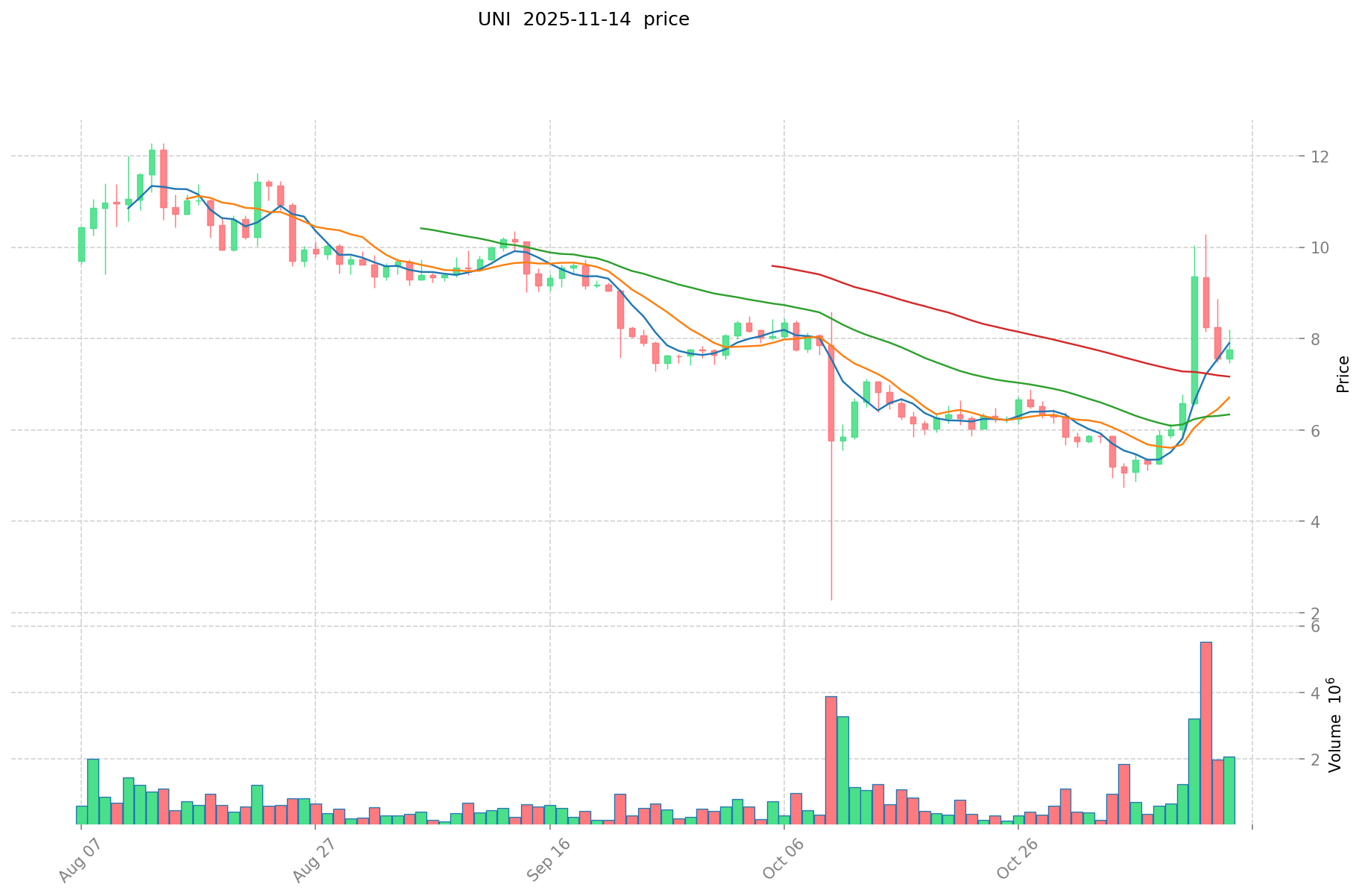
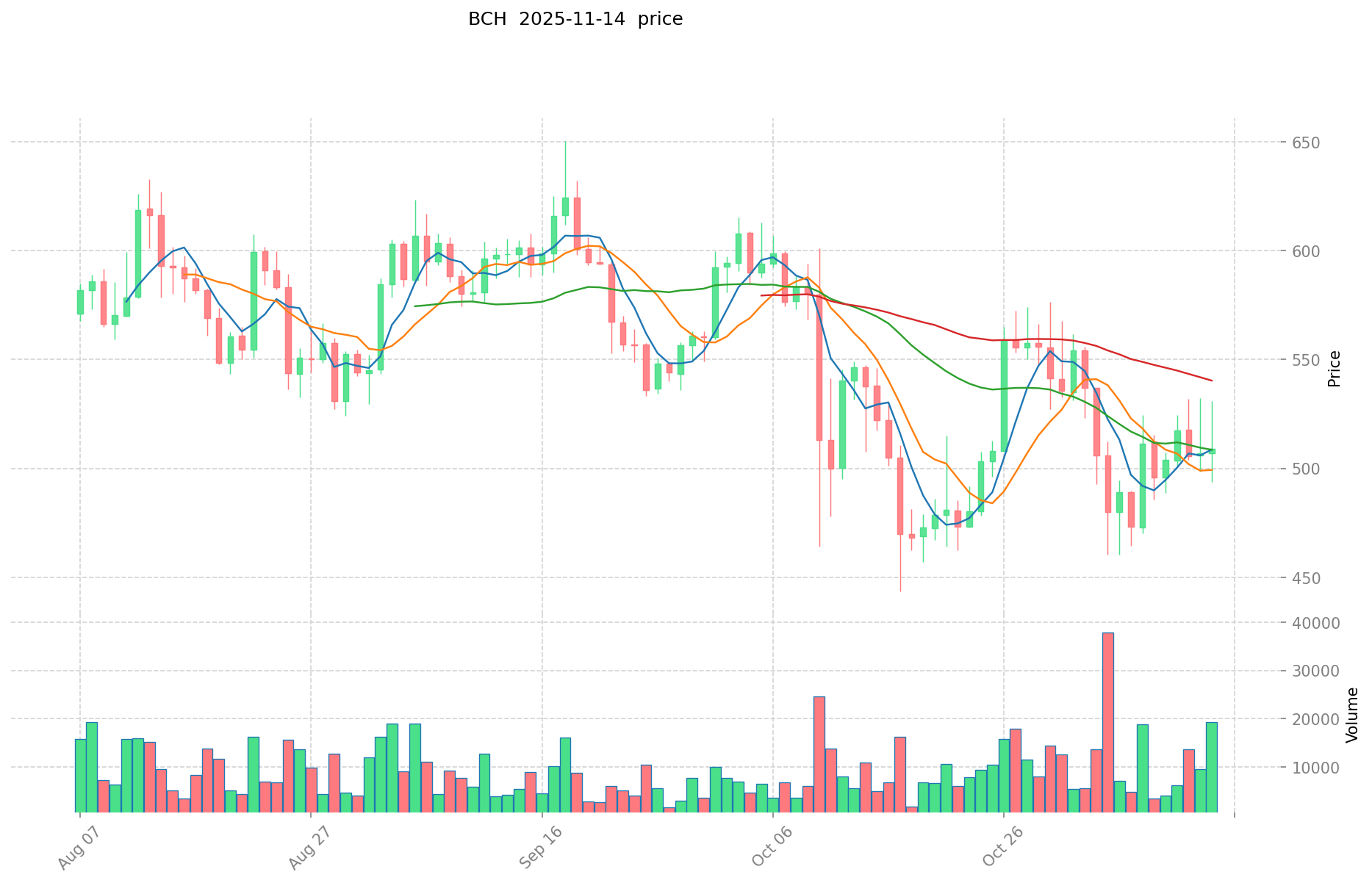
II. Core Factors Affecting the Investment Value of UNI vs BCH
Supply Mechanism Comparison (Tokenomics)
- UNI: Fixed supply of 1 billion tokens, with initial distribution to team members, investors, and community members. About 60% of the supply is allocated to community members through governance.
- BCH: Follows a deflationary model with halving mechanism similar to Bitcoin, with a maximum supply of 21 million coins.
- 📌 Historical Pattern: Fixed supply models like UNI typically create scarcity value during bull markets, while BCH's deflationary mechanism aims to preserve long-term value through controlled issuance.
Institutional Adoption and Market Applications
- Institutional Holdings: UNI has gained more institutional traction through DeFi exposure, while BCH has struggled to achieve the same level of institutional adoption as Bitcoin.
- Enterprise Adoption: UNI is primarily utilized within DeFi protocols and liquidity provisioning, while BCH focuses on payment solutions and merchant adoption for everyday transactions.
- Regulatory Attitudes: BCH faces fewer regulatory challenges as it's primarily positioned as a payment system, while UNI's governance token status creates regulatory uncertainty in some jurisdictions.
Technical Development and Ecosystem Building
- UNI Technical Upgrades: Uniswap V3 introduced concentrated liquidity and multiple fee tiers, significantly improving capital efficiency for liquidity providers.
- BCH Technical Development: Focused on scaling solutions, smart contracts via SmartBCH, and maintaining low transaction fees for payment use cases.
- Ecosystem Comparison: UNI leads in DeFi applications with billions in total value locked, while BCH has stronger adoption in payment systems and developing markets where transaction costs are critical.
Macroeconomic Factors and Market Cycles
- Performance in Inflationary Environments: BCH positions itself as an inflation hedge similar to Bitcoin, while UNI's value is more tied to DeFi sector growth and usage.
- Macroeconomic Monetary Policy: Interest rate hikes typically pressure both assets, but affect UNI more directly due to its connection to DeFi lending/borrowing markets.
- Geopolitical Factors: BCH benefits from cross-border payment demands in regions with currency restrictions, while UNI's utility remains largely within the crypto ecosystem regardless of geopolitical situations.
III. 2025-2030 Price Prediction: UNI vs BCH
Short-term Prediction (2025)
- UNI: Conservative $6.90 - $7.18 | Optimistic $7.18 - $8.84
- BCH: Conservative $369.00 - $485.53 | Optimistic $485.53 - $626.33
Mid-term Prediction (2027)
- UNI may enter a growth phase, with expected prices of $7.72 - $12.49
- BCH may enter a consolidation phase, with expected prices of $339.06 - $612.69
- Key drivers: Institutional capital inflow, ETF, ecosystem development
Long-term Prediction (2030)
- UNI: Base scenario $13.80 - $15.18 | Optimistic scenario $15.18 - $15.18
- BCH: Base scenario $832.36 - $1240.21 | Optimistic scenario $1240.21 - $1240.21
View detailed price predictions for UNI and BCH
Disclaimer: This analysis is for informational purposes only and should not be considered as financial advice. Cryptocurrency markets are highly volatile and unpredictable. Always conduct your own research before making any investment decisions.
UNI:
| 年份 |
预测最高价 |
预测平均价格 |
预测最低价 |
涨跌幅 |
| 2025 |
8.83509 |
7.183 |
6.89568 |
0 |
| 2026 |
11.0524821 |
8.009045 |
4.72533655 |
11 |
| 2027 |
12.4853002505 |
9.53076355 |
7.7199184755 |
32 |
| 2028 |
14.2003611513225 |
11.00803190025 |
9.466907434215 |
53 |
| 2029 |
14.998993865685637 |
12.60419652578625 |
7.814601845987475 |
75 |
| 2030 |
15.181754715309538 |
13.801595195735943 |
10.213180444844598 |
92 |
BCH:
| 年份 |
预测最高价 |
预测平均价格 |
预测最低价 |
涨跌幅 |
| 2025 |
626.3337 |
485.53 |
369.0028 |
0 |
| 2026 |
633.762309 |
555.93185 |
483.6607095 |
14 |
| 2027 |
612.692491885 |
594.8470795 |
339.062835315 |
22 |
| 2028 |
869.4284913972 |
603.7697856925 |
338.1110799878 |
24 |
| 2029 |
928.114914566511 |
736.59913854485 |
589.27931083588 |
51 |
| 2030 |
1240.211969567963945 |
832.3570265556805 |
757.444894165669255 |
71 |
IV. Investment Strategy Comparison: UNI vs BCH
Long-term vs Short-term Investment Strategies
- UNI: Suitable for investors focused on DeFi ecosystem potential and liquidity provision
- BCH: Suitable for investors seeking payment solutions and potential inflation hedge
Risk Management and Asset Allocation
- Conservative investors: UNI: 30% vs BCH: 70%
- Aggressive investors: UNI: 60% vs BCH: 40%
- Hedging tools: Stablecoin allocation, options, cross-currency portfolio
V. Potential Risk Comparison
Market Risks
- UNI: High correlation with DeFi sector performance and Ethereum ecosystem
- BCH: Susceptibility to Bitcoin market trends and competition from other payment-focused cryptocurrencies
Technical Risks
- UNI: Scalability issues on Ethereum, smart contract vulnerabilities
- BCH: Mining centralization, potential 51% attacks
Regulatory Risks
- Global regulatory policies may impact UNI more due to its governance token status, while BCH faces fewer immediate regulatory challenges as a payment system
VI. Conclusion: Which Is the Better Buy?
📌 Investment Value Summary:
- UNI advantages: Leading position in DeFi, strong ecosystem growth, potential for capital efficiency improvements
- BCH advantages: Established brand in crypto payments, deflationary model, focus on low transaction fees
✅ Investment Advice:
- New investors: Consider a balanced approach, leaning towards BCH for its simpler value proposition
- Experienced investors: Explore UNI for DeFi exposure while maintaining a position in BCH for diversification
- Institutional investors: Evaluate UNI for DeFi sector representation and BCH for potential payment system innovation
⚠️ Risk Warning: The cryptocurrency market is highly volatile, and this article does not constitute investment advice.
None
VII. FAQ
Q1: What are the main differences between UNI and BCH in terms of investment potential?
A: UNI represents the DeFi sector and is closely tied to the Ethereum ecosystem, offering potential growth through liquidity provision and protocol upgrades. BCH focuses on being a payment solution with a deflationary model similar to Bitcoin, aiming for widespread adoption as digital cash.
Q2: How do the supply mechanisms of UNI and BCH differ?
A: UNI has a fixed supply of 1 billion tokens, with about 60% allocated to community governance. BCH follows a deflationary model with a maximum supply of 21 million coins and a halving mechanism similar to Bitcoin.
Q3: Which coin has shown better price performance historically?
A: During the 2021 bull market, UNI reached its all-time high of $44.92, while BCH peaked at around $1,600 but did not surpass its 2017 high of $3,785.82. UNI has shown stronger short-term growth potential, while BCH has maintained a more stable long-term value.
Q4: How do institutional adoption rates compare between UNI and BCH?
A: UNI has gained more institutional traction through DeFi exposure, while BCH has struggled to achieve the same level of institutional adoption as Bitcoin. UNI is primarily utilized within DeFi protocols, whereas BCH focuses on payment solutions and merchant adoption.
Q5: What are the key technical developments for each coin?
A: UNI's Uniswap V3 introduced concentrated liquidity and multiple fee tiers, improving capital efficiency. BCH has focused on scaling solutions, smart contracts via SmartBCH, and maintaining low transaction fees for payment use cases.
Q6: How might macroeconomic factors affect UNI and BCH differently?
A: BCH positions itself as an inflation hedge similar to Bitcoin, while UNI's value is more tied to DeFi sector growth. Interest rate hikes typically pressure both assets but affect UNI more directly due to its connection to DeFi lending/borrowing markets.
Q7: What are the main risks associated with investing in UNI and BCH?
A: UNI faces risks related to Ethereum scalability issues and smart contract vulnerabilities. BCH risks include mining centralization and potential 51% attacks. Regulatory risks may impact UNI more due to its governance token status, while BCH faces fewer immediate regulatory challenges as a payment system.
* The information is not intended to be and does not constitute financial advice or any other recommendation of any sort offered or endorsed by Gate.














