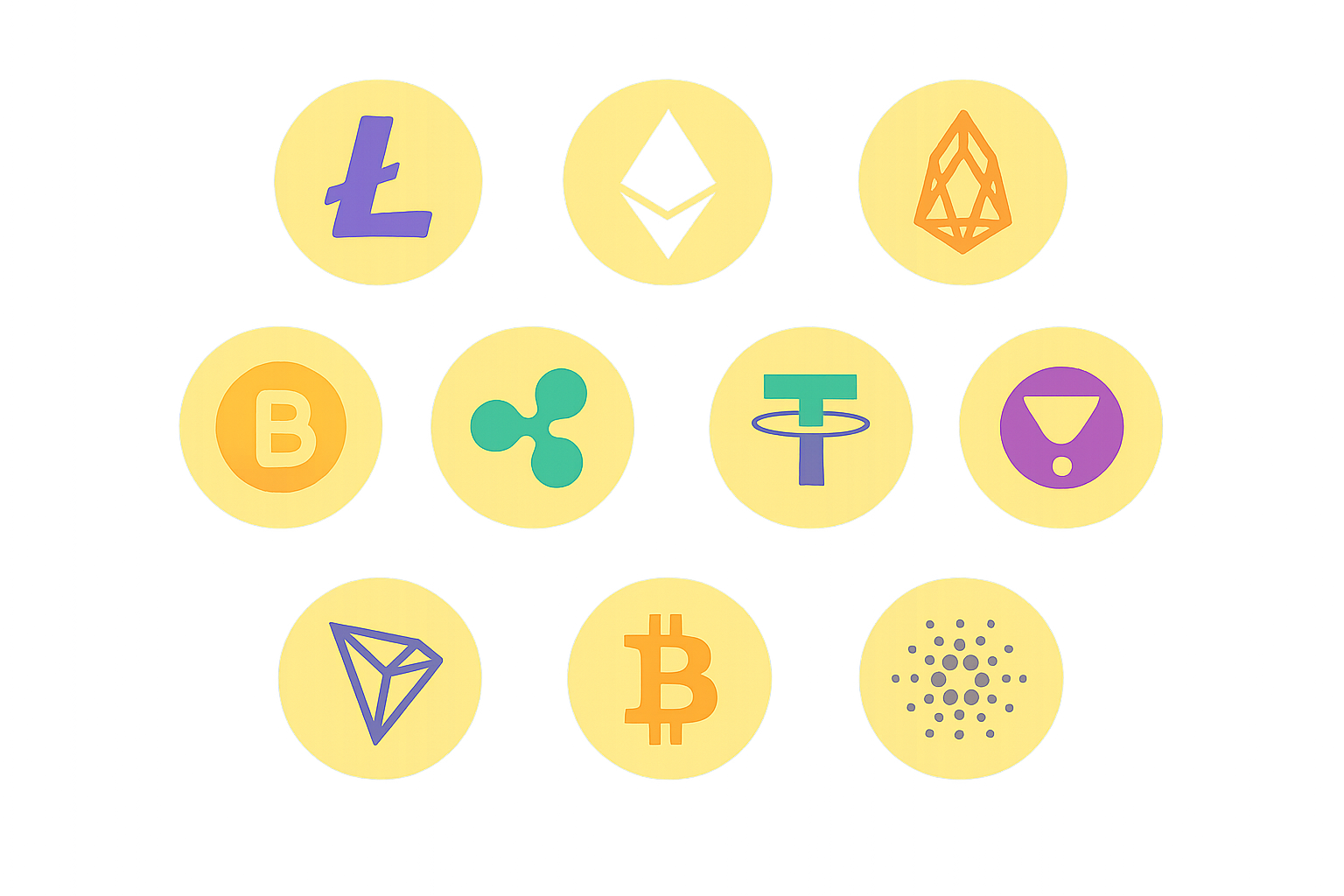
Explore the fundamentals of altcoins—their definition, mechanisms, and prospects within the broader cryptocurrency market. Review the top 10 altcoins, including standout tokens like Ethereum, Litecoin, and Tether, and learn best practices for secure investing on Gate. This comprehensive guide provides essential insights for both seasoned crypto investors and newcomers to blockchain and Web3 technologies.
What Is an Altcoin?
An altcoin, short for "alternative coin," refers to any cryptocurrency introduced after Bitcoin. Today, the crypto market has evolved to include more than 2,000 actively traded altcoins, each with its own distinct features and objectives.
The first altcoin was Namecoin, created in 2011—just two years after Bitcoin’s launch. Namecoin wasn’t just a digital currency; it aimed to decentralize domain name registration on the web, marking a new direction for blockchain technology beyond payments.
Although the market features thousands of altcoins, only projects with strong foundations, advanced technology, and real-world applications can survive and achieve sustainable growth. Not all altcoins are simple Bitcoin clones—many have developed unique value, breakthrough technologies, and specialized use cases. Some leading altcoins play vital roles in the rapidly growing NFT and DeFi markets.
Differences Between Altcoins and Bitcoin
Bitcoin was designed primarily as a decentralized means of payment and a store of value. In contrast, most altcoins were created to address Bitcoin’s limitations or to support different use cases.
Some altcoins, such as Litecoin, focus on faster transactions and lower fees. Others, like Ethereum, extend blockchain capabilities to enable smart contracts and decentralized applications. There are also altcoins built for specialized functions, including privacy (Monero), cross-border payments (Ripple), or the Internet of Things (IOTA).
Common Types of Altcoins
Altcoins are often categorized by their underlying technology and intended purpose:
Payment Coins: Primarily designed for payments, these coins offer improvements over Bitcoin in transaction speed and fees.
Stablecoins: Pegged to stable assets like the US dollar, gold, or other fiat currencies to reduce price volatility.
Utility Tokens: Used within specific blockchain ecosystems to access services or pay transaction fees.
Smart Contract Platforms: Support the development and deployment of decentralized applications (dApps) and smart contracts.
Privacy Coins: Emphasize privacy and anonymity in transactions.
Top 10 Altcoins
Litecoin (LTC): Dubbed the "silver" to Bitcoin’s "gold," Litecoin was launched in 2011 to serve as a more efficient decentralized digital payment system. Litecoin delivers faster transaction confirmations (2.5 minutes vs. Bitcoin’s 10 minutes), much lower fees, and a higher total supply (84 million LTC vs. 21 million BTC). These features make Litecoin well-suited for everyday transactions.
Ethereum (ETH): Ethereum is more than just a cryptocurrency—it’s a revolutionary second-generation blockchain platform. Launched in 2015, Ethereum introduced smart contracts, which are self-executing programs triggered by preset conditions. Ether (ETH) is used to pay network transaction fees (gas), deploy decentralized applications (dApps), and is the leading currency for Initial Coin Offerings (ICOs). Ethereum now powers thousands of DeFi, NFT, and Web3 projects.
EOS Token (EOS): EOS is a second-generation blockchain platform built to compete directly with Ethereum as infrastructure for dApps and decentralized autonomous organizations (DAOs). EOS employs Delegated Proof of Stake (DPoS), enabling thousands of transactions per second—far surpassing Ethereum’s capacity. To achieve this speed, EOS operates with just 21 elected validator nodes, resulting in lower decentralization.
Bitcoin Cash (BCH): Launched in August 2017 as a hard fork of Bitcoin, Bitcoin Cash addresses scalability by increasing block size from 1MB to 8MB (and later up to 32MB), enabling more transactions per block. This reduces confirmation times, lowers transaction fees, and saves energy. Bitcoin Cash aims to be a practical daily payment method, unlike Bitcoin, which is primarily seen as a store of value.
Ripple (XRP): XRP, developed by Ripple Labs, is a digital token designed for the financial and banking sectors. Unlike most altcoins, XRP facilitates real-time cross-border payments between financial institutions. It acts as a "liquidity bridge" between different fiat currencies, enabling rapid, low-cost transactions. XRP transactions settle in 3–5 seconds and can process up to 1,500 transactions per second.
Tether (USDT): Tether is the most widely used stablecoin, issued by Tether Limited. Each USDT maintains a 1:1 value with the US dollar, backed by corresponding asset reserves. Tether combines blockchain’s advantages—speed, transparency, and borderless transfers—with traditional currency stability. USDT is commonly used as a "safe haven" in volatile crypto markets and is a key medium for trading crypto pairs.
TRON (TRX): TRON is a blockchain platform aiming to decentralize the entertainment and digital content industry. Its core mission is to connect content creators directly with consumers, eliminating intermediaries. TRX tokens are used for content payments, creator rewards, and network services. TRON also supports high-speed, low-fee development of dApps and smart contracts.
Monero (XMR): Monero is a leading privacy-focused altcoin. Released in 2014, Monero uses advanced cryptographic techniques like ring signatures, stealth addresses, and confidential transactions to ensure complete privacy. Unlike Bitcoin’s public ledger, Monero transactions can’t be traced to the sender, recipient, or amount. Monero also offers faster transactions and better scalability through dynamic block sizing.
Cardano (ADA): Cardano is a third-generation blockchain platform built on academic research and rigorous scientific methodology. Its native token, ADA, is used for transaction fees, staking to secure the network, and governance. Cardano supports smart contracts, dApps, sidechains, and secure multiparty computation. It uses an energy-efficient Proof of Stake consensus mechanism and a unique layered architecture for optimal performance.
IOTA (MIOTA): IOTA is a unique altcoin project tailored for the Internet of Things (IoT). Unlike most blockchain-based altcoins, IOTA uses Tangle—a distributed ledger built on a directed acyclic graph (DAG). This architecture enables fee-free microtransactions between IoT devices and unlimited scalability as more devices join the network. IOTA can also be used as a digital currency for everyday transactions.
Summary
The altcoin market is highly diverse, with thousands of projects—each introducing distinctive ideas, technologies, and applications. While some altcoins seek to improve Bitcoin’s technical aspects such as speed, fees, and scalability, many others venture into completely new sectors.
Among the top 10 altcoins, there’s a broad spectrum of use cases: smart contract and dApp platforms (Ethereum, EOS, Cardano), next-generation payment coins (Litecoin, Bitcoin Cash), asset-backed stablecoins (Tether), cross-border payment solutions (Ripple), privacy coins (Monero), digital content ecosystems (TRON), and IoT integration (IOTA).
Choosing the right altcoin depends on your specific needs and intended use. Both investors and users should carefully research the technology, development team, project roadmap, and real-world utility before participating in any altcoin project. Although thousands of altcoins exist, only those with real value, robust technology, and strong communities are likely to achieve long-term growth.
FAQ
What Is an Altcoin? How Does It Differ from Bitcoin?
An altcoin is any cryptocurrency that serves as an alternative to Bitcoin. Unlike Bitcoin—the original coin—altcoins leverage different technologies and target a range of use cases. Some altcoins focus on smart contracts, dApps, or other unique features.
What Are the Most Popular Altcoins Right Now?
The most popular altcoins today include Ethereum (ETH), Binance Coin (BNB), Tether (USDT), XRP, and USD Coin (USDC). These cryptocurrencies have high trading volumes and are widely adopted across the global blockchain ecosystem.
What Are the Risks of Investing in Altcoins? Are Altcoins Safer or Is Bitcoin Safer?
Altcoins are generally riskier due to higher price volatility and lower liquidity compared to Bitcoin. Bitcoin is considered more secure, thanks to its long-standing and stable market presence, while altcoins are more speculative.
How Do You Choose a Good Altcoin to Invest In?
Prioritize technology, the development team, market demand, and the project’s long-term potential. Study use cases, community support, and trading volume. Avoid projects lacking solid fundamentals.
Can You Make Money with Altcoins? What Is Their Price Growth Potential?
Some altcoins offer significant growth potential as the market matures. However, returns are not guaranteed and depend on project selection and market timing. Careful research is essential before investing.
* The information is not intended to be and does not constitute financial advice or any other recommendation of any sort offered or endorsed by Gate.