This article provides a comprehensive overview of Balancer (BAL), an automated market maker protocol reshaping decentralized finance since its 2020 launch. It covers BAL's technical architecture built on Ethereum's blockchain, detailing how weighted pools and the Vault architecture enable efficient liquidity provision and self-balancing portfolios. The article examines BAL's current market performance with circulating supply of 64.58 million tokens and price volatility, while highlighting on-chain metrics including 48,525 token holders. Key sections explore Balancer's DeFi applications, strategic partnerships, community engagement, and participation methods through Gate and other platforms. Despite regulatory challenges and competitive pressures, Balancer's innovative governance model and ecosystem expansion position it as a significant infrastructure component in decentralized finance for both new and experienced participants.
Balancer's Position and Significance
In 2020, the Balancer team launched Balancer (BAL), aiming to address inefficiencies in decentralized liquidity provision and portfolio management.
As an automated market maker protocol with self-balancing properties, Balancer plays a key role in the DeFi sector.
As of 2026, Balancer has evolved into a significant infrastructure component within decentralized finance, with over 48,525 token holders and an active developer community.
This article will analyze its technical architecture, market performance, and future potential.
Origin and Development History
Birth Background
Balancer was created by the Balancer Labs team in 2020, aiming to solve the challenge of efficient automated portfolio rebalancing and liquidity provision in decentralized markets.
It emerged during the rapid expansion of DeFi protocols, with the goal of enabling liquidity providers to earn fees while maintaining diversified portfolios through automated rebalancing and changing the traditional approach.
Balancer's launch brought new possibilities to DeFi traders and liquidity providers.
Important Milestones
- 2020: Mainnet launch on Ethereum, implementing weighted pool functionality and automated market making.
- June 2020: BAL governance token distribution began, introducing community-driven protocol governance.
- 2021: Balancer V2 upgrade introduced the Vault architecture, significantly improving capital efficiency and gas optimization.
- 2022-2023: Ecosystem expansion with integration of multiple layer-2 solutions and cross-chain deployments.
- 2024-2025: Continued protocol development with advanced pool types and composable liquidity solutions.
With support from the Balancer community and Balancer Labs, Balancer continues to optimize its technology, security, and real-world applications.
How Balancer Works
No Central Control
Balancer operates on a decentralized network of nodes across the Ethereum blockchain and compatible networks, free from bank or government control.
These nodes collaborate to validate transactions, ensuring system transparency and attack resistance, granting users greater autonomy and enhancing network resilience.
Blockchain Core
Balancer's smart contracts operate on the Ethereum blockchain, a public and immutable digital ledger that records every transaction.
Transactions are grouped into blocks and linked through cryptographic hashes to form a secure chain.
Anyone can view the records, establishing trust without intermediaries.
Balancer V2's Vault architecture further enhances performance by enabling single-vault design for improved capital efficiency and reduced gas costs.
Ensuring Fairness
Balancer relies on Ethereum's Proof of Stake (PoS) consensus mechanism to validate transactions and prevent fraudulent activities such as double-spending.
Ethereum validators maintain network security through staking ETH and validating blocks, earning rewards in the process.
Balancer's innovation includes flexible weighted pools and customizable liquidity provision models.
Secure Transactions
Balancer utilizes public-private key cryptography to protect transactions:
- Private keys (similar to secret passwords) are used to sign transactions
- Public keys (similar to account numbers) are used to verify ownership
This mechanism ensures fund security while transactions maintain pseudonymous transparency on the blockchain.
Balancer's smart contract architecture incorporates multiple security audits and emergency pause functionality to enhance protocol safety.
Circulation Overview
As of January 21, 2026, Balancer's circulating supply stands at 64,580,537 BAL tokens, with a total supply of 71,290,745 BAL. The maximum supply is capped at 96,150,704 BAL, indicating a fixed supply model with potential for further distribution.
New tokens enter the market through liquidity mining rewards and ecosystem incentives, influencing the supply-demand dynamics of the protocol. The current circulation ratio represents approximately 67.17% of the total supply, suggesting controlled token distribution over time.
Price Volatility
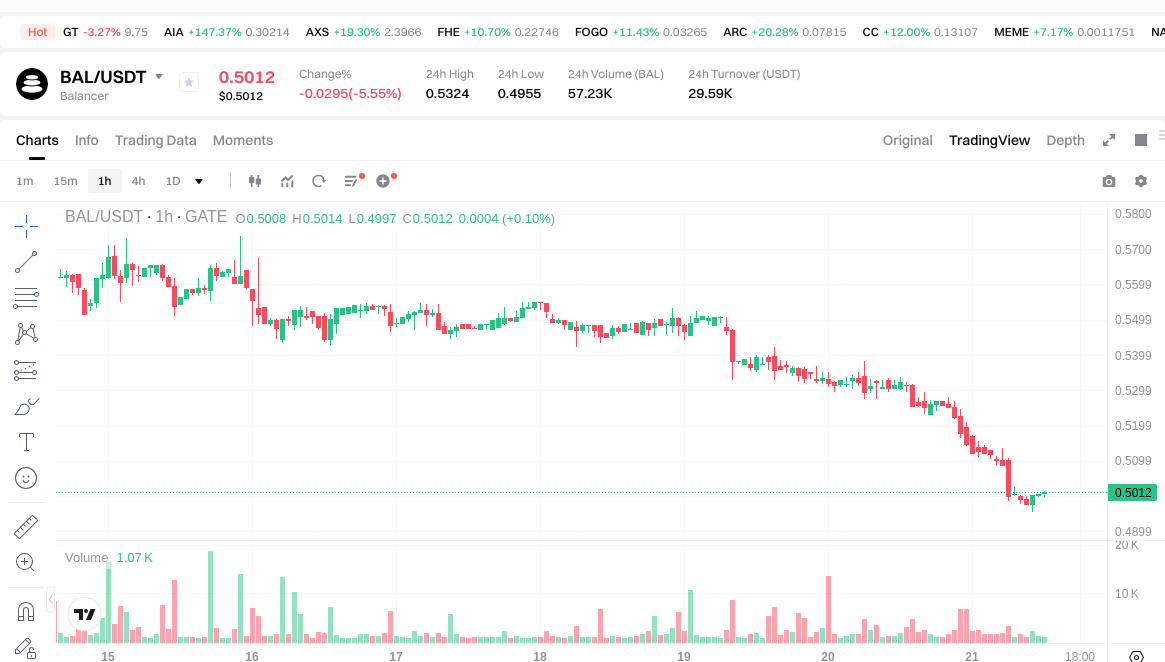
Balancer reached its all-time high price of $74.45 on May 4, 2021, driven by the broader DeFi summer momentum and increased adoption of automated market maker protocols during the cryptocurrency bull market cycle.
The lowest price of $0.49734 was recorded on January 21, 2026, reflecting current market pressures and broader cryptocurrency market downturns. As of the latest update, BAL is trading at $0.4997, showing a 24-hour decline of 5.8% and a 7-day decline of 11.70%.
These fluctuations reflect market sentiment shifts, adoption trends, and external macroeconomic factors affecting the decentralized finance sector. The token has experienced an 81.47% decline over the past year, indicating significant market challenges.
Click to view the current BAL market price
On-Chain Metrics
- 24-Hour Trading Volume: Approximately $29,551.81 (indicating current market activity levels)
- Token Holders: 48,525 addresses (reflecting user base distribution)
- Market Cap to Fully Diluted Valuation Ratio: 67.17% (demonstrating the proportion of tokens currently in circulation relative to maximum supply)
- Market Dominance: 0.0011% (representing Balancer's share within the broader cryptocurrency market)
The current market capitalization stands at approximately $32.27 million, while the fully diluted valuation reaches $35.62 million, suggesting limited additional dilution risk from token unlocks.
Balancer Ecosystem Applications and Strategic Partners
Core Use Cases
Balancer's ecosystem supports multiple applications:
- DeFi: Balancer Protocol provides automated market making and liquidity provisioning, enabling users to create customizable liquidity pools with multiple tokens and flexible weightings.
- Portfolio Management: The platform facilitates self-balancing investment portfolios, where liquidity providers earn trading fees while maintaining desired asset allocations.
Strategic Partnerships
Balancer has established collaborations within the DeFi ecosystem, enhancing its technical capabilities and market presence.
These partnerships provide a solid foundation for Balancer's ecosystem expansion.
Controversies and Challenges
Balancer faces the following challenges:
- Technical Issues: Complexity in pool management and potential smart contract vulnerabilities
- Regulatory Risks: Evolving DeFi regulations and compliance requirements across jurisdictions
- Competitive Pressure: Competition from other automated market makers and decentralized exchanges in the rapidly evolving DeFi landscape
These issues have sparked discussions within the community and market, while also driving Balancer's continuous innovation.
Balancer's community demonstrates active participation, with 48,525 token holders as of January 21, 2026.
On X platform, relevant posts and hashtags (such as #Balancer and #BAL) frequently generate engagement.
Protocol updates and liquidity mining programs have energized community enthusiasm.
Sentiment on X shows diverse perspectives:
- Supporters praise Balancer's innovative approach to automated market making and customizable liquidity pools, viewing it as a valuable tool for decentralized portfolio management.
- Critics focus on price volatility and market challenges, with BAL experiencing significant fluctuations.
Recent trends indicate mixed sentiment, with the token showing a decline of 5.8% over 24 hours and 11.70% over 7 days.
Hot Topics
X users actively discuss Balancer's protocol innovations, liquidity incentives, and governance mechanisms,
showcasing both its transformative potential and the challenges in achieving broader adoption.
- Official Website: Visit Balancer Official Website to learn about features, use cases, and latest developments.
- White Paper: Balancer White Paper details its technical architecture, objectives, and vision.
- X Updates: On X platform, Balancer maintains an active presence via @Balancer,
posting content about protocol upgrades, community initiatives, and ecosystem developments, generating substantial engagement.
How to Participate in Balancer?
- Purchase Options: Buy BAL on cryptocurrency exchanges including Gate.com
- Storage Solutions: Securely store tokens using compatible wallets such as MetaMask or hardware wallets
- Governance Participation: Engage in community decision-making through the Balancer governance forum
- Ecosystem Building: Visit developer documentation to build applications or contribute to the protocol
Summary
Balancer has redefined decentralized finance through innovative automated market making technology, providing flexible liquidity provisioning, customizable pool creation, and self-balancing portfolio management.
Its active community, comprehensive resources, and established market presence distinguish it within the cryptocurrency sector.
Despite facing regulatory uncertainties and competitive pressures, Balancer's innovative approach and commitment to decentralized finance position it as a noteworthy protocol in the evolving DeFi landscape.
Whether you are new to DeFi or an experienced participant, Balancer merits attention and engagement.
FAQ
What is BAL (Balancer) token and what does it do?
BAL is the governance token of Balancer, a decentralized automated market maker (AMM) protocol. It enables holders to participate in governance decisions, earn protocol fees, and incentivize liquidity provision on the platform. BAL tokens are distributed to liquidity providers as rewards.
How can I buy and store BAL tokens?
You can purchase BAL tokens on major cryptocurrency exchanges using fiat or other cryptocurrencies. Store them in a secure wallet such as MetaMask, Ledger, or Trezor for optimal security and control over your assets.
What is Balancer protocol and how does BAL token provide governance?
Balancer is an automated market maker enabling liquidity pools with custom token weights. BAL token holders govern protocol decisions through voting on proposals, fee structures, and treasury allocation, ensuring community-driven development.
What are the risks and benefits of investing in BAL cryptocurrency?
BAL offers governance participation and yield farming opportunities through Balancer protocol. Benefits include liquidity rewards and protocol ownership. Risks include market volatility, smart contract vulnerabilities, and liquidity challenges. Investors should assess personal risk tolerance carefully.
How does BAL compare to other DeFi governance tokens?
BAL enables liquidity providers to govern Balancer protocol through voting and proposal mechanisms. Unlike other DeFi governance tokens, BAL uniquely rewards liquidity provision while granting governance rights, creating stronger incentive alignment between token holders and protocol success.
What is the total supply and tokenomics of BAL?
BAL has a maximum supply of 100 million tokens. The tokenomics include community governance allocation, liquidity mining rewards, and team/investor vesting schedules designed to support long-term ecosystem development and decentralized governance participation.
* The information is not intended to be and does not constitute financial advice or any other recommendation of any sort offered or endorsed by Gate.