Biconomy (BICO) is a decentralized infrastructure platform launched in 2021 to simplify Web3 adoption by eliminating complexity and high transaction costs. This comprehensive guide explores how Biconomy enables gasless transactions, cross-chain functionality, and seamless user experiences through its developer-friendly API and meta-transaction technology. As of January 2026, BICO trades at $0.04196 with a market cap of approximately $41.96 million across 28 exchanges including Gate. The article analyzes Biconomy's technical architecture built on Ethereum's security layer, market performance dynamics including notable price volatility, and its growing ecosystem of DeFi and cross-chain applications. Key topics covered include token economics with 1 billion fixed supply, on-chain metrics showing 17,190 token holders, community engagement trends, competitive challenges, and the platform's roadmap for enhanced infrastructure development. Whether you're a developer seeking Web3 integration tools or an investor eval
Biconomy's Position and Significance
In 2021, the Biconomy team launched Biconomy (BICO), aiming to address the complexity and high costs associated with Web3 user experiences.
As a developer tool provider simplifying Web3 interactions, Biconomy plays a key role in decentralized application development and user onboarding.
As of 2026, Biconomy has established itself as a recognized infrastructure solution in the Web3 ecosystem, with an active developer community and ongoing technological development.
This article will provide an in-depth analysis of its technical architecture, market performance, and future potential.
Origin and Development History
Birth Background
Biconomy was created by its founding team in 2021, aiming to solve the barriers to mass adoption of Web3 applications, including complex wallet interactions and gas fee management.
It emerged during the rapid expansion of decentralized finance and blockchain applications, with the goal of enabling seamless user experiences through simplified transaction processes and reduced operational costs.
Biconomy's launch brought new possibilities for developers building user-friendly decentralized applications.
Important Milestones
- 2021: Mainnet launch with the introduction of meta-transaction capabilities and gasless transaction infrastructure.
- December 2021: BICO token trading began, with initial circulation on Gate.com and other platforms.
- 2022-2024: Ecosystem expansion with integration of cross-chain application support and ERC20 token gas payment solutions.
- 2025: Continued development of zero-gas transfer applications to further reduce user friction in Web3 interactions.
With support from its community and development team, Biconomy continues to optimize its technology, security features, and real-world applications.
How Biconomy Works
No Central Control
Biconomy operates as a decentralized infrastructure layer serving Web3 applications globally, independent of traditional intermediaries.
The protocol enables developers to implement customized user experiences without requiring users to manage complex blockchain operations directly.
This approach grants developers greater flexibility and enhances network accessibility for end users.
Blockchain Foundation
Biconomy's infrastructure is built on Ethereum, leveraging its public, immutable ledger to record and verify transactions.
The protocol utilizes smart contracts deployed on Ethereum to facilitate meta-transactions, gasless operations, and cross-chain functionality.
Anyone can verify the protocol's operations through the blockchain explorer, establishing trust without intermediaries.
The system's modular API architecture further enhances integration capabilities for developers.
Ensuring Efficiency
Biconomy employs Ethereum's Proof of Stake (PoS) consensus mechanism as its underlying security layer, benefiting from Ethereum's network security.
Developers and relayers within the Biconomy ecosystem facilitate transaction processing and gas management to maintain network functionality and user experience optimization.
Its innovation includes enabling users to pay gas fees in ERC20 tokens rather than native ETH, simplifying the onboarding process.
Secure Transactions
Biconomy uses public-private key cryptography to protect transactions:
- Private keys (similar to secret passwords) are used to sign transactions
- Public keys (similar to account numbers) are used to verify ownership
This mechanism ensures fund security while maintaining pseudonymous transaction privacy consistent with Ethereum's design.
The protocol implements meta-transaction relayer systems to enable gasless user experiences while maintaining cryptographic security standards.
Circulation Overview
As of January 20, 2026, Biconomy's circulating supply is 999,998,453.89 BICO tokens, with a total supply of 1,000,000,000 BICO, representing a circulation ratio of approximately 100%. The maximum supply is capped at 1,000,000,000 tokens, indicating a fixed supply model with no inflationary mechanism.
Price Volatility
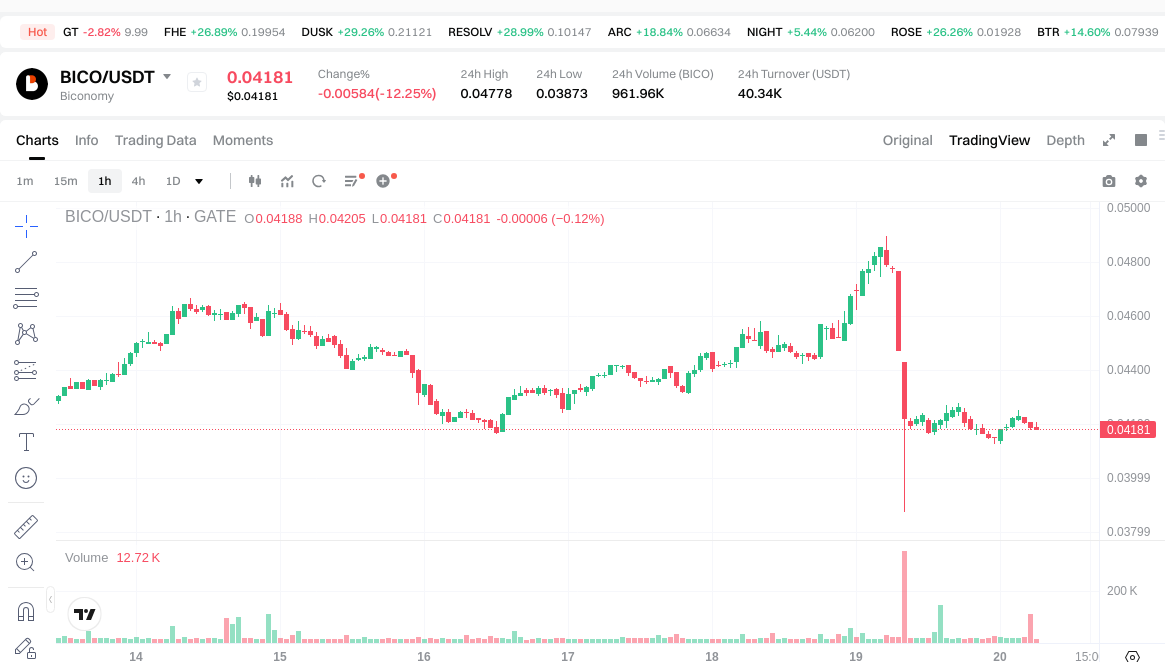
BICO reached its peak price of $21.45 on December 2, 2021, driven by favorable market conditions during the broader cryptocurrency bull market and growing interest in Web3 infrastructure solutions. The token's lowest recorded price was $0.0398811, which occurred on December 19, 2025, reflecting market-wide bearish sentiment and potential selling pressure. As of January 20, 2026, BICO is trading at $0.04196, showing a 24-hour decline of 11.79% and a one-year decrease of 85.16%. The 24-hour trading range spans from $0.03873 to $0.04778, demonstrating notable intraday volatility. These price movements reflect shifts in market sentiment, adoption trends, and external market factors affecting the broader cryptocurrency ecosystem.
Click to view the current BICO market price
On-chain Metrics
- Token Holders: 17,190 addresses hold BICO tokens, indicating the breadth of community participation and token distribution across the network.
- Exchange Listings: BICO is available on 28 cryptocurrency exchanges, providing multiple access points for traders and investors.
- Market Capitalization: The current market cap stands at approximately $41.96 million, representing 0.0012% of the total cryptocurrency market, with a market cap to fully diluted valuation ratio of 100%.
Biconomy Ecosystem Applications and Partners
Core Use Cases
Biconomy's ecosystem supports multiple applications:
- DeFi: Projects such as decentralized exchanges and lending protocols leverage Biconomy's gasless transaction capabilities to provide seamless user experiences.
- Cross-chain Applications: Through Biconomy's API, developers enable interoperability across different blockchain networks, facilitating asset transfers and data exchange.
Strategic Partnerships
Biconomy has established collaborations with various blockchain projects and protocols, enhancing its technical capabilities and market reach.
These partnerships provide a solid foundation for Biconomy's ecosystem expansion.
Controversies and Challenges
Biconomy faces the following challenges:
- Technical Challenges: Scaling solutions and maintaining seamless cross-chain functionality require continuous development
- Regulatory Risks: The evolving regulatory landscape for Web3 infrastructure presents potential compliance considerations
- Competitive Pressure: The emergence of alternative Web3 infrastructure providers creates a dynamic competitive environment
These issues have sparked discussions within the community and market, while also driving Biconomy's ongoing innovation.
Biconomy's community demonstrates active participation, with the token showing trading activity across 28 exchanges.
On X platform, discussions and hashtags related to Biconomy appear regularly among Web3 developer communities.
New feature releases and integration announcements generate community interest.
Sentiment on X presents varied perspectives:
- Supporters praise Biconomy's developer-friendly tools and gasless transaction features, viewing it as essential infrastructure for Web3 adoption.
- Critics focus on price volatility and competitive dynamics in the Web3 infrastructure sector.
Recent trends reflect the broader market conditions affecting infrastructure tokens.
Popular Topics
X users discuss Biconomy's API integration capabilities, gas fee abstraction technology, and cross-chain functionality,
showcasing both its potential to simplify Web3 experiences and the challenges of mainstream adoption.
- Official Website: Visit Biconomy's official website for features, use cases, and latest updates.
- X Updates: On X platform, Biconomy maintains an active presence through @biconomy,
with posts covering technical updates, community activities, and partnership announcements.
Biconomy Future Roadmap
- Ongoing Development: Enhancement of cross-chain capabilities and gasless transaction infrastructure
- Ecosystem Goals: Expansion of developer tools and API integrations to support wider Web3 adoption
- Long-term Vision: To become essential infrastructure enabling seamless Web3 user experiences
How to Participate in Biconomy?
- Purchase Channels: Buy BICO on Gate.com and other supported exchanges
- Storage Solutions: Use compatible wallets such as MetaMask to securely store BICO tokens
- Build Ecosystem: Access developer documentation on the official website to integrate Biconomy's API into applications
Summary
Biconomy addresses key challenges in Web3 adoption through its developer tools and infrastructure, providing gasless transactions, cross-chain functionality, and simplified user experiences.
Its active development, strategic positioning in the Web3 infrastructure sector, and focus on developer needs make it a notable project in the cryptocurrency space.
Despite facing market volatility and competitive pressures, Biconomy's commitment to simplifying Web3 interactions positions it as relevant infrastructure in the decentralized technology landscape.
Whether you are a developer or crypto enthusiast, Biconomy's approach to Web3 infrastructure merits attention.
FAQ
What is BICO (Biconomy) and what problem does it solve in the Web3 ecosystem?
Biconomy (BICO) is a Web3 infrastructure platform that abstracts blockchain complexity for users. It solves key problems by enabling gasless transactions, simplifying user onboarding, and improving transaction efficiency through meta-transactions and relayers, making Web3 more accessible.
How does BICO token work and what are its use cases?
BICO is the native token of Biconomy, a Web3 infrastructure platform. It powers transaction relaying, meta-transactions, and gasless transactions. BICO holders can stake tokens for network security, participate in governance decisions, and access premium protocol features. The token enables seamless user experiences by abstracting gas complexities in blockchain applications.
Where can I buy BICO tokens and what are the associated risks?
BICO tokens are available on major cryptocurrency exchanges. Purchase directly through spot trading pairs. Risks include market volatility, liquidity fluctuations, and smart contract vulnerabilities. Always verify exchange security and use secure wallets for storage.
What is the difference between BICO and other Web3 infrastructure projects?
BICO stands out through its focus on accessible blockchain infrastructure and developer tools. It emphasizes interoperability, user-friendly solutions, and enterprise-grade reliability, enabling seamless Web3 adoption across diverse applications and user bases.
What is the tokenomics and total supply of BICO?
BICO has a total supply of 1 billion tokens. The tokenomics include community allocation, team vesting, and ecosystem development funds designed to support long-term growth and decentralized governance of the Biconomy protocol.
* The information is not intended to be and does not constitute financial advice or any other recommendation of any sort offered or endorsed by Gate.