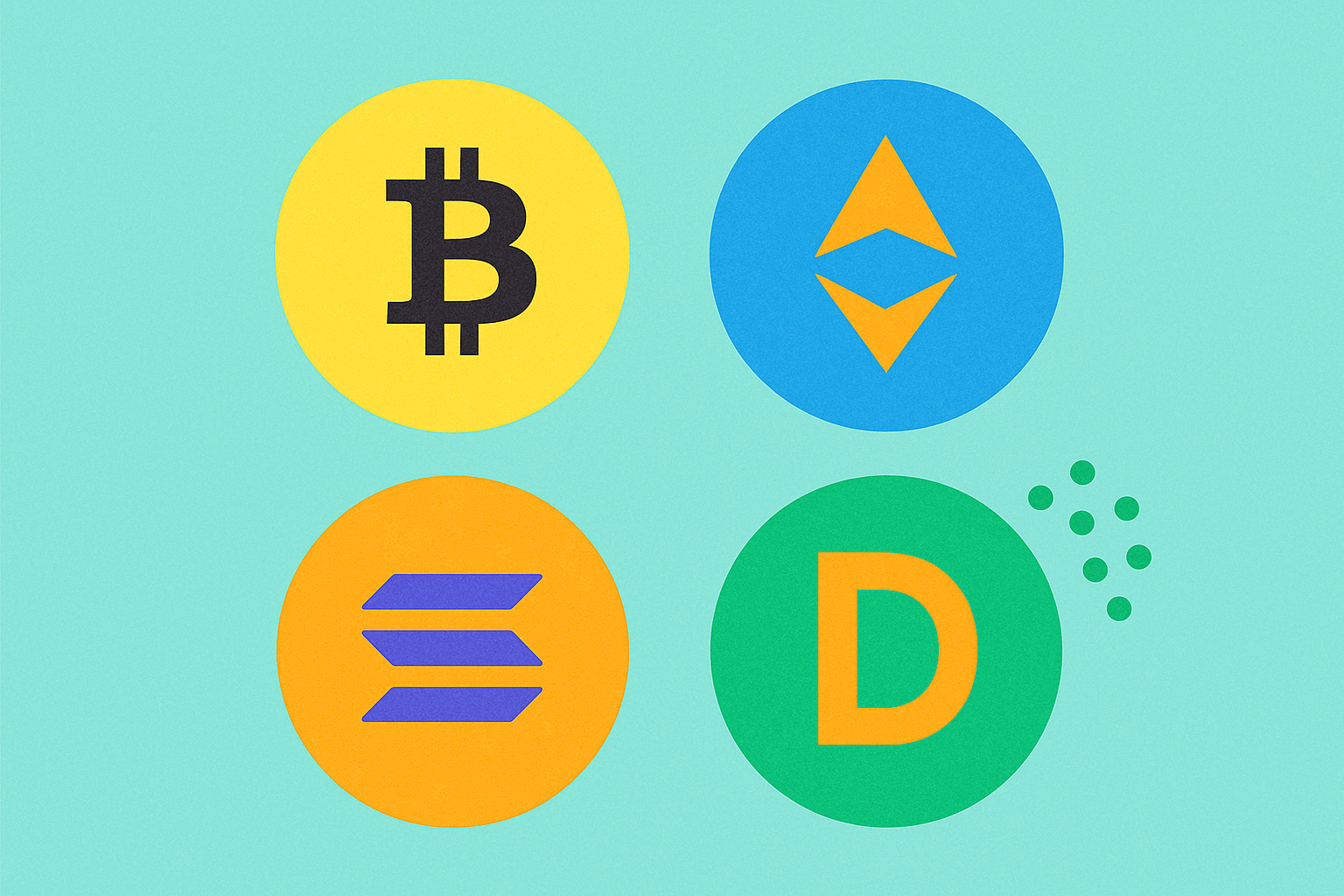
This competitive analysis examines how Dogecoin positions itself against Bitcoin, Ethereum, and Solana in 2026's evolving cryptocurrency landscape. Bitcoin dominates with $1.2 trillion valuation as digital gold, while Ethereum controls 63% of DeFi TVL through smart contract infrastructure, and Solana leads with 4000 TPS transaction speed. Dogecoin differentiates through community-driven meme culture and celebrity endorsements, offering faster transactions and lower fees than Bitcoin and Ethereum. The approval of Dogecoin ETFs catalyzed significant institutional participation, with concentrated inflows outperforming distributed XRP products. While DOGE ranks ninth globally at $21.4 billion, it excels as a micropayment tool for tipping and everyday transactions, though facing competitive pressures from stronger fundamentals of established cryptocurrencies and declining retail trader interest in 2026.
Market dominance comparison: Bitcoin's $1.2 trillion valuation versus Ethereum's 63% DeFi TVL share and Solana's 4000 TPS transaction speed
The cryptocurrency market reveals stark contrasts in how different blockchain networks achieve dominance through distinct mechanisms. Bitcoin maintains its position as the market leader with a projected valuation of $1.2 trillion in 2026, establishing the benchmark for overall market capitalization and network security-based trust. This dominance reflects Bitcoin's role as the primary store of value in the crypto ecosystem, attracting institutional investment and serving as the gateway for most new market participants.
Ethereum pursues dominance through a different lens, controlling 63% of total value locked across decentralized finance protocols. This DeFi TVL share demonstrates Ethereum's specialized strength in building financial infrastructure and smart contract applications, with approximately $70 billion deployed across its ecosystem. Unlike Bitcoin's broad market dominance, Ethereum's power concentrates in enabling the infrastructure that powers decentralized applications and financial services.
Solana distinguishes itself through technical performance metrics, achieving 4000 TPS transaction throughput that far exceeds competitors' processing speeds. This velocity advantage addresses scalability challenges inherent in other networks, creating advantages for high-frequency trading and applications requiring rapid settlement. The transaction speed differential illustrates how blockchain networks compete on technical capabilities beyond market valuation alone.
Dogecoin occupies a different competitive position entirely, with a $21.4 billion market capitalization ranking it ninth globally. While significantly smaller than these competing standards, Dogecoin's longevity and community-driven adoption demonstrate that market dominance manifests through multiple pathways beyond pure technological specifications or financial infrastructure control.
Differentiated competitive advantages: Dogecoin's meme culture and celebrity endorsements versus Bitcoin's store-of-value positioning
Dogecoin and Bitcoin represent fundamentally divergent positioning strategies within the cryptocurrency market. Dogecoin's competitive advantage originates from its meme culture foundation and the infectious enthusiasm of its community. This memecoin thrives on social media engagement, where celebrity endorsements—particularly from figures like Elon Musk and Mark Cuban—amplify awareness and adoption. The Dallas Mavericks' acceptance of Dogecoin as payment further demonstrates how celebrity and influencer backing can drive credibility within niche communities. However, this social-driven momentum creates significant volatility and market sensitivity.
Bitcoin, conversely, pursues an institutional positioning as digital gold. Its store-of-value narrative rests on verifiable scarcity—a fixed maximum supply of 21 million coins—and functions as a hedge against inflation. This economic fundamentalism contrasts sharply with Dogecoin's unlimited supply and speculative nature. Research indicates that while celebrity endorsements provide temporary adoption boosts, Bitcoin's market legitimacy derives from macroeconomic narratives and institutional acceptance rather than social media trends. Investors perceive Bitcoin as a long-term wealth preservation mechanism, whereas Dogecoin appeals primarily to enthusiasts seeking speculative gains. The sustainability question differs: Bitcoin's value proposition anchors to established monetary principles, while Dogecoin's longevity depends on maintaining community engagement and favorable social sentiment.
Market share evolution: Dogecoin's ETF approval driving institutional adoption while competing with 6 XRP ETF products in the altcoin landscape
Dogecoin's ETF approval catalyzed a significant shift in institutional participation within the altcoin landscape. Following the SEC's authorization for spot Dogecoin trading products in late 2025, the asset attracted substantial capital inflows, with leveraged DOGE funds driving notable market activity by early 2026. This institutional influx fundamentally altered Dogecoin's market share dynamics, positioning it more competitively among leading cryptocurrencies.
The competitive landscape reveals an interesting contrast. While Dogecoin features a streamlined single-product ETF approach, XRP's ecosystem encompasses six distinct trading vehicles—including UXRP, XRPR, TOXR, and offerings from Canary Capital, Bitwise, and 21Shares. Despite the numerical advantage, early 2026 data demonstrates Dogecoin ETFs outperforming their XRP counterparts in terms of inflow momentum and market impact. XRP spot ETFs accumulated $1.37 billion in assets under management while Dogecoin leveraged products rebounded with aggressive gains.
This performance differential suggests that concentrated institutional interest through a single Dogecoin product may drive more pronounced market effects than distributed capital across multiple XRP platforms. As the altcoin market matures, Dogecoin's emerging institutional presence increasingly competes for investor capital previously concentrated in Bitcoin and Ethereum, reshaping overall market share distribution within the sector.
FAQ
What are the main differences between Dogecoin (DOGE) and Bitcoin (BTC)?
DOGE was created for community and humor, while BTC is a serious digital currency. Bitcoin has larger market capitalization, stricter security protocols, and greater institutional adoption. DOGE offers faster transaction times and lower fees, appealing to retail users and community-driven projects.
How does Dogecoin compare to Ethereum (ETH) and Solana (SOL) in transaction speed and costs in 2026?
Dogecoin offers faster transaction speeds than Ethereum but lower throughput than Solana. Transaction fees on Dogecoin remain significantly lower than Ethereum, though Solana's costs are comparable. By 2026, Dogecoin maintains its advantage in affordability while Solana leads in speed and capacity.
What are Dogecoin's technical innovations and development roadmap? Can it compete with other mainstream cryptocurrencies?
Dogecoin focuses on community-driven development and ecosystem projects. Its roadmap emphasizes accessibility and social use cases. While competitive in transaction speed and community engagement, it lacks the advanced features of Bitcoin, Ethereum, and Solana in smart contracts and institutional adoption.
Dogecoin excels as a micropayment and tipping tool due to its low transaction fees and fast confirmation times. Its main use cases include social media tips, gaming rewards, and community donations. Compared to Bitcoin and Ethereum, DOGE offers superior transaction speed and cost efficiency for small-value payments, making it ideal for everyday transactions rather than store-of-value purposes.
How does Dogecoin rank in terms of market liquidity and trading volume among cryptocurrencies?
Dogecoin consistently ranks in the top ten cryptocurrencies by liquidity and trading volume. Its stable market position is supported by strong community engagement and widespread adoption, maintaining substantial daily trading activity across global markets.
What are the main competitive threats and risk factors facing Dogecoin in 2026?
Dogecoin faces weakening retail demand and competition from Bitcoin, Ethereum, and Solana. Limited utility, reduced trader interest, and decreased open positions threaten its market position. Rising institutional adoption of alternatives further pressures DOGE's relevance in the evolving crypto landscape.
How does Dogecoin's community ecosystem and developer support compare to BTC and ETH?
Dogecoin has an active and vibrant community known for charitable initiatives, but developer support and technical innovation lag significantly behind Bitcoin and Ethereum. While BTC and ETH drive continuous protocol upgrades and attract top developers, DOGE relies on legacy code with limited ecosystem development.
From an investment perspective, how does Dogecoin's long-term value potential compare to Bitcoin and Ethereum?
Bitcoin and Ethereum have stronger fundamentals and established use cases, offering more stable long-term value potential. Dogecoin's value is primarily driven by speculation and social sentiment, making it higher risk with less intrinsic utility compared to Bitcoin's scarcity and Ethereum's smart contract ecosystem.
* The information is not intended to be and does not constitute financial advice or any other recommendation of any sort offered or endorsed by Gate.