KernelDao is a decentralized restaking ecosystem on Ethereum and BNB Chain, launched in 2025 to address liquidity fragmentation and maximize staked asset utility in DeFi. With over $2 billion TVL across 10 chains, 50+ DeFi partnerships, and 13,192 active holders, KERNEL token trades on Gate and 32 exchanges. This guide covers KernelDao's technical architecture utilizing smart contracts and public-private key cryptography, market performance including price volatility and on-chain metrics, and its ecosystem applications in shared security and automated vault strategies. Explore how KernelDao operates without central control, its community engagement, and participation opportunities through staking, governance, and DeFi integration while understanding the challenges in multi-chain infrastructure management.
KernelDao's Positioning and Significance
In 2025, the KernelDao team launched KernelDao (KERNEL), aiming to address challenges in maximizing staked asset utility, liquidity fragmentation, and network security across decentralized finance ecosystems.
As a restaking ecosystem on Ethereum and BNB Chain, KernelDao plays a critical role in DeFi infrastructure and liquidity optimization.
As of 2026, KernelDao has established itself as a significant player in the restaking space, with over $2 billion TVL locked across 10 chains, 50+ DeFi partnerships, and 30+ projects building within its ecosystem. This article provides an in-depth analysis of its technical architecture, market performance, and future potential.
Origin and Development Timeline
Background
KernelDao was created by its founding team in 2025, aiming to solve inefficiencies in staked asset utilization, fragmented liquidity pools, and security vulnerabilities across blockchain networks.
It emerged during the evolution of restaking protocols and growing demand for shared security models, with the goal of enabling cross-chain asset management and maximizing rewards through automated vault strategies.
KernelDao's launch brought new possibilities for DeFi protocols, institutional stakers, and individual crypto holders seeking optimized yield strategies.
Key Milestones
- 2025: Mainnet launch on Ethereum and BNB Chain, implementing restaking infrastructure and automated vault strategies.
- 2025: Platform expansion reaching $2 billion+ TVL across 10 blockchain networks.
- 2025: Ecosystem growth with 50+ DeFi partnerships and 30+ projects integrating KernelDao protocols.
- 2025: Token listing on Gate.com and 32 cryptocurrency exchanges, enhancing market accessibility.
With support from its development team and growing community, KernelDao continues to enhance its technology, security features, and real-world applications.
How KernelDao Works
No Central Control
KernelDao operates on decentralized networks across Ethereum and BNB Chain, functioning without control from banks or governments.
These distributed nodes collaborate to validate transactions and manage restaking operations, ensuring system transparency and attack resistance while granting users greater autonomy and enhancing network resilience.
Blockchain Foundation
KernelDao's infrastructure utilizes blockchain technology as a public, immutable digital ledger recording all restaking activities and transactions.
Operations are organized into blocks, linked through cryptographic hashing to form a secure chain.
Anyone can verify records without intermediaries, establishing trust through transparency.
The platform's smart contract systems enable secure asset management and efficient reward distribution across its multi-chain ecosystem.
Ensuring Fairness
KernelDao leverages smart contract-based protocols on Ethereum and BNB Chain consensus mechanisms to validate transactions and prevent fraudulent activities.
Network participants contribute through providing liquidity, staking assets, or utilizing vault strategies, helping maintain network security while earning KERNEL rewards.
Its innovation includes cross-chain restaking capabilities and automated optimization strategies that enhance capital efficiency.
Secure Transactions
KernelDao employs public-private key cryptography to protect transactions:
- Private keys (similar to secret passwords) are used to authorize operations
- Public keys (similar to account numbers) are used to verify ownership
This mechanism ensures fund security while transactions maintain transparency within the protocol's security framework.
The platform integrates advanced smart contract systems for additional security layers in asset management and reward distribution.
Circulation Overview
As of January 25, 2026, KERNEL's circulating supply stands at 162,317,496 tokens, with a total supply of 1,000,000,000 tokens representing a fixed supply model.
The current circulation ratio is approximately 16.23%, indicating that a significant portion of tokens remains to be released into the market, which may influence future supply-demand dynamics.
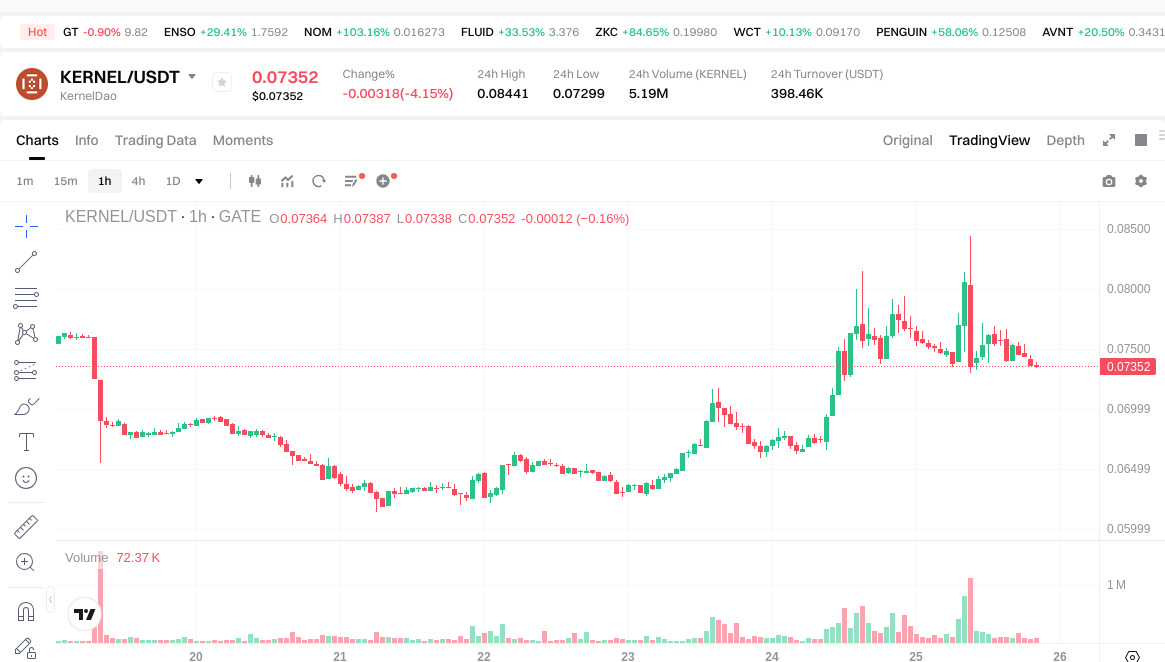
Price Volatility
KERNEL reached a notable price level of $0.4998 on April 14, 2025, driven by factors such as ecosystem expansion and increased DeFi partnerships.
Its lower price point was $0.05612, occurring on December 18, 2025, influenced by broader market conditions and sentiment shifts.
These fluctuations reflect the interplay of market sentiment, adoption trends, and external factors affecting the restaking ecosystem.
Click to view current KERNEL market price
On-Chain Metrics
- Market Capitalization: Approximately $11.97 million (indicating current market valuation)
- 24-Hour Trading Volume: $402,254.92 (reflecting trading activity levels)
- Active Holders: 13,192 addresses (demonstrating user participation in the ecosystem)
KernelDAO Ecosystem Applications and Partners
Core Use Cases
KernelDAO's ecosystem supports multiple applications:
- DeFi: With over 50 DeFi partners integrated, the platform provides restaking and automated vault strategies that maximize asset utility across Ethereum and BNB Chain.
- Network Security Enhancement: Projects building on Kernel ecosystem leverage shared security mechanisms to strengthen network infrastructure while optimizing liquidity management.
Strategic Partnerships
KernelDAO has established collaborations with 50+ DeFi partners and 30+ projects building within its ecosystem, enhancing its technical capabilities and market reach across 10 blockchain networks.
These partnerships provide a solid foundation for KernelDAO's ecosystem expansion, with the Total Value Locked (TVL) reaching substantial levels across multiple chains.
Controversies and Challenges
KernelDAO faces the following challenges:
- Technical Complexities: Managing secure asset management and efficient reward distribution across multiple blockchain networks requires sophisticated smart contract systems
- Market Volatility: The token has experienced price fluctuations, with recent data showing varied performance across different time periods
- Competitive Landscape: Operating in the restaking sector means facing competition from other blockchain protocols offering similar staking and security solutions
These issues have sparked discussions within the community and market, while also driving KernelDAO's continuous innovation.
KernelDAO's community demonstrates notable activity, with 13,192 holders participating in the ecosystem as of January 25, 2026.
The platform has achieved meaningful adoption across its supported networks, with projects and users engaging with restaking functionalities.
Factors such as new protocol launches and partnership announcements have contributed to community enthusiasm.
Sentiment on X shows diverse perspectives:
- Supporters praise KernelDAO's innovative approach to restaking and shared security, viewing it as a valuable infrastructure component for maximizing staked asset utility.
- Critics focus on market performance concerns and the complexities of navigating multi-chain ecosystems.
Recent trends indicate mixed sentiment as the project continues developing its technology and expanding partnerships.
Popular Topics
X users actively discuss KernelDAO's restaking mechanisms, smart contract security, and cross-chain integration capabilities,
showcasing both its innovative potential and the challenges in building comprehensive multi-chain infrastructure.
- Official Website: Visit KernelDAO Official Site for features, use cases, and latest updates.
- Documentation: KernelDAO Documentation provides detailed information about its technical architecture, objectives, and vision.
- X Updates: On X platform, KernelDAO maintains an active presence via @kernel_dao,
with posts covering technical upgrades, community events, and partnership announcements.
KernelDAO Future Roadmap
- Ongoing Development: Advancing smart contract systems and automated vault strategies to enhance security and reward distribution efficiency
- Ecosystem Goals: Expanding cross-chain integration and strengthening partnerships within the DeFi landscape
- Long-term Vision: Becoming a leading infrastructure provider for restaking and shared security across multiple blockchain networks
How to Participate in KernelDAO?
- Purchase Options: Acquire KERNEL on Gate.com and other supporting exchanges
- Storage Solutions: Securely store tokens using compatible Ethereum-based wallets
- Ecosystem Participation: Explore restaking opportunities and automated vault strategies through the platform
- Development Contribution: Access KernelDAO Documentation to learn about building on the ecosystem
Summary
KernelDAO leverages blockchain technology to redefine restaking infrastructure, offering shared security, enhanced network protection, and optimized reward generation across Ethereum and BNB Chain.
Its growing ecosystem of partners, substantial TVL across multiple chains, and focus on secure asset management position it as a notable player in the restaking sector.
Despite facing market volatility and multi-chain technical complexities, KernelDAO's innovative approach and expanding partnership network give it a meaningful role in the evolution of decentralized finance infrastructure.
Whether you're new to crypto or an experienced participant, KernelDAO represents an interesting development in blockchain security and staking solutions.
FAQ
What is Crypto KERNEL and how does it work?
Crypto KERNEL is a blockchain protocol designed to enhance transaction efficiency and security. It operates through a distributed network architecture, utilizing consensus mechanisms to validate transactions and maintain ledger integrity. KERNEL enables decentralized applications with improved scalability and reduced computational overhead.
What is the purpose and function of KERNEL in blockchain systems?
KERNEL serves as a core governance and utility token in blockchain ecosystems, enabling decentralized decision-making, protocol upgrades, and staking mechanisms. It facilitates network participation and incentivizes validators while providing holders with voting rights on critical infrastructure decisions.
How does Crypto KERNEL differ from other blockchain consensus mechanisms?
Crypto KERNEL employs an innovative hybrid consensus model combining Proof of Stake with advanced cryptographic validation, offering superior energy efficiency, faster transaction finality, and enhanced security compared to traditional PoW or standard PoS mechanisms.
Is Crypto KERNEL secure? What are the potential risks?
Crypto KERNEL employs advanced encryption and multi-layer security protocols to protect user assets. While blockchain technology is inherently secure, risks include market volatility, smart contract vulnerabilities, and user error. Always practice proper security hygiene and due diligence.
What are the real-world applications of Crypto KERNEL technology?
Crypto KERNEL enables decentralized computing, smart contract optimization, and scalable blockchain infrastructure. Applications include DeFi protocols, enterprise data security, IoT device networks, and cross-chain interoperability solutions for enhanced transaction efficiency.
How do you use or interact with Crypto KERNEL in practice?
You can interact with Crypto KERNEL by holding tokens in your wallet, participating in governance voting, staking for rewards, and engaging with ecosystem dApps. Transfer tokens peer-to-peer, monitor holdings through blockchain explorers, and leverage smart contracts for decentralized finance activities within the network.
* The information is not intended to be and does not constitute financial advice or any other recommendation of any sort offered or endorsed by Gate.