Layer3 (L3) is a revolutionary omnichain identity and distribution protocol addressing attention fragmentation in the crypto ecosystem. Launched in 2023, Layer3 commoditizes attention as a scarce resource while providing decentralized identity management across multiple blockchain networks. This comprehensive guide explores Layer3's technical architecture, market performance with 22,890 token holders, and ecosystem applications. With a circulating supply of 1.19 billion L3 tokens and market capitalization of $14.4 million, Layer3 operates through decentralized nodes ensuring transaction security and fairness. The article covers core use cases, competitive challenges, community sentiment on social platforms, purchasing options on Gate.com, and Layer3's strategic roadmap for becoming crypto's leading attention commoditization protocol. Whether you're a newcomer or blockchain enthusiast, understand how Layer3 transforms user-owned value through innovative distribution mechanisms and cross-chain functionality.
Layer3's Positioning and Significance
In 2023, the Layer3 team launched Layer3 (L3), aiming to address attention fragmentation and distribution inefficiency in the crypto ecosystem.
As the infrastructure for user-owned value and crypto's first protocol to commoditize attention, Layer3 plays a critical role in identity management, user engagement, and distribution.
As of 2026, Layer3 has established itself as an innovative protocol in the crypto ecosystem, with approximately 22,890 token holders and an active developer community.
This article will provide an in-depth analysis of its technical architecture, market performance, and future potential.
Origin and Development History
Birth Background
Layer3 was created by its founding team in 2023, aiming to solve the challenge of attention scarcity and fragmentation across multiple blockchain networks.
It emerged during the proliferation of L1s, L2s, and L3s competing for user mindshare, with the goal of creating an open identity, incentive, and interface network owned by participants to transform the current landscape.
Layer3's launch brought new possibilities for projects seeking effective user distribution strategies and community engagement.
Important Milestones
- June 2023: Official launch, introducing the omnichain identity and distribution protocol.
- 2024-2025: Ecosystem expansion with growing adoption of the attention commoditization framework.
- March 2025: Token reached a notable price level of 0.16087.
- 2025-2026: Continued protocol development with over 22,890 holders participating in the network.
With support from its community and development team, Layer3 continues to refine its technology, security, and real-world applications.
How Layer3 Works?
No Central Control
Layer3 operates on a decentralized network of nodes distributed globally, free from control by banks or governments.
These nodes collaboratively validate transactions, ensuring system transparency and attack resistance, granting users greater autonomy and enhancing network resilience.
Blockchain Core
Layer3's blockchain serves as a public, immutable digital ledger recording every transaction.
Transactions are grouped into blocks and linked through cryptographic hashes to form a secure chain.
Anyone can view the records, establishing trust without intermediaries.
The protocol's omnichain architecture enables cross-chain identity and distribution functionality, further enhancing performance.
Ensuring Fairness
Layer3 implements mechanisms to validate transactions and prevent fraudulent activities.
Network participants maintain system security through their engagement and contribution activities, supporting the protocol's decentralized nature.
Its innovation includes commoditizing attention as a scarce resource and creating sustainable distribution strategies.
Secure Transactions
Layer3 utilizes public-private key cryptography to protect transactions:
- Private keys (similar to secret passwords) are used to sign transactions
- Public keys (similar to account numbers) are used to verify ownership
This mechanism ensures fund security while transactions maintain pseudonymous characteristics.
The protocol's identity framework provides additional security features for user interactions across multiple chains.
Circulation Overview
As of January 25, 2026, Layer3's circulating supply stands at 1,190,381,329.57 L3 tokens, with a total supply of 3,333,333,333 tokens, representing a circulation ratio of approximately 35.71%. The token operates under a fixed supply model with a maximum cap of 3,333,333,333 L3 tokens.
The token follows an ERC-20 standard. The distribution dynamics influence supply-demand relationships as tokens gradually enter circulation through protocol mechanisms.
Price Fluctuation
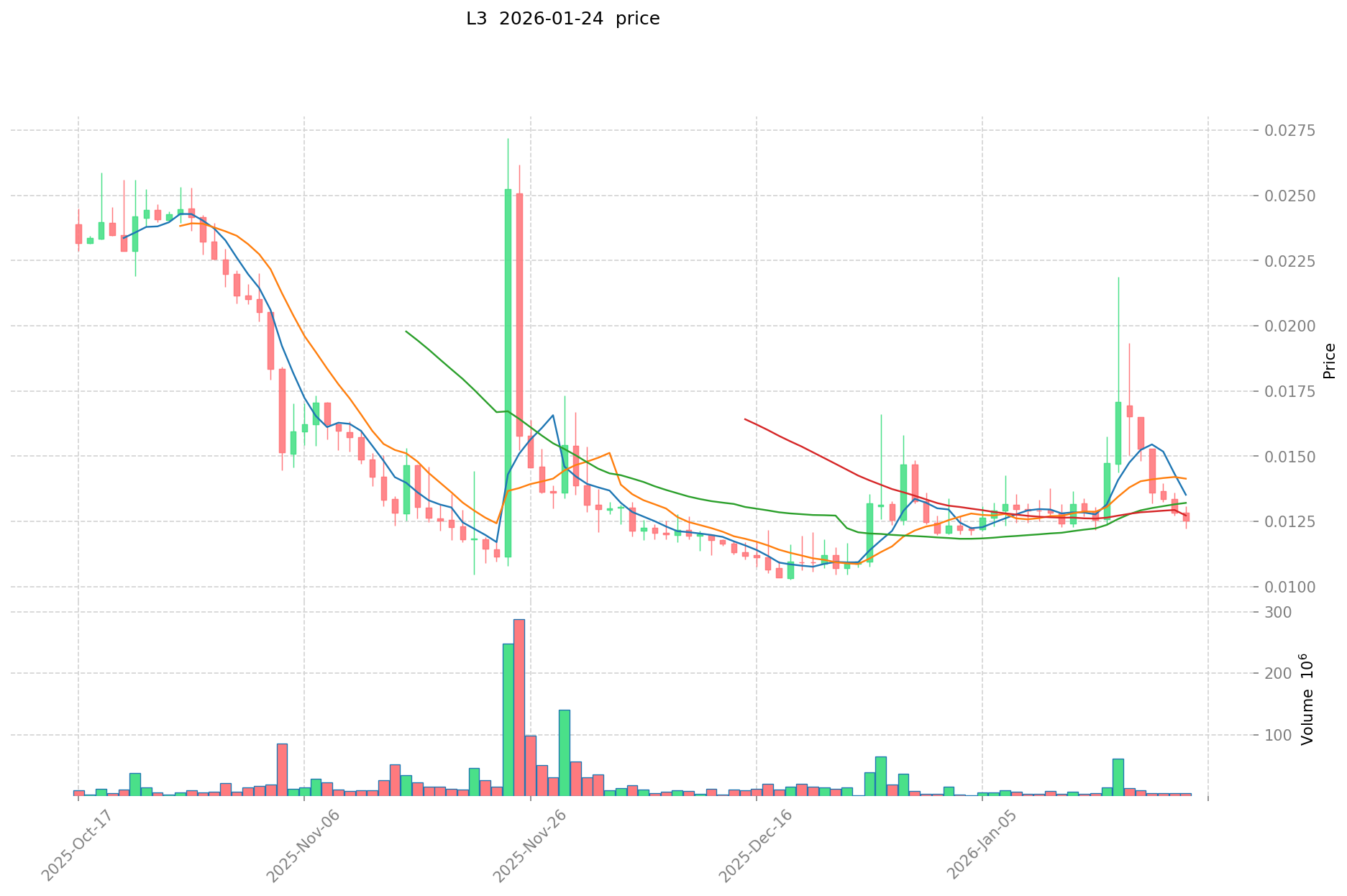
Layer3 reached its peak price of $0.16087 on March 28, 2025, driven by market conditions during that period.
The token recorded its lowest price of $0.01026 on December 19, 2025, reflecting market volatility and broader sector trends.
Recent price movements show:
- 1-hour change: -0.82% (-$0.0001)
- 24-hour change: -3.66% (-$0.0004596)
- 7-day change: -31.20% (-$0.005487)
- 30-day change: +11.01% (+$0.0012)
- 1-year change: -88.83% (-$0.09623)
These fluctuations demonstrate the token's sensitivity to market sentiment, adoption patterns, and external factors within the cryptocurrency ecosystem.
Click to view current L3 market price
On-chain Metrics
- 24-hour Trading Volume: $77,998.38 (indicating network activity levels)
- Holder Count: 22,890 addresses (reflecting user participation)
- Market Capitalization: $14,403,614.09 (representing current market valuation)
Layer3 Ecosystem Applications and Partners
Core Use Cases
Layer3's ecosystem supports multiple applications:
- Identity Management: Layer3's omnichain identity protocol, providing decentralized user identity and reputation systems across multiple chains.
- Distribution Protocol: Incentive mechanisms, driving user attention commoditization and engagement rewards.
Strategic Partnerships
Layer3 has established partnerships to enhance its technical capabilities and market influence.
These partnerships provide a solid foundation for Layer3's ecosystem expansion.
Controversies and Challenges
Layer3 faces the following challenges:
- Technical Issues: Attention fragmentation across multiple L1s, L2s, and L3s creating distribution complexity
- Competition Pressure: Rising competition from new blockchain layers and AI-driven ecosystems
These issues have sparked discussions within the community and market, while also driving Layer3's continuous innovation.
Layer3's community demonstrates notable activity, with 22,890 holders as of the latest data.
On X platform, related posts and hashtags (such as #Layer3 or #L3) frequently appear in trending topics.
New feature releases and protocol updates have ignited community enthusiasm.
Sentiment on X shows polarization:
- Supporters praise Layer3's innovative approach to attention commoditization and omnichain identity, considering it "the infrastructure for user-owned value".
- Critics focus on price volatility and ecosystem fragmentation challenges.
Recent trends indicate mixed sentiment with cautious optimism.
Hot Topics
X users actively discuss Layer3's attention economy model, identity protocol implementation, and competition from similar distribution platforms,
showcasing both its transformative potential and obstacles toward mainstream adoption.
- Official Website: Visit Layer3 Official Site for features, use cases, and latest updates.
- White Paper: Layer3 White Paper details its technical architecture, goals, and vision.
- X Updates: On X platform, Layer3 is active using @layer3xyz, with posts covering protocol updates, community activities, and partnership announcements, generating substantial engagement.
Layer3 Future Roadmap
- Upcoming Development: Expansion of omnichain identity protocol and distribution mechanisms, enhancing cross-chain user experience
- Ecosystem Goals: Building an open identity, incentive, and interface network owned by participants
- Long-term Vision: Becoming the leading protocol for attention commoditization in crypto
How to Participate in Layer3?
- Purchase Channels: Buy L3 on Gate.com and other supporting exchanges
- Storage Solutions: Use compatible ERC-20 wallets for secure storage
- Participate in Governance: Engage with the community through official channels to contribute to protocol development
- Build Ecosystem: Visit developer documentation to integrate with Layer3's identity and distribution protocol
Summary
Layer3 redefines user-owned value through blockchain technology, providing decentralized identity management, attention commoditization, and omnichain distribution.
Its active community, comprehensive resources, and market presence position it distinctively in the cryptocurrency space.
Despite facing technical complexity and competitive pressures, Layer3's innovative approach and clear roadmap secure its important position in the future of decentralized technology.
Whether you are a newcomer or experienced participant, Layer3 deserves attention and engagement.
FAQ
What is Layer 3 (L3) in cryptocurrency and how does it differ from L1 and L2?
Layer 3 is a scaling solution built on top of Layer 2, providing additional transaction throughput and reduced costs. L1 is the main blockchain, L2 handles transactions off-chain, while L3 enables specialized applications and further scalability with even lower fees.
What are the main advantages and application scenarios of Crypto L3 scaling solutions?
L3 solutions offer ultra-low fees, instant transactions, and enhanced privacy. Key applications include DeFi protocols, gaming ecosystems, NFT marketplaces, and high-frequency trading. They enable seamless user experiences while maintaining security through L2 settlement layers.
What are some examples of L3 projects? Which are the well-known L3 blockchain projects currently?
Notable L3 projects include Arbitrum Orbit, Optimism Stack-based chains, Starknet, zkSync Era, Polygon CDK, and Mantle. These leverage parent chains for security while offering customized features, scalability, and lower costs for specific applications.
How does L3 optimize transaction speed and costs?
L3s leverage rollup technology and optimized execution layers to batch transactions, reducing on-chain settlement costs. They inherit security from L2s while processing transactions faster and cheaper through parallel processing and improved data compression techniques.
What risks and limitations should I be aware of when using L3 networks?
L3 networks face centralization risks, lower liquidity, and reduced security compared to L1. Smart contract vulnerabilities, limited validator networks, and dependency on L2 sequencers pose additional concerns. Cross-chain bridges introduce technical risks, while smaller ecosystems may experience slower development and adoption.
* The information is not intended to be and does not constitute financial advice or any other recommendation of any sort offered or endorsed by Gate.