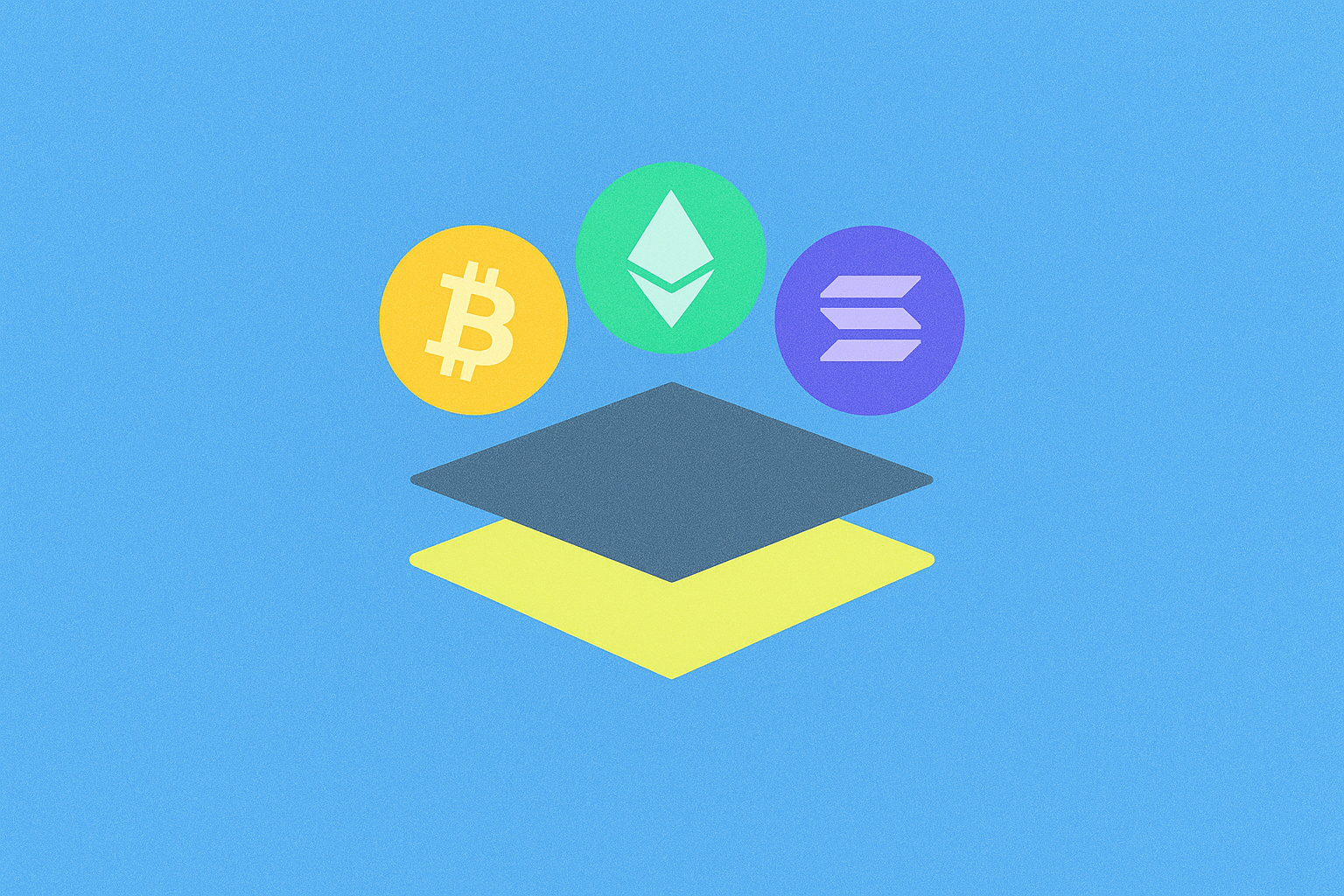
Explore the fundamentals of Layer 1 in blockchain with this in-depth guide. Gain insights into scalability, sharding, the differences between Layer 1 and Layer 2, and examine top Layer 1 blockchains including Bitcoin, Ethereum, Solana, Elrond, and Harmony. Understand the core architecture that underpins blockchain networks.
Overview
Layer 1 refers to a foundational blockchain network—such as Bitcoin, Ethereum, or Solana—and its core infrastructure. These Layer 1 blockchains have the capability to independently validate and finalize transactions without relying on external networks. However, improving the scalability of Layer 1 networks is notoriously difficult, as shown by Bitcoin's persistent limitations. To address these challenges, developers have introduced Layer 2 protocols that depend on the Layer 1 network for security and consensus. Bitcoin's Lightning Network is a prime example of a Layer 2 protocol, enabling users to transact off-chain before settling final records on the main blockchain.
Introduction
Layer 1 and Layer 2 are key concepts that clarify the architecture of various blockchains, projects, and development tools. If you've ever questioned how different scaling solutions relate or how blockchain ecosystems interact, understanding these layered structures will offer crucial perspective.
What Is Layer 1?
A Layer 1 network is simply another term for a base blockchain. Protocols like Bitcoin, Ethereum, and Solana, along with other leading public blockchains, are all considered Layer 1. They're called Layer 1 because they serve as the primary networks within their respective ecosystems. By contrast, off-chain and Layer 2 solutions are built atop these main chains.
Essentially, a protocol qualifies as Layer 1 when it processes and finalizes transactions directly on its own blockchain. Layer 1 networks also issue their own native tokens, which users pay for transaction fees and use in network validation. These networks function independently and do not rely on other blockchains for core operations.
Layer 1 Scaling
One of the most persistent challenges for Layer 1 networks is efficient scalability. Major blockchains like Bitcoin have struggled to process transactions promptly during periods of high demand. Bitcoin's Proof of Work (PoW) consensus protocol requires significant computational power to maintain both security and decentralization.
While PoW delivers robust decentralization and security, these networks tend to slow dramatically under heavy transaction loads. As a result, confirmation times increase and transaction fees spike. The trade-off between security, decentralization, and scalability—often called the blockchain trilemma—remains a core issue.
Blockchain developers continue to explore and debate various scalability strategies. For Layer 1 scaling, the primary approaches include:
-
Increasing block size: Processing more transactions per block, though this can undermine network decentralization.
-
Changing the consensus mechanism: Moving from Proof of Work to Proof of Stake, as with Ethereum's upgrade to boost energy efficiency and throughput.
-
Implementing sharding: Partitioning the database so the network is divided into smaller segments that can process transactions in parallel.
Layer 1 upgrades are complex, often require extensive work, and typically involve trade-offs among critical network properties. Not all users agree on proposed changes, which may result in community splits or hard forks, as seen throughout blockchain history.
SegWit
Bitcoin's SegWit (Segregated Witness) is a well-known Layer 1 scalability upgrade. This innovation increased Bitcoin's throughput by restructuring how block data is stored—removing digital signatures from transaction inputs. This adjustment freed space for more transactions per block without compromising security. SegWit was introduced as a backward-compatible soft fork, so Bitcoin nodes that haven't upgraded can still process transactions, preserving network compatibility during the transition.
What Is Layer 1 Sharding?
Sharding is a leading Layer 1 scalability solution designed to boost transaction throughput. This approach partitions the blockchain's distributed ledger into multiple shards, dividing the network and nodes to spread out workloads and accelerate transaction processing. Each shard handles a portion of network activity, maintaining separate transactions, nodes, and blocks.
With sharding, individual nodes no longer need to store a full copy of the blockchain. Instead, each node submits its work to the main chain, reporting the status of its local data, such as account balances and other key metrics. This model significantly reduces computational demands on individual nodes, while cross-shard communication upholds network security.
Layer 1 vs. Layer 2
Not every network improvement can be efficiently achieved at Layer 1. Due to technological limitations and the need to preserve decentralization and security, some changes are extremely difficult—if not impossible—to implement directly on the main blockchain. For instance, transitioning to Proof of Stake requires vast development and rigorous testing to maintain network stability.
Certain applications simply can't operate effectively on Layer 1 because of scalability constraints. For example, a blockchain-based game might be impractical on some Layer 1 networks due to slow transactions and high fees. Those projects, however, may still want to capitalize on Layer 1's security and decentralization. The preferred solution is to build on top of Layer 1 using a Layer 2 protocol.
Lightning Network
Layer 2 solutions are built atop Layer 1 networks and rely on them to finalize transactions. The Lightning Network, built on Bitcoin, is a flagship example. When the Bitcoin network is congested, it can take a long time to process transactions. The Lightning Network allows users to make fast Bitcoin payments off-chain, with final balances reported to the main chain later. This process aggregates multiple payments into a single on-chain transaction, dramatically saving time and resources while maintaining security through cryptographic proofs.
Layer 1 Blockchain Examples
With a solid grasp of Layer 1, let's look at several prominent examples. There's a wide range of Layer 1 blockchains, each tailored for different use cases and tackling the blockchain trilemma—decentralization, security, and scalability—in unique ways.
Elrond
Launched in 2018, Elrond is a Layer 1 blockchain that leverages sharding to achieve high performance and scalability. Elrond can process over 100,000 transactions per second (TPS), far outpacing traditional networks. Its standout features include Secure Proof of Stake (SPoS) consensus and Adaptive State Sharding.
Adaptive State Sharding dynamically splits and merges shards as the network's user activity changes. The entire architecture—including state and transaction processing—is sharded. Validators shift between shards, reducing the risk of malicious actors gaining control of any one shard.
Elrond's native EGLD token is used for transaction fees, deploying decentralized apps, and rewarding validators in the consensus process. The network also holds Carbon Negative certification, offsetting more CO2 than its Proof of Stake operations produce.
Harmony
Harmony is a Layer 1 network using Effective Proof of Stake (EPoS) and native sharding. Its mainnet runs four shards that concurrently create and verify new blocks. Each shard progresses independently, allowing for different block heights across the network.
Harmony's approach to ecosystem growth centers on cross-chain compatibility. Trustless bridges connect to major blockchains, letting users swap tokens without the custodial risks of centralized bridges. The network's scaling roadmap highlights Decentralized Autonomous Organizations (DAOs) and zero-knowledge proofs.
As DeFi increasingly values multi-chain and cross-chain integration, Harmony's bridging capabilities have become a major asset. NFT infrastructure, DAO tooling, and protocol bridges are key development priorities.
Harmony's native token, ONE, is used for network fees, staking in the consensus mechanism, and governance. Validators and stakers who contribute to network operations earn block rewards and transaction fees.
Celo
Celo, a Layer 1 network forked from Go Ethereum (Geth) in 2017, has since implemented notable changes like Proof of Stake and a unique address system. The Celo Web3 ecosystem covers DeFi, NFTs, and payments, with more than 100 million transactions confirmed. Importantly, Celo lets users use phone numbers or email addresses as public keys, making blockchain access more inclusive. The chain runs efficiently on standard computers—no specialized hardware required.
The CELO token acts as a utility asset for transactions, network security, and rewards. The network also supports multiple stablecoins—cUSD, cEUR, and cREAL—whose value is maintained by mechanisms similar to MakerDAO's DAI. Any Celo asset can be used to pay for stablecoin transactions, offering flexibility for users.
Celo's address system and stablecoins are designed to make crypto more accessible and drive mainstream adoption. By addressing volatility and complexity—traditional barriers for newcomers—Celo bridges the gap between conventional finance and blockchain.
THORChain
THORChain is a Layer 1, cross-chain, permissionless decentralized exchange (DEX) built with the Cosmos SDK. It uses the Tendermint consensus protocol for transaction validation. THORChain's core mission is to enable decentralized cross-chain liquidity without pegged or wrapped assets, which otherwise add risk and complexity for multi-chain investors.
THORChain acts as a decentralized vault manager, tracking deposits and withdrawals across multiple blockchains. This model provides decentralized liquidity and eliminates the risks associated with centralized intermediaries. RUNE is the native token, used for transaction fees, governance, security deposits, and network validation.
The Automated Market Maker (AMM) system uses RUNE as the base pair, allowing users to trade RUNE for any supported asset. In effect, THORChain works as a cross-chain DEX, with RUNE serving as both settlement asset and security for liquidity pools.
Kava
Kava is a Layer 1 blockchain that unites Cosmos's speed and interoperability with Ethereum's developer ecosystem. The Kava Network features a "co-chain" design—separate blockchains for EVM and Cosmos SDK environments. With Inter-Blockchain Communication (IBC) on the Cosmos co-chain, developers can launch decentralized applications that operate seamlessly across Cosmos and Ethereum.
Kava uses the Tendermint Proof of Stake consensus for strong scalability on the EVM co-chain. Supported by KavaDAO, the network offers transparent, on-chain incentives to reward the top 100 projects on each co-chain, based on user activity.
KAVA is the native utility and governance token, alongside USDX, a USD-pegged stablecoin. KAVA is used for transaction fees and is staked by validators to secure the network. Users can delegate KAVA to validators to share in emissions. Both stakers and validators participate in governance, shaping the network's operational rules.
IoTeX
IoTeX is a Layer 1 blockchain launched in 2017 with a focus on integrating blockchain and the Internet of Things (IoT). This approach gives users control over their device-generated data, powering "machine-backed" DApps, assets, and services. By securing personal data via blockchain, users achieve true digital asset ownership.
IoTeX's integrated hardware-software model enables individuals to control their privacy and data without sacrificing usability. Its MachineFi system lets users earn digital assets from real-world data, introducing a new paradigm for data ownership.
IoTeX has launched hardware like Ucam and Pebble Tracker. Ucam is a cutting-edge home security camera that provides private, remote monitoring. Pebble Tracker is a 4G-enabled smart GPS device that captures real-time environmental data—temperature, humidity, air quality—alongside location tracking.
On the architectural side, IoTeX supports multiple Layer 2 protocols atop its chain. The platform provides tools for building custom networks that utilize IoTeX for transaction settlement. These sub-chains can interact and exchange information through IoTeX, enabling developers to create tailored solutions for different IoT needs. The IOTX coin is used for transaction fees, staking, governance, and network validation.
Closing Thoughts
The modern blockchain landscape features a broad mix of Layer 1 networks and Layer 2 protocols—each engineered for specific purposes and scalability challenges. Mastering these distinctions is vital for navigating blockchain's complex ecosystem. As you assess new projects—especially those focused on interoperability and cross-chain integration—understanding Layer 1 and Layer 2 architectures will provide the technical context needed for thorough evaluation.
FAQ
O que é Layer 1 em blockchain e qual é seu propósito principal?
Layer 1 is the primary blockchain layer that stores data, validates transactions, and runs smart contracts. Its main role is to provide the core framework for the blockchain network.
Quais são as diferenças entre blockchains de Camada 1 e Camada 2?
Layer 1 is the foundational network where all transactions occur directly, like Bitcoin or Ethereum. Layer 2 consists of secondary networks built on Layer 1 to boost scalability and speed, handling transactions off-chain to reduce base network load.
Quais são exemplos de blockchains Layer 1 populares?
Popular Layer 1 blockchains include Bitcoin, Ethereum, and Binance Smart Chain. Other leading examples are Cardano, Solana, Avalanche, Polkadot, Algorand, and NEAR Protocol.
Quais são as vantagens e desvantagens dos blockchains Layer 1?
Layer 1 delivers strong security and full decentralization, but often faces slow speeds and limited scalability. Transaction fees can spike under congestion. Benefits: complete control. Drawbacks: lower throughput versus Layer 2.
Por que os blockchains de Camada 1 enfrentam desafios de escalabilidade?
Layer 1 blockchains struggle with scalability due to decentralization, which leads to congestion and higher fees during periods of peak activity—limiting both transaction speed and processing capacity.
Como a Layer 1 garante segurança e descentralização?
Layer 1 achieves security through a distributed network of nodes that validate transactions, preventing centralized control. Consensus mechanisms like Proof of Work or Proof of Stake reinforce security, while decentralized governance ensures no single entity dominates the network.
* The information is not intended to be and does not constitute financial advice or any other recommendation of any sort offered or endorsed by Gate.