Lisk is a JavaScript-based blockchain platform launched in 2016 to democratize decentralized application development for web developers. This comprehensive guide explores Lisk's technical architecture powered by Delegated Proof-of-Stake consensus, sidechain technology, and its native LSK cryptocurrency. The article examines Lisk's market performance, ecosystem applications, and strategic positioning within the competitive blockchain landscape. It covers key features including modular development tools, community engagement, and integration with Gate exchange for token accessibility. Whether you're a developer seeking to build dApps or an investor evaluating blockchain platforms, this guide provides essential insights into Lisk's mechanisms, challenges, and long-term vision for scalable decentralized application infrastructure.
Lisk's Positioning and Significance
In 2016, Max Kordek and Olivier Beddows launched Lisk (LSK), aiming to address the complexity of decentralized application development and the accessibility barriers for mainstream developers.
As a JavaScript-based blockchain application platform leveraging sidechain technology, Lisk plays a key role in decentralized application development and blockchain scalability.
As of 2026, Lisk has established itself within the blockchain ecosystem, featuring a contract address on the Ethereum network and maintaining an active presence across multiple development channels including GitHub repositories for its SDK, core, desktop, and mobile implementations.
This article will provide an in-depth analysis of its technical architecture, market performance, and future potential.
Origin and Development Timeline
Birth Background
Lisk was created by Max Kordek and Olivier Beddows in early 2016, aiming to solve the technical barriers preventing web developers from building decentralized applications.
It emerged from the Crypti blockchain project, with its founders seeking to create a more accessible development environment through JavaScript-based architecture and sidechain solutions.
Lisk's launch brought new possibilities to web developers and the decentralized application ecosystem.
Important Milestones
- 2016: Project separated from Crypti, establishing the foundation with lightcurve GmbH as its development entity.
- 2018: Mainnet launched in June, implementing the dPoS consensus mechanism with 101 delegates.
- Development of comprehensive ecosystem tools including Lisk SDK, Lisk Core, Lisk Desktop, and Lisk Mobile applications.
- Establishment of an active community presence through forums and social media channels.
With support from lightcurve GmbH and an active developer community, Lisk continues to evolve its technical capabilities and real-world applications.
How Lisk Works
Decentralized Control
Lisk operates on a decentralized network of computers (nodes) distributed globally, independent of banking or governmental control.
These nodes collaborate to validate transactions, ensuring system transparency and attack resistance, granting users greater autonomy and enhancing network resilience.
Blockchain Foundation
Lisk's blockchain serves as a public, immutable digital ledger recording every transaction.
Transactions are grouped into blocks, linked through cryptographic hashes to form a secure chain.
Anyone can view the records, establishing trust without intermediaries.
The platform's sidechain architecture is designed to enhance performance by allowing developers to deploy applications on separate chains while maintaining security through the main blockchain.
Ensuring Fairness
Lisk employs Delegated Proof of Stake (dPoS) to validate transactions and prevent fraudulent activities such as double-spending.
101 elected delegates maintain network security through block production and validation, earning LSK rewards for their service.
The system features 10-second block times and efficient transaction processing, with delegates elected through blockchain-based voting where each account's voting power corresponds to its LSK holdings.
Secure Transactions
Lisk utilizes public-private key cryptography to protect transactions:
- Private keys (similar to secret passwords) are used to sign transactions
- Public keys (similar to account numbers) are used to verify ownership
This mechanism ensures fund security while maintaining pseudonymous transaction privacy.
The JavaScript-based architecture provides developers with familiar tools for building secure decentralized applications within the Lisk ecosystem.
Circulation Overview
As of January 20, 2026, Lisk's circulating supply stands at 226,353,085.95 LSK, with a total supply of 400,000,000 LSK, representing a maximum cap.
New coins enter the market through block rewards, with the network generating 4 LSK per block under a 10-second block time structure. This mechanism influences supply-side dynamics, contributing to an inflationary model with an annual rate exceeding 12% based on initial supply levels.
The distribution follows a delegated proof-of-stake (dPoS) consensus model, where 101 elected delegates serve as block producers and receive LSK rewards for network validation.
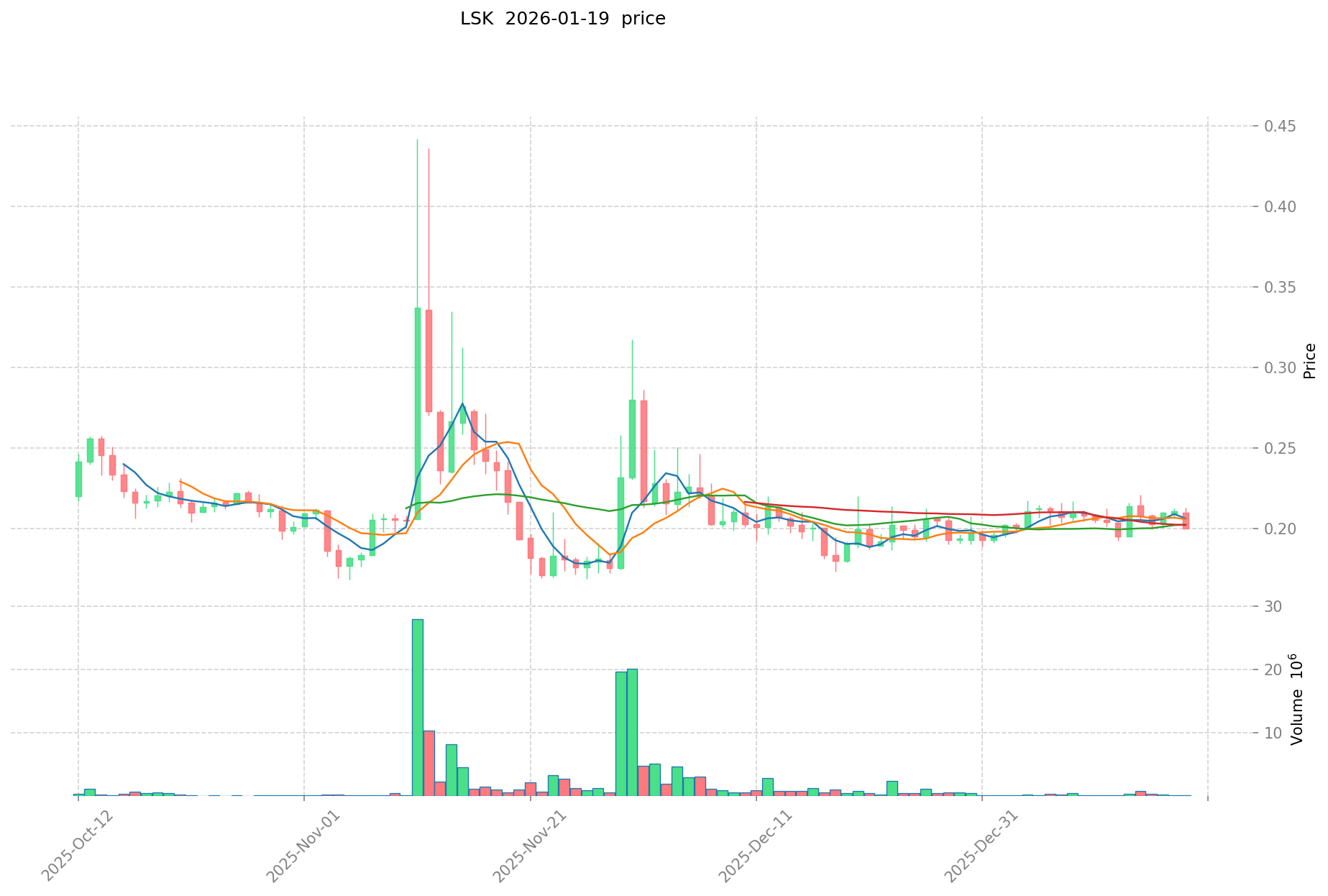
Price Fluctuations
Lisk reached an all-time high of $34.92 on January 7, 2018, during a period of heightened market activity and broader cryptocurrency sector expansion.
Its all-time low of $0.101672 occurred on March 1, 2017, during early-stage project development and limited market recognition.
These price movements reflect evolving market sentiment, ecosystem development phases, and broader industry trends affecting blockchain application platforms.
Click to view current LSK market price
On-Chain Metrics
- Holder addresses: 1,972 addresses (indicating current user base)
- Trading exchanges: Available on 25 platforms (reflecting accessibility and liquidity distribution)
- Consensus mechanism: Delegated Proof-of-Stake (dPoS) with 101 active delegates (demonstrating network governance structure)
Lisk Ecosystem Applications and Partners
Core Use Cases
Lisk's ecosystem supports multiple application scenarios:
- Decentralized Application Development: The platform provides a JavaScript-based development environment, enabling web developers familiar with JavaScript and Node.js to build decentralized applications.
- Sidechain Technology: Lisk utilizes sidechain architecture to support application deployment, allowing developers to quickly deploy their applications on the platform.
Strategic Partnerships
Lisk was established through the joint founding of lightcurve GmbH by Max Kordek and Olivier Beddows, serving as a blockchain consulting company, development studio, and marketing agency. More than 50 professionals work for lightcurve, with Lisk as its sole client.
These partnerships provide a solid foundation for Lisk's ecosystem expansion.
Controversies and Challenges
Lisk faces the following challenges:
- Technical Questions: The clarity regarding whether Lisk version 1.0 includes sidechain technology remains uncertain.
- Consensus Trade-offs: The dPoS consensus algorithm offers speed and scalability but comes at the cost of decentralization.
- Market Competition: Operating in a competitive blockchain landscape with various platforms vying for developer adoption.
These issues have sparked discussions within the community and market, while also driving Lisk's continuous innovation.
Lisk's community demonstrates notable activity, with the token contract address deployed on the Ethereum network. The project maintains presence across multiple platforms including Twitter, Reddit, Facebook, and a dedicated forum.
Community interest has been influenced by factors such as platform development updates and technological advancements.
Sentiment on social platforms shows varying perspectives:
- Supporters praise Lisk's JavaScript-based development approach and its accessibility for web developers, viewing it as an innovative solution for decentralized application development.
- Critics focus on aspects such as price volatility and technical implementation details.
Recent trends reflect the broader market conditions affecting cryptocurrency projects.
Hot Topics
Social media users discuss Lisk's technological architecture, development accessibility, and its positioning in the decentralized application ecosystem, highlighting both its potential for innovation and the challenges in gaining mainstream adoption.
- Official Website: Visit Lisk Official Site for features, use cases, and latest updates.
- Social Media: On X platform, Lisk maintains an active presence through @LiskHQ, sharing updates about technical developments, community activities, and ecosystem news.
- Community Channels: Engage with the community through Reddit, Facebook, and the Official Forum.
- Development Resources: Access technical documentation through GitHub repositories, including lisk-sdk, lisk-core, lisk-desktop, and lisk-mobile.
Lisk Future Roadmap
Lisk continues to evolve its platform with focus on:
- Ecosystem Development: Enhancing the JavaScript-based development environment and sidechain functionality
- Developer Support: Providing comprehensive tools and resources for decentralized application creation
- Long-term Vision: Establishing a complete plug-and-play system for developers to complete all steps from design, development, deployment, to monetization on one platform
How to Participate in Lisk?
- Purchase Options: Lisk (LSK) is available on Gate.com and other cryptocurrency platforms
- Storage Solutions: Store LSK tokens securely using compatible Ethereum wallets, as the token operates on the Ethereum network (contract address: 0x6033F7f88332B8db6ad452B7C6D5bB643990aE3f)
- Community Participation: Engage with the community through official forums and social media channels
- Ecosystem Building: Access development resources through GitHub repositories to contribute to the platform or build decentralized applications
Summary
Lisk offers a JavaScript-based blockchain platform for decentralized application development, providing accessibility for web developers, sidechain architecture, and an integrated development ecosystem.
Its active community, development resources, and focus on developer-friendly tools position it distinctively in the cryptocurrency space.
While facing challenges such as consensus mechanism trade-offs and competitive pressures, Lisk's developer-centric approach and technological innovation maintain its relevance in the decentralized technology landscape.
Whether you are a newcomer or an experienced participant, Lisk presents opportunities for engagement and contribution to decentralized application development.
FAQ
What is Lisk (LSK) and how does it work?
Lisk is a blockchain platform enabling developers to build and deploy decentralized applications using JavaScript. LSK is its native cryptocurrency used for transaction fees, staking, and network participation. It operates as a sidechain ecosystem allowing scalable dApp development.
What are the main features and use cases of Lisk cryptocurrency?
Lisk is a blockchain platform enabling developers to build decentralized applications using JavaScript. Main features include modular architecture, delegated proof-of-stake consensus, and sidechain functionality. Use cases span gaming, supply chain, and enterprise solutions requiring scalable, customizable blockchain infrastructure.
How can I buy and store Lisk (LSK) tokens?
You can purchase LSK tokens on cryptocurrency exchanges using fiat or other cryptocurrencies. For secure storage, use hardware wallets like Ledger or Trezor, or the official Lisk wallet application for optimal security and control.
Lisk uses a sidechain architecture for scalability, while Ethereum operates as a single Layer 1. Lisk enables JavaScript-based smart contracts and modular blockchain development, offering better accessibility for developers compared to Ethereum's Solidity-focused approach.
Is Lisk a safe investment and what are the associated risks?
Lisk offers solid blockchain infrastructure with active development and community support. Like all crypto assets, it carries market volatility and regulatory risks. Success depends on adoption of its sidechain ecosystem and long-term technological competitiveness in the evolving blockchain landscape.
What is the current price and market cap of Lisk (LSK)?
As of January 2026, Lisk (LSK) is trading at approximately $0.85-$1.20 USD with a market capitalization around $850 million-$1.2 billion, depending on market conditions. LSK remains a notable blockchain platform token with consistent trading volume and ecosystem development.
* The information is not intended to be and does not constitute financial advice or any other recommendation of any sort offered or endorsed by Gate.