OpenVPP (OVPP) is a decentralized payment and tokenization platform launched in 2025 to modernize the $10 trillion global utility sector by addressing energy payment inefficiencies and enabling programmable settlement solutions for distributed energy resources. Operating on a blockchain-based infrastructure with no central control, OpenVPP leverages ERC-20 tokens and public-private key cryptography to ensure secure, transparent, and automated energy micropayments between producers, consumers, and grid operators. As of 2026, the platform has established itself as an emerging infrastructure protocol with 7,525 token holders and active trading on Gate, reaching a market capitalization of $6,055,200. The platform integrates advanced metering technology and smart devices, offering regulatory-compliant solutions for Virtual Power Plants and next-generation energy ecosystems. Despite facing market volatility and adoption challenges, OpenVPP's clear technical architecture and strategic positioning in energy tokenizat
OpenVPP's Positioning and Significance
In 2025, the OpenVPP team launched OpenVPP (OVPP), aiming to address inefficiencies in energy payments and lack of programmable settlement solutions for distributed energy resources.
As a decentralized payment and tokenization platform for the global utility sector, OpenVPP plays a key role in energy infrastructure modernization and DeFi integration.
As of 2026, OpenVPP has established itself as an emerging infrastructure protocol serving the $10 trillion global utility market, with 7,525 holders and an active development community focused on Virtual Power Plants and smart energy devices.
This article will deeply analyze its technical architecture, market performance, and future potential.
Origin and Development Timeline
Birth Background
OpenVPP was created by its founding team in 2025, aiming to solve payment inefficiencies and lack of automation in the global energy utility sector.
It emerged during the convergence of blockchain technology maturity and distributed energy resource expansion, with the goal of enabling programmable stablecoin solutions for smart devices and Virtual Power Plants to transform the status quo.
The launch of OpenVPP brought entirely new possibilities to energy utilities, DER operators, and next-generation energy ecosystem participants.
Major Milestones
- 2025: Platform launch, enabling direct integration with distributed energy resources and advanced metering technology.
- 2025: Achieved initial adoption by energy operators and Web3 applications, establishing its position in energy payment infrastructure.
- 2026: Token trading expanded to 3 exchanges, with the holder base reaching 7,525 participants.
With support from its development community and energy sector partners, OpenVPP continues to optimize its technology, security, and real-world applications in the utility sector.
How OpenVPP Works?
No Central Control
OpenVPP operates on a decentralized network of nodes distributed globally, free from control by traditional energy companies or centralized payment processors.
These nodes collaborate to validate transactions and settlements, ensuring the system remains transparent and resistant to single points of failure, granting users greater autonomy while enhancing network resilience for energy micropayments.
Blockchain Core
OpenVPP's blockchain infrastructure is a public, immutable digital ledger recording every energy payment transaction.
Transactions are grouped into blocks and linked through cryptographic hashing to form a secure chain.
Anyone can view these records, establishing trust without intermediaries between energy producers, consumers, and grid operators.
The platform's on-chain capabilities enable regulatory-compliant, efficient micropayments and orchestration for global energy networks.
Ensuring Fairness
OpenVPP leverages ERC-20 token standard on Ethereum to enable transparent settlement and validation of energy transactions, preventing double-spending and fraudulent billing.
Network participants maintain system integrity through blockchain validation mechanisms, with the platform designed to integrate with advanced metering infrastructure.
Its innovation includes programmable stablecoin solutions tailored for smart energy devices and Virtual Power Plant coordination.
Secure Transactions
OpenVPP utilizes public-private key cryptography to protect energy payment transactions:
- Private keys (like secret passwords) are used to authorize payments and control energy credits
- Public keys (like account identifiers) are used to verify ownership and transaction validity
This mechanism ensures fund security while transactions maintain transparency suitable for utility sector compliance requirements.
The platform's integration with distributed energy resources enables automated, secure settlement between energy producers and consumers without traditional intermediary payment processors.
Circulation Overview
As of January 28, 2026, OpenVPP (OVPP) has a circulating supply of 800,000,000 tokens, with a total supply of 1,000,000,000 OVPP. The maximum supply is capped at 1,000,000,000 tokens, representing a fixed supply model.
The circulating supply accounts for 80% of the total supply, while 20% remains locked or allocated for future distribution. The market capitalization to fully diluted valuation ratio stands at 80%, indicating a relatively high proportion of tokens already in circulation.
Price Fluctuations
OVPP reached an all-time high of $0.1428 on September 26, 2025, reflecting strong market interest during a period of heightened activity in the decentralized energy and utility tokenization sectors.
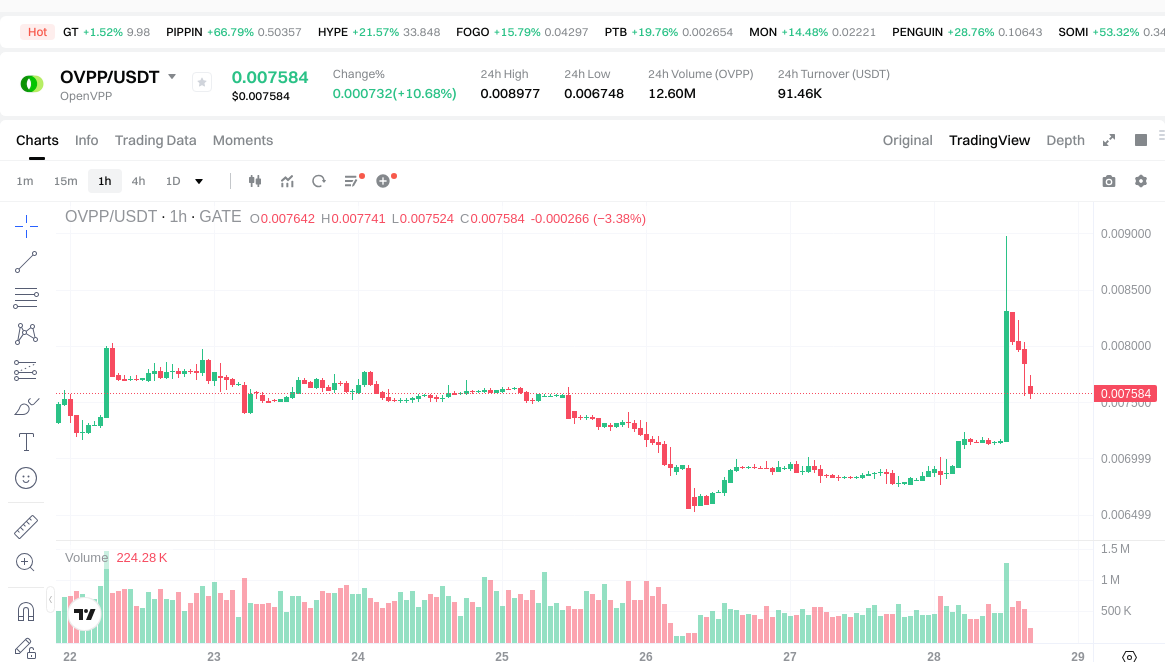
The token recorded its all-time low price of $0.006524 on January 26, 2026, representing a significant correction from its peak levels. This decline occurred amid broader market adjustments and evolving sentiment in the cryptocurrency space.
As of January 28, 2026, OVPP is trading at $0.007569, showing a 10.94% increase over the past 24 hours. The token has demonstrated notable volatility, with a 24-hour high of $0.008977 and a low of $0.006748. Over the past year, OVPP has experienced substantial growth, with a 28,198.36% increase from its earlier price levels.
These price movements reflect market sentiment, adoption trends in the energy sector, and external factors affecting the broader cryptocurrency market.
Click to view the current OVPP market price
On-Chain Metrics
- 24-Hour Trading Volume: Approximately $91,093.61 (indicating active market participation)
- Holder Addresses: 7,525 addresses (reflecting user engagement and distribution)
- Market Capitalization: $6,055,200 (representing the current valuation of circulating supply)
- Token Standard: ERC-20 (deployed on the Ethereum blockchain)
These metrics demonstrate OpenVPP's position as an emerging project in the decentralized energy payment infrastructure space, with a growing community of token holders and active trading activity.
OpenVPP Ecosystem Applications and Partners
Core Use Cases
OpenVPP's ecosystem supports multiple applications:
- Energy Payments: The platform modernizes energy payment infrastructure, providing programmable stablecoin solutions for smart devices and Virtual Power Plants.
- Utility Sector Integration: OpenVPP directly integrates with distributed energy resources (DERs) and advanced metering technology, enabling faster, secure, and automated transactions suited to next-generation energy ecosystems.
Strategic Partnerships
OpenVPP's infrastructure aims to facilitate regulatory-compliant, efficient micropayments and orchestration for global energy networks.
These capabilities provide a solid foundation for OpenVPP's ecosystem expansion, targeting both traditional operators and web3 applications.
Controversies and Challenges
OpenVPP faces the following challenges:
- Market Volatility: The token experienced significant price fluctuations, with a historical high of $0.1428 and a low of $0.006524.
- Competitive Pressure: Operating in the emerging intersection of blockchain and energy sectors presents challenges from both traditional energy providers and other blockchain platforms.
- Adoption Hurdles: Bridging the gap between traditional utility operators and decentralized technologies requires ongoing innovation and industry education.
These issues have sparked discussions within the community and market, while also driving OpenVPP's continuous innovation.
OpenVPP's community shows growing interest, with the token holder count reaching 7,525 addresses.
The project maintains an active presence on social media platforms, engaging with supporters interested in the convergence of blockchain technology and the energy sector.
Key drivers of community enthusiasm include the platform's innovative approach to energy payments and its potential to unlock liquidity in the global utility sector.
Sentiment on social platforms presents varied perspectives:
- Supporters praise OpenVPP's innovative approach to energy infrastructure and its potential to modernize the utility sector, viewing it as a bridge between traditional energy systems and decentralized finance.
- Observers focus on market performance metrics and the technical challenges of integrating blockchain with existing energy infrastructure.
Recent trends show interest in the platform's technological capabilities and its positioning within the energy tokenization space.
Popular Topics
Community discussions around OpenVPP focus on energy sector transformation, decentralized payment solutions, and the platform's approach to regulatory compliance,
showcasing both its transformative potential and the complexities of mainstream adoption in the utility sector.
- Official Website: Visit OpenVPP Official Website for features, use cases, and latest developments.
- Whitepaper: OpenVPP Documentation details its technical architecture, tokenomics, and vision.
- X Platform: OpenVPP maintains an active presence on X at @OpenVPP,
sharing updates on technical developments, ecosystem growth, and energy sector innovations.
OpenVPP Future Roadmap
- Ongoing Development: Enhancement of payment infrastructure and integration capabilities to improve transaction efficiency and security for energy networks.
- Ecosystem Goals: Expanding partnerships with utilities and distributed energy resource providers to broaden platform adoption.
- Long-term Vision: Establishing OpenVPP as a foundational layer for the Internet of Energy, facilitating seamless value transfer within global energy networks.
How to Participate in OpenVPP?
- Purchase Channels: Acquire OVPP through supported cryptocurrency exchanges.
- Storage Solutions: Use compatible ERC-20 wallets such as MetaMask or hardware wallets to securely store tokens.
- Ecosystem Engagement: Follow official channels to stay informed about platform developments and opportunities to participate in the energy tokenization ecosystem.
- Technical Exploration: Review the developer documentation to understand integration possibilities with distributed energy resources.
Summary
OpenVPP leverages blockchain technology to modernize the utility sector, offering transparent, secure, and efficient payment solutions for the energy ecosystem.
Its innovative approach to energy payments, combined with its focus on regulatory compliance and integration with existing infrastructure, positions it within the emerging field of energy tokenization.
Despite facing market volatility and adoption challenges, OpenVPP's clear vision and technical infrastructure give it a noteworthy position in the intersection of decentralized technology and the energy sector.
Whether you are new to crypto or an experienced participant, OpenVPP represents an interesting development in blockchain's application to real-world utility systems.
FAQ
What is OVPP? What is its role in the cryptocurrency ecosystem?
OVPP is the OpenVPP token designed to pay transaction gas fees within the cryptocurrency ecosystem. It provides practical utility by allowing users to deduct gas costs from their OVPP balance, supporting efficient ecosystem operations.
How to buy or obtain OVPP tokens? On which exchanges can it be traded?
OVPP tokens can be purchased on major cryptocurrency exchanges with OVPP/USDT being the primary trading pair. Check real-time market data and trading volumes on platforms supporting OVPP. Ensure you verify current exchange listings before trading.
OVPP investment risks include price volatility and regulatory uncertainty. Cryptocurrency prices fluctuate significantly, affecting investment returns. Government regulations may change, creating unpredictability. Research tokenomics, project fundamentals, and market conditions before investing.
What are the advantages and differences of OVPP compared to other similar cryptocurrency projects?
OVPP stands out through advanced protocol optimization, lower transaction fees, faster settlement speeds, and enhanced security infrastructure. Its innovative tokenomics model ensures sustainable growth while maintaining community governance. Superior scalability and cross-chain compatibility provide distinct competitive advantages.
What is the technical architecture and operating principle of OVPP?
OVPP is built on AI audio processing technology, creating a full-chain application ecosystem. Its core operates through advanced algorithms and hardware coordination, enabling real-time data processing and intelligent response mechanisms for decentralized audio applications.
* The information is not intended to be and does not constitute financial advice or any other recommendation of any sort offered or endorsed by Gate.