This comprehensive guide explores QuarkChain (QKC), a layer-1 blockchain utilizing sharding technology to address scalability limitations. Launched in 2018, QuarkChain delivers high-performance infrastructure with over 100,000 transactions per second capability. The article examines its two-layer consensus mechanism, decentralized architecture, and market metrics including 7.2 billion circulating tokens and $29.46 million market cap. You'll discover QuarkChain's technical innovations, price volatility analysis, and ecosystem applications designed for developers seeking scalable blockchain solutions. Learn how to participate through Gate exchange, explore community engagement channels, and understand competitive positioning in the evolving blockchain infrastructure landscape.
QuarkChain's Positioning and Significance
In 2018, the QuarkChain team launched QuarkChain (QKC), aiming to address scalability limitations and low transaction throughput in existing blockchain networks.
As a blockchain infrastructure solution utilizing sharding technology, QuarkChain plays a key role in high-performance decentralized applications and scalable blockchain ecosystems.
As of 2026, QuarkChain has established itself as a layer-1 blockchain focused on sharding-based scalability, with over 10,000 token holders and an active development community.
This article will provide an in-depth analysis of its technical architecture, market performance, and future potential.
Origin and Development History
Background
QuarkChain was created by its founding team in 2018, aiming to solve blockchain scalability challenges and enable mass adoption through high transaction throughput.
It emerged during the blockchain scalability debate and the pursuit of enterprise-grade blockchain solutions, with the goal of achieving 100,000+ transactions per second while maintaining security and decentralization.
QuarkChain's launch brought new possibilities to developers and enterprises seeking scalable blockchain infrastructure.
Key Milestones
- 2018: Mainnet launched in June, achieving sharding-based architecture with multi-layer design.
- 2018: Token launched on Gate.com and other platforms, establishing initial market presence.
- 2020: Network continued development through market cycles, reaching its lowest price point of $0.00137714 in March.
- 2024: Expanded cross-chain capabilities with Ethereum integration, as evidenced by its ERC-20 token deployment.
With support from its community and development foundation, QuarkChain continues to optimize its technology, security features, and real-world applications.
How QuarkChain Works
Decentralized Architecture
QuarkChain operates on a decentralized network of computers (nodes) distributed globally, independent of centralized control by banks or governments.
These nodes collaborate to validate transactions, ensuring system transparency and attack resistance, granting users greater autonomy and enhancing network resilience.
Blockchain Foundation
QuarkChain's blockchain is a public, immutable digital ledger that records every transaction.
Transactions are grouped into blocks and linked through cryptographic hashing to form a secure chain.
Anyone can view the records, establishing trust without intermediaries.
Its sharding technology partitions the network into smaller chains (shards) that process transactions in parallel, significantly improving throughput and scalability.
Consensus Mechanism
QuarkChain employs a two-layer consensus mechanism combining different approaches across root chain and shards to validate transactions and prevent double-spending and other fraudulent activities.
Network participants maintain security through operating nodes and validating transactions across the sharded architecture, earning QKC rewards.
Its innovation includes achieving high transaction throughput while maintaining security and decentralization through its multi-layer sharding design.
Secure Transactions
QuarkChain uses public-private key cryptography to protect transactions:
- Private keys (similar to secret passwords) are used to sign transactions
- Public keys (similar to account numbers) are used to verify ownership
This mechanism ensures fund security while transactions maintain transparency through the public blockchain.
The sharding architecture provides additional security by isolating potential issues within individual shards while maintaining overall network integrity.
Circulation Overview
As of January 21, 2026, QuarkChain's circulating supply stands at 7,202,047,921 QKC tokens, with a total supply of 10,000,000,000 QKC and no maximum supply cap (∞), indicating an inflationary model.
The circulating supply represents approximately 72.02% of the total supply, reflecting the token distribution and release schedule.
Price Fluctuations
QuarkChain reached its peak price of $0.338765 on June 5, 2018, during the early phase of blockchain infrastructure development and heightened market interest in scalability solutions.
Its lowest price of $0.00137714 occurred on March 13, 2020, coinciding with broader market volatility and uncertain economic conditions.
These fluctuations reflect shifts in market sentiment, adoption trends, and external macroeconomic factors affecting the crypto asset sector.
Click to view the current QKC market price
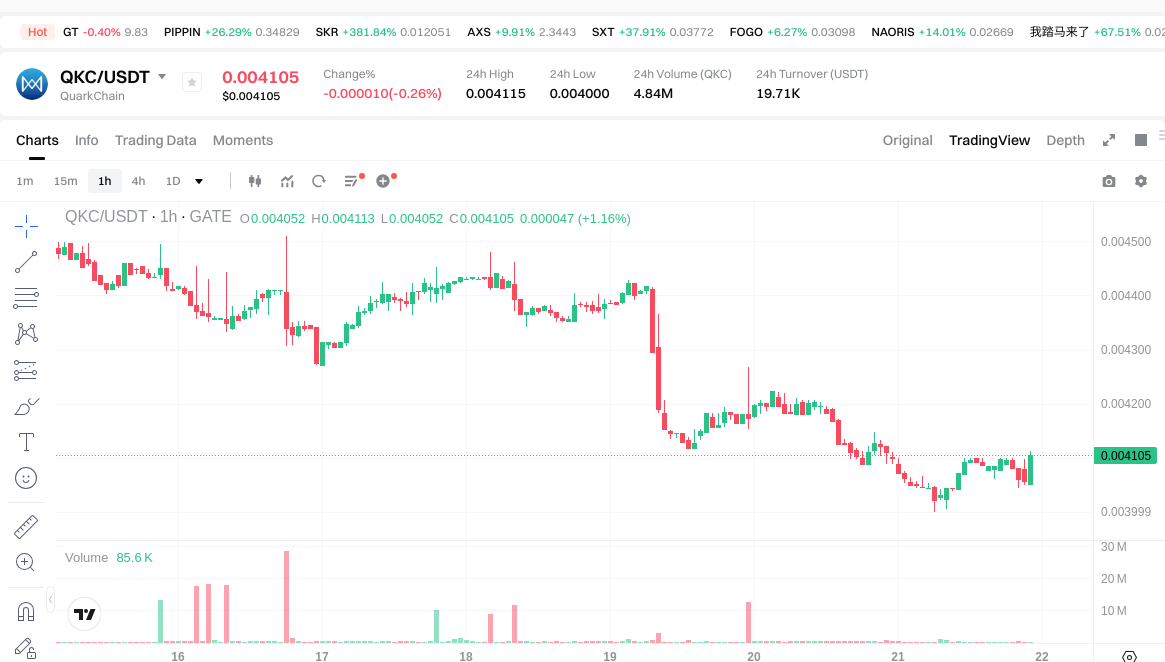
Price Trends Analysis
- 1-Hour Change: +1.09% ($0.000044)
- 24-Hour Change: -0.43% (-$0.000018)
- 7-Day Change: -7.33% (-$0.000324)
- 30-Day Change: +4.22% (+$0.000166)
- 1-Year Change: -58.63% (-$0.005798)
The short-term volatility demonstrates typical market dynamics, while the annual decline reflects broader market adjustments and evolving competitive landscape in blockchain infrastructure solutions.
On-Chain Metrics
- Holders: Approximately 10,053 addresses hold QKC tokens, indicating the distribution of ownership across the community
- Trading Volume (24H): $19,792.92, reflecting current market activity and liquidity levels
- Market Capitalization: $29,463,578, positioning QuarkChain at rank 725 among crypto assets
QuarkChain Ecosystem Applications and Partners
Core Use Cases
QuarkChain's ecosystem is built on its sharding technology foundation, designed to support scalable blockchain applications:
- High-Throughput Infrastructure: QuarkChain's architecture enables transaction processing capabilities exceeding 100,000 TPS, providing technical support for decentralized applications requiring high-performance blockchain solutions.
- Flexible Sharding Framework: The platform's sharding mechanism allows developers to deploy customizable blockchain networks with varying security and performance parameters.
Strategic Collaborations
QuarkChain maintains active development through its open-source community on GitHub, with repositories including pyquarkchain and quarkchain-web3.js, facilitating developer engagement and ecosystem growth.
These technical foundations support QuarkChain's ongoing ecosystem development efforts.
Challenges and Considerations
QuarkChain faces several considerations in the competitive blockchain landscape:
- Market Competition: The blockchain infrastructure space includes numerous platforms offering scalability solutions, requiring continuous innovation to maintain relevance.
- Price Volatility: QKC has experienced significant price fluctuations, with a one-year change of -58.63% as of January 21, 2026.
- Adoption Dynamics: With approximately 10,053 holders and a market cap of approximately $29.46 million, expanding user adoption remains an ongoing focus.
These factors influence community discussions and drive the project's evolution.
QuarkChain maintains an active presence across multiple platforms, with official channels on Twitter, Facebook, and Reddit (r/quarkchainio).
The project's social media presence serves as a hub for technical updates, community discussions, and ecosystem developments.
Community activity reflects ongoing interest in the project's sharding-based approach to blockchain scalability.
Discussions on social platforms present varied perspectives:
- Supporters highlight QuarkChain's technical approach to scalability through sharding technology and its focus on decentralization.
- Observers note the price performance challenges, with QKC trading at $0.004091 as of January 21, 2026, compared to its peak.
Recent trends show community attention to both technical developments and market dynamics.
Discussion Topics
Community members engage with topics including QuarkChain's sharding implementation, scalability benchmarks, and the project's position in the evolving blockchain infrastructure landscape.
- Official Website: Visit QuarkChain Official Site for technical specifications, use cases, and project updates.
- GitHub Repository: Access QuarkChain's GitHub for technical documentation and open-source development resources.
- Social Media: QuarkChain maintains active presence on Twitter, sharing updates on technical progress, community initiatives, and ecosystem developments.
QuarkChain Future Roadmap
Specific roadmap details were not available in the provided materials. For the latest development plans and technical upgrades, refer to the official QuarkChain channels and GitHub repositories.
How to Participate in QuarkChain?
- Acquisition Options: QKC is available on Gate.com and 14 other exchanges, with a 24-hour trading volume of approximately $19,793.
- Storage Solutions: QKC tokens deployed on Ethereum (contract address: 0xea26c4ac16d4a5a106820bc8aee85fd0b7b2b664) can be stored in compatible wallets supporting ERC-20 tokens.
- Developer Engagement: Explore QuarkChain's GitHub repositories to contribute to the project or build applications on the network.
- Community Participation: Join discussions on the official subreddit and follow social media channels for community updates.
Summary
QuarkChain represents a technical approach to blockchain scalability through sharding technology, offering infrastructure designed for high-throughput transaction processing.
With its open-source development model, multi-platform community presence, and focus on decentralized architecture, QuarkChain occupies a position in the blockchain infrastructure space.
Despite facing market volatility and competitive pressures in the evolving blockchain ecosystem, QuarkChain's technical foundation and active development community continue to support its role in decentralized technology.
Whether exploring scalability solutions or researching blockchain infrastructure, QuarkChain presents an interesting case study in sharding-based blockchain design.
FAQ
What is QKC (QuarkChain)? What are its main features and advantages?
QuarkChain is a blockchain platform designed for high scalability and throughput. Its main features include a two-layer sharding architecture enabling massive parallel processing, support for multiple cryptocurrencies, and fast transaction settlement. Key advantages are high transaction capacity, low latency, and enhanced network security through innovative consensus mechanisms.
Where can I buy QKC? How to safely purchase and store QKC?
QKC is available on major cryptocurrency exchanges. Purchase through reputable platforms with strong security measures. For storage, use hardware wallets like Ledger or Trezor for optimal security, or trusted custodial services. Enable two-factor authentication and never share private keys.
What are the differences between QKC and other public chains like Ethereum and BSC?
QKC features high throughput sharding technology enabling faster transactions and lower fees. Unlike Ethereum and BSC, QKC uses hierarchical sharding structure for superior scalability and cross-shard communication efficiency.
How does QuarkChain's sharding technology work? What problems does it solve?
QuarkChain uses dynamic sharding to split the blockchain into parallel shards, each processing transactions independently. This dramatically increases throughput while maintaining security. It solves blockchain scalability issues, reducing congestion and transaction costs.
What are the risks of investing in QKC? How should I evaluate its value and prospects?
QKC faces market volatility and adoption risks. Evaluate value through technical fundamentals, ecosystem development, and transaction volume growth. Strong sharding technology and mainnet performance indicate promising prospects for scalability solutions in blockchain infrastructure.
* The information is not intended to be and does not constitute financial advice or any other recommendation of any sort offered or endorsed by Gate.