Radicle (RAD) is a Web3-native decentralized network addressing centralized control risks in software development. Launched in 2021 and trading on Gate, RAD operates on blockchain infrastructure enabling developers to collaborate without platform dependency. The token powers governance participation, project management through smart contracts, and community voting mechanisms. With 7,775 token holders and a market cap of approximately $14.46 million, Radicle offers GitHub-like functionality with transparent, censorship-resistant code collaboration. As of January 2026, RAD trades at $0.2902, reflecting market volatility across cryptocurrency sectors. This guide explores its technical architecture, market performance, ecosystem applications, and strategic roadmap for decentralized software development infrastructure.
Radicle's Positioning and Significance
In 2021, the Radicle team launched Radicle (RAD), aiming to address centralized control and censorship risks in traditional code collaboration platforms.
As a Web3-native network for software collaboration, Radicle plays a critical role in decentralized development and open-source ecosystems.
As of 2026, Radicle has established itself as a decentralized alternative to traditional code hosting platforms, with 7,775 token holders and an active developer community.
This article will provide an in-depth analysis of its technical architecture, market performance, and future potential.
Origin and Development History
Birth Background
Radicle was created by its founding team in 2021, aiming to solve centralized control, censorship, and platform dependency issues in software development.
It emerged during the rapid growth of Web3 and decentralized technologies, with the goal of providing developers with truly decentralized infrastructure for code collaboration and transforming the status quo.
Radicle's launch brought entirely new possibilities for open-source developers and decentralized software projects.
Important Milestones
- 2021: Mainnet launch, implementing decentralized code collaboration with GitHub-like functionality.
- 2021: Token (RAD) listed on Gate.com, enabling governance participation and network access benefits.
- Ongoing: Ecosystem development with NFT integration, multi-signature wallets, and smart contracts for project funding and management.
With support from the Radicle community and decentralized governance structure, Radicle continues to optimize its technology, security, and real-world applications.
How Does Radicle Work?
No Central Control
Radicle operates on a decentralized network of computers (nodes) distributed globally, free from control by centralized platforms or corporations.
These nodes collaborate to maintain code repositories and verify transactions, ensuring system transparency and attack resistance, granting users greater autonomy and enhancing network resilience.
Blockchain Foundation
Radicle's blockchain infrastructure is a public, immutable digital ledger that records governance activities and token transactions.
Transactions are grouped into blocks and linked through cryptographic hashes to form a secure chain.
Anyone can view records, establishing trust without intermediaries.
The integration with Ethereum enables additional functionality through smart contracts.
Ensuring Fairness
Radicle utilizes Ethereum-based smart contracts and governance mechanisms to validate proposals and prevent fraudulent activities.
Token holders maintain network governance through voting and proposal submission, earning participation rights in the ecosystem.
Its innovation includes combining decentralized code hosting with tokenized governance.
Secure Transactions
Radicle uses public-private key cryptography to protect transactions:
- Private keys (similar to secret passwords) are used to sign transactions
- Public keys (similar to account numbers) are used to verify ownership
This mechanism ensures fund security while maintaining pseudonymous transaction privacy.
Additional features include multi-signature wallet support and smart contract-based project management.
Circulation Overview
As of January 25, 2026, Radicle (RAD) has a circulating supply of 49,829,110.57 tokens, with a total supply of 99,998,580 tokens and a maximum supply capped at 100,000,000 tokens. This represents approximately 49.83% of the total supply currently in circulation. The token follows a fixed supply model, approaching its maximum cap.
Price Fluctuations
Radicle (RAD) reached its peak price of $27.61 on April 16, 2021, coinciding with broader market momentum during the cryptocurrency bull market period. The token experienced significant growth during this phase, driven by increased interest in decentralized development infrastructure and Web3 collaboration tools.
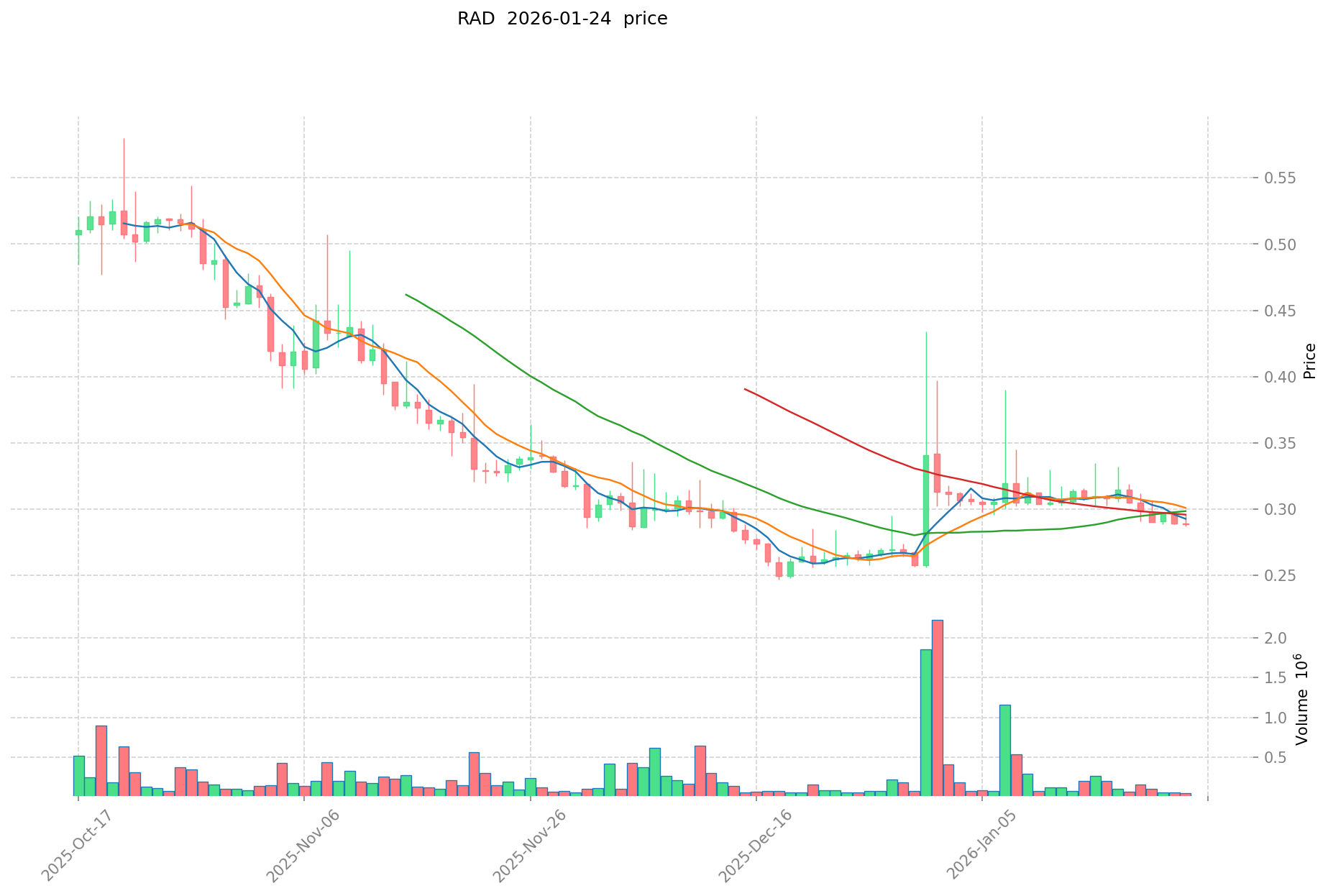
The lowest price point was recorded at $0.247899 on December 19, 2025, reflecting broader market corrections and reduced trading activity. As of January 25, 2026, RAD is trading at $0.2902, showing a recovery from its recent low. Recent price movements indicate:
- 1-hour change: -0.1%
- 24-hour change: -0.54%
- 7-day change: -6.60%
- 30-day change: +9.19%
- 1-year change: -73.42%
These fluctuations reflect various factors including market sentiment shifts, adoption patterns of decentralized development tools, and broader cryptocurrency market dynamics. The 30-day positive trend suggests potential stabilization after the December 2025 low.
Click to view current RAD market price
On-Chain Metrics
- 24-hour Trading Volume: $14,319.90 (indicating current market liquidity levels)
- Holder Addresses: 7,775 addresses (reflecting user base distribution)
- Market Capitalization: $14,460,407.89 (representing current network valuation)
- Market Cap to Fully Diluted Valuation Ratio: 49.83% (showing alignment between circulating and total supply)
Radicle Ecosystem Applications and Partners
Core Use Cases
Radicle's ecosystem supports multiple applications:
- Software Development Collaboration: Radicle provides a Web3-native network for software collaboration, offering decentralized code hosting and version control.
- Project Governance: Radicle enables developers to utilize NFTs, multi-signature wallets, and smart contracts to fund, monetize, and manage software projects.
Strategic Partnerships
Radicle has established collaborations with various partners in the blockchain and development communities, enhancing its technical capabilities and market influence.
These partnerships provide a solid foundation for Radicle's ecosystem expansion.
Controversies and Challenges
Radicle faces the following challenges:
- Technical Issues: Scalability and network performance optimization remain areas of focus
- Regulatory Risks: Evolving cryptocurrency regulations globally may impact governance token models
- Competitive Pressure: Competition from other decentralized collaboration platforms and existing centralized solutions like GitHub
These issues have sparked discussions within the community and market, while also driving Radicle's continuous innovation.
Radicle's community demonstrates active participation, with 7,775 token holders as of January 2026.
On X platform, related posts and hashtags (such as #RAD and #Radicle) generate consistent engagement.
New features, protocol upgrades, and governance proposals ignite community enthusiasm.
Sentiment on X presents varied perspectives:
- Supporters praise Radicle's decentralization features, GitHub-like functionality, and Web3-native approach, viewing it as "the future of collaborative software development".
- Critics focus on price volatility, market capitalization relative to competitors, and adoption challenges.
Recent trends show community discussions centered around protocol development and ecosystem growth.
Trending Topics
X users actively discuss Radicle's governance mechanisms, integration with Ethereum, and potential for mainstream developer adoption,
showcasing both its transformative potential and the obstacles toward widespread adoption.
- Official Website: Visit Radicle's official site for features, use cases, and latest updates.
- X Updates: On X platform, Radicle maintains an active presence via @radicle, with posts covering protocol upgrades, community activities, and partnership announcements, generating significant engagement.
- Developer Resources: Access the GitHub repository for technical documentation and development resources.
Radicle's Future Roadmap
- Ongoing Development: Enhance protocol performance and user experience, improving decentralized collaboration tools
- Ecosystem Goals: Expand support for more development teams and open-source projects
- Long-term Vision: Become the standard infrastructure for decentralized software collaboration
How to Participate in Radicle?
- Purchase Options: Buy RAD on Gate.com and other major cryptocurrency exchanges
- Storage Solutions: Securely store RAD using Ethereum-compatible wallets such as MetaMask or hardware wallets
- Governance Participation: Engage in community decision-making through governance proposals and voting mechanisms
- Ecosystem Building: Visit Radicle's developer documentation to contribute to the protocol or build applications
Summary
Radicle redefines software collaboration through blockchain technology, providing decentralization, transparency, and innovative project management tools.
Its active community, comprehensive resources, and unique positioning make it distinctive in the cryptocurrency space.
Despite facing regulatory uncertainties and competitive pressures, Radicle's innovative approach and clear development path position it as a significant player in the future of decentralized technology.
Whether you are a newcomer or an experienced participant, Radicle is worth following and engaging with.
FAQ
What is Radix (RAD) and how does it work?
Radix is a layer-1 blockchain designed for decentralized finance. RAD is its native token used for network security, governance, and transaction fees. Radix uses a unique consensus mechanism enabling high throughput and low latency for DeFi applications.
What are the main use cases and features of the RAD token?
RAD token enables governance participation, staking rewards, and community decision-making within the protocol. It facilitates platform fees, incentivizes network validators, and grants access to premium features and services.
How can I buy and store RAD tokens securely?
Purchase RAD tokens through major cryptocurrency platforms, then transfer to a hardware wallet like Ledger or Trezor for maximum security. Enable two-factor authentication and keep your private keys offline.
What is the difference between RAD and other layer-1 blockchain projects?
RAD distinguishes itself through innovative consensus mechanisms, enhanced scalability solutions, and superior transaction efficiency. It offers faster finality times, lower gas fees, and robust developer ecosystems compared to traditional layer-1 blockchains, positioning itself as a next-generation infrastructure for decentralized applications.
What are the risks and potential benefits of investing in RAD?
RAD offers potential gains through community governance and ecosystem growth. Risks include market volatility, regulatory uncertainty, and adoption challenges. Long-term believers may see significant returns as the protocol matures and use cases expand.
What is the current market cap and tokenomics of RAD?
RAD's market cap fluctuates based on token price and circulating supply. Tokenomics features a fixed total supply with strategic allocation for development, community, and ecosystem growth. Check official sources for real-time market cap data.
* The information is not intended to be and does not constitute financial advice or any other recommendation of any sort offered or endorsed by Gate.