Spark (SPK) is an innovative on-chain capital allocator managing $3.95 billion across decentralized finance, centralized finance, and real-world assets. Launched in 2025 on Gate, Spark addresses capital inefficiency through automated, risk-managed allocation strategies. As an ERC20 token on Ethereum, SPK operates with 15,938 holders and 42 exchange listings globally. The protocol implements decentralized operations using Ethereum's public ledger and cryptographic security, dynamically balancing investments across multiple platforms. With 1.8 billion tokens circulating from a 10 billion total supply, SPK traded at $0.02232 as of January 2026, showing 9.73% monthly gains. Spark's ecosystem enables automated portfolio management, RWA integration, and institutional-grade capital deployment. The project faces market volatility and competitive pressures while maintaining strong community engagement and development momentum. Whether exploring DeFi capital management or institutional allocation strategies, Spark offe
Spark's Positioning and Significance
In 2025, the Spark team launched Spark (SPK), aiming to address inefficient capital allocation and limited liquidity access across decentralized and centralized finance.
As an onchain capital allocator managing $3.95 billion across DeFi, CeFi, and RWA, Spark plays a critical role in decentralized finance and institutional capital management.
As of 2026, Spark has established itself as a significant player in the blockchain finance ecosystem, with 15,938 holders and an active development community.
This article will explore its technical framework, market performance, and future potential.
Origin and Development History
Birth Background
Spark was created by its development team in 2025, aiming to solve capital inefficiency and the complexity of managing allocations across multiple financial platforms.
It emerged during the maturation of DeFi infrastructure and growing institutional interest in blockchain finance, with the goal of unlocking capital efficiency at scale through automated, risk-managed allocation strategies.
Spark's launch brought new possibilities to institutional investors and DeFi participants seeking optimized capital deployment.
Key Milestones
- February 2025: Token launch on Gate.com, establishing market presence with initial trading activity.
- July 2025: Price reached $0.19866, reflecting strong market interest in the project's capital allocation model.
- December 2025: Market adjustment period with price finding support at $0.01896, demonstrating resilience.
- January 2026: Maintained stable operations with 42 exchange listings, expanding accessibility for users globally.
With support from its community and development team, Spark continues to refine its allocation mechanisms, security protocols, and real-world applications.
How Spark Works
Decentralized Operations
Spark operates on the Ethereum blockchain network, functioning without centralized banking or governmental control.
The distributed node network validates transactions and maintains system transparency, providing users with greater autonomy while enhancing network resilience through decentralization.
Blockchain Foundation
Spark's infrastructure leverages Ethereum's public, immutable digital ledger that records all transactions.
Transactions are grouped into blocks and linked through cryptographic hashing to form a secure chain.
Anyone can view transaction records, establishing trust without intermediaries.
As an ERC20 token, Spark benefits from Ethereum's established security and interoperability features.
Capital Allocation Mechanism
Spark implements an automated capital allocation system that dynamically balances investments across DeFi, CeFi, and RWA based on market conditions.
The protocol maintains a conservative risk profile while optimizing returns through strategic deployment of the $3.95 billion under management.
This mechanism enables efficient capital utilization across multiple platforms while preserving security through risk management protocols.
Secure Transactions
Spark utilizes Ethereum's public-private key cryptography to protect transactions:
- Private keys (similar to secret passwords) are used to sign transactions
- Public keys (similar to account numbers) are used to verify ownership
This mechanism ensures fund security while maintaining transaction pseudonymity on the blockchain.
The ERC20 standard provides additional security through smart contract auditing and established protocol standards.
Circulation Overview
As of January 20, 2026, Spark's circulating supply stands at 1,806,938,484 SPK tokens, with a total supply of 10,000,000,000 tokens. The maximum supply is capped at 10 billion tokens, establishing a fixed supply model. Currently, approximately 18.07% of the total supply is in circulation, with the market cap to fully diluted valuation ratio reflecting this distribution.
Price Fluctuations
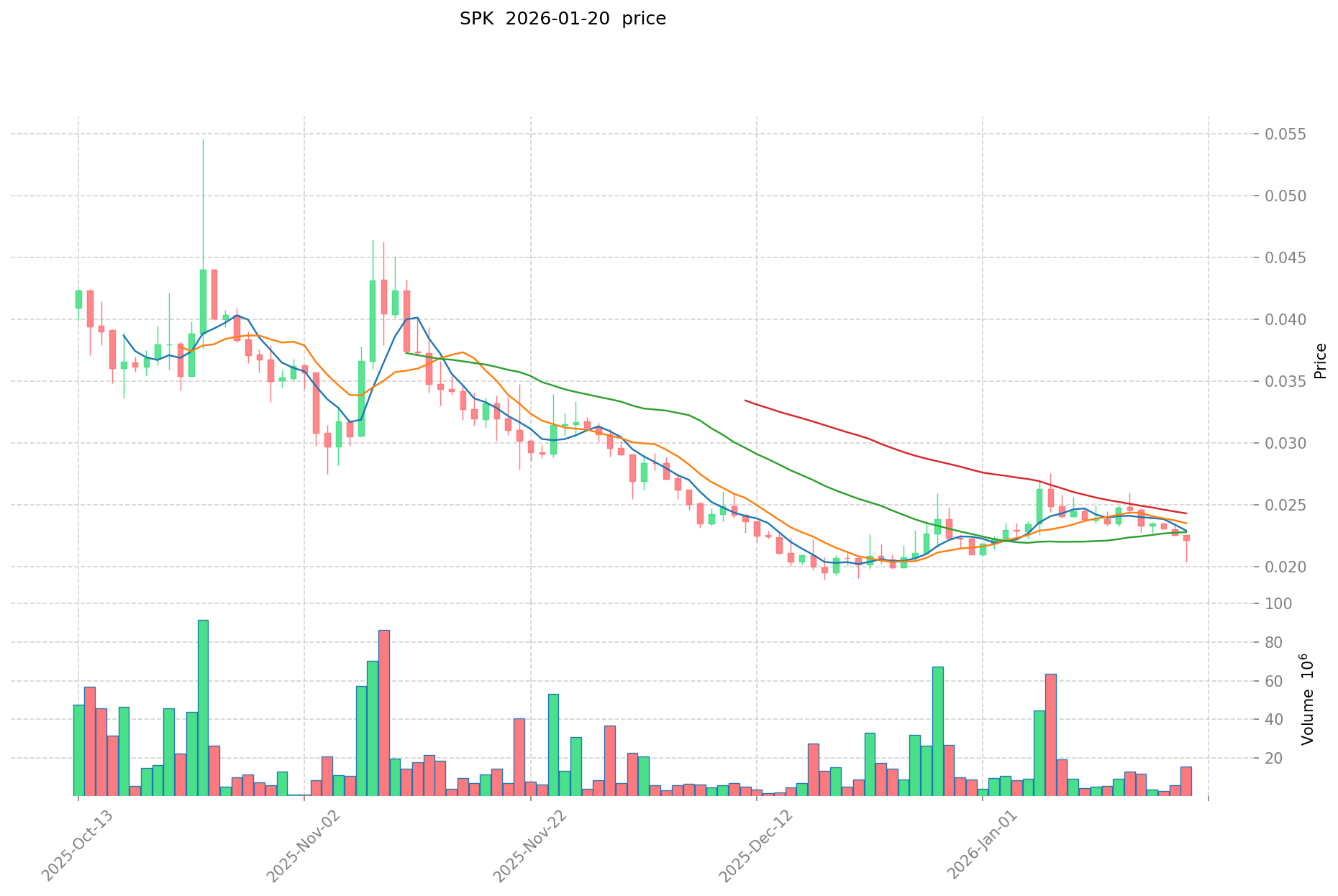
Spark reached its all-time high price of $0.19866 on July 23, 2025, driven by favorable market conditions during that period. Its lowest price of $0.01896 occurred on December 18, 2025, reflecting subsequent market adjustments. As of January 20, 2026, SPK is trading at $0.02232, showing a 24-hour increase of 2.99% and a 30-day gain of 9.73%, though experiencing a 7-day decline of 4.74%. These price movements demonstrate the dynamic nature of market sentiment and trading activity.
Click to view the current SPK market price
On-chain Metrics
- Holder Count: 15,938 addresses (indicating user adoption levels)
- 24-Hour Trading Volume: $174,283.27 (reflecting current market activity)
- Market Capitalization: $40,330,866.96 (representing the current circulating value)
Spark Ecosystem Applications and Partners
Core Use Cases
Spark's ecosystem supports multiple applications across the DeFi landscape:
- Capital Allocation: Automated portfolio management across DeFi protocols, optimizing yield generation strategies while maintaining risk-balanced exposure across multiple asset classes.
- Real World Assets (RWA): Integration with tokenized real-world assets, enabling efficient capital deployment beyond traditional crypto-native instruments.
Strategic Partnerships
Spark operates within the broader DeFi infrastructure, leveraging decentralized protocols and blockchain networks to enhance its capital allocation capabilities.
These integrations provide a solid foundation for Spark's ecosystem expansion and operational efficiency.
Challenges and Considerations
Spark faces several challenges in the evolving DeFi landscape:
- Technical Considerations: Managing capital efficiency at scale across multiple protocols while maintaining optimal risk parameters
- Market Dynamics: Adapting allocation strategies to volatile market conditions and changing yield opportunities
- Competitive Environment: Operating in an increasingly competitive DeFi capital management space with emerging alternative protocols
These factors drive ongoing innovation and community engagement around Spark's capital allocation mechanisms.
Spark's community demonstrates notable activity, with 15,938 token holders participating in the ecosystem.
On X platform, discussions around Spark and its capital allocation strategies generate consistent engagement among DeFi participants.
Key developments such as protocol updates and allocation performance fuel community interest and participation.
X platform discussions reflect diverse perspectives:
- Supporters highlight Spark's automated capital efficiency and conservative risk management approach, viewing it as an innovative solution for institutional-grade DeFi capital allocation.
- Observers monitor aspects including market performance, allocation strategies, and protocol governance.
Recent trends indicate growing interest in capital-efficient DeFi protocols and automated allocation mechanisms.
Key Discussion Topics
X users actively discuss Spark's capital deployment strategies, risk management frameworks, and position within the evolving DeFi landscape,
reflecting both the potential for optimized yield generation and considerations around protocol risk exposure.
- Official Website: Visit Spark Official Site for features, use cases, and latest developments.
- Documentation: Spark Documentation provides detailed information on the SPK token, governance mechanisms, and protocol architecture.
- X Platform: Spark maintains an active presence on X via @sparkdotfi,
sharing updates on protocol developments, community initiatives, and capital allocation insights.
Spark Future Roadmap
- Ongoing Development: Enhancement of capital allocation algorithms and risk management frameworks, improving efficiency and returns across multiple protocols
- Ecosystem Goals: Expanding allocation capabilities across DeFi, CeFi, and RWA sectors while maintaining conservative risk profiles
- Long-term Vision: Establishing Spark as a leading on-chain capital allocation infrastructure for institutional and retail participants
How to Participate in Spark?
- Purchase Options: Acquire SPK on Gate.com and other supported exchanges
- Storage Solutions: Store SPK tokens securely using compatible Ethereum wallets
- Governance Participation: Engage in protocol governance through the SPK token voting mechanism
- Community Engagement: Join the Spark Discord to connect with the community and stay updated on protocol developments
Summary
Spark represents an innovative approach to capital allocation through blockchain technology, offering automated portfolio management, risk-optimized deployment, and cross-sector exposure across DeFi, CeFi, and RWA.
Its active community, comprehensive documentation, and focused market positioning distinguish it within the DeFi capital management sector.
Despite facing market volatility and competitive pressures, Spark's systematic approach and clear development trajectory position it as a notable participant in the evolution of on-chain capital allocation.
Whether you are exploring DeFi capital management or seeking exposure to automated allocation strategies, Spark offers a distinctive value proposition worth considering.
FAQ
What is SPK token and what project is it associated with?
SPK is the native utility token of the Speak project, a decentralized platform leveraging blockchain technology for content creation and community engagement. SPK enables governance participation, transaction settlement, and rewards distribution within the Speak ecosystem.
What are the main use cases and functions of SPK cryptocurrency?
SPK serves as a utility token for decentralized content creation and distribution platforms. Main functions include rewarding content creators, enabling community governance, facilitating micropayments, and incentivizing network participation. It powers Web3 media ecosystems where users earn tokens through content creation and engagement.
How can I buy and trade SPK tokens?
You can purchase SPK tokens on major cryptocurrency exchanges by creating an account, completing verification, and depositing funds. Once verified, search for SPK in the trading pairs, place your buy order, and manage your holdings. You can trade SPK against other cryptocurrencies or fiat currencies depending on available trading pairs.
What is the total supply and tokenomics of SPK?
SPK has a total supply of 10 billion tokens. The tokenomics include community rewards, development fund allocation, and ecosystem incentives. Token distribution is designed to support long-term sustainable growth and project development.
What are the risks and security considerations when investing in SPK?
SPK investments involve market volatility, liquidity risks, and smart contract vulnerabilities. Ensure secure wallet management, use hardware wallets, enable two-factor authentication, and verify contract audits. Conduct thorough research before investing.
How does SPK compare to other similar cryptocurrency projects?
SPK distinguishes itself through innovative tokenomics, strong community governance, and unique utility features. Unlike traditional projects, SPK offers superior transaction efficiency, lower fees, and enhanced scalability. Its ecosystem delivers real-world adoption advantages and competitive sustainability mechanisms.
What is the roadmap and future development plan for SPK?
SPK is focused on expanding its ecosystem with enhanced DeFi protocols, Layer 2 scaling solutions, and NFT marketplace integration. The team plans to launch governance improvements and strategic partnerships to strengthen community engagement and market adoption throughout 2026-2027.
* The information is not intended to be and does not constitute financial advice or any other recommendation of any sort offered or endorsed by Gate.