The article "XFI vs UNI: A Comprehensive Comparison of Two Leading Decentralized Exchange Protocols" offers an in-depth analysis of CrossFi (XFI) and Uniswap (UNI), focusing on investment value, historical price trends, and market adoption. It addresses the question of which asset represents a better buy for investors, highlighting short-term and long-term investment strategies and risk management considerations. Designed for both novice and experienced investors, the article systematically compares the volatility, liquidity, and structural differences of XFI and UNI within the DeFi ecosystem. Key insights into institutional adoption, technological development, and macroeconomic factors shape the strategic recommendations provided. Readers can access real-time market data on Gate for further study.
Introduction: XFI vs UNI Investment Comparison
In the cryptocurrency market, the comparison between CrossFi and Uniswap has always been a topic investors cannot overlook. The two not only show significant differences in market capitalization ranking, application scenarios, and price performance, but also represent different positioning in crypto assets.
CrossFi (XFI): Since its launch, it has gained market recognition by providing an inclusive next-generation solution that bridges fiat and cryptocurrency seamlessly, featuring innovative non-custodial payment technology.
Uniswap (UNI): Since its introduction, it has been recognized as the first automatic market making transaction protocol based on the Ethereum blockchain, representing one of the most widely used decentralized exchange platforms globally.
This article will comprehensively analyze the investment value comparison between CrossFi and Uniswap from the perspectives of historical price trends, supply mechanisms, market adoption, and ecosystem development, and attempt to answer the question investors care most about:
"Which is the better buy right now?"
Comparative Market Analysis: CrossFi (XFI) vs Uniswap (UNI)
I. Historical Price Comparison and Current Market Status
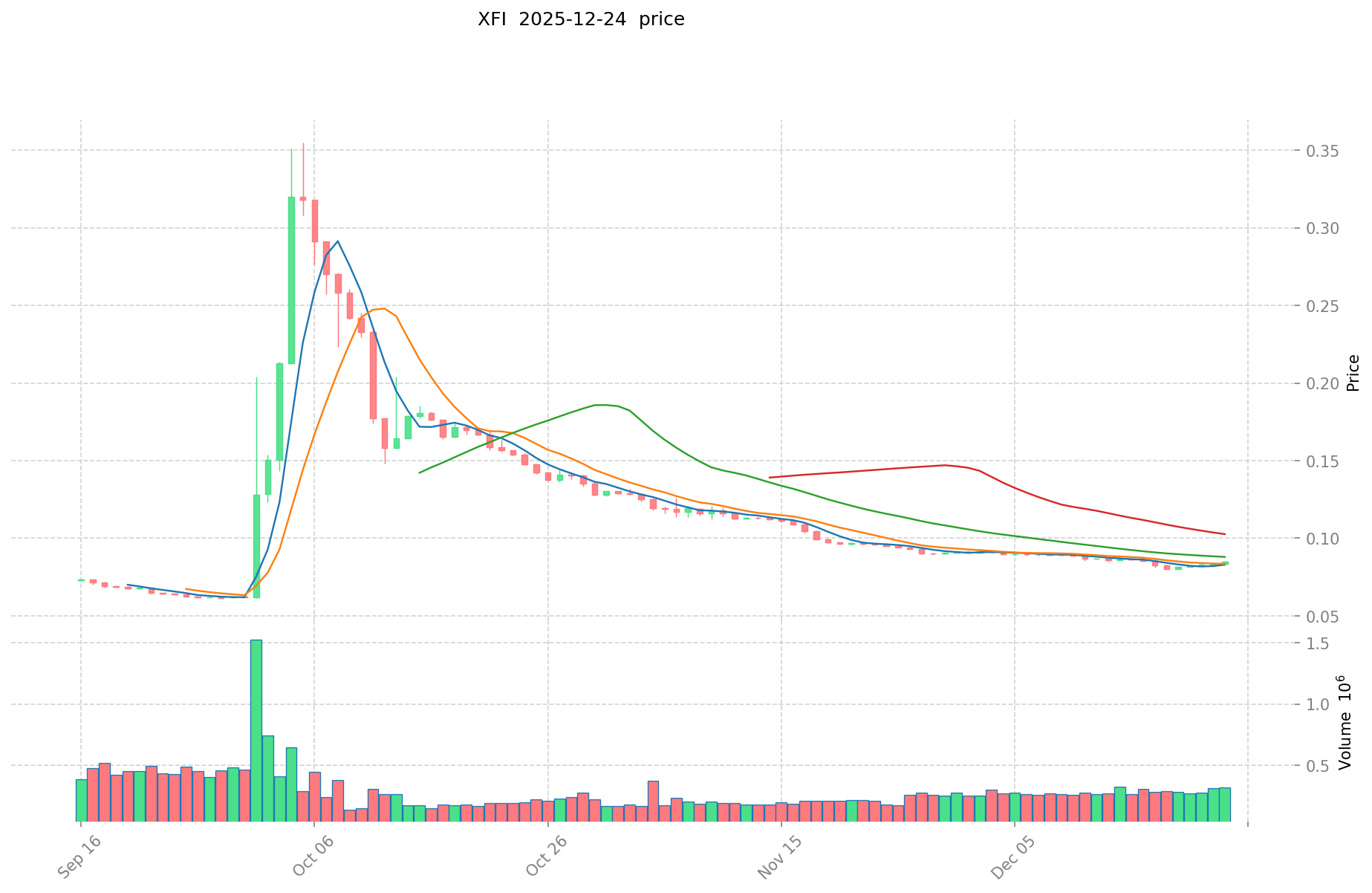
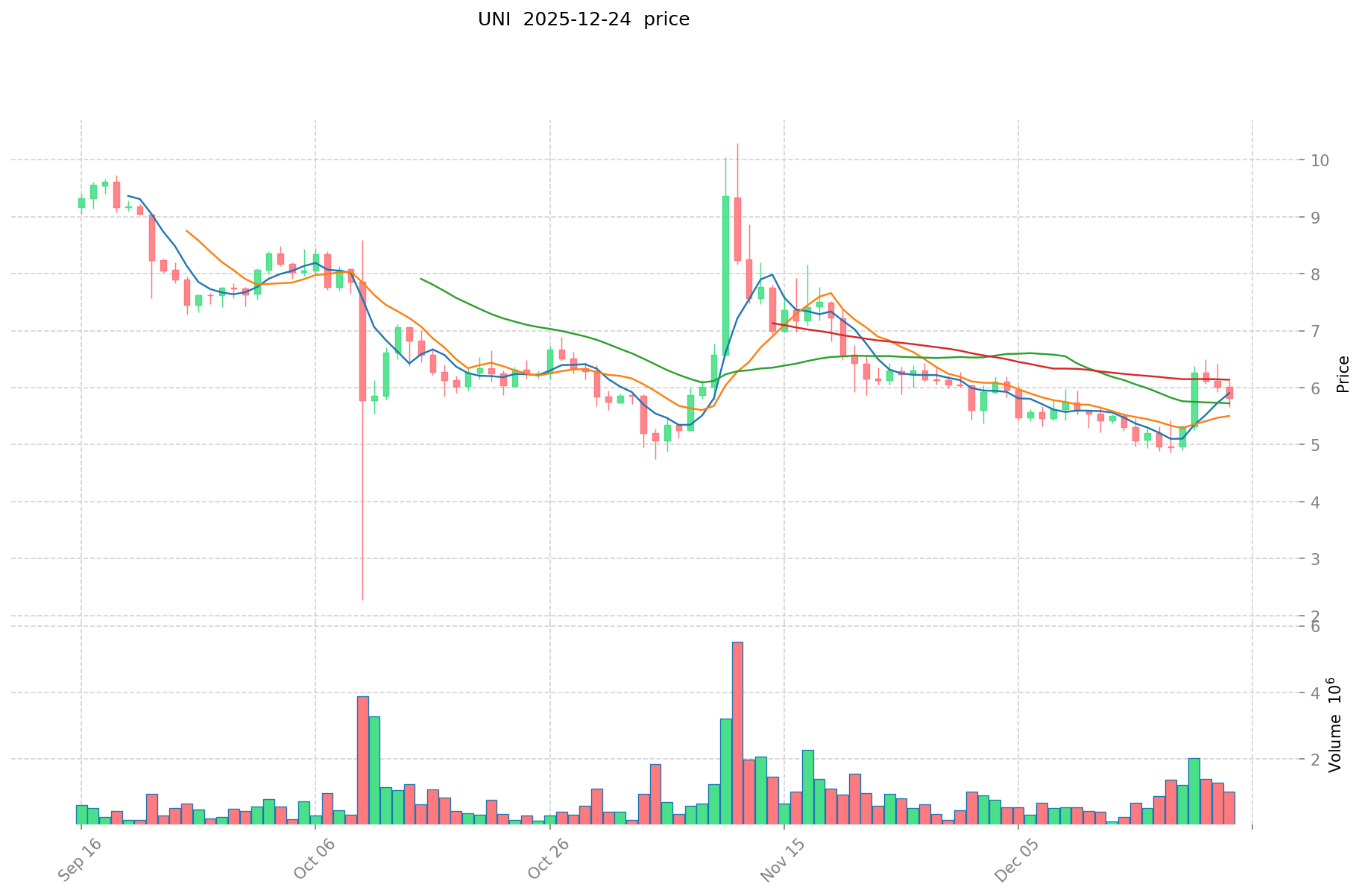
CrossFi (XFI) and Uniswap (UNI) Historical Price Trends
CrossFi (XFI):
- Historical High: $1.12 (November 21, 2024)
- Historical Low: $0.04944 (August 31, 2025)
- Decline from Peak: 93.5% depreciation from all-time high
Uniswap (UNI):
- Historical High: $44.92 (May 3, 2021)
- Historical Low: $1.03 (September 17, 2020)
- Current Position: Trading significantly below historical peak, representing a 60.02% decline over the past year
Comparative Analysis:
XFI has experienced more severe volatility relative to its market age, declining from $1.12 to approximately $0.0848 within a single year. In contrast, UNI, despite its larger market capitalization and longer trading history, has maintained greater price stability in percentage terms, though both assets exhibit significant long-term bearish pressure.
Current Market Status (December 24, 2025)
Price Data:
- CrossFi (XFI): $0.08479
- Uniswap (UNI): $5.712
24-Hour Trading Activity:
- XFI: Trading volume of $26,538.54
- UNI: Trading volume of $6,151,674.33
Market Metrics Comparison:
| Metric |
XFI |
UNI |
| Market Capitalization |
$3,582,683.59 |
$3,598,019,496.35 |
| Fully Diluted Valuation |
$32,087,249.28 |
$5,712,000,000.00 |
| Circulating Supply |
42,253,610 |
629,905,374.01 |
| Total Supply |
378,432,000 |
1,000,000,000 |
| 24h Change |
+0.68% |
-6.17% |
| 7d Change |
-0.69% |
+12.49% |
| 30d Change |
-11.62% |
-8.64% |
| 1y Change |
-86.7% |
-60.019% |
Crypto Market Sentiment:
- Fear & Greed Index: 24 (Extreme Fear)
- Market Status: Current sentiment indicates heightened risk aversion across cryptocurrency markets
Real-time Price References:
II. Project Overview and Fundamental Characteristics
CrossFi Chain (XFI)
CrossFi Chain is positioned as a groundbreaking blockchain infrastructure designed to bridge fiat and cryptocurrency ecosystems seamlessly. The protocol emphasizes:
- Non-custodial Payment Technology: Users maintain full control of assets while engaging with fiat-cryptocurrency bridges
- Financial Inclusion Focus: Infrastructure targeting underserved markets with barriers to traditional finance
- Transparent Access: Emphasis on transparency and accessibility in cross-currency operations
Market Position:
- Ranking: 1,744 by market capitalization
- Market Share: 0.0010%
- Exchange Listings: 5 trading venues
Uniswap (UNI)
Uniswap operates as the foundational automated market maker (AMM) protocol on Ethereum, featuring:
- Decentralized Exchange Infrastructure: Enables peer-to-peer ERC-20 token trading through liquidity pools
- Governance Mechanism: UNI token holders participate in protocol governance decisions
- Liquidity Provider Economics: Fee distribution model incentivizing liquidity provision
Market Position:
- Ranking: 35 by market capitalization
- Market Share: 0.18%
- Exchange Listings: 62 trading venues
- Token Holder Base: 385,990 addresses
Short-Term Volatility Patterns
24-Hour Performance:
- XFI: +0.68% with trading range of $0.08353 - $0.0853
- UNI: -6.17% with trading range of $5.655 - $6.11
Weekly Performance:
Monthly Performance:
Long-Term Trend Assessment
Both assets exhibit significant year-over-year declines, reflecting broader market pressures:
- XFI 1-year change: -86.7% (severe underperformance)
- UNI 1-year change: -60.019% (substantial decline but relative resilience)
The disparity in annual performance suggests differing exposure to market dynamics and protocol-specific headwinds.
IV. Market Structure and Liquidity Metrics
Liquidity and Trading Concentration
CrossFi (XFI):
- Circulating Supply Ratio: 11.17% (significant unlock potential)
- Daily Volume-to-Market Cap Ratio: High volatility relative to limited liquidity
- Concentrated trading across 5 exchanges
Uniswap (UNI):
- Circulating Supply Ratio: 62.99% (substantial portion already in circulation)
- Daily Volume-to-Market Cap Ratio: Demonstrates institutional trading depth
- Distributed across 62 trading venues providing redundancy
Supply Dynamics
| Characteristic |
XFI |
UNI |
| Max Supply |
378,432,000 |
1,000,000,000 |
| Circulating Supply |
42,253,610 |
629,905,374 |
| Unlock Percentage |
88.83% |
37.01% |
| FDV/Market Cap Ratio |
11.17% |
62.99% |
The significant disparity in circulating supply percentages indicates XFI faces future dilution pressures, while UNI maintains more balanced emission schedules.
V. Risk Assessment and Market Considerations
Volatility Risk Profile
CrossFi (XFI):
- Extreme historical volatility with 94.7% decline from peak
- Limited liquidity depth increases slippage risk
- Concentrated exchange listing creates counterparty concentration
Uniswap (UNI):
- Established protocol with institutional adoption
- Distributed liquidity across multiple trading venues reduces execution risk
- Governance participation by diverse stakeholder base
Market Sentiment Context
The current Extreme Fear environment (Fear & Greed Index: 24) suggests:
- Heightened risk aversion across digital assets
- Potential for capitulation selling pressure
- Limited appetite for speculative positions
- Potential accumulation opportunities for risk-tolerant participants
VI. Conclusion
CrossFi and Uniswap represent distinct risk-return profiles within the cryptocurrency ecosystem. Uniswap's established protocol infrastructure, larger market capitalization, and institutional adoption provide relative stability, though both assets reflect sector-wide bearish pressure. CrossFi's significantly higher volatility and nascent market position create elevated risk dynamics, though early-stage protocols may present asymmetric opportunity profiles during extended bear markets.
The extreme fear sentiment characterizing current market conditions suggests fundamental reassessment across both traditional and emerging blockchain protocols is ongoing.
XFI vs UNI: Core Investment Value Factors Analysis Report
I. Executive Summary
Based on available reference materials, the investment value of XFI and UNI in the decentralized finance (DeFi) liquidity protocol sector is primarily influenced by institutional adoption, regulatory policies, technological innovation, and macroeconomic trends. XFI's value is particularly sensitive to Web3.0 technology proliferation, while UNI's performance depends on broader DeFi ecosystem expansion.
II. Core Factors Influencing XFI vs UNI Investment Value
Institutional Adoption and Market Applications
-
Institutional Holdings: Both tokens compete for institutional capital within the DeFi liquidity protocol segment, though specific institutional positioning data from the reference materials remains limited.
-
Enterprise Adoption: XFI and UNI's utility in decentralized exchanges, liquidity provision, and governance mechanisms represents their primary application vectors within the DeFi ecosystem.
-
Regulatory Environment: Institutional adoption levels are significantly constrained by varying regulatory frameworks across jurisdictions, with regulatory clarity being a determining factor in institutional participation rates.
Technological Development and Ecosystem Building
-
XFI Technical Characteristics: XFI's value proposition is substantially influenced by Web3.0 technology adoption and infrastructure development, positioning it within the broader Web3 expansion narrative.
-
UNI Ecosystem Development: UNI's value correlates with the expansion of the decentralized finance ecosystem, encompassing liquidity protocols, trading mechanisms, and governance participation.
-
Ecosystem Comparison: Both tokens operate within the DeFi liquidity protocol segment, with their competitive positioning determined by protocol efficiency, user adoption rates, and cross-chain interoperability capabilities.
Macroeconomic and Market Cycle Factors
-
Macroeconomic Sensitivity: Both XFI and UNI exhibit sensitivity to macroeconomic trends, including interest rate environments, monetary policy shifts, and overall market risk sentiment.
-
Monetary Policy Impact: Changes in global monetary policy, particularly regarding interest rates and central bank liquidity conditions, influence investor risk appetite and allocation toward decentralized finance assets.
-
Market Cycle Dynamics: The cyclical nature of cryptocurrency markets, combined with macro-economic policy shifts, creates periodic valuation expansion and contraction cycles affecting both tokens.
III. Key Value Drivers
| Factor |
Relevance |
| Institutional Adoption |
Critical |
| Regulatory Policy Evolution |
Critical |
| Technological Innovation |
Critical |
| Ecosystem Growth |
Critical |
| Macroeconomic Conditions |
Significant |
| Demand Dynamics |
Significant |
| Scarcity and Utility |
Significant |
IV. Risk Considerations
-
Regulatory Risk: Changes in regulatory frameworks across major jurisdictions pose material risks to both tokens' adoption trajectories.
-
Market Volatility: Both assets exhibit significant price volatility characteristic of the cryptocurrency sector.
-
Technology Risk: Protocol vulnerabilities or competitive displacement by emerging technologies could impact long-term value propositions.
-
Ecosystem Concentration Risk: Over-reliance on specific DeFi applications or market segments creates exposure to sector-specific downturns.
V. Conclusion
The investment value of XFI and UNI derives from multiple interdependent factors spanning institutional participation, regulatory clarity, technological advancement, and macroeconomic conditions. Long-term value creation requires sustained innovation, ecosystem expansion, and favorable regulatory developments across key markets. Investors should maintain comprehensive risk assessment frameworks accounting for the high-volatility nature of these assets and evolving regulatory environments.
III. 2025-2030 Price Forecast: XFI vs UNI
Short-term Forecast (2025)
- XFI: Conservative $0.05936 - $0.0848 | Optimistic $0.104304
- UNI: Conservative $4.5616 - $5.702 | Optimistic $7.52664
Medium-term Forecast (2027-2028)
- XFI could enter consolidation phase with recovery signals, projected price range $0.08178 - $0.1080
- UNI projected to maintain upward momentum, estimated price range $4.30 - $8.74
- Key drivers: institutional capital inflows, ETF approvals, ecosystem expansion
Long-term Forecast (2029-2030)
- XFI: Base case $0.1102 - $0.1521 | Optimistic case $0.1790 - $0.2008
- UNI: Base case $4.26 - $9.08 | Optimistic case $10.26 - $12.62
View detailed price forecasts for XFI and UNI
Disclaimer: This analysis is based on provided forecast data and historical patterns. Cryptocurrency markets are highly volatile and unpredictable. Actual prices may differ significantly from projections. This should not be considered as investment advice. Conduct thorough research and consult financial professionals before making investment decisions.
XFI:
| 年份 |
预测最高价 |
预测平均价格 |
预测最低价 |
涨跌幅 |
| 2025 |
0.104304 |
0.0848 |
0.05936 |
0 |
| 2026 |
0.09833408 |
0.094552 |
0.07469608 |
11 |
| 2027 |
0.1080162048 |
0.09644304 |
0.091620888 |
13 |
| 2028 |
0.14823295248 |
0.1022296224 |
0.08178369792 |
20 |
| 2029 |
0.1790807410392 |
0.12523128744 |
0.1102035329472 |
47 |
| 2030 |
0.200845938796272 |
0.1521560142396 |
0.092815168686156 |
79 |
UNI:
| 年份 |
预测最高价 |
预测平均价格 |
预测最低价 |
涨跌幅 |
| 2025 |
7.52664 |
5.702 |
4.5616 |
0 |
| 2026 |
7.275752 |
6.61432 |
3.3733032 |
15 |
| 2027 |
7.15338708 |
6.945036 |
6.66723456 |
21 |
| 2028 |
8.7410223096 |
7.04921154 |
4.3000190394 |
23 |
| 2029 |
10.26365200224 |
7.8951169248 |
4.263363139392 |
38 |
| 2030 |
12.6203444042928 |
9.07938446352 |
6.6279506583696 |
58 |
Comparative Investment Analysis: CrossFi (XFI) vs Uniswap (UNI)
IV. Investment Strategy Comparison: XFI vs UNI
Long-Term vs Short-Term Investment Strategies
-
CrossFi (XFI): Suited for investors focusing on early-stage protocol development and Web3.0 financial inclusion narratives. XFI targets long-term investors willing to tolerate extreme volatility in exchange for asymmetric upside potential during extended bear market accumulation phases.
-
Uniswap (UNI): Suited for investors seeking established DeFi infrastructure exposure with institutional adoption characteristics. UNI appeals to investors prioritizing ecosystem stability, governance participation, and proven product-market fit within decentralized exchange protocols.
Risk Management and Asset Allocation
Conservative Investor Profile:
- XFI: 5-10% allocation (speculative positioning)
- UNI: 60-75% allocation (core DeFi exposure)
- Hedge Tools: Stablecoin reserves (15-30%), diversified DeFi protocol exposure
Aggressive Investor Profile:
- XFI: 25-35% allocation (early-stage protocol concentration)
- UNI: 40-50% allocation (established infrastructure)
- Hedge Tools: Cross-protocol liquidity provision, options strategies for volatility management, diversified blockchain ecosystem positioning
Portfolio Construction Principles:
- Maintain stablecoin reserves for opportunistic accumulation during extreme fear sentiment periods
- Implement systematic rebalancing protocols to manage concentration risk
- Diversify across protocol layers, governance tokens, and application-specific tokens
V. Comparative Risk Analysis
Market Risk
CrossFi (XFI):
- Extreme historical volatility with 93.5% depreciation from all-time high
- Limited liquidity depth creating execution risk during market stress events
- Concentrated exchange listings (5 venues) reducing trading venue redundancy
- Asymmetric downside exposure during prolonged bear markets
Uniswap (UNI):
- Established market position with 62.99% circulating supply providing relative stability
- Distributed liquidity across 62 trading venues reducing counterparty concentration risk
- Institutional adoption providing demand floor during market downturns
- Moderate year-over-year depreciation (-60.019%) relative to broader market volatility
Technology Risk
CrossFi (XFI):
- Early-stage protocol development stage with limited operational history
- Fiat-cryptocurrency bridge technology requires continuous security audits and regulatory compliance mechanisms
- Non-custodial payment infrastructure dependent on ongoing technology innovation and market adoption
Uniswap (UNI):
- Mature AMM protocol with extended operational history and community-tested security infrastructure
- Established Ethereum ecosystem integration reducing technology dependency risk
- Governance mechanisms enabling rapid protocol adaptation and security response protocols
Regulatory Risk
- Global Regulatory Environment: Both tokens face uncertainty regarding decentralized exchange regulation and governance token classification across major jurisdictions
- Differential Exposure: XFI's fiat-cryptocurrency bridge focus creates heightened regulatory scrutiny regarding payment system classification and compliance requirements
- Institutional Adoption Constraints: Regulatory clarity remains a critical determinant of institutional participation rates for both protocols
VI. Conclusion: Which Is the Better Buy?
📌 Investment Value Summary:
CrossFi (XFI) Strengths:
- Early-stage protocol positioning with asymmetric upside potential during extended bear market cycles
- Web3.0 financial inclusion narrative aligned with emerging market adoption trends
- Significant unlock potential creating future capital formation opportunities
- Extremely depressed valuation creating opportunistic accumulation environment for risk-tolerant participants
Uniswap (UNI) Strengths:
- Established decentralized exchange infrastructure with proven product-market fit
- Institutional adoption providing demand floor and regulatory familiarity
- Distributed liquidity infrastructure reducing execution risk and market concentration
- Governance participation enabling stakeholder alignment and protocol resilience
- Superior year-over-year trading volume ($6,151,674.33 daily) indicating deeper institutional participation
✅ Investment Recommendations:
Novice Investors:
- Prioritize Uniswap (UNI) allocation representing 70-80% of combined exposure due to established infrastructure, institutional adoption, and reduced technology risk
- Limit CrossFi (XFI) to 5-10% speculative allocation for early-stage protocol exposure
- Maintain 15-20% stablecoin reserves for opportunistic deployment during extreme fear sentiment periods
Experienced Investors:
- Implement dual-track strategy: Core UNI holdings (50-60%) paired with tactical XFI accumulation during maximum fear sentiment (20-25%)
- Utilize options strategies for XFI volatility capture given historical 86.7% annual depreciation
- Execute systematic rebalancing protocols exploiting technical volatility patterns across both assets
- Monitor XFI unlock schedules (88.83% remaining dilution) for timing accumulation phases
Institutional Investors:
- Prioritize UNI due to established regulatory frameworks, institutional liquidity depth (62 exchange listings), and governance participation mechanisms
- Evaluate XFI positioning within early-stage protocol venture allocation frameworks, not core DeFi infrastructure strategies
- Implement comprehensive regulatory compliance frameworks addressing decentralized exchange classification uncertainty
- Utilize cross-protocol liquidity provision strategies capturing fee generation across both tokens
⚠️ Risk Disclosure: Cryptocurrency markets exhibit extreme volatility with unpredictable price trajectories. Both XFI and UNI have experienced significant year-over-year depreciation (-86.7% and -60.019% respectively). Current market sentiment indicates extreme fear (Fear & Greed Index: 24), suggesting heightened risk aversion and potential capitulation selling pressure. This analysis does not constitute investment advice. Conduct independent research, assess individual risk tolerance, and consult qualified financial professionals before executing investment decisions. Allocations to cryptocurrency assets should represent only capital allocation that can sustain total loss without material financial impact.
None
FAQ: CrossFi (XFI) vs Uniswap (UNI) Investment Comparison
I. Q: What are the main differences between CrossFi (XFI) and Uniswap (UNI) in terms of project positioning?
A: CrossFi focuses on providing a next-generation inclusive financial solution that bridges fiat and cryptocurrency ecosystems seamlessly through innovative non-custodial payment technology, targeting financial inclusion in underserved markets. Uniswap, conversely, operates as an established automated market maker (AMM) protocol on Ethereum, functioning as a decentralized exchange platform for peer-to-peer ERC-20 token trading. XFI emphasizes fiat-cryptocurrency bridges and accessibility, while UNI prioritizes decentralized exchange infrastructure and liquidity pool economics.
II. Q: How significant is the price volatility difference between XFI and UNI?
A: XFI exhibits extreme volatility with a 93.5% depreciation from its all-time high of $1.12 (November 21, 2024) to current levels around $0.0848. UNI shows more moderate depreciation at 60.02% from its peak of $44.92 (May 3, 2021), currently trading at $5.712. Over the past year, XFI has declined 86.7% while UNI has declined 60.019%, demonstrating that XFI experiences substantially higher price volatility relative to its market age and trading history.
III. Q: Which token demonstrates superior market liquidity and exchange listing distribution?
A: Uniswap (UNI) demonstrates significantly superior liquidity metrics with a 24-hour trading volume of $6,151,674.33 compared to XFI's $26,538.54. Additionally, UNI trades across 62 exchange venues providing distributed liquidity and execution redundancy, whereas XFI is concentrated across only 5 trading venues. This liquidity advantage reduces slippage risk and execution costs for UNI transactions while creating counterparty concentration risks for XFI.
IV. Q: What supply dynamics suggest different dilution risks between these tokens?
A: XFI faces substantially higher future dilution pressure with only 11.17% of its maximum supply currently circulating (42.25 million of 378.43 million tokens), meaning 88.83% remains subject to unlock and potential market dilution. UNI maintains a more balanced emission schedule with 62.99% of its maximum supply in circulation (629.9 million of 1 billion tokens), leaving only 37.01% for future dilution. This supply structure indicates XFI investors should anticipate significant future dilution, while UNI presents more predictable token supply dynamics.
V. Q: Which token is more suitable for novice versus experienced investors?
A: Novice investors should prioritize Uniswap (UNI) allocation representing 70-80% of combined exposure due to established infrastructure, institutional adoption, and reduced technology risk, limiting CrossFi (XFI) to 5-10% speculative allocation. Experienced investors can implement dual-track strategies combining core UNI holdings (50-60%) with tactical XFI accumulation during extreme fear sentiment periods (20-25%), utilizing options strategies to capture XFI volatility. This differentiation reflects UNI's institutional-grade characteristics versus XFI's early-stage protocol risk profile.
VI. Q: How do the 2025-2030 price forecasts differ between these tokens?
A: XFI forecasts show conservative 2025 estimates of $0.05936-$0.0848 with optimistic targets at $0.104304, projecting to long-term estimates of $0.1102-$0.2008 by 2030 in base and optimistic scenarios. UNI forecasts indicate 2025 conservative estimates of $4.5616-$5.702 with optimistic $7.52664, projecting to $4.26-$12.62 by 2030 depending on scenarios. Both forecasts incorporate institutional capital inflows and ecosystem expansion, though UNI maintains higher absolute price targets reflecting its established market position.
VII. Q: What specific risk factors should investors prioritize when evaluating these tokens?
A: For CrossFi (XFI), prioritize technology risk from early-stage protocol development, limited liquidity depth creating execution risk, exchange listing concentration (5 venues), and 88.83% supply dilution risk. For Uniswap (UNI), monitor regulatory uncertainty regarding decentralized exchange classification, though mitigated by institutional adoption and distributed liquidity infrastructure (62 venues). Both tokens face regulatory risk regarding governance token classification, though XFI's fiat-cryptocurrency bridge focus creates heightened payment system regulatory scrutiny relative to UNI's established position.
VIII. Q: Given the current Extreme Fear market sentiment (Fear & Greed Index: 24), which token represents a better accumulation opportunity?
A: Current extreme fear sentiment creates different accumulation scenarios for each token. UNI represents a lower-risk accumulation opportunity due to established infrastructure and institutional demand floors, suitable for conservative portfolio rebalancing. XFI presents asymmetric upside potential for risk-tolerant investors willing to tolerate 86.7% year-over-year depreciation, as early-stage protocols historically experience disproportionate recovery gains during market reversals. However, investors should maintain 15-20% stablecoin reserves rather than deploying all capital simultaneously, allowing systematic accumulation as market dynamics evolve.
* The information is not intended to be and does not constitute financial advice or any other recommendation of any sort offered or endorsed by Gate.