I. Incident Review: From Cross-Chain Attack to On-Chain Freezing
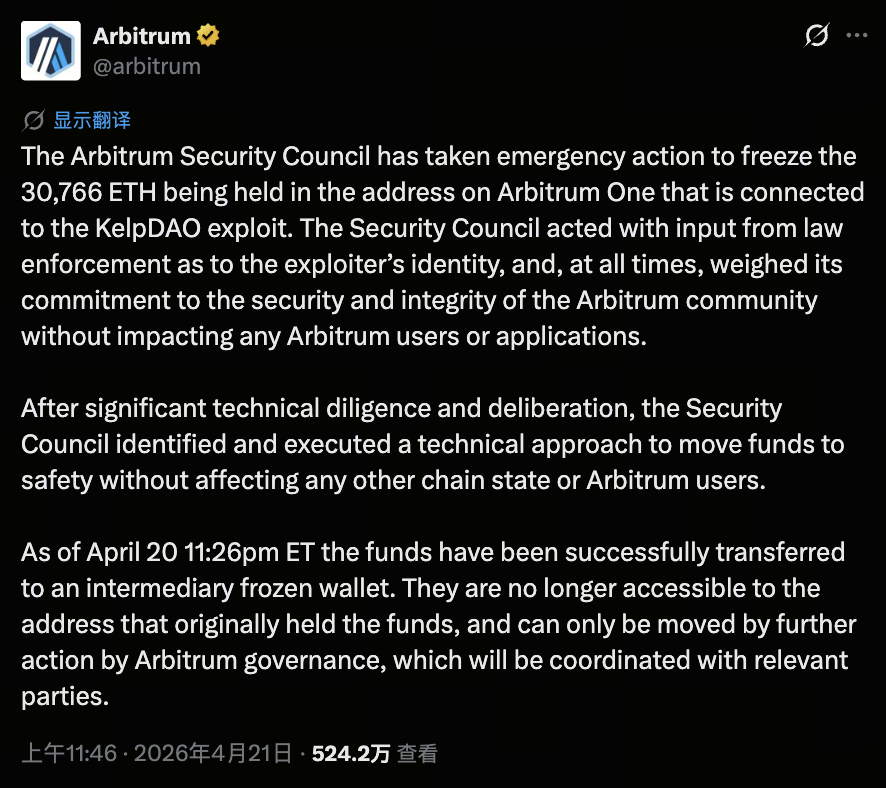
Image source: Arbitrum Post
In April 2026, the crypto market faced another major security incident with systemic repercussions. Kelp DAO experienced a critical vulnerability during cross-chain interactions, allowing attackers to exploit flaws in the cross-chain verification mechanism and successfully siphon off approximately $290 million in assets. Following the breach, funds quickly moved across multiple chains and were funneled into lending protocols for collateralization and subsequent borrowing, with Aave serving as a key destination.
The attack route displayed classic DeFi composability attack traits: after breaching the cross-chain entry, the funds were “washed” through liquidity protocols, then further converted into more liquid assets (such as ETH) via lending mechanisms. This sequence not only widened the loss scope but also propagated risk across several protocol layers.
What truly shifted the course of the incident was a rare detail: a portion of the funds remained on the Arbitrum network for several days without being moved. This “time window” enabled on-chain governance to intervene for the first time. Ultimately, the Arbitrum Security Council exercised emergency powers to transfer and freeze approximately 30,766 ETH (about $71–72 million) from associated addresses. This marked the first instance in crypto history of a major Layer 2 network proactively freezing on-chain assets.
II. Technical Root Cause: Why Cross-Chain Bridges Remain Prime Attack Targets
From a technical standpoint, this event did not stem from a traditional smart contract vulnerability, but rather from a breakdown in the cross-chain trust mechanism. The underlying infrastructure involved LayerZero, with the core issue being the erosion of security assumptions at the verification layer.
The core of cross-chain systems is “transmitting trusted information between different chains,” typically relying on the following structure:
- Verification nodes (DVN)
- Relay mechanisms
- Signature and confirmation processes
If any of these links are compromised or forged, “incorrect assets may be legitimately released.” In this case, the attacker exploited this weakness to fabricate false messages and move assets.
From an industry perspective, cross-chain bridges have long been hotspots for security incidents, for three main reasons:
- High trust complexity: Cross-chain operations require mapping between different security models, inherently expanding the attack surface
- Centralized verification mechanisms: Some solutions have single-point verification or low-threshold signature vulnerabilities
- Composability amplifies risk: Once the cross-chain entry is breached, funds can rapidly flow into lending, DEX, and other scenarios, magnifying the impact
It’s clear that cross-chain bridges remain the most critical source of systemic risk in DeFi—not just isolated protocol vulnerabilities.
III. Governance Intervention: The Real Implications of Arbitrum’s “God Mode”
The most contentious aspect of this incident was the intervention by the Arbitrum Security Council. The so-called “God Mode” was not a temporary measure, but an inherent part of the system’s design.
Its structure is as follows:
- 12 Security Council members
- 9-of-12 multisig threshold for execution
- Authority derived from DAO approval
This mechanism was originally intended for protocol upgrades and emergency fixes, but had never before been used to directly alter user asset status. The essence of this operation was:
- Bypassing standard transaction logic
- Forcibly transferring assets
- Locking funds into a governance-controlled address
It’s important to note that freezing does not mean disposal. Under current rules, the final allocation of these assets still requires a governance vote, preserving a degree of procedural legitimacy for decentralization.
Even so, this action has fundamentally changed a key perception: on-chain assets are not absolutely immune to intervention.
IV. Core Conflict: Are Decentralization and Security Fundamentally at Odds?
This incident swiftly split the industry into two camps.
Supporters argue that, faced with nation-state hackers (widely attributed to North Korea’s Lazarus Group), inaction would result in far greater systemic risk. In this context, limited intervention is seen as a “necessary evil.”
Opponents counter that once assets can be proactively frozen on-chain, it means:
- “Immutability” no longer holds
- User assets are exposed to intervention risk
- The door is opened for future regulatory overreach or abuse
At its core, the debate boils down to a fundamental question: is decentralization about being “immutable,” or just “difficult to change”?
In reality, absolute immutability was already broken in the past—such as with the Ethereum hard fork following The DAO Hack. This incident is not the first challenge to the principle; rather, it shifts this capability from “extreme consensus actions” to “routine governance mechanisms.”
V. Trust Migration: From Code Trust to Governance Trust
A deeper impact of this incident lies in the evolving trust model.
Traditional DeFi’s core narrative is “Code is Law,” where rules are defined entirely by code and immune to human intervention. But as systems grow more complex, this model is shifting.
The new trust structure can be summarized as:
- Code layer: responsible for execution and constraints
- Governance layer: responsible for exceptions and risk backstops
- Market layer: ultimately constrained by price feedback
In other words, trust is moving from “code absolutism” to “governance credibility.” Users now need to evaluate not just smart contract security, but also:
- Whether governance structures are transparent
- Whether power distribution is reasonable
- Whether intervention mechanisms have clear boundaries
DeFi is gradually converging with traditional finance: a hybrid framework of rules + exceptions + discretionary authority.
VI. Market Response: Repricing Liquidity and Risk
Following the security incident, the market responded swiftly and quantitatively. The DeFi ecosystem saw significant liquidity contraction as capital exited higher-risk protocols and lending rates fluctuated sharply.
Key developments included:
- Rapid spikes in borrowing rates for some stablecoins
- Reassessment of collateralization ratios for risk assets
- Multiple protocols pausing or adjusting related asset parameters
More importantly, this incident triggered a revaluation of “on-chain security and governance capabilities.” The market began to distinguish between:
- Systems with no intervention capability but high risk
- Systems with intervention capability but governance risk
This differentiation will shape capital flows for the long term.
VII. Three Evolutionary Paths for DeFi
Based on current trends, three possible development directions emerge:
- Governance Enhancement Path (most likely)
- More protocols introduce emergency powers
- Multisig and DAO governance become the norm
- Security takes priority over pure decentralization
- Ecosystem Split Path
- Some systems emphasize absolute immutability
- Others prioritize security and controllability
- Users choose according to their risk preferences
- Regulatory Integration Path
- External regulation gradually influences on-chain governance
- Freezing mechanisms become institutionalized
- The scope of decentralization contracts further
These paths are not mutually exclusive and may coexist across different ecosystems.
VIII. Conclusion: Blockchain Is Moving Toward “Limited Intervenability”
The Arbitrum $72 million asset freeze is not merely an isolated security response, but a structural signal. It demonstrates that:
- Blockchain is not absolutely immutable
- Governance mechanisms are becoming core infrastructure
- The market is reassessing the “security vs. decentralization” trade-off
More importantly, this incident highlights a long-term trend: DeFi is evolving from a “code-driven system” to a “governance-driven system.”
In this process, true system credibility will be determined not just by technology, but by the dynamic balance among governance structure, boundaries of authority, and market feedback.
The central question for the future is no longer “Can assets be frozen?” but:
- Are the conditions for freezing clearly defined?
- Is authority auditable?
- Does the market have ultimate veto power?
The answers to these questions will decide whether DeFi can transition from experiment to maturity.







