What Does a $10 Million Polymarket Winner’s Strategy Actually Look Like?
By leveraging the Data API and on-chain records, I reverse-engineered the Top 20 leaderboards for both sports and crypto on Polymarket. That’s 40 addresses, over 100,000 trades, dissected one by one.
This goes far beyond dashboard screenshots. Every buy, sell, and redemption was mapped to actual strategic behavior. The process: pull transaction histories per address via the Polymarket Data API, verify profit and loss with the LB API, and reconstruct real cash flows using on-chain REDEEM/MERGE data. Each address had between 2,000 and 15,000 trades.
After breaking down the data, one thing became clear: whether in sports or crypto, profitable addresses fall into three distinct categories. The differences aren’t just about parameters—they represent fundamentally different games.
Type 1: Directional—Pick a Side and Hold
The most profitable sports strategy is so simple it’s hard to believe.
Of 18 active addresses, 14 only bought—never sold. They held until settlement, redeemed if they won, and went to zero if they lost. No swing trading.
Yet even among those who only buy and never sell, their approaches to profit are radically different.
swisstony: $494 million in trading volume, 1% return rate, $4.96 million net profit. Fully automated, 353 trades in 30 minutes, spanning all five major leagues. Each trade nets a small gain, but the sheer volume adds up.
majorexploiter: 39% return rate, single largest bet $990,000. Over 600 trades, nearly all focused on just two Arsenal matches. Massive conviction—one win delivers millions.
One relies on massive volume, the other on high-stakes bets, but both earned millions. Their methods are opposites, yet both share one thing: an informational edge in the events they target.
Top of the Leaderboard, Losing Momentum
kch123, first on the sports leaderboard, with $10.35 million in cumulative profits.
But as of mid-March, the past 30 days saw a $479,000 loss. In the last 7 days, the win rate dropped to just 31% (15 wins, 33 losses). All 14,303 trades were buys—zero sells. That’s an average of 493 trades per day, with 74% of trades less than 10 seconds apart.
A $10 million profit engine is losing steam. You’d never see this from the leaderboard alone—only on-chain analysis reveals the full picture.
Misled by My Own Labels
fengdubiying, 13th in sports with $3.13 million in profit.
In my batch analysis, I labeled them “sell-dominated,” assuming a swing trading approach.
But the data tells another story: 93.6% of returns came from redemptions, only 6% from sells. The real strategy was concentrated betting on LoL esports. The largest single-market bet was $1.58 million (T1 vs. KT Rolster), with a 74.4% win rate and a 7.5:1 profit/loss ratio.
Selling was merely a stop-loss tool—not the core strategy. Relying on dashboard buy/sell ratios alone leads to misjudging what’s really happening.
Type 2: Structural—Profit Without Prediction
The crypto leaderboard is a different world. Sports is about betting direction; crypto is about acting as the house.
A closer look at the crypto Top 5: three are market-making bots for up/down binary options, one is a price-threshold market maker managing inventory with MERGE, and one specializes in event-driven arbitrage for public sales (43.3% return rate).
Retail bets on direction—the top players run the house.
How Market Makers Win
0x8dxd, a BTC 5/15-minute up/down market maker.
94% of trades are symmetric—simultaneously buying up and down. Runs 24/7, with a median trade under $6. The combined up and down buy-in is less than $1—the spread is pure profit. At least three independent addresses use this same model.
Another market-making address is even more extreme, nearly monopolizing liquidity in the Economics category: 982 buys, zero sells, six-figure PnL. Profits come from maker rebates and liquidity premiums.
Good Code Doesn’t Guarantee Profits
It might seem like market making is a sure bet. There’s an open-source Polymarket market-making bot on GitHub, built with real-time WebSocket data, a three-part risk control suite (stop-loss, volatility freeze, cooldown), and automatic position merging. The author admits it’s not profitable.
Why? The pricing logic is penny jumping—front-running the best current bid by a penny. In short, it just copies others, with no independent pricing ability.
No matter how good the code, market-making profits depend on your pricing model outperforming the market.
Another key data point: on-chain timestamp analysis shows that over 70% of arbitrage profits in Polymarket crypto price markets go to bots with sub-100ms latency. Fewer than 8% of wallets are profitable in the entire market. If your bot’s latency is measured in seconds, you’re just providing liquidity to high-frequency players.
Type 3: Cognitive—Low Frequency, High Conviction
The third category is a world apart. Trading frequency is extremely low—maybe two or three trades a month—but every trade is deeply researched.
Examples: one address in the weather category builds models using public meteorological data, only entering when win probability exceeds 0.77—just two or three trades per month, with each netting tens of thousands. Another address buys NO in 89% of trades, holds for months, and despite a low win rate, averages over 9x payoff per win—covering all losses with a few big wins.
A more extreme example: in the FDV (Full Outcome) market, the address does only one thing—buys NO at 50–55 cents, waits for settlement, and collects $1. Win rate: 100%. Not luck—just exploiting a pricing anomaly others missed.
But cognitive strategies aren’t “do more research and you’ll profit.” I’ve seen someone use 1.37 million rows of historical data to build a BTC price deviation probability matrix. Backtests were flawless, but live rolling validation failed instantly. Market efficiency evolves quickly—what worked last month may already be arbitraged away.
The real edge in cognitive strategies is understanding a category more deeply than the market’s pricing—not just building a more complex model.
Comparison of the Three Approaches
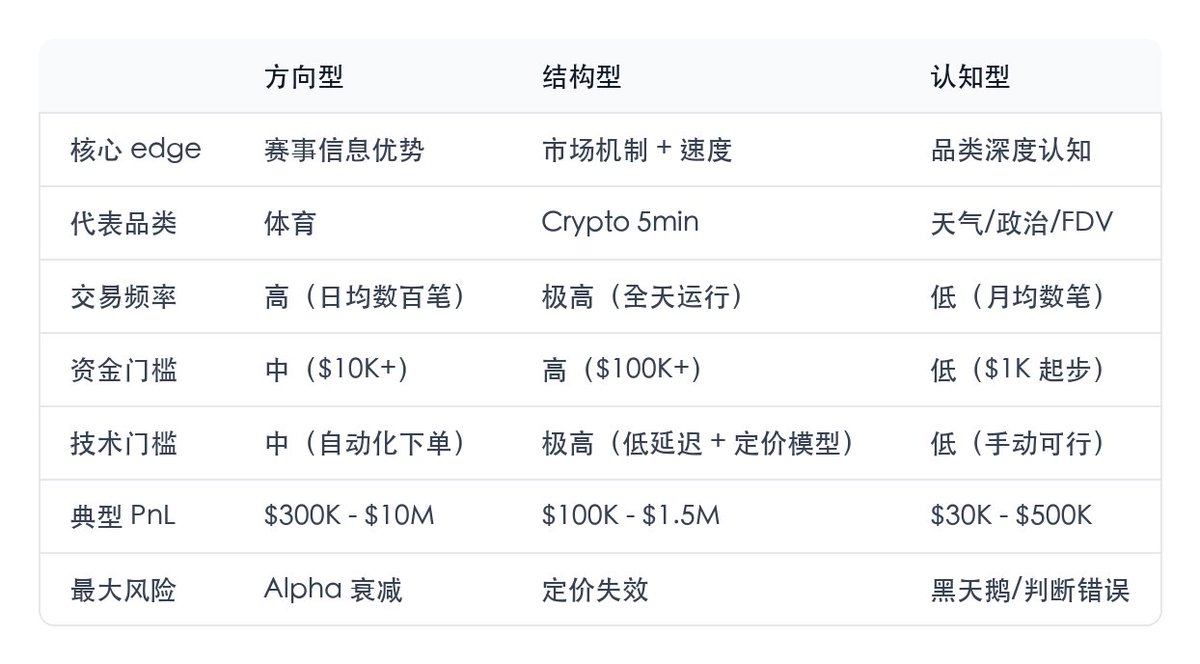
Comparison Table: Three Approaches
My Own Approach
After analyzing others, here’s my own take.
I run several strategies in parallel: crypto market making (structural), sports probabilistic pricing (directional), and weather data modeling (cognitive). Each is small-scale—nothing like kch123’s 493 trades a day or swisstony’s $494 million in volume.
After dissecting 40 addresses, my biggest takeaway: knowing which game you’re playing matters more than optimizing any parameter.
If you’re directional without an information edge, even flawless execution is just guessing. If you’re structural but can’t keep up with latency, you’re the one being harvested. That’s not just a platitude—it’s what the data showed me.
Now I run small-scale validations for each line, only scaling up when I confirm an edge. No rush to expand—prove one or two categories first.
Data sources: Polymarket Data API + LB API + Polygon on-chain data | Analysis period: January–March 2026
Thinking about trying Polymarket? Figure out which game you want to play first.
Disclaimer:
-
This article is reposted from [runes_leo]. Copyright belongs to the original author [runes_leo]. If you have any concerns about this repost, please contact the Gate Learn team for prompt resolution.
-
Disclaimer: The views and opinions expressed in this article are solely those of the author and do not constitute investment advice.
-
Other language versions of this article are translated by the Gate Learn team. Unless Gate is mentioned, do not copy, distribute, or plagiarize the translated article.







