Curve's "Optimal Trade Path" isn't a traditional multi-path routing algorithm. Instead, it leverages mathematical curve design and liquidity structure optimization to enable high-efficiency stablecoin swaps within a single pool. This approach reduces trade path complexity and minimizes slippage and trading fee losses.
Within the Decentralized Finance (DeFi) ecosystem, stablecoin trades usually depend on multiple liquidity pools or cross-protocol routes. Curve streamlines this process using a specialized mechanism, allowing funds to achieve optimal swaps within a unified structure. This makes Curve a foundational component for stable asset trading infrastructure.
Core Mechanism Behind Curve's "Optimal Trade Path"
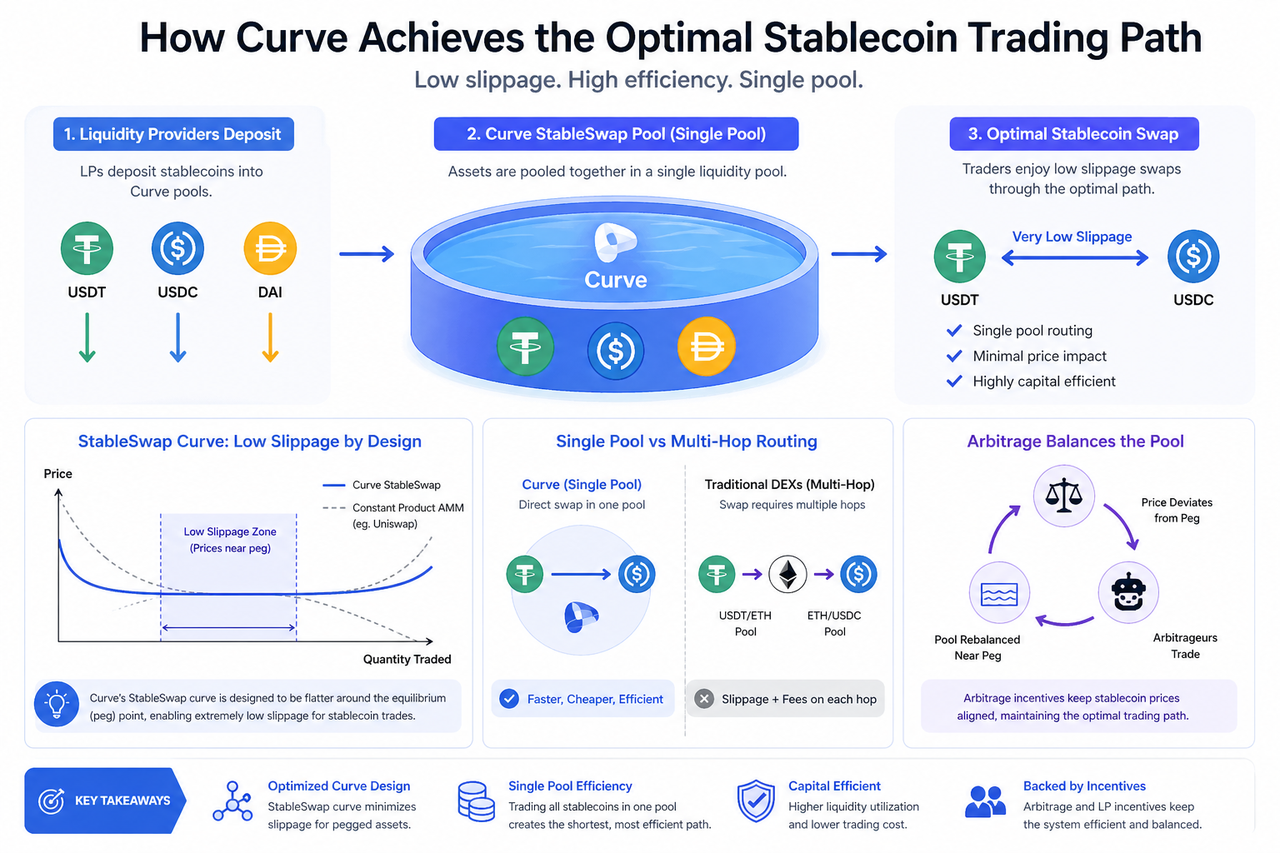
How StableSwap Curve Defines Trade Paths
At the heart of Curve is the StableSwap curve, which integrates the constant product model and constant sum model from traditional AMMs. This fusion creates a trading curve that adapts across different price ranges.
When asset prices are near their peg, the curve flattens, resulting in trades with virtually zero slippage. If prices move away from the peg, the curve becomes more protective, helping prevent liquidity imbalances. This dynamic structure fundamentally determines the optimal trade path.
How Single Pool Structure Reduces Path Complexity
Unlike DEXs that require multi-hop swaps, Curve supports multiple stable assets in a single liquidity pool, shifting the trade path from "multi-node routing" to "direct single pool."
This design eliminates cumulative slippage across pools and reduces trade path uncertainty, allowing funds to settle through the shortest possible route as they enter the system and enhancing overall trading efficiency.
How Liquidity Distribution Impacts Trading Efficiency
Curve's Liquidity Providers collectively shape trading depth, and how their funds are distributed directly affects trade path quality. When liquidity is concentrated at the price center, trades almost always follow the optimal path.
This structure enables Curve to maintain a consistently low-cost environment for stablecoin swaps, ensuring path stability even during periods of high trading volume.
Dynamic Balancing Mechanism During Price Deviations
When an asset strays from its pegged value, the StableSwap curve automatically adjusts trade weights, allowing arbitrageurs to step in and correct price discrepancies.
This mechanism not only restores price equilibrium but also indirectly optimizes trade paths through arbitrage activity, returning the system to a low-slippage state.
Curve vs. Traditional DEX Path Models
| Dimension |
Curve |
Traditional DEX (e.g., Uniswap) |
| Path Structure |
Single Pool Optimal Path |
Multi-Pool Routing Path |
| Slippage Performance |
Extremely Low (Stable Assets) |
Depends on Liquidity Depth |
| Trading Logic |
Curve-Optimized Path |
Routing Algorithm Finds Path |
| Applicable Assets |
Stablecoins/Similar Assets |
All Asset Types |
Curve's strength is its "endogenous pathing," where the trade path is determined by mathematical models, not external routing calculations.
Curve's Role in DeFi Path Systems
Curve offers more than just trading functionality—it serves as DeFi path infrastructure, integrated by multiple protocols. Lending platforms, return aggregators, and stablecoin systems often embed Curve directly to simplify trading complexity.
In this setup, Curve acts as the "default shortest path layer," enabling assets to move through the DeFi network with minimal intermediate steps.
Summary
Curve delivers optimal trade paths for stablecoin swaps through StableSwap curve design, single pool liquidity structure, and dynamic arbitrage balancing. Its core innovation isn't traditional routing optimization, but the use of mathematical models to compress trade paths at the protocol level into the lowest-cost structure, significantly boosting stable asset swap efficiency.
FAQ
What is Curve's "Optimal Trade Path"?
It's a mechanism that enables stablecoin trades to settle within a single liquidity pool at minimal slippage, using the StableSwap curve and single pool structure.
Does Curve use routing algorithms to optimize trade paths?
No. Curve doesn't rely on traditional multi-path routing algorithms. Instead, it determines trade path efficiency directly through mathematical curves.
Why does Curve reduce slippage?
Because its trading curve is extremely flat when prices are close to the peg, resulting in trades with nearly zero price impact.
How does Curve differ from regular DEXs in path design?
Curve uses a single pool endogenous path structure, while regular DEXs depend on multi-pool routing to find the best trade path.
How does Curve's arbitrage mechanism optimize trade paths?
Arbitrageurs intervene when prices deviate, restoring the curve to a stable state and reestablishing the optimal trade path environment.







