Ethereum Staking: From Technical Mechanisms to Investment Strategies
Ethereum has completed its transition from Proof of Work to Proof of Stake as blockchain consensus mechanisms evolve. This new approach moves network security away from competition for computing power and instead relies on staking assets to maintain system operations. In this model, holders can stake ETH to participate in the network’s validation process. By helping confirm blocks and maintain the network, participants earn block rewards and related returns. As a result, staking is increasingly recognized as a key source of income for long-term holders.
Traditional staking models often require assets to be locked for a set period, restricting free allocation. When markets experience rapid fluctuations, investors may struggle to adjust their asset allocation in time, making liquidity a critical concern for staking strategies.
GTETH: Turning Staked Rights into Tradable Assets
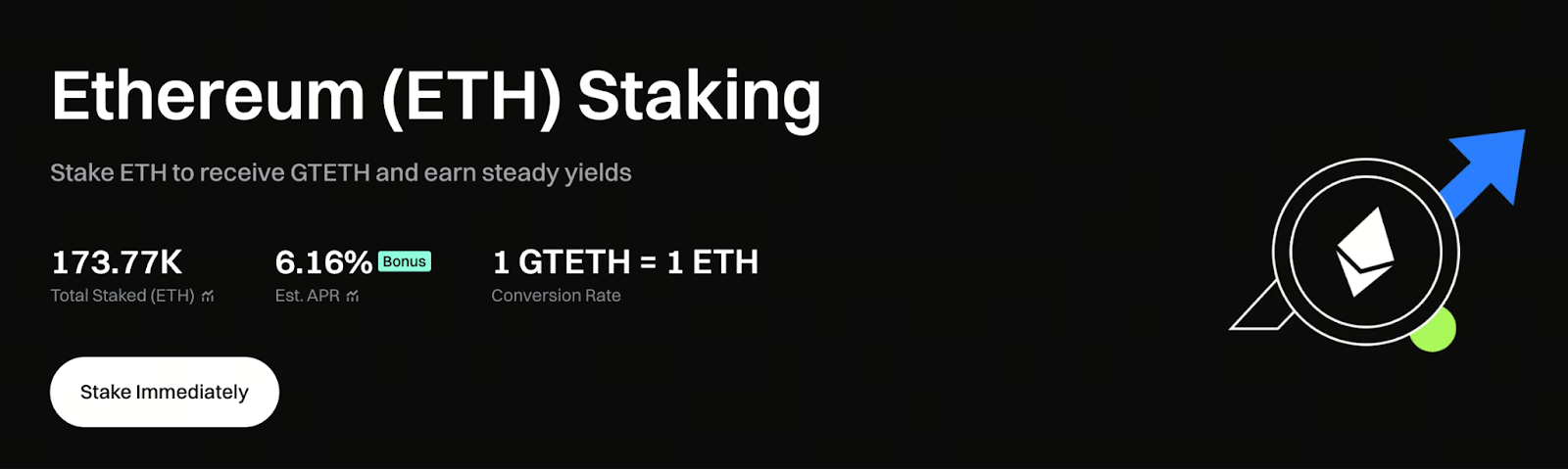
GTETH is designed to tokenize the asset rights that are typically locked in staking mechanisms, offering investors a more flexible way to manage their holdings. When users stake ETH, the system issues GTETH at a one-to-one ratio. This token represents the corresponding staked asset rights and continuously tracks the accumulation of staking rewards.
Unlike some staking mechanisms that distribute extra tokens as rewards, GTETH’s yield is reflected directly in the token’s value. As network validation rewards accumulate, GTETH’s value increases accordingly. When holders wish to exit staking, they can redeem their GTETH for the equivalent amount of ETH, completing the redemption process.
Lowering Barriers to Participation: Expanding Access to Staking
Early Ethereum staking architectures required substantial capital and technical expertise to operate validator nodes directly. For many individual investors, these requirements posed significant barriers.
GTETH streamlines the process through platform-based services, enabling users to earn staking rewards without deploying nodes or managing technical details themselves. GTETH is fully backed by ETH reserves, with each token corresponding to an equal amount of staked ETH. This structure provides genuine asset backing and enhances transparency across the mechanism.
GTETH Yield Sources
GTETH yields come primarily from two sources:
-
Ethereum network validation rewards: Staked ETH participates in blockchain validation and earns block rewards according to network rules.
-
Platform incentives: Occasionally, the platform may launch special campaigns or reward structures to boost overall staking returns.
Staking yields are not fixed and are influenced by several factors, including:
As a result, annualized returns may vary over time.
Platforms typically deduct a portion of actual returns as service fees to cover node operation and system maintenance. Certain user tiers, such as VIP, may benefit from lower fee rates.
Join Gate ETH Staking now and start your on-chain mining journey: https://www.gate.com/staking/ETH?ch=ann46659
Asset Management Flexibility with Liquid Staking
The central idea behind Liquid Staking is to restore liquidity to assets that would otherwise be locked. Through GTETH’s tokenized structure, ETH is no longer a static asset during staking—it can be incorporated into more flexible investment strategies, such as:
-
Staking rewards accumulate in the token’s value over time
-
Investors can adjust asset allocation in response to market conditions
-
GTETH can serve as an income-generating asset within an investment portfolio
This approach keeps staked assets connected to the market, maintaining a degree of liquidity across various strategies.
Maintaining Asset Allocation Flexibility in Fast-Moving Markets
The cryptocurrency market is highly dynamic, with new investment opportunities emerging rapidly. If funds are locked for extended periods, investors may be unable to adjust their strategies promptly.
By converting staking rights into tokens, GTETH allows investors to earn on-chain rewards while retaining flexibility in asset management. This design elevates staking from a simple long-term income tool to a comprehensive asset allocation and investment strategy option.
Conclusion
As the blockchain ecosystem matures, investor demand for asset efficiency and liquidity continues to grow. GTETH’s one-to-one correspondence and redemption mechanism enable ETH to retain liquidity while participating in staking. This liquid staking model transforms assets that would otherwise be locked into flexible investment tools. In a fast-changing market environment, strategies that balance yield and asset allocation flexibility are becoming increasingly important, and GTETH offers a practical solution for this asset management approach.