Gate Metals Zone: Trading Gold and Silver Opportunities in Uncertain Markets

Last Updated 2026-04-03 14:59:19
Reading Time: 4m
Amid continued volatility in the global economy and financial markets, precious metals like gold and silver are once again drawing investor interest. These assets serve as indicators of risk-averse sentiment in the marketplace and provide traders with diverse trading opportunities. In this article, we examine the core factors driving precious metal prices and discuss how to leverage Perpetual Futures in the Gate Metals section to engage with the market more flexibly.

Market Uncertainty Fuels Demand for Safe-Haven Assets

When the global economy comes under pressure—whether from rising inflation, slowing growth, or geopolitical tensions—investors typically move capital into more stable asset classes. Gold and silver have long served as core safe-haven assets in financial markets.

These precious metals not only act as stores of value but also serve as key indicators of market sentiment. Their prices do not move in a strictly one-way direction. When economic prospects improve and risk appetite grows, capital often shifts to equities or other high-risk assets, putting downward pressure on gold and silver prices. As a result, the performance of precious metals is closely tied to the broader economic environment.

Key Drivers of Precious Metals Prices

Gold and silver prices rarely respond to a single event; instead, they reflect the combined impact of multiple factors.

  1. Macroeconomic Data
    Indicators such as inflation, interest rates, and employment reports shape how capital is allocated among asset classes. When inflation expectations rise, investors often favor precious metals to hedge against declining purchasing power.

  2. Central Bank Monetary Policy
    Policy shifts by global central banks have a significant effect on markets. Easing measures typically boost gold's appeal, while rising interest rates may reduce the attractiveness of non-yielding assets.

  3. Geopolitical and Unexpected Events
    International conflicts or major political incidents frequently trigger risk-off sentiment, prompting capital flows into gold and silver.

These factors intertwine, creating cyclical price movements in the precious metals market.
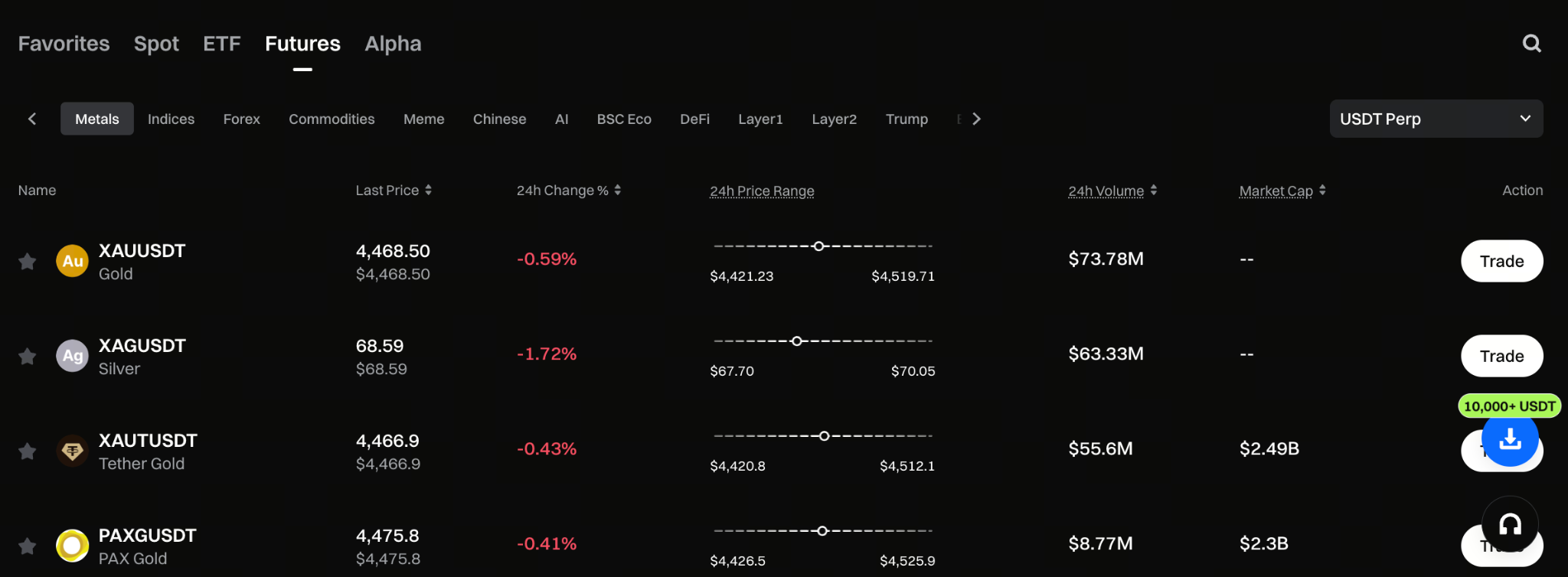
Accessing the Precious Metals Market with Perpetual Futures

Participating in the Precious Metals Market via Perpetual Futures

In fast-moving markets, flexible trading tools are essential. The Gate Metals section offers perpetual futures trading for precious metals, giving investors greater agility. Unlike traditional futures, perpetual futures have no expiration date, so traders can hold positions as long as market conditions warrant—without worrying about settlement deadlines.

Additionally, trades are settled in USDT, simplifying fund management and enabling quick adjustments to capital and positions when volatility strikes.

Start trading now in the Gate Metals section: https://www.gate.com/price/futures/category-metals/usdt

Advantages of Perpetual Futures

Perpetual futures attract traders due to their operational flexibility and strategic diversity, including:

  1. No expiration date means traders can freely adjust holding periods and strategies in response to market shifts.
  2. Leverage increases capital efficiency, allowing participation in larger markets with less upfront capital.

However, leverage also magnifies potential risks. Effective position sizing and fund management are critical. Strong risk control practices form the foundation of stable, long-term trading.

The Critical Role of Risk Management in Trading

In volatile markets, risk control is vital for trading stability. Comprehensive trading systems typically provide a range of risk management mechanisms to help users mitigate risk.

Examples include:

  • Dynamic margin system: Adjusts margin requirements in response to market volatility
  • Auto-close position mechanism: Executes timely stop-losses when risk thresholds are breached
  • Funding rate mechanism: Reflects the balance of long and short positions and affects holding costs

These features help traders pursue returns while safeguarding capital and maintaining operational stability.

Trading Strategies for Different Market Conditions

In the precious metals market, traders often tailor their strategies to their own style and prevailing market conditions.

  1. Short-Term Trading Strategies
    Capitalize on short-term price movements for rapid entry and exit, typically with clear stop-loss and take-profit settings.

  2. Trend-Following Strategies
    Open positions in the direction of established trends, adjusting holdings as the trend evolves.

  3. Hedging Strategies
    Hold precious metals to reduce portfolio volatility during turbulent markets.

  4. Arbitrage Strategies
    Seek returns by exploiting price differences between markets or trading products.

Each strategy suits different market conditions, and traders can adapt them to fit their personal approach.

Conclusion

As global economic conditions and market sentiment continue to shift, gold and silver remain key assets for investors. Their price trends often mirror changes in macroeconomic factors and risk appetite, providing a range of trading opportunities. With the perpetual futures trading tools available in the Gate Metals section, investors can access the precious metals market with greater flexibility, using leverage and diverse strategies to navigate volatility. In an era of persistent uncertainty, combining flexible trading instruments with robust risk management is essential for achieving long-term, stable results.

Author:  Allen
Disclaimer
* The information is not intended to be and does not constitute financial advice or any other recommendation of any sort offered or endorsed by Gate.
* This article may not be reproduced, transmitted or copied without referencing Gate. Contravention is an infringement of Copyright Act and may be subject to legal action.

Related Articles

What is Fartcoin? All You Need to Know About FARTCOIN
Intermediate

What is Fartcoin? All You Need to Know About FARTCOIN

Fartcoin (FARTCOIN) is a representative meme coin within the Solana ecosystem based on an AI-driven narrative. Its core concept originated from an experiment aimed at exploring the "boundaries between AI Agents and humor." More than just a digital asset with social attributes, the project deeply couples absurd humor culture with on-chain financial logic by integrating autonomous AI interaction models.
2026-04-04 22:01:19
Gold Price Forecast for the Next Five Years: 2026–2030 Trend Outlook and Investment Implications, Could It Reach $6,000?
Beginner

Gold Price Forecast for the Next Five Years: 2026–2030 Trend Outlook and Investment Implications, Could It Reach $6,000?

Analyze current gold price trends alongside authoritative five-year forecasts, integrating an evaluation of market risks and opportunities. This gives investors insight into the potential trajectory of gold prices and the main drivers expected to shape the market over the next five years.
2026-03-25 18:13:30
Aster vs Hyperliquid: Which Perp DEX Will Prevail?
Beginner

Aster vs Hyperliquid: Which Perp DEX Will Prevail?

Aster and Hyperliquid are the two representative protocols of the "purpose-built L1 path" within the current decentralized perpetual exchange (Perp DEX) sector. As a pioneer in the field, Hyperliquid has built a deep liquidity moat through its highly mature order book architecture and strong community consensus. Conversely, Aster, as a rising challenger, seeks to leapfrog the competition in high-performance trading through more aggressive multi-chain aggregation logic, private transaction modules, and an underlying execution environment optimized for 2026 market demands.
2026-03-24 11:58:33
AI-Native Settlement Layers: How United Stables Is Building the Next Financial Rail
Beginner

AI-Native Settlement Layers: How United Stables Is Building the Next Financial Rail

Stablecoins were originally designed as dollar substitutes within exchanges, primarily used for asset pricing and trade settlement. As on-chain financial ecosystems have matured, their role has expanded beyond simple payments to include collateral assets, cross-chain liquidity mediums, and unified settlement units. In particular, as AI systems and automated agents begin to participate directly in economic activity, demand has risen sharply for programmable value units capable of instant settlement. This shift is pushing stablecoins toward the role of foundational financial infrastructure.
2026-03-25 03:16:17
Aerodrome Tokenomics: How ve(3,3) Powers Base's Most Profitable DEX
Beginner

Aerodrome Tokenomics: How ve(3,3) Powers Base's Most Profitable DEX

AERO is the native token of Aerodrome Finance, a core decentralized exchange and liquidity protocol in the Base ecosystem. It is primarily used for liquidity incentives and ecosystem operations. veAERO is a governance NFT that users receive by locking AERO, representing both voting power and the right to share protocol revenue. Through a dual track structure of AERO as a utility token and veAERO as a governance credential, Aerodrome separates liquidity usage value from long term governance power, allowing participants to act as liquidity providers, governance decision makers, and revenue sharers within the same system.
2026-03-25 06:40:31
Hybrid Collateral Stablecoins: Inside United Stables' Stability and Yield Architecture
Beginner

Hybrid Collateral Stablecoins: Inside United Stables' Stability and Yield Architecture

In the early stages of the crypto market, traditional stablecoins mainly relied on single-reserve or single-collateral models. Their primary focus was price stability and payment convenience, which allowed them to become foundational tools for on-chain trading and capital flows. As the market has entered a more mature financial phase, however, this structure has begun to reveal limitations, including high concentration risk and the difficulty of balancing liquidity with yield. These constraints have driven the evolution toward multi-layer collateral and portfolio-based designs, such as the dual-layer hybrid collateral architecture proposed by United Stables, which seeks to redefine the underlying logic of stable assets.
2026-03-25 03:17:39





