Gold Plunges 26%: The Truth Behind a Liquidity-Driven Crash Fueled by Leverage and Macro Forces

Last Updated 2026-03-24 11:58:52
Reading Time: 1m
The sharp correction in gold prices results from the interplay of a stronger US dollar, changing interest rate expectations, and leveraged liquidations. This article offers an in-depth examination of the factors driving the recent slump in gold, shifts in capital structure, and projections for future market movements.

Why Did Gold Suddenly Plunge? An Unexpected Market Correction
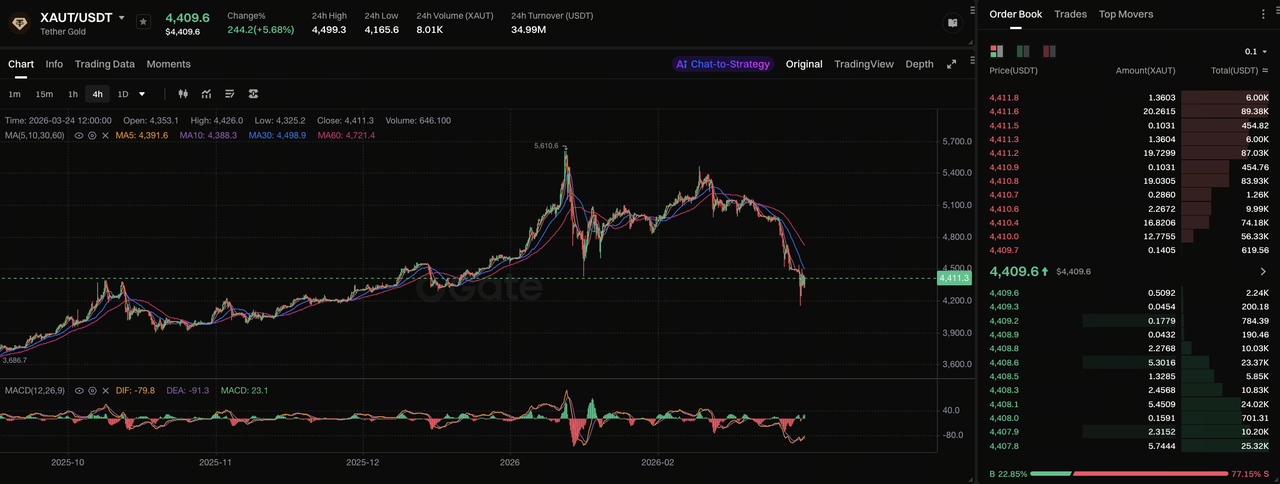
Why Did Gold Suddenly Plunge Image source: Gate Market Page

Following a year-long rally, the gold market saw a dramatic correction. Prices retreated sharply from their recent highs, dropping more than 20% in just a few trading sessions. This was not a gradual trend reversal, but a classic case of “accelerated decline”—marked by heightened volatility, surging trading volume, and a rapid shift in market sentiment.

Notably, the speed of this downturn far exceeded historical averages, signaling a shift in the market’s internal structure rather than simply weaker fundamentals.

Macro Variables Reverse: Dual Pressure from the Dollar and Interest Rates

Macro Variables Reverse

As a non-yielding asset, gold’s price is highly sensitive to macroeconomic conditions—especially the US dollar and interest rates.

Gold typically benefits when markets expect rates to fall; however, when those expectations reverse, gold comes under pressure. In this downturn, a stronger dollar and upwardly revised rate projections set the backdrop.

Inflation expectations have resurfaced due to rising energy prices, prompting investors to reassess the sustainability of loose monetary policy.

At the same time, capital has started to flow back into dollar-denominated assets, strengthening the dollar index and putting additional pressure on gold.

While these macro shifts provide a logical explanation for gold’s correction, they alone do not account for the severity of the decline.

The Real Trigger: Leverage Structure and a Liquidity Crunch

The true catalyst behind gold’s rapid drop was the market’s internal leverage structure.

During the previous rally, significant capital entered leveraged long positions in gold via futures, derivatives, and similar instruments, creating a crowded long-side trade. Once prices began to pull back, this structure quickly unraveled.

  • Prices broke through key technical levels, triggering algorithmic trading and stop-loss orders;
  • Exchanges raised margin requirements, forcing some highly leveraged positions to liquidate;
  • Forced liquidations drove prices down further, setting off a chain reaction.

This sequence is a textbook “liquidity crunch”—not all investors turned bearish on gold, but many were forced to sell.

The Significance of Silver’s Plunge: Amplified Risk

Silver’s decline was even more severe than gold’s, offering important insight. Silver serves as both a precious and industrial metal, and when risk appetite falls, it tends to be more volatile. As a result, during deleveraging phases, silver often acts as an “amplifier.”

When silver falls much more sharply than gold, it typically signals that the market is experiencing a deeper risk unwinding, not just a price correction. This further supports the view that the current move is a structural deleveraging, not a routine pullback.

Changing Fund Flows: Who’s Exiting and Who’s Accumulating?

From a capital flow perspective, this correction has revealed clear divergence.

Short-term capital—particularly investors using ETFs and derivatives—has exited rapidly. These funds are highly sensitive to price swings and tend to pull out quickly when trends reverse.

Long-term capital, especially central banks, continues to hold gold allocations. While the pace of accumulation may have slowed, the overall direction remains unchanged.

This divergence indicates that short-term price volatility is driven by trading behavior, while the long-term investment thesis remains intact.

Historical Review: The “Standard Script” of Gold Sell-Offs

Historically, major gold sell-offs have followed a familiar pattern:

  • Macro environment shifts (higher rates or a stronger dollar)
  • Market expectations turn
  • Leverage is unwound in concentrated fashion
  • Prices drop sharply, completing a valuation reset

This pattern held true in both the high-rate cycle of 1980 and the prolonged correction after 2011. Gold is not just a safe-haven asset—its price is also deeply influenced by financial structure and market sentiment.

The Essence of This Downturn: A Correction After Overtrading

This episode represents a price correction following “overtrading.” During the rally, markets priced in bullish expectations in advance, pushing prices above fundamental value. When new bullish catalysts failed to materialize, prices began to revert.

This reversion is rarely gradual—it typically happens through sharp volatility.

Will Gold Rebound or Enter a Bear Market?

Future trends can be analyzed from three perspectives:

  • Short term: The market is still deleveraging, so prices may remain volatile or even retest recent lows.
  • Medium term: The key factors are the dollar and interest rates. If high rates persist, gold’s upside will remain limited.
  • Long term: Global debt levels, changes in monetary systems, and geopolitical risks continue to support gold’s value. This means gold’s long-term allocation value remains substantial.

Conclusion:

Gold’s decline does not mark the end of its safe-haven role—it reflects a structural adjustment in the market. Under the combined influence of macro factors and leverage, prices have undergone a sharp correction.

For investors, the priority is not to predict short-term moves but to understand the underlying market drivers. In an environment where uncertainty remains, gold continues to be an indispensable component of global asset allocation.

Author:  Max
Disclaimer
* The information is not intended to be and does not constitute financial advice or any other recommendation of any sort offered or endorsed by Gate.
* This article may not be reproduced, transmitted or copied without referencing Gate. Contravention is an infringement of Copyright Act and may be subject to legal action.

Share

Crypto Calendar
Tokenların Kilidini Aç
Wormhole, 3 Nisan'da 1.280.000.000 W token açacak ve bu, mevcut dolaşımdaki arzın yaklaşık %28,39'unu oluşturacak.
W
-7.32%
2026-04-02
Tokenların Kilidini Aç
Pyth Network, 19 May'da 2.130.000.000 PYTH tokenini serbest bırakacak ve bu, mevcut dolaşım arzının yaklaşık %36,96'sını oluşturacak.
PYTH
2.25%
2026-05-18
Tokenların Kilidini Aç
Pump.fun, 12 Temmuz'da 82,500,000,000 PUMP token'ı kilidini açacak ve bu, mevcut dolaşımdaki arzın yaklaşık %23,31'ini oluşturacak.
PUMP
-3.37%
2026-07-11
Token Kilidi Açma
Succinct, 5 Ağustos'ta mevcut dolaşımdaki arzın yaklaşık %104,17'sini oluşturan 208,330,000 PROVE token'ını serbest bırakacak.
PROVE
2026-08-04
sign up guide logosign up guide logo
sign up guide content imgsign up guide content img
Sign Up

Related Articles

Reflections on Ethereum Governance Following the 3074 Saga
Intermediate

Reflections on Ethereum Governance Following the 3074 Saga

The Ethereum EIP-3074/EIP-7702 incident reveals the complexity of its governance structure: in addition to the formal governance processes, the informal roadmaps proposed by researchers also have significant influence.
2026-03-24 11:54:35
Gate Research: 2024 Cryptocurrency Market  Review and 2025 Trend Forecast
Advanced

Gate Research: 2024 Cryptocurrency Market Review and 2025 Trend Forecast

This report provides a comprehensive analysis of the past year's market performance and future development trends from four key perspectives: market overview, popular ecosystems, trending sectors, and future trend predictions. In 2024, the total cryptocurrency market capitalization reached an all-time high, with Bitcoin surpassing $100,000 for the first time. On-chain Real World Assets (RWA) and the artificial intelligence sector experienced rapid growth, becoming major drivers of market expansion. Additionally, the global regulatory landscape has gradually become clearer, laying a solid foundation for market development in 2025.
2026-03-24 11:56:16
Gate Research: BTC Breaks $100K Milestone, November Crypto Trading Volume Exceeds $10 Trillion For First Time
Advanced

Gate Research: BTC Breaks $100K Milestone, November Crypto Trading Volume Exceeds $10 Trillion For First Time

Gate Research Weekly Report: Bitcoin saw an upward trend this week, rising 8.39% to $100,550, breaking through $100,000 to reach a new all-time high. Support levels should be monitored for potential pullbacks. Over the past 7 days, ETH price increased by 6.16% to $3,852.58, currently in an upward channel with key breakthrough levels to watch. Grayscale has applied to convert its Solana Trust into a spot ETF. Bitcoin's new ATH coincided with surging Coinbase premiums, indicating strong buying power from U.S. market participants. Multiple projects secured funding this week across various sectors including infrastructure, totaling $103 million.
2026-03-24 11:55:47
Altseason 2025: Narrative Rotation and Capital Restructuring in an Atypical Bull Market
Intermediate

Altseason 2025: Narrative Rotation and Capital Restructuring in an Atypical Bull Market

This article offers a deep dive into the 2025 altcoin season. It examines a fundamental shift from traditional BTC dominance to a narrative-driven dynamic. It analyzes evolving capital flows, rapid sector rotations, and the growing impact of political narratives – hallmarks of what’s now called “Altcoin Season 2.0.” Drawing on the latest data and research, the piece reveals how stablecoins have overtaken BTC as the core liquidity layer, and how fragmented, fast-moving narratives are reshaping trading strategies. It also offers actionable frameworks for risk management and opportunity identification in this atypical bull cycle.
2026-03-24 11:57:00
2025 DePIN Market Outlook and Trends
Beginner

2025 DePIN Market Outlook and Trends

This article analyzes the current development and 2025 trends of DePIN (Decentralized Physical Infrastructure Networks). It examines DePIN's application prospects in AI computing, storage, wireless networks, and other sectors, focusing on the market landscape, investment trends, and key sectors. As capital investment and technological advancements grow, DePIN is moving from a token incentive phase to large-scale application. Despite facing challenges like technical complexity and hardware maintenance, DePIN shows tremendous potential in transforming global digital infrastructure and is poised to become a key pillar of the Web3 ecosystem.
2026-03-24 11:56:27
NFTs and Memecoins in Last vs Current Bull Markets
Intermediate

NFTs and Memecoins in Last vs Current Bull Markets

This article explores the market dynamics of Memecoins and NFTs in current and past bull markets, providing a comparative analysis. It offers insights and recommendations on both value and security aspects, emphasizing the importance of asset protection alongside investment.
2026-03-24 11:54:39