2026 Gold Pricing Outlook: Why the Market Is No Longer Driven by a Single Variable
The defining feature of gold in 2026 is not simply whether it rises or falls, but the increasing complexity of its pricing structure.
Historically, the market explained gold with singular logic—such as “gold rises because inflation is high” or “gold climbs as risk aversion increases.” Today, the reality is that multiple variables interact simultaneously:
- On the macro level: monitor interest rates and the US dollar.
- On the risk level: assess geopolitical conflicts and fiscal uncertainty.
- On the capital level: track central bank gold purchases and ETF allocation.
As a result, gold in 2026 is unlikely to follow a straightforward trend. Instead, expect a “higher median with amplified volatility” composite market.
Six Core Variables Shaping Gold Prices
Fed Policy and Real Interest Rates
Gold is fundamentally most sensitive to real interest rates.
When nominal rates decline or inflation expectations rise, real rates fall—typically benefiting gold valuations.
US Dollar Index (DXY)
Gold has a long-standing negative correlation with the US dollar.
A weaker dollar boosts buying power outside the US, increasing gold’s appeal; a stronger dollar, on the other hand, suppresses gold demand.
Geopolitical Conflict and Risk Premium
Conflicts in regions like the Middle East and Russia-Ukraine elevate uncertainty in energy and shipping, driving up safe-haven demand.
However, keep in mind: price surges driven by geopolitical risk are often short-lived and do not necessarily signal a lasting trend.
Global Central Bank Gold Purchases
Ongoing central bank accumulation acts as “slow variable support.”
These flows do not chase short-term swings; instead, they provide structural upward pressure on the price baseline.
ETF and Institutional Allocation
Sustained net inflows into gold ETFs typically indicate that institutional capital is shifting from “trading” to “allocation,” reinforcing trend durability.
Fiscal Deficits and Sovereign Credit Expectations
When markets question the sustainability of sovereign debt, gold commands a “credit hedge asset” premium—especially pronounced in high-deficit environments.
2026 Scenario Analysis: Conservative, Base Case, Optimistic
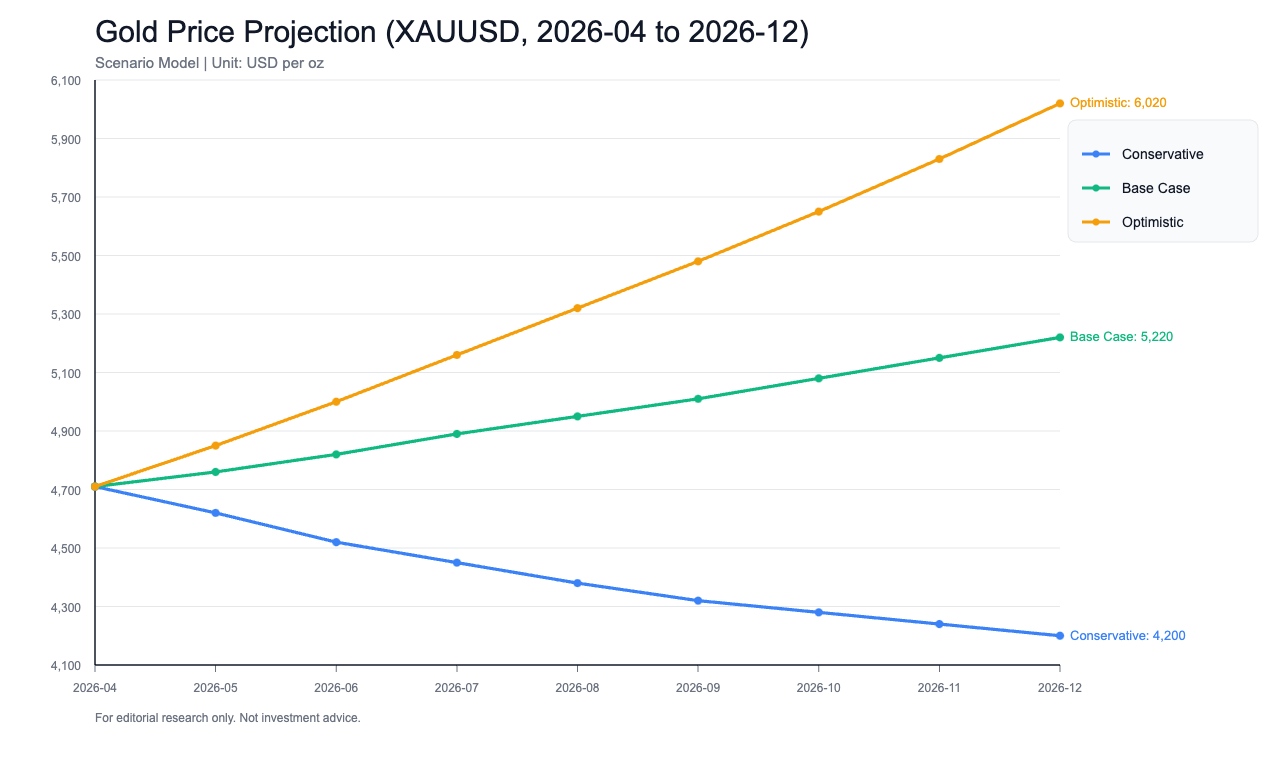
The following scenario framework is more suitable for research and trading than for single-point forecasts.
- Conservative Scenario (Moderate Probability)
- Conditions: US dollar rebounds, real interest rates rise, and risk appetite recovers.
- Result: Gold experiences a deeper drawdown followed by consolidation, with a defensive tone for the year.
- Base Case Scenario (Highest Probability)
- Conditions: Interest rates remain neutral to slightly loose, geopolitical risks persist but are manageable, and central bank gold buying continues.
- Result: Gold consolidates at elevated levels with a bullish tilt, capital supports pullbacks, and the annual average moves higher.
- Optimistic Scenario (Slightly Lower Probability)
- Conditions: Real interest rates fall sharply, geopolitical and fiscal risks intensify together, and ETF inflows persist.
- Result: Gold breaks out in a sustained uptrend, repeatedly hitting new highs during the year.
In 2026, gold is best viewed as a “high-volatility asset,” not a “one-way, no-drawdown” trade.
Key Price Levels and Market Rhythm: Distinguishing Trends from Ranges
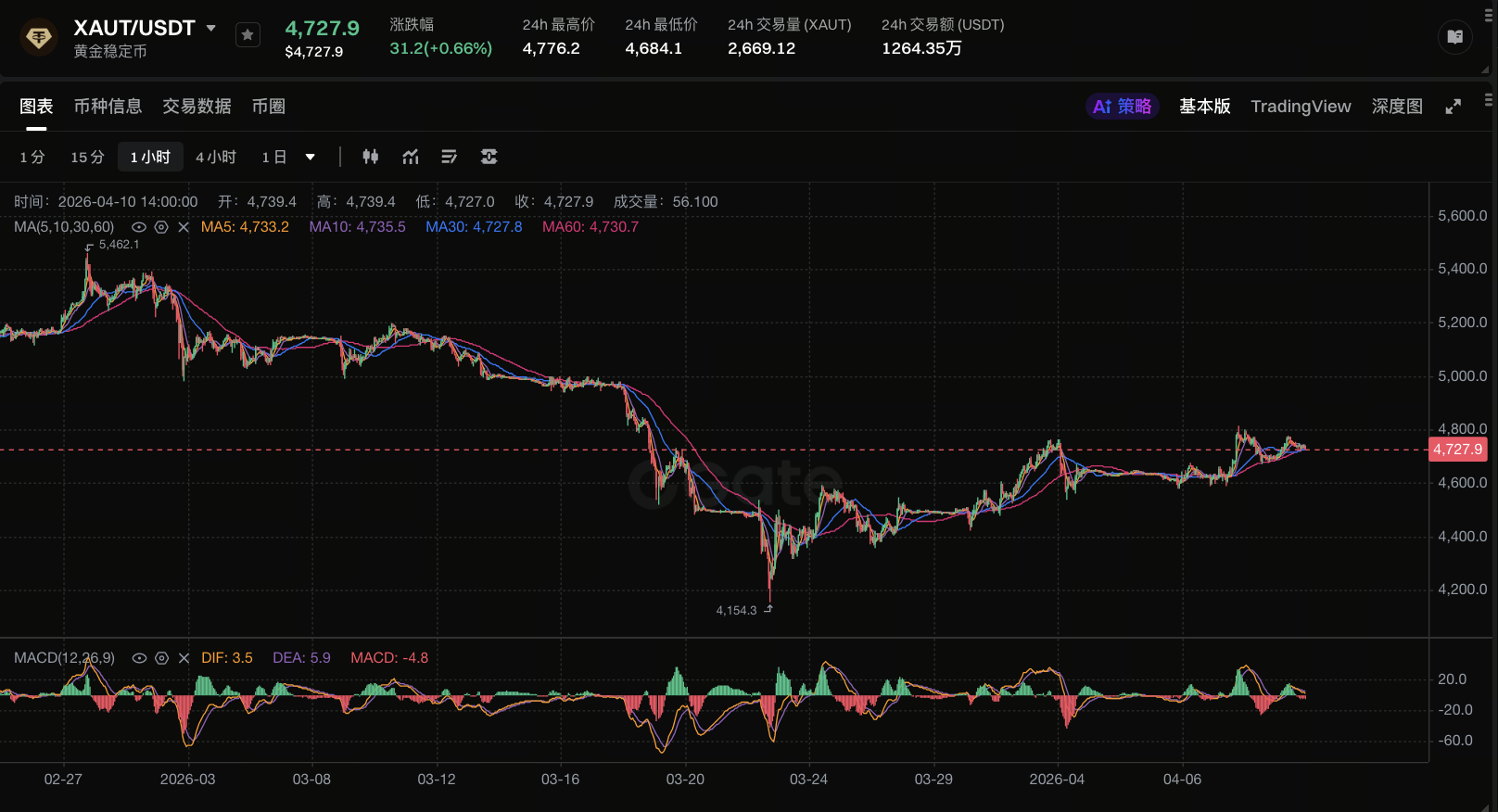
Image source: Gate Market Page
In a high-volatility year, timing the market is more important than predicting direction. Use the following framework:
Trend Confirmation Signals
- Gold breaks previous highs and holds above on retest
- Sustained net inflows into ETFs
- Simultaneous weakness in the US dollar and real interest rates
Range-Bound Signals
- Gold becomes less responsive to positive news
- Lack of volume after price spikes
- Repeated macro data releases cause expectations to shift
Drawdown Risk Signals
- US dollar strengthens rapidly
- Real interest rates rise
- Broad recovery in risk assets reduces safe-haven demand
For investors, avoid treating every geopolitical event as the start of a “long-term bull run”—more often, it’s just a catalyst for short-term volatility.
5. Investment Strategy and Risk Control: How to Avoid “Right Direction, Wrong Timing” in High-Volatility Markets
In 2026, the recommended approach is “layered allocation and dynamic position sizing.”
- Long-term allocation: Hold for gold’s hedging properties, not frequent trading on short-term swings.
- Trading position: Trade around shifts in interest rate expectations, US dollar inflection points, and geopolitical events.
- Risk management discipline:
- Avoid chasing highs or going all-in on single news events
- Set position limits and drawdown thresholds
- Use the US dollar and real interest rates for counter-validation
Two common mistakes:
- Mistaking “high-level consolidation” for “trend exhaustion”
- Mistaking “event-driven rallies” for “endless upside”
The most effective strategy is to define scenarios first, then adjust based on data—not just trade on headlines.
6. Conclusion: Gold Likely to Show “High-Level Consolidation with a Bullish Tilt”
Considering the prevailing variables in 2026, gold’s most probable path is:
- The price baseline remains elevated, unlikely to revert to previous low-volatility, undervalued levels
- Rallies and drawdowns alternate, with a faster tempo than in prior years
- The true drivers for the annual trend remain real interest rates and the US dollar—not isolated geopolitical headlines
Thus, gold in 2026 still offers allocation value, but return generation depends more on rhythm management. Gold is no longer a “one-way bet,” but a macro hedge asset characterized by a higher baseline and greater volatility.