As financial markets expand in scale and complexity, the volume of available information ranging from price movements to news narratives has grown beyond what manual analysis can efficiently handle. This shift has made automated research workflows increasingly relevant, particularly those that integrate both structured data and real-time information streams. By combining resources such as Gate News and Gate Info within Gate for AI framework, these systems provide a more balanced view of market conditions, linking measurable indicators with the broader context in which they evolve.
Overview of AI Agent Market Research
AI agent market research refers to the use of automated systems that integrate modular data sources such as structured asset information and real-time news feeds to collect, organize, and interpret financial and contextual market data.
These systems typically operate by:
-
Aggregating data from multiple sources: Collecting information from diverse inputs such as news, databases, and market feeds. This ensures broader coverage and reduces reliance on any single data source.
-
Structuring unorganized information: Transforming raw or unstructured data into standardized formats This enables consistent processing and easier comparison across different datasets.
-
Applying analytical or statistical models: Using algorithms to identify patterns, relationships, or anomalies This allows the system to convert raw data into interpretable insights.
-
Producing summaries or signals for further use: Generating concise outputs such as alerts, indicators, or reports This supports downstream decision-making by simplifying complex information.
Unlike manual research, AI agents can continuously monitor markets and update interpretations in near real time.
Why Market Research Needs More Than Price Data
Price data reflects outcomes, but it does not explain the underlying causes of market movements. Relying solely on numerical indicators can lead to incomplete interpretations, as market behavior is often shaped by factors that are not immediately visible in price charts.
News events, for example, can influence short-term sentiment by shaping expectations and triggering reactions before fundamental data adjusts. Similarly, policy and regulatory developments may alter market structure or participation conditions, introducing new constraints or opportunities that affect valuation. Technological updates within projects also play a role, as upgrades or milestones can signal progress, shifts in risk, or changes in long-term potential.
In addition, behavioral patterns among market participants such as herd behavior, risk aversion, or speculative momentum can drive trends that extend beyond purely fundamental factors. For this reason, effective market research requires a combination of quantitative data, such as prices and volumes, and qualitative context, including news, narratives, and disclosures.
How Gate News and Gate Info Complement Each Other
Gate News and Gate Info represent two complementary data layers used in AI-driven market research.
| Component |
Data Type |
Description |
| Gate News |
Unstructured / Narrative |
Provides real-time updates, announcements, and sentiment-driven information |
| Gate Info |
Structured / Quantitative |
Offers project data, metrics, classifications, and standardized attributes |
Together, they support AI agents in the following ways:
| Function |
Explanation |
| Event–Outcome Connection |
Links news events with measurable market changes |
| Cross-Referencing Data |
Aligns narrative signals with structured project attributes |
| Ambiguity Reduction |
Improves interpretation by combining context with verifiable data |
This combination improves the ability to detect not only what is happening, but also why it may be happening.
Architecture of AI Research Workflows
AI research workflows are typically organized into modular stages that process data from ingestion to interpretation.
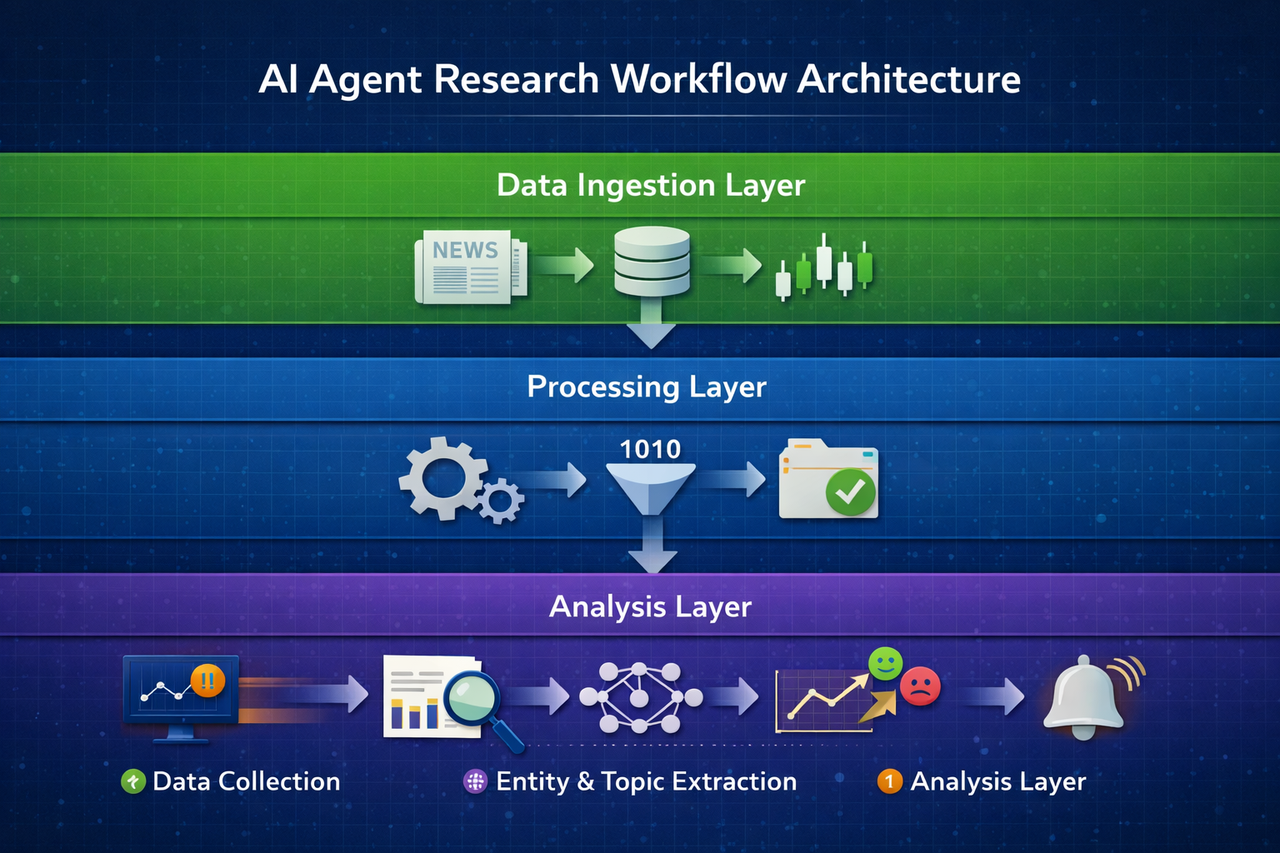
A simplified structure includes:
• Data Ingestion Layer Collects inputs from sources such as news feeds and structured databases
• Processing Layer Normalizes, filters, and categorizes incoming data
• Analysis Layer Applies models such as sentiment analysis, clustering, or trend detection
• Output Layer Generates summaries, signals, or alerts for downstream use
This layered design allows flexibility in integrating both real-time and structured information.
Example Research Workflow for an AI Agent
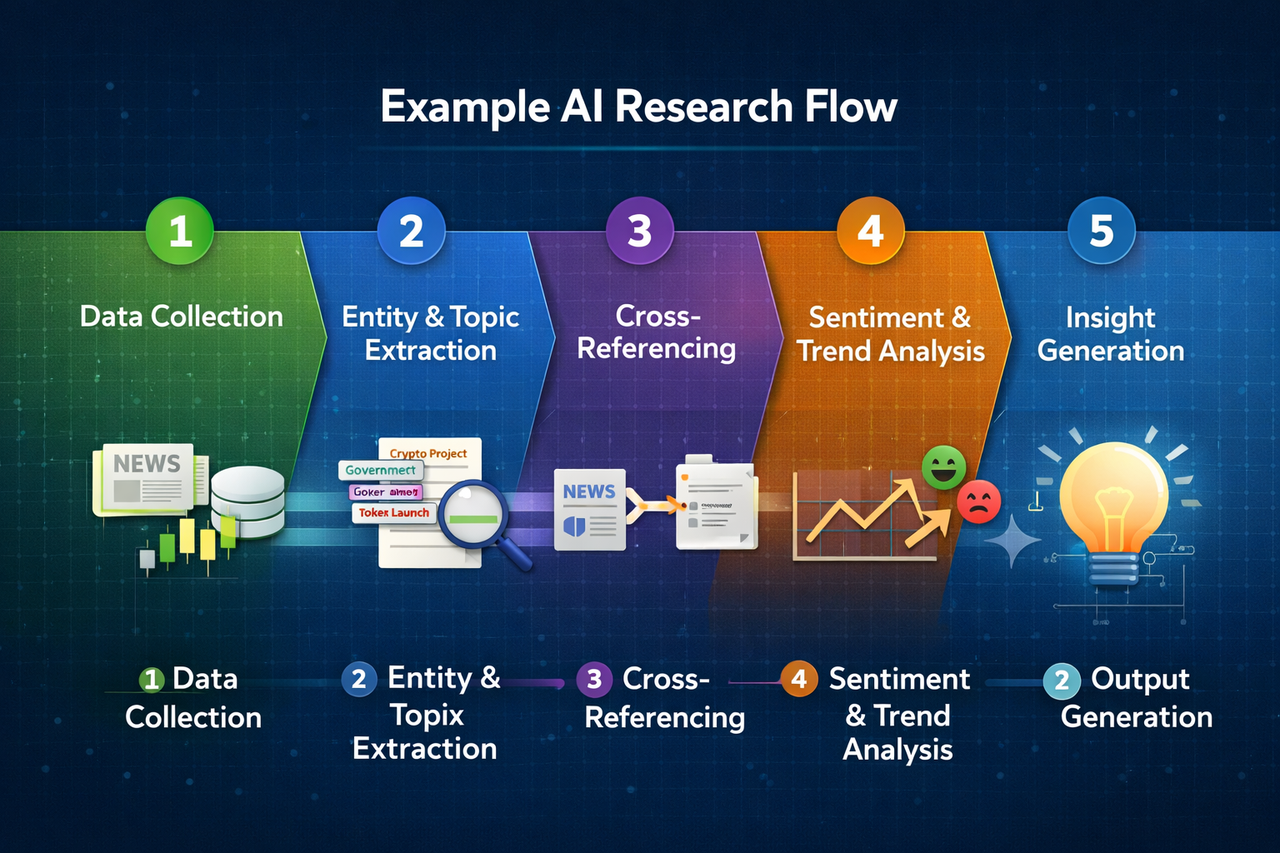
A typical AI-driven market research process may follow a sequence of steps:
-
Data Collection The agent gathers recent news articles and structured asset data
-
Entity and Topic Extraction Key themes, projects, or events are identified
-
Cross-Referencing News signals are linked with structured data attributes
-
Sentiment and Trend Analysis The agent evaluates whether signals indicate positive, negative, or neutral developments
-
Insight Generation A summarized interpretation is produced for further evaluation
This workflow demonstrates how multiple data types interact within a unified system.
Practical Use Cases of AI Agents for Market Research
AI agents are applied across various market research scenarios:
-
Trend Monitoring: Identifying emerging narratives or shifts in market focus. This helps detect early changes in attention cycles before they are reflected in price movements.
-
Event Impact Analysis: Assessing how announcements influence market behavior. It connects specific events, such as updates or policy changes, to observable market reactions.
-
Project Evaluation: Combining descriptive data with external signals to understand positioning. This provides a more complete view by linking project fundamentals with current sentiment and activity.
-
Information Filtering: Reducing noise by prioritizing relevant updates. It enables efficient analysis by isolating high-signal information from large volumes of data.
These use cases highlight the role of AI in managing information complexity.
Benefits and Advantages of AI Agents for Market Research
AI-driven research systems provide several structural advantages that make them well-suited for analyzing complex financial environments. One key advantage is scalability, as these systems can continuously process large volumes of data, allowing them to monitor multiple markets and information sources simultaneously without capacity constraints.
Speed is another important factor, as AI agents can identify new developments more quickly than manual analysis. By processing incoming data in real time, they enable faster responses to changing market conditions. In addition, consistency plays a critical role, since standardized evaluation criteria help reduce subjective bias and ensure that similar data inputs are interpreted using the same logic over time.
Another defining advantage is integration, where multiple types of data are combined into a unified analytical framework. This allows structured metrics to be analyzed alongside unstructured information such as news and narratives, resulting in more comprehensive insights. Together, these characteristics make AI agents particularly effective in environments with high data density.
Risks in AI-Driven Market Interpretation
Despite their advantages, AI-based research systems have inherent limitations that affect how their outputs should be interpreted. One primary concern is data quality dependence, as inaccurate or incomplete inputs can distort results, making the reliability of insights directly tied to the integrity of underlying data sources.
Another limitation lies in context misinterpretation. Natural language often contains nuance, tone, and domain-specific expressions that AI systems may not fully capture, which can lead to errors in sentiment analysis or event classification. In addition, these systems may overfit to signals by assigning excessive importance to short-term patterns, potentially mistaking temporary fluctuations for meaningful trends.
There is also the challenge of limited human judgment. Complex macroeconomic conditions, behavioral dynamics, and geopolitical factors are not always fully represented in data, requiring interpretation beyond algorithmic analysis. Recognizing these limitations is essential for forming balanced and informed conclusions when using AI-driven market research.
Future Outlook of AI Agents for Market Research
The role of AI agents in market research is expected to expand as data availability and model sophistication increase.
Key developments may include several evolving directions in how AI agents process and interpret market data. One major area is the improved integration of multimodal data, where text, quantitative metrics, and on-chain signals are combined into a unified analytical process. This allows AI agents to generate more complete insights by correlating different types of market information within a single framework.
Another important development is enhanced contextual understanding. With the advancement of language models, systems are becoming better at interpreting complex and nuanced information, enabling more accurate analysis of unstructured data such as news reports and narratives. At the same time, research workflows are becoming more customizable, allowing configurations to be tailored to specific analytical goals or strategies, and aligning data processing with user-defined priorities.
In addition, increased interoperability between data platforms is improving how information flows across systems. Seamless data exchange enables more consistent and efficient workflows, reducing fragmentation between tools. Taken together, these developments indicate a shift toward more adaptive, flexible, and context-aware AI-driven research systems.
Conclusion
AI agents represent an evolving approach to market research by combining structured data and real-time information streams. The integration of sources such as Gate News and Gate Info illustrates how different data layers contribute to a more comprehensive understanding of market dynamics. While these systems improve efficiency and scalability, their effectiveness depends on data quality and proper interpretation. Understanding their structure and limitations provides a clearer perspective on their role in modern financial analysis.
FAQ
What is an AI agent in market research?
An AI agent is a system that automatically collects and analyzes data to generate insights about market conditions.
Why combine news and structured data?
Because price and metrics alone do not explain market behavior; contextual information helps interpret underlying causes.
What type of data does Gate Info provide?
It provides structured information such as project details, classifications, and measurable attributes.
How does Gate News contribute to research?
It offers real-time updates and narratives that reflect market sentiment and external developments.
Are AI agents fully reliable for market decisions?
They are useful analytical tools but depend on data quality and should be interpreted with awareness of their limitations.