USDe is engineered as a crypto-native stablecoin. The protocol holds Assets like BTC and ETH, and establishes corresponding short positions in Derivatives markets, enabling asset price volatility to offset itself. This structure distinguishes Ethena as a novel stablecoin design, setting it apart from Fiat-collateralized stablecoins.
In addition, Ethena introduces sUSDe, a yield-generating Stablecoin. When users Stake USDe, they receive protocol Returns derived from Funding Rate and Staked Asset yields.
By integrating stabilization and yield mechanisms, Ethena transforms stablecoins from mere transactional mediums into yield-bearing Assets, pushing stablecoin innovation in a new direction.
Ethena (ENA) and USDe Stablecoin Mechanism Overview
USDe is the core stablecoin of the Ethena protocol, designed to create a stable Asset independent of traditional financial systems. USDe achieves stability through crypto Asset collateralization and a Derivatives hedging mechanism, known as the synthetic dollar model.
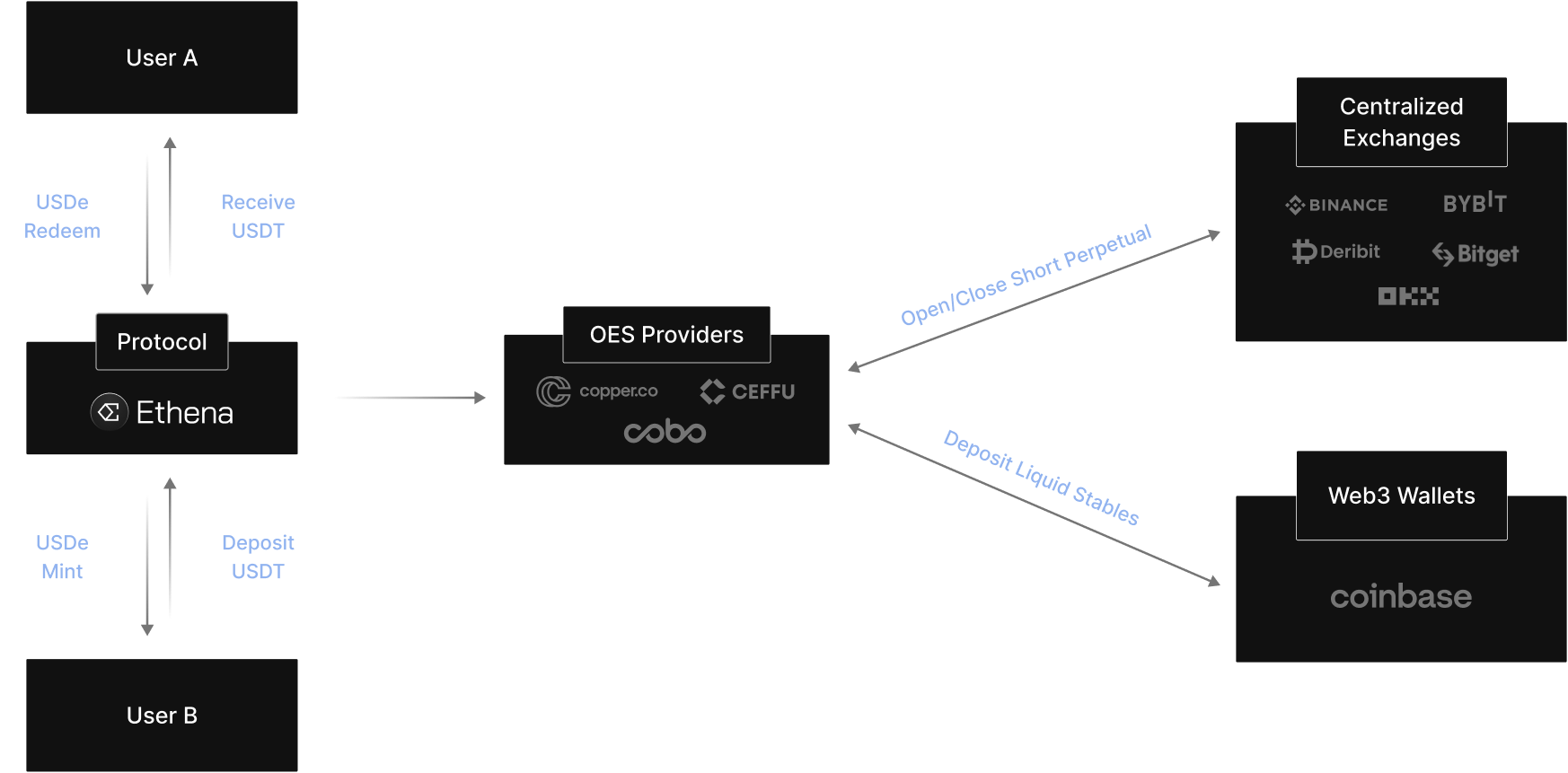
Source: ethena.fi
USDe’s collateral includes leading crypto Assets like ETH and BTC, and the protocol may also hold Stablecoins such as USDC and USDT. This multi-Asset structure boosts system stability and acts as a buffer during market swings.
USDe uses a 1:1 collateralization model. Unlike Over-Collateralized stablecoins, its stability is driven by a hedging mechanism rather than excessive collateral, improving capital efficiency and system flexibility.
USDe is usable across both CeFi and DeFi ecosystems, including lending, trading, and liquidity pools. This composability amplifies the utility of the stablecoin.
| Stablecoin Type |
Stabilization Method |
Collateral Type |
Capital Efficiency |
| Fiat-Collateralized |
Bank Reserves |
USD and Treasuries |
High |
| Over-Collateralized |
Crypto Asset Collateral |
ETH, etc. |
Low |
| Ethena (USDe) |
Delta-Neutral Hedging |
Spot + Derivatives |
High |
As the table shows, Ethena strikes a new balance between stabilization and capital efficiency, positioning itself as a pioneering stablecoin model.
How the Delta-Neutral Hedging Mechanism Delivers Stability
Delta-Neutral is the foundation of USDe’s stability. By pairing Spot Assets with short Derivatives positions, Ethena offsets Market Price risk. Unlike traditional stablecoins that depend on Fiat reserves, Ethena uses financial engineering to achieve stability, making USDe a true crypto-native stablecoin.
Practically, when the protocol holds crypto Assets (such as ETH or BTC) as collateral, it simultaneously opens equivalent short positions in the Derivatives market. For instance, if it holds $100 in ETH Spot, it also opens a $100 short in ETH Perpetual Futures. If ETH’s price rises, the Spot Asset gains value while the short position loses value; if the price falls, the short position profits while the Spot Asset incurs a Loss—keeping the total Asset Value stable.
This hedging mechanism minimizes Market Price risk, so USDe’s value is determined by the hedging structure, not underlying Asset price trends. The dynamic balance between Spot and Derivatives positions allows USDe to remain stable in both bull and bear markets.
Ethena’s Delta-Neutral strategy is typically executed via automated systems. The protocol dynamically rebalances hedges in response to market shifts or Funding Rate changes, maintaining structural stability and reducing risk. This automation is essential for USDe’s long-term resilience.
Ethena’s Spot Asset and Perpetual Futures Hedging Architecture
Ethena’s stabilization relies on a hedging structure between Spot Assets and Perpetual Futures. Spot Assets serve as core collateral, while Perpetual Futures shorts hedge against Spot Price volatility. This approach allows Ethena to build a stablecoin without relying on Fiat reserves.
For Spot Assets, Ethena holds highly liquid tokens like BTC and ETH, ensuring deep liquidity for large-scale hedging and minimizing Slippage and liquidity risk. The protocol may also hold Stablecoins such as USDT and USDC to further stabilize the system and optimize capital management.
On the Derivatives side, Ethena opens short positions across multiple exchanges. Cross-exchange hedging reduces single-exchange risk and increases execution efficiency, strengthening system robustness and risk management.
Ethena employs Off-Exchange Custody, meaning collateral Assets are stored with independent custodians rather than directly on exchanges. Funds only move during settlement or Adjust Margin events, reducing exchange risk and enhancing Asset security.
| Component |
Function |
Risk Control |
| Spot Assets (BTC, ETH) |
Provide Collateral |
High Liquidity |
| Perpetual Futures Shorts |
Hedge Price Volatility |
Multi-Exchange |
| Stablecoin Assets |
Provide Liquidity Buffer |
Bear Market Protection |
| Off-Exchange Custody |
Asset Custody |
Minimize Exchange Risk |
This multi-layered architecture enables Ethena to maintain stability in a variety of market conditions.
The Role of Funding Rate Returns in Ethena
Funding Rate is a key Source of Return for the Ethena protocol. In Perpetual Futures markets, Funding Rate payments between longs and shorts keep contract prices aligned with Spot Price. When the market leans long, longs pay Funding Rate to shorts.
Because Ethena maintains significant short positions, it earns Funding Rate Returns when the market is net long. These Returns are a core income stream for the protocol and support the sUSDe yield model.
Ethena also generates Returns from its Spot Assets—staking ETH, for example, can yield staking Rewards, while Stablecoins may earn additional Returns. Together with Funding Rate, this creates a diversified Return profile.
In 2024, BTC’s average Funding Rate is around 11%, and ETH’s is approximately 12.6%. Supported by these income streams, sUSDe’s average Annual Percentage Yield (APY) has reached about 19%, establishing Ethena as a stablecoin model that combines stability and yield.
Ethena’s Risk Management and Stabilization Framework
Despite its Delta-Neutral hedging, Ethena faces various risks and requires a robust risk management framework. Automated hedging mechanisms reduce Market Price risk by continuously adjusting positions to maintain stability.
A multi-exchange strategy mitigates single-exchange risk and enhances system stability. If one exchange faces liquidity issues, operations continue on others.
Off-Exchange Custody reduces custody risk by keeping collateral Assets with independent custodians, minimizing exposure to exchange insolvency or security incidents.
Ethena also uses a dynamic risk model for system management. If Funding Rate drops or volatility spikes, the protocol may restructure Assets or reduce risk exposure to safeguard long-term stability.
Full Ethena (ENA) Operational Workflow
Ethena’s workflow starts when users Mint USDe by providing collateral (such as USDT or ETH) to the protocol, typically via Smart Contract.
The protocol then opens corresponding short positions in Derivatives markets, creating a Delta-Neutral hedge.
Throughout operation, the protocol dynamically rebalances positions and collects Funding Rate Returns, which are pooled to support the sUSDe yield model.
Users can Stake USDe to receive sUSDe and earn Returns. When redeeming, the protocol closes the corresponding positions and releases the collateral, completing the cycle.
Summary
Ethena’s Delta-Neutral hedging mechanism underpins the stability of USDe, freeing it from reliance on traditional Fiat reserves and anchoring it in crypto Assets and Derivatives markets. By offsetting price swings between Spot and short positions, Ethena maintains stability.
Simultaneously, Ethena’s yield model—powered by Funding Rate and Asset Returns—turns USDe into a yield-bearing Asset, enhancing both utility and capital efficiency.
As the crypto market evolves, Ethena’s synthetic dollar model could become a major direction for stablecoin design, further advancing the crypto financial ecosystem.
FAQ
- How does Ethena maintain stability?
Ethena maintains stability through a Delta-Neutral hedging mechanism, holding Spot Assets and opening equivalent short positions to offset price fluctuations.
- Is USDe fully collateralized?
USDe uses a 1:1 collateralization model and achieves stability through Derivatives hedging, not Over-Collateralization.
- Where does Ethena’s yield come from?
Ethena’s Returns are primarily sourced from Funding Rate, staking yields, and Stablecoin income.
- What is sUSDe?
sUSDe is the staked version of USDe. Users Stake USDe to receive sUSDe and earn protocol Returns.