Within modular blockchain systems, it is often difficult for users to understand how transactions move between the execution layer and the settlement layer. This makes the question of how a transaction is completed central to understanding the system as a whole.
This topic typically involves three key components: the transaction submission path, execution layer processing logic, and settlement confirmation. Together, these form the complete operational flow of SOON.
How Users Enter the SOON Rollup Ecosystem
Users typically access the SOON network through wallets or application interfaces that connect to the execution layer.
At the mechanism level, a user connects to a SOON compatible wallet or dApp and bridges assets into the relevant Rollup network. This enables interaction within the execution layer. Asset bridging is usually handled through underlying chains and cross chain protocols.
Structurally, the user entry point consists of wallets, front end applications, and cross chain bridges. These components together form the interface between the user and the execution layer. Instead of interacting directly with the base chain, user actions are routed into the execution layer first.
The value of this design lies in abstracting away complex base layer interactions, allowing users to operate in a high performance environment while still remaining connected to the underlying blockchain.
How Transactions Are Submitted and Broadcast in the SOON Network
Transactions in SOON are submitted as standardized data and broadcast across execution nodes.
Mechanically, once a user initiates a transaction, the data is packaged into a request and sent to the execution node network. These nodes perform basic validation, such as checking signatures and balances. The transaction is then propagated across nodes to ensure synchronized processing.
Structurally, the propagation process involves clients, node networks, and mempools. Before execution, transactions are temporarily stored and ordered to optimize processing efficiency.
This mechanism ensures that transactions are distributed across multiple nodes, improving reliability and consistency.
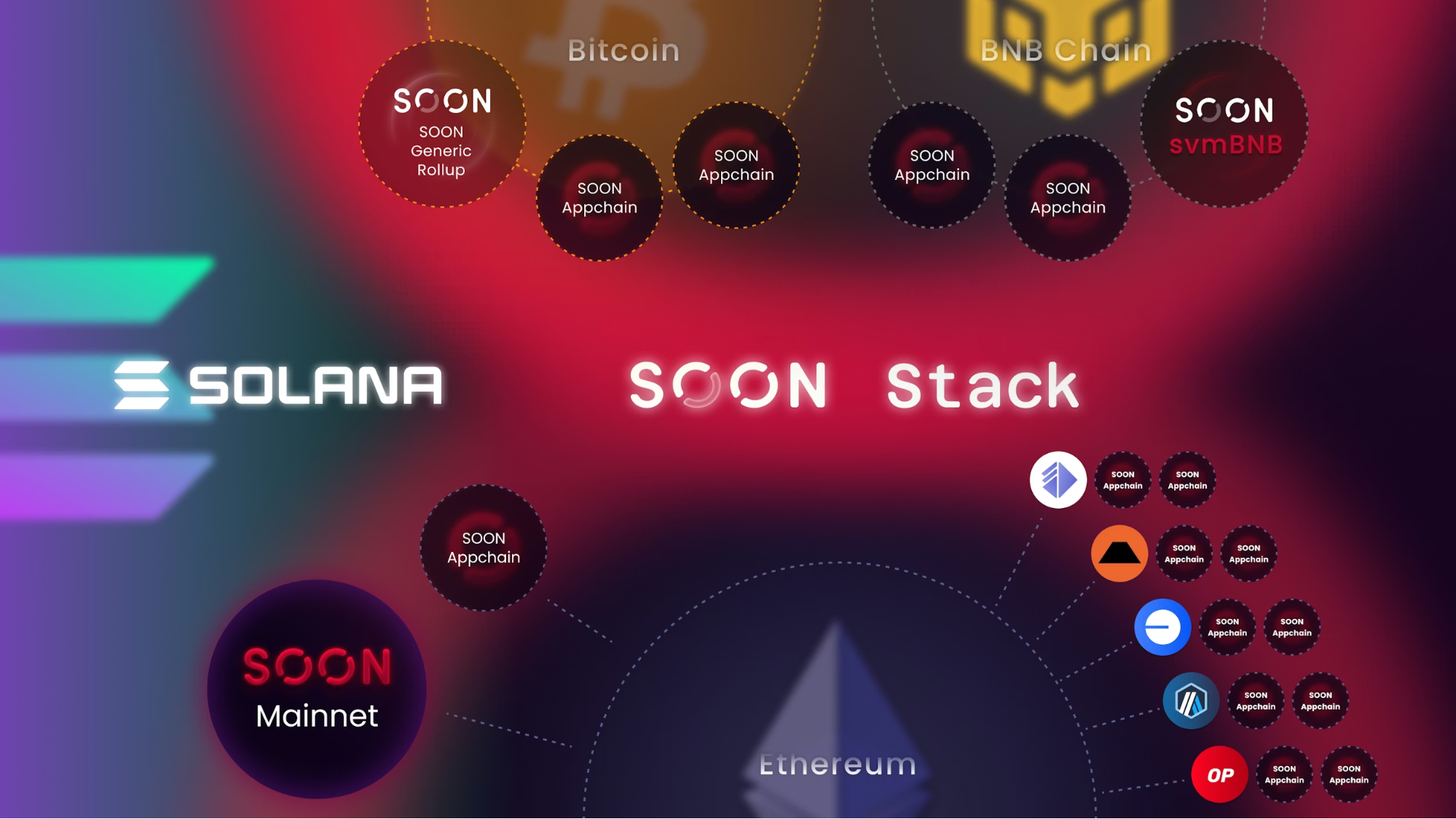
How the SOON Execution Layer Processes Transactions and Updates State
The execution layer is the core of the system, responsible for running transaction logic and updating state.
At the mechanism level, once a transaction enters the execution layer, it is processed by the SVM environment, which executes the corresponding smart contract logic. This includes asset transfers, contract calls, and data updates.
Structurally, the execution layer consists of execution nodes, state storage, and a computation engine. It leverages parallel processing to increase throughput. The output is a set of state changes that are passed on for settlement.
The importance of this design is that computation heavy tasks are handled in a high performance environment, reducing the load on the base chain while improving efficiency.
How the SOON Settlement Layer Achieves Final Confirmation
The settlement layer is responsible for finalizing execution results and providing security guarantees.
Mechanically, state updates generated by the execution layer are batched and submitted to a base chain, where they are verified through consensus and recorded On-Chain.
Structurally, this layer is typically provided by major base chains such as Ethereum, which offer strong security and immutability.
This separation allows SOON to combine high performance execution with the proven security of established blockchains.
How Cross Chain Communication Works in the InterSOON System
Cross chain communication in SOON is enabled through the InterSOON protocol, which connects data and assets across different networks.
At the mechanism level, InterSOON uses a message passing system. State changes on one chain are encoded into messages, which are then verified and executed on the destinatiOn-Chain.
Structurally, InterSOON includes a messaging layer, validation mechanisms, and execution interfaces. Together, these components establish a unified communication pathway between execution environments and base chains.
This design allows SOON to extend beyond a single ecosystem, supporting interoperability and shared liquidity across multiple chains.
A Structural Breakdown of the SOON Transaction Lifecycle
The full transaction lifecycle can be broken down into several key steps:
Step 1: Transaction Initiation The user submits a transaction through a wallet or application, specifying the intended action.
Step 2: Network Entry The transaction is sent to execution nodes, where it is propagated and validated.
Step 3: Execution Layer Processing The SVM environment executes the transaction logic and updates the system state.
Step 4: Submission to Settlement Layer Execution results are bundled and submitted to the base chain for verification.
Step 5: Final Confirmation The base chain reaches consensus and permanently records the transaction outcome.
At the mechanism level, this flow separates execution from settlement, allowing computation and security to be handled independently.
Structurally, each step is handled by a distinct module, including the client layer, execution layer, and settlement layer, ensuring clear functional separation.
The significance of this design is that it transforms user actions into verifiable On-Chain state changes while improving both performance and system reliability.
Conclusion
SOON uses a modular architecture to divide the transaction lifecycle into submission, execution, and settlement stages. By allowing the execution layer and security layer to operate in tandem, it achieves both high performance and strong security guarantees.
FAQ
Are SOON transactions executed directly on the main chain?
No. Transactions are first processed in the execution layer, and only the final results are submitted to the main chain.
What is the difference between the execution layer and the settlement layer?
The execution layer handles computation and state updates, while the settlement layer provides final confirmation and security.
Why is cross chain communication necessary?
It enables data and asset transfers across different blockchains, supporting broader ecosystem interoperability.
How does SOON improve transaction speed?
By using the SVM execution environment and parallel processing to increase throughput.
What happens if a transaction fails?
The execution layer reverts the state changes, ensuring consistency across the system.