As decentralized finance continues to expand, on-chain liquidity has become increasingly distributed across multiple trading protocols. When users execute swaps on only a single platform, they may not obtain the most favorable price or sufficient market depth. For this reason, DEX aggregators have become an important part of the DeFi trading infrastructure. By combining liquidity from different platforms, these systems help improve overall trading efficiency.
Within the Solana ecosystem, Jupiter is widely regarded as an important liquidity routing layer. Many wallets, DeFi applications, and trading tools execute swaps through Jupiter’s routing system, which automatically searches for better pricing across available liquidity sources. This mechanism has made Jupiter a key infrastructure component that connects multiple decentralized trading protocols.
The Role Of Jupiter In The Solana DeFi Trading System
Within the Solana DeFi trading ecosystem, different protocols typically perform distinct functional roles. Some protocols focus on providing liquidity pools and facilitating asset swaps, while others specialize in optimizing trade execution or offering financial tools. Jupiter is positioned as a liquidity aggregation layer, designed to connect multiple decentralized trading protocols and improve trade routing efficiency.
Several decentralized exchanges operate within the Solana ecosystem, including platforms such as Raydium and Orca. Each of these platforms maintains its own liquidity pools and market depth. When users trade on only one of these exchanges, they may not always receive the best available price.
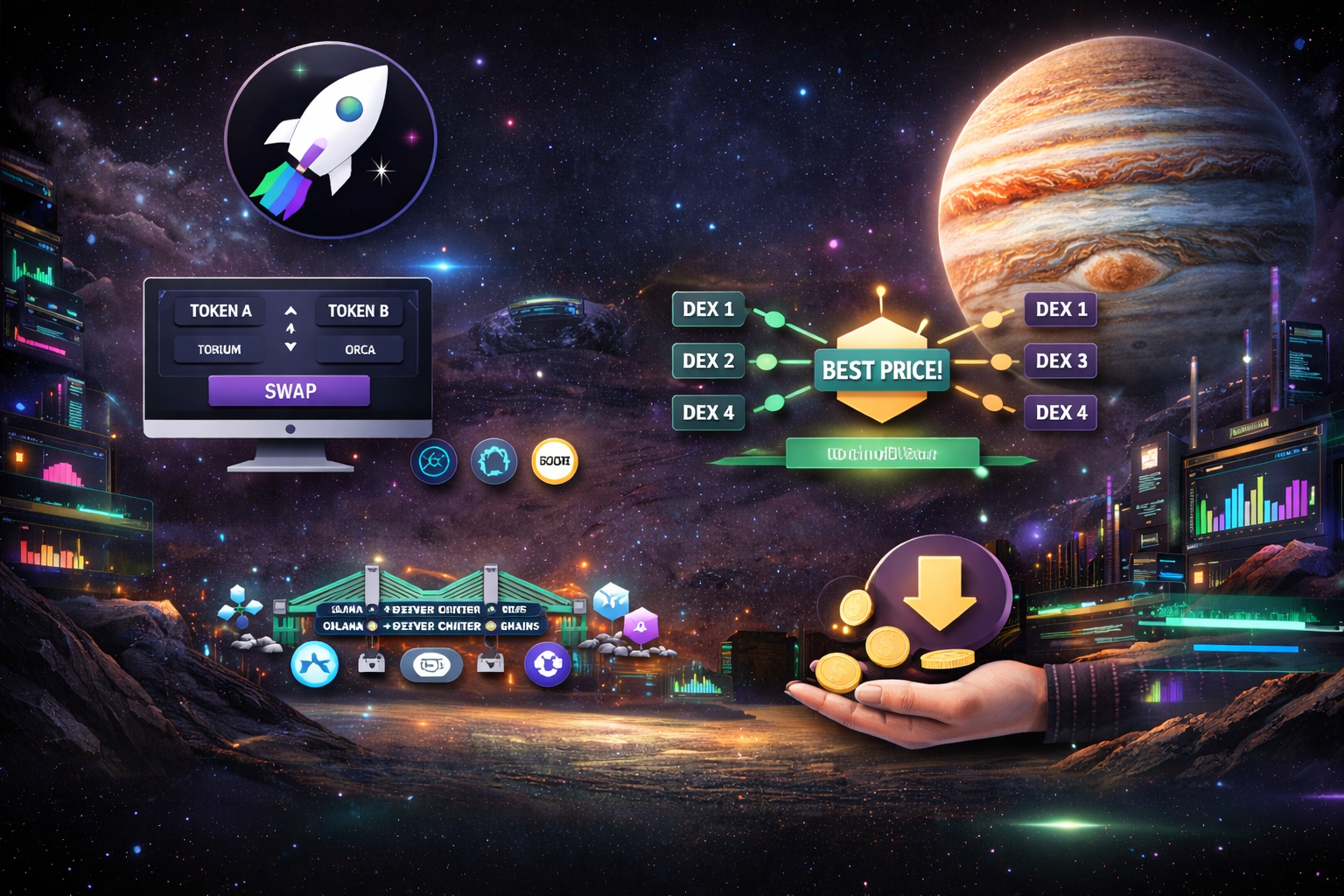
Jupiter addresses this limitation by scanning liquidity across multiple trading platforms and calculating the most efficient trading route. By aggregating liquidity from different protocols, Jupiter allows users to access better pricing automatically across several exchanges. Within the broader trading system, Jupiter therefore functions as a trade optimization engine that coordinates liquidity across multiple platforms.
The Basic Operating Logic Of DEX Aggregators
The core logic of a DEX aggregator lies in reducing information asymmetry across fragmented liquidity sources. Its operation generally follows three key steps:
-
Global Liquidity Scanning: The system continuously collects real time price data from hundreds of liquidity pools across multiple decentralized exchanges. This allows the aggregator to maintain a comprehensive view of available market liquidity.
-
Route Calculation: Within milliseconds, the routing engine evaluates the available data and determines one or more trading paths that can complete the swap at the lowest possible cost. This calculation takes into account factors such as price differences, liquidity depth, and expected slippage.
-
Transaction Construction: Once the optimal route is identified, the aggregator packages the routing logic into a single atomic transaction on the Solana network. This transaction executes all required swaps in sequence, ensuring that the trade completes as planned within one on-chain operation.
How Jupiter Calculates Trading Routes
The core technology behind Jupiter’s routing system has evolved from the earlier Metis algorithm to the more advanced Iris engine, which was introduced with Ultra V3.
-
Multi Hop Routing: If the direct swap from Token A to Token C does not offer efficient pricing, Jupiter can search for intermediate assets that create a better execution path. For example, a route such as A -> USDC -> C may produce a lower overall cost than swapping directly from A -> C.
-
Numerical Optimization Methods: The newer Iris engine uses mathematical optimization models such as the Golden section search and Brent’s method. These techniques allow the system to identify optimal solutions much faster within complex liquidity graphs. Compared with previous routing generations, the Iris engine is designed to search for efficient execution paths at a significantly higher speed.
How Multi Route Trade Splitting Reduces Slippage
Large transactions executed within a single liquidity pool can cause significant price impact. This occurs because a large order may consume a substantial portion of the available liquidity in that pool. Jupiter addresses this issue through trade splitting, which distributes a transaction across multiple liquidity sources.
Instead of executing one large swap in a single pool, Jupiter divides the order into several smaller transactions and executes them simultaneously across different liquidity pools. These pools may exist on decentralized exchanges such as Raydium, Orca, or Meteora.
For example, if a user wants to swap assets worth $100,000 for a token such as JUP, Jupiter may distribute the order across several pools. A possible allocation might route 40% of the order to the deepest liquidity pool, 35% to a second pool, and the remaining 25% to another pool.
Executing these trades in parallel reduces the liquidity pressure placed on any single pool. As a result, the overall slippage of the transaction is minimized. This multi route execution model is one of the defining characteristics that distinguishes DEX aggregators from conventional decentralized exchanges.
Jupiter Trade Execution Process
The operation of Jupiter follows a typical atomic transaction workflow. The process can be understood in three stages: input, execution, and output.
-
Input Conditions: The process begins when a user enters trade parameters on the interface. These parameters usually include the token pair to be exchanged, the transaction amount, and the maximum slippage tolerance the user is willing to accept.
-
Execution Process: Once the trade request is submitted, Jupiter performs several steps in the background.
-
Quote Simulation: The routing engine runs thousands of simulations to evaluate potential swap routes. Based on price data, liquidity depth, and slippage estimates, the system selects the most efficient execution path.
-
Transaction Construction: After determining the optimal route, Jupiter packages multiple swap instructions into a single Solana transaction. This transaction may include several steps if the trade requires multiple liquidity pools or intermediate assets.
-
Atomic Submission: The constructed transaction is then submitted to a Solana RPC node for execution.
- Output Result: If the transaction meets the specified slippage conditions, the trade is completed within a single confirmation cycle, typically within zero to one block. The user then receives the target asset in their wallet. If market conditions move beyond the permitted slippage range during execution, the entire transaction is reverted.
Because the Solana network offers high throughput and low latency, these complex routing transactions can usually be executed within a short period of time.
Advantages And Potential Limitations Of The Jupiter Aggregation Model
Jupiter’s liquidity aggregation model introduces several advantages for decentralized trading, but it also comes with certain limitations that users should understand.
Advantages
-
Improved Pricing Efficiency: By aggregating liquidity from multiple decentralized exchanges, Jupiter increases the likelihood that users receive the most competitive price available in the market.
-
Greater Market Liquidity: Because trades can be executed across multiple liquidity pools, the effective market depth available to a transaction is higher than what a single platform could provide.
-
Automated Trade Routing: Users do not need to manually compare prices across different exchanges. The routing engine automatically determines the most efficient execution path.
Potential Limitations
-
Dependence On External Liquidity: Jupiter does not operate as a primary liquidity provider. Instead, it relies on liquidity from other decentralized trading protocols.
-
Routing Complexity: Multi route transactions may introduce additional complexity. In some situations, this can increase the likelihood of transaction failure if one part of the route cannot be executed as expected.
-
Network Dependence: The execution of trades relies on the performance of the Solana network. If the network experiences congestion or technical disruptions, transaction confirmation may be delayed or affected.
For these reasons, users should consider both market liquidity conditions and network performance when executing trades through Jupiter.
Conclusion
Jupiter has become an important trading infrastructure within the Solana DeFi ecosystem. Through advanced smart routing and multi route trade splitting mechanisms, it addresses the fragmentation of liquidity across different decentralized exchanges and provides users with a more efficient way to swap assets on-chain.
The design of Jupiter demonstrates how decentralized protocols can use algorithmic optimization to improve trading execution. As activity within decentralized finance continues to grow, aggregation protocols such as Jupiter are increasingly becoming key components of on-chain trading systems.
FAQs
Does Jupiter charge additional trading fees?
No. Jupiter does not charge an additional protocol fee for its aggregation swap service. Users typically only pay the underlying DEX trading fees and the Solana network transaction fee.
How does Jupiter find the best trading route?
The system scans pricing information across multiple decentralized exchanges and calculates the most efficient trading path using routing algorithms.
Why are some trading routes complex and involve several tokens?
In some cases, the algorithm determines that routing through intermediate assets, known as multi hop routing, results in lower slippage than a direct swap between two tokens.
Why does Jupiter split transactions?
Trade splitting distributes a large order across multiple liquidity pools. This reduces price impact on any single pool and helps minimize overall slippage.
What is an atomic transaction?
An atomic transaction means that all operations within the transaction either succeed together or fail together. Even if a trade is split across multiple routes, the transaction will only complete if every step executes successfully, ensuring asset safety.







