As decentralized finance expanded, liquidity became fragmented across numerous protocols, reducing efficiency and increasing reliance on short-term token incentives. This created a need for systems that could unify liquidity and generate more sustainable yield sources. Katana introduces a vertically integrated model that combines liquidity concentration, protocol-owned capital, and governance coordination.
Its structure centers on a liquidity flywheel, chain-owned liquidity, and a vote-escrow token system that collectively shape how capital flows through the ecosystem.
What are Katana's Design Objectives?
Katana is designed to address two persistent structural issues in decentralized finance: the fragmentation of liquidity across too many protocols and the reliance on short-term, emission-driven incentives.
In many DeFi systems, liquidity is spread thinly across multiple exchanges, lending platforms, and derivatives markets. This fragmentation reduces market depth, increases slippage, and makes capital less efficient overall. Katana approaches this problem by intentionally concentrating liquidity into a small number of core financial applications, allowing capital to be used more effectively within a unified system.
At the same time, traditional DeFi incentives often depend heavily on continuous token emissions. While this can attract liquidity in the short term, it may not be sustainable if it is not supported by real economic activity. Katana introduces a different approach by emphasizing “real yield,” where rewards are increasingly derived from actual usage, such as trading fees, borrowing interest, and other protocol-generated revenue.
This design reflects a shift from a loosely connected ecosystem toward a coordinated financial structure, where liquidity, incentives, and governance are aligned at the chain level.
Key objectives can be summarized as:
-
Reducing liquidity fragmentation: Concentrating capital into a limited set of core markets to improve depth and execution quality
-
Improving capital efficiency: Enabling the same liquidity to support multiple financial functions more effectively
-
Transitioning to real yield: Prioritizing revenue generated from actual user activity over token inflation
-
Coordinating incentives at the system level: Aligning liquidity allocation and rewards through a unified governance mechanism
Together, these objectives position Katana as a system designed not just to host DeFi applications, but to actively coordinate how capital flows within them.
Chain-Owned Liquidity (CoL) refers to liquidity that is controlled by the protocol itself rather than external liquidity providers.
Katana accumulates CoL through multiple sources:
-
Sequencer fees generated by network activity
-
A portion of revenues from core applications
-
Yield generated by integrated financial products
This capital is then deployed directly into key markets, including decentralized exchanges, lending pools, and derivatives platforms.
Unlike external liquidity, which can quickly enter and exit markets, CoL is structurally persistent. This allows it to stabilize trading conditions, maintain depth during volatility, and support more predictable borrowing and pricing environments.
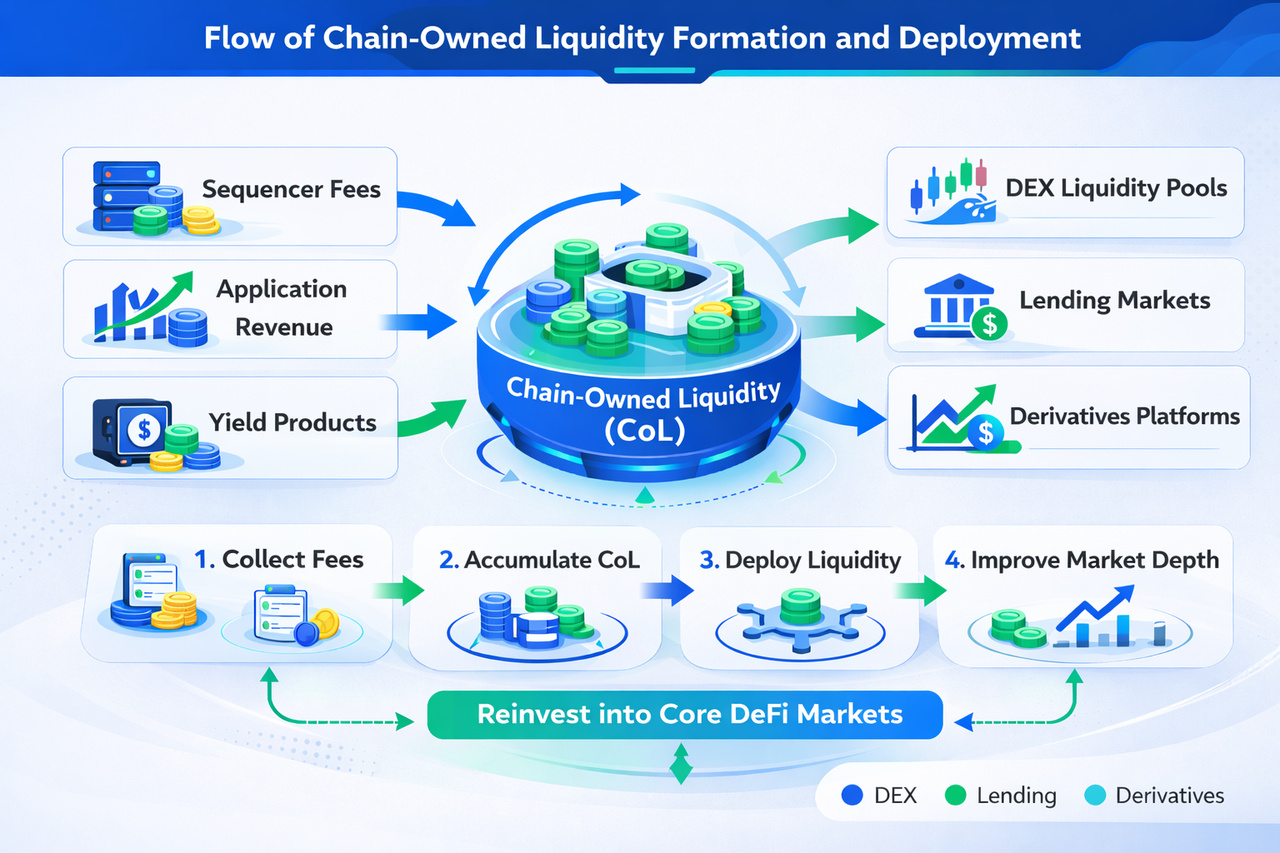
How the Katana Liquidity Flywheel Distributes and Reinvests
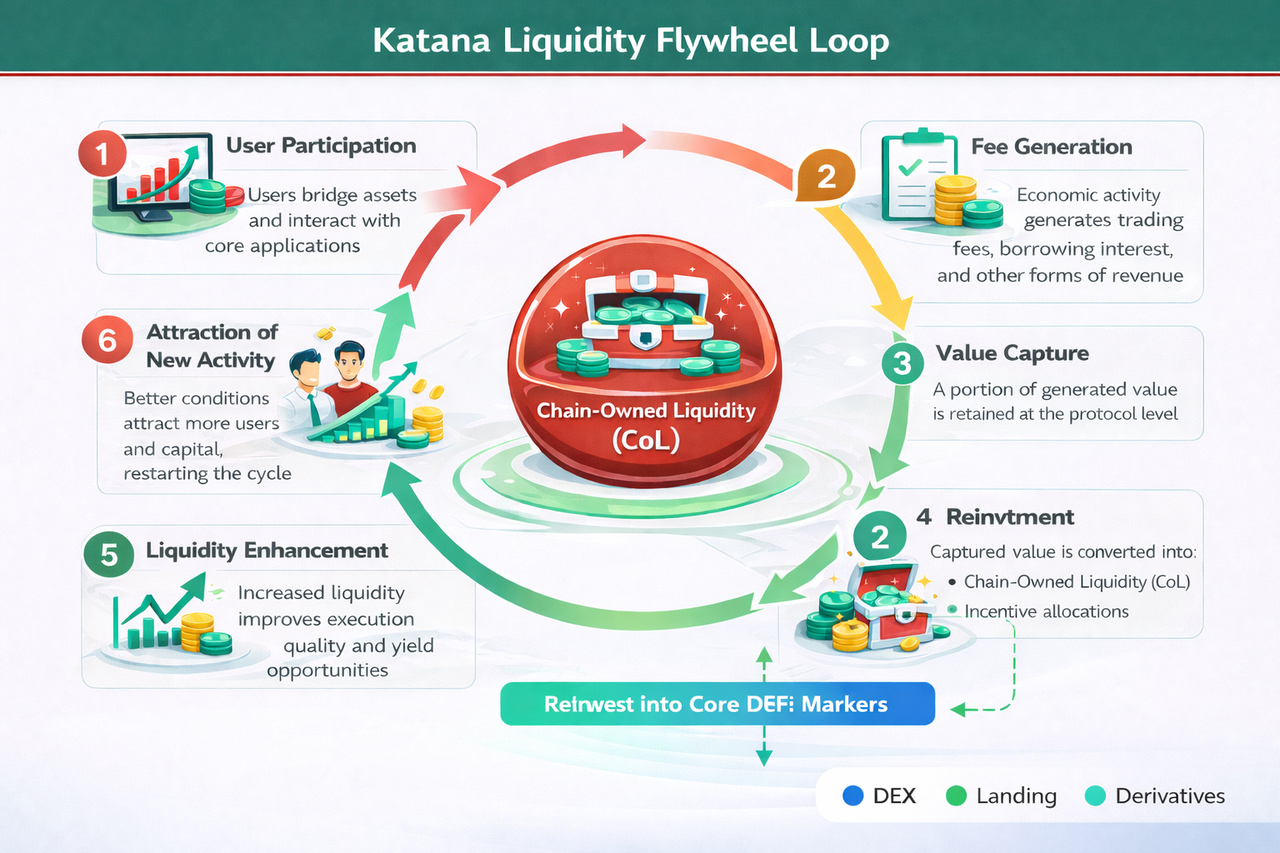
Katana operates through a feedback mechanism commonly described as a liquidity flywheel.
The cycle can be understood in several stages:
-
User participation: Users bridge assets and interact with core applications (trading, lending, derivatives).
-
Fee generation: Economic activity generates trading fees, borrowing interest, and other forms of revenue.
-
Value capture: A portion of generated value is retained at the protocol level.
-
Reinvestment: Captured value is converted into:
-
Chain-Owned Liquidity (CoL)
-
Incentive allocations
-
Liquidity enhancement: Increased liquidity improves execution quality and yield opportunities.
-
Attraction of new activity: Better conditions attract more users and capital, restarting the cycle.
This recursive process links user activity directly to liquidity growth.
As the system matures, the reliance on new token emissions is intended to decrease, with a greater share of incentives funded by actual economic activity.
The Settlement Role of vKAT in Yield Distribution and Governance
vKAT is a vote-escrowed token derived from locking the native KAT token, functioning as the coordination layer for incentives and governance.
Its role can be understood through three primary functions:
-
Emission direction Holders vote on how token incentives are distributed across liquidity pools and markets.
-
Fee participation Participants may receive a share of protocol-generated fees based on voting alignment.
-
Governance coordination Only locked tokens grant influence, encouraging longer-term participation in decision-making.
This mechanism extends the concept of vote-escrow tokenomics from individual protocols to the entire chain level, allowing coordinated allocation of liquidity incentives across multiple financial applications.
The Differences Between Katana and Traditional DeFi Models
Katana differs from conventional DeFi systems and general-purpose Layer 2 networks in both structure and incentive design.
Key distinctions include:
| Dimension |
Traditional DeFi / General L2s |
Katana Model |
| Liquidity structure |
Fragmented across many protocols |
Concentrated in core applications |
| Incentive system |
Protocol-level emissions |
Chain-level coordinated emissions (vKAT) |
| Revenue usage |
Distributed or siloed |
Recycled into CoL and shared incentives |
| Liquidity ownership |
Mostly user-provided |
Combination of user liquidity and CoL |
| Yield model |
Often emission-driven |
Increasingly based on real economic activity |
These differences reflect a shift from modular competition toward coordinated capital allocation.
The Advantages and Potential Issues of the Katana Operating Model
Katana’s operating model introduces a coordinated approach to liquidity, incentives, and governance, which reshapes how capital flows within a DeFi ecosystem. This structure brings measurable improvements in efficiency and sustainability, but it also introduces new trade-offs related to concentration, complexity, and system dependency. Understanding both sides helps clarify how the model performs under different market conditions.
Advantages
-
Improved capital efficiency: Concentrated liquidity can reduce slippage and improve execution quality.
-
More sustainable yield structure: Incentives increasingly rely on actual economic activity rather than token issuance.
-
Coordinated ecosystem growth: Governance mechanisms allow resources to be directed toward the most active or critical markets.
-
Liquidity stability: Protocol-owned liquidity provides a more persistent base compared to short-term external capital.
Potential Issues
-
Concentration risk: Liquidity and governance influence may become centralized among a limited number of participants.
-
System complexity: Multiple interconnected mechanisms can make the system difficult to fully understand and evaluate.
-
Dependence on activity levels: Reduced trading or borrowing demand may weaken revenue generation and incentive sustainability.
-
Competitive environment: The model must compete with both general-purpose blockchains and alternative DeFi coordination systems.
Conclusion
Katana represents a structural shift in decentralized finance by integrating liquidity concentration, protocol-owned capital, and chain-level governance into a single coordinated system.
Its liquidity flywheel links user activity with capital growth, while vKAT provides a mechanism for directing incentives and distributing value across the ecosystem. By emphasizing real yield and coordinated liquidity allocation, the model seeks to address inefficiencies present in fragmented DeFi environments.
Its long-term effectiveness depends on sustained activity, balanced governance, and the system’s ability to manage complexity and concentration.
FAQs
-
Is KAT used for transaction fees?
No. Transaction fees are typically paid using the base network asset, while KAT is used for incentives and governance coordination.
-
How is vKAT different from standard vote-escrow tokens?
vKAT operates at the chain level, influencing multiple applications rather than a single protocol.
-
Is liquidity fully controlled by the Katana?
No. Katana combines protocol-owned liquidity with external user-provided liquidity to form its overall market structure.







