In the decentralized finance DeFi ecosystem, lending protocols typically rely on liquidity pools to match supply and demand. While this model provides strong stability and liquidity, it often results in lower yields for depositors and higher borrowing costs in practice, revealing room for improvement in capital efficiency.
Against this backdrop, Morpho emerges as an optimization layer built on top of major lending protocols. By introducing a new matching mechanism, it improves the interest rate structure without compromising the security of the underlying protocols. Through more precise capital matching, Morpho enhances user experience and has gradually become a key innovation in the DeFi lending space.
Overview of How Morpho Works
At its core, Morpho can be understood as adding an intelligent matching layer on top of traditional lending protocols. When users deposit or borrow funds, the system first attempts to match lenders and borrowers directly instead of immediately routing funds into a liquidity pool.
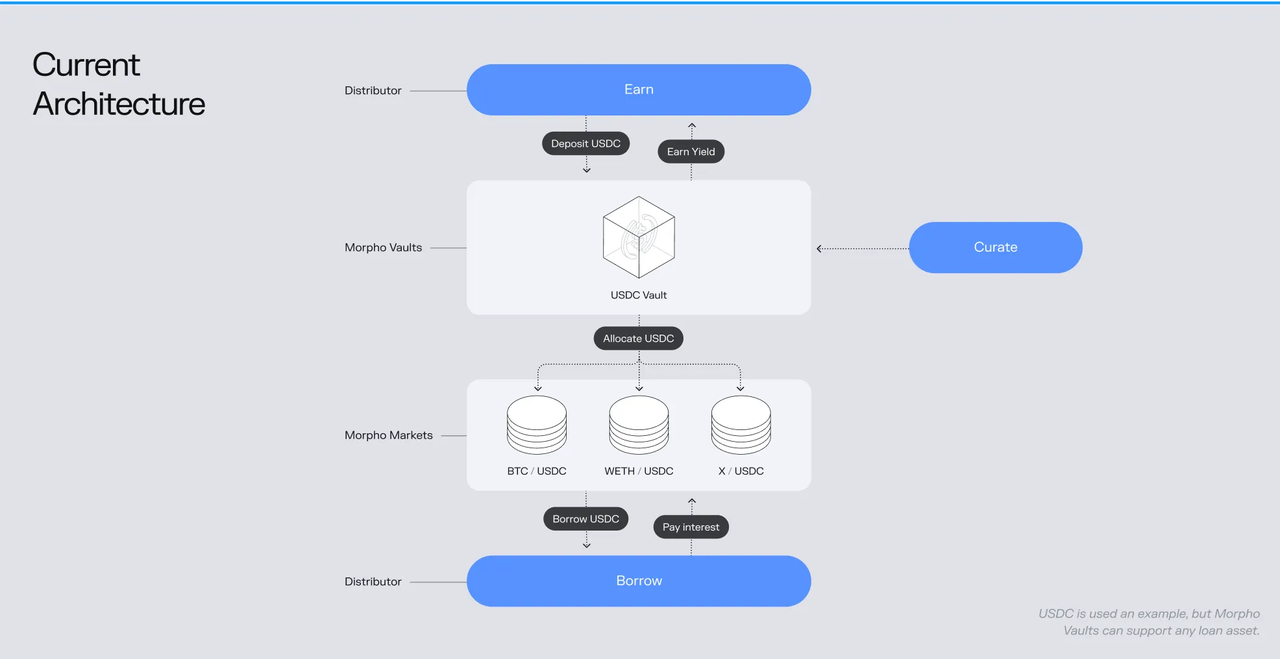
The key elements of this mechanism include:
This approach allows Morpho to optimize interest rates and capital efficiency without altering the existing infrastructure.
Core Mechanisms of Morpho
Morpho’s efficiency comes from the coordinated design of multiple mechanisms rather than a single improvement. To optimize interest rates while maintaining liquidity and security, Morpho breaks down the traditional lending process into several components and refines each one. Together, these mechanisms form its unique lending framework.
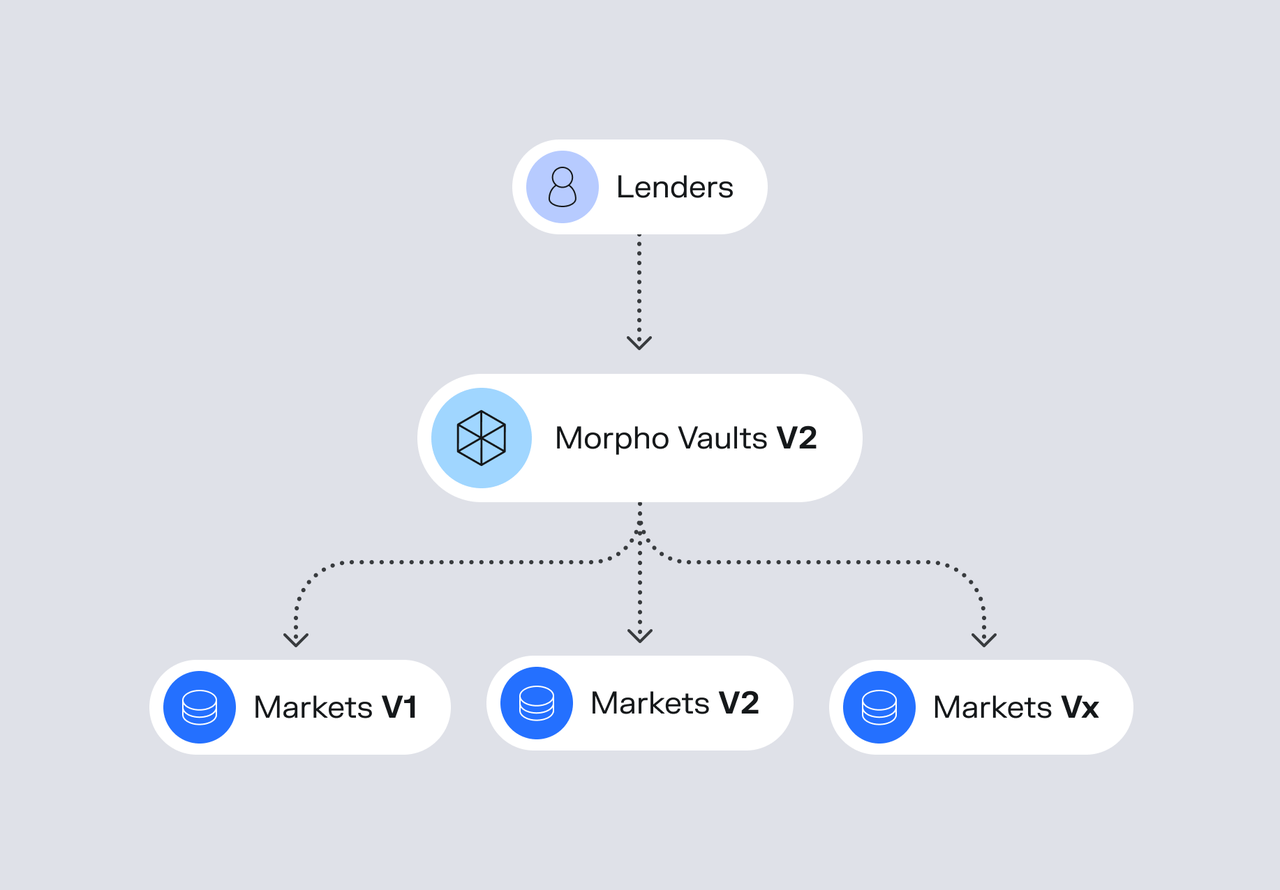
Morpho’s core system is built on four pillars: P2P matching, pool fallback, yield optimization, and its next-generation architecture, all working together to fundamentally improve lending efficiency.
Peer-to-Peer (P2P) Matching Model
P2P matching is one of Morpho’s most important innovations. In this model, lenders and borrowers are directly paired, bypassing the uniform interest rates of traditional liquidity pools.
In this setup:
Essentially, Morpho creates a middle rate range between the two, allowing both sides to benefit.
Pool Fallback Mechanism
While P2P matching improves efficiency, real-world markets rarely achieve perfect supply and demand balance. To address this, Morpho introduces a pool fallback mechanism.
In cases where:
Unmatched funds are automatically allocated to liquidity pools such as Aave or Compound.
This ensures:
Morpho Optimizer
Morpho Optimizer is one of the protocol’s early core products, designed to enhance yields on top of existing lending platforms.
It works by:
-
Automatically identifying P2P matching opportunities
-
Dynamically allocating funds between P2P and pool
-
Selecting the optimal strategy under different rate conditions
This allows users to achieve better returns or lower borrowing costs without manual intervention.
Morpho Blue (Next-Generation Architecture)
Morpho Blue represents the protocol’s next stage, moving toward a modular lending framework.
In this architecture:
This shift gradually transforms Morpho from an optimization layer into a more flexible and scalable lending infrastructure.
Advantages of Morpho’s Mechanism
Morpho’s design focuses on improving capital efficiency, with benefits across several dimensions.
First, P2P matching narrows the spread between lending and borrowing rates, making the market more efficient. Second, the pool fallback mechanism ensures stable liquidity, allowing the system to function even under extreme conditions.
Additionally, the introduction of Morpho Optimizer and Morpho Blue provides automatic optimization and modular scalability, enabling the protocol to adapt to the evolving DeFi landscape.
Potential Limitations and Risks of Morpho
Despite its advantages, Morpho’s design also comes with certain limitations.
P2P matching depends on market supply and demand, and its effectiveness may be limited when imbalances occur. Furthermore, because Morpho is built on top of underlying lending platforms, its security partially depends on those infrastructures.
As the system becomes more complex, new users may face a learning curve in understanding how it works, which could affect broader adoption.
Conclusion
By combining P2P matching with liquidity pools, Morpho offers a more efficient solution for DeFi lending. Its mechanism represents a shift from pooled matching to intelligent matching, allowing both lenders and borrowers to achieve better outcomes within a single system.
With the development of architectures like Morpho Blue, this model is evolving from an optimization tool into a more flexible and scalable lending infrastructure.
FAQs
What is Morpho’s core mechanism?
It combines peer-to-peer P2P matching with a pool fallback system.
What is pool fallback?
When P2P matching cannot be completed, funds are automatically routed into underlying liquidity pools to ensure liquidity.
What is the difference between Morpho Blue and Morpho Optimizer?
Optimizer is a yield optimization tool, while Blue is a modular lending architecture.
Does Morpho rely on Aave or Compound?
In its early stages, it relies on these protocols as sources of underlying liquidity.
How does Morpho improve yields?
By enabling more efficient interest rate matching, allowing both lenders and borrowers to access better rates.







