Prediction markets are systems that allow users to trade on the outcomes of future events. Participants express their subjective probability judgments by buying or selling binary shares, and final settlement is determined by real-world results. While such markets have existed for years in traditional finance and betting contexts, they often face issues such as centralized custody, opaque rules, and geographic or identity restrictions, which limit their ability to aggregate global information effectively.
In the Web3 era, Polymarket brings this mechanism on-chain. By using smart contracts and stablecoin settlement, it offers greater transparency and global accessibility. It is not just a trading platform, but increasingly a tool for observing market expectations and information flow.
The Core Logic of Polymarket
At its core, Polymarket can be summarized in one sentence: prices represent probabilities, and trades express beliefs.
In Polymarket, each market is typically structured as a binary question, such as whether a candidate will win an election before a specific date. This results in two possible outcomes, YES and NO. The platform requires all positions to be collateralized in USDC.e, which is USDC bridged to Polygon. For every 1 dollar deposited, the system mints a pair of YES and NO tokens on-chain through the Gnosis Conditional Token Framework. Together, these tokens are always fully backed by collateral.
During trading, users can buy shares of a specific outcome, sell shares they hold, or provide liquidity by placing orders. Before settlement, YES and NO shares typically trade between 0 and 1 dollar, with their combined value close to 1 dollar. This reflects the market’s relative belief in each outcome. After settlement, the winning shares can be redeemed for 1 dollar, while the losing shares become worthless, fully realizing the associated risk and reward.
The Pricing Mechanism in Prediction Markets
Polymarket uses a central limit order book (CLOB) structure to determine prices. Users submit limit and market orders with specified quantities and prices, and a matching engine coordinates trades either on-chain or off-chain. The counterparty is always another user, not the platform itself.
In a binary market, the price of a YES share can be interpreted as p, while the NO share is theoretically close to 1 minus p. Their total price fluctuates around 1 dollar, with any deviation reflecting fees, spreads, and liquidity conditions.
Each share trades within the 0 to 1 dollar range:
-
0.01 indicates extremely low probability
-
0.5 indicates an even chance
-
0.99 indicates near certainty
When more users are bullish on an outcome, they bid higher prices for YES shares, pushing up both bid and ask levels while driving down NO prices. This continues until prices reflect stronger market conviction. Conversely, if sentiment shifts, holders of high-priced YES shares may sell to lock in gains, pushing prices lower. Ultimately, prices continuously adjust through the interaction of information, sentiment, and liquidity.
Because shares can be traded at any time before settlement, Polymarket’s price curve reflects not only the final probability, but also real-time reactions to news, data releases, and public sentiment.
Polymarket Trading Flow (Core Modules)
From a user perspective, the trading process can be broken down into several key modules.
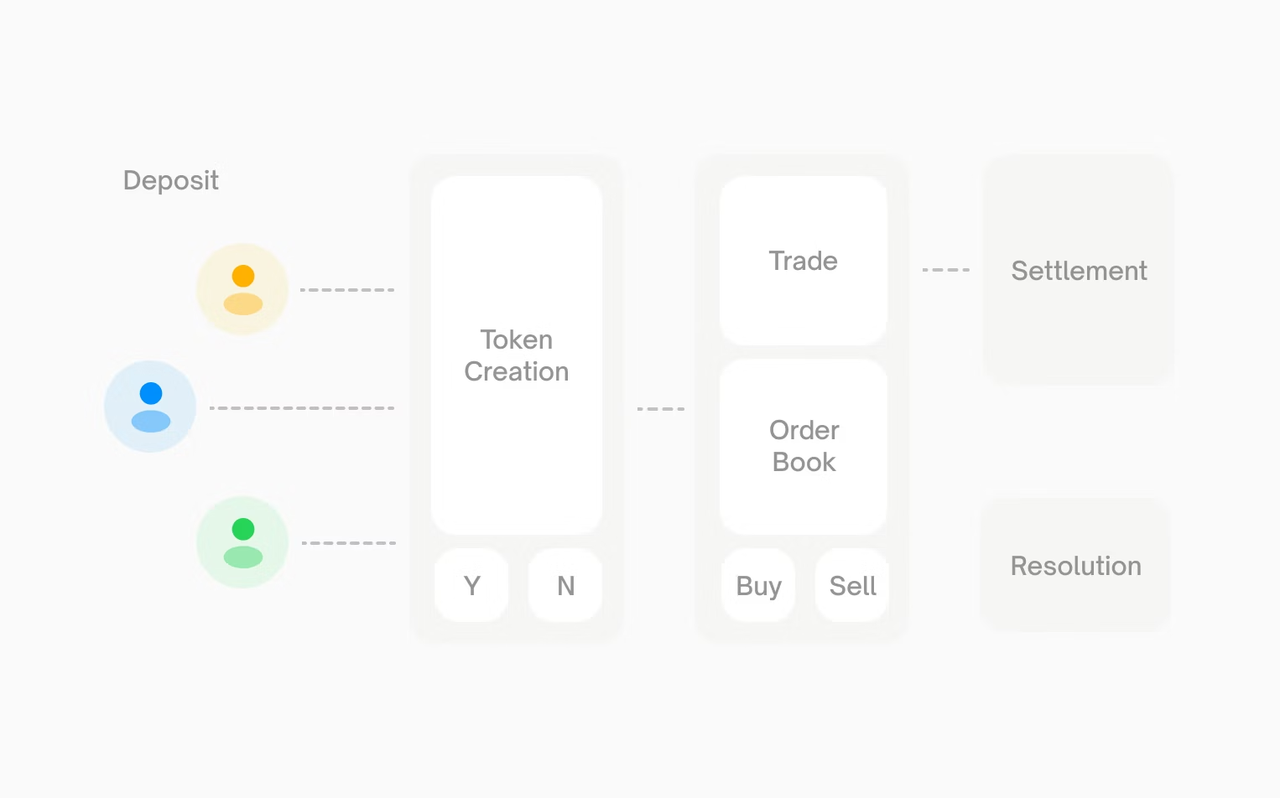
Source: Polymarket official website
-
Connect Wallet and Deposit Collateral Users connect an Ethereum-compatible wallet such as MetaMask to the Polymarket interface and transfer USDC or USDC.e to a supported network like Polygon. This serves as collateral for trading and market making.
-
Select Market and View Order Book After choosing a market, users can review the best bid and ask prices, order book depth, and historical price trends to evaluate current market sentiment and liquidity.
-
Place Orders: Market and Limit Orders Market Order: Executes immediately at the best available price, prioritizing speed over price precision. Limit Order: Allows users to set a maximum buy price or minimum sell price. Orders remain on the book until matched and may qualify for liquidity rewards.
-
Position Management and Early Exit Before settlement, users can partially or fully close positions through reverse trades, locking in profits or cutting losses without waiting for the final outcome.
-
Market Closure and Settlement Preparation When the event occurs or the trading deadline is reached, the market stops accepting new trades and enters a pending settlement state.
-
Result Submission and Settlement After the dispute window ends, UMA’s Optimistic Oracle writes the final result on-chain. The settlement contract then allows holders of winning shares to redeem them for 1 dollar each, while losing shares become worthless.
Throughout this process, trading fees and any market creation fees are automatically deducted by smart contracts. User funds remain held in token form within on-chain contracts rather than by a centralized custodian.
How Does Polymarket Determine Outcomes?
One of the key challenges in prediction markets is how on-chain contracts can learn real-world outcomes.
Polymarket addresses this by integrating UMA’s Optimistic Oracle. After trading ends, anyone can submit a result request to the oracle, including the market question, resolution criteria, and reference data sources. A proposer then submits a candidate outcome.
Once submitted, a fixed dispute window begins. During this time, anyone who believes the proposal is incorrect can challenge it by posting a bond. This triggers UMA’s Data Verification Mechanism, where token holders vote to resolve the dispute.
If no one challenges the proposal, it is accepted as correct and recorded on-chain. If a dispute occurs, the mechanism escalates to a broader vote among stakers, producing an economically secured final decision. Once confirmed, the settlement contract maps YES and NO shares to 1 dollar or 0, completing the clearing process.
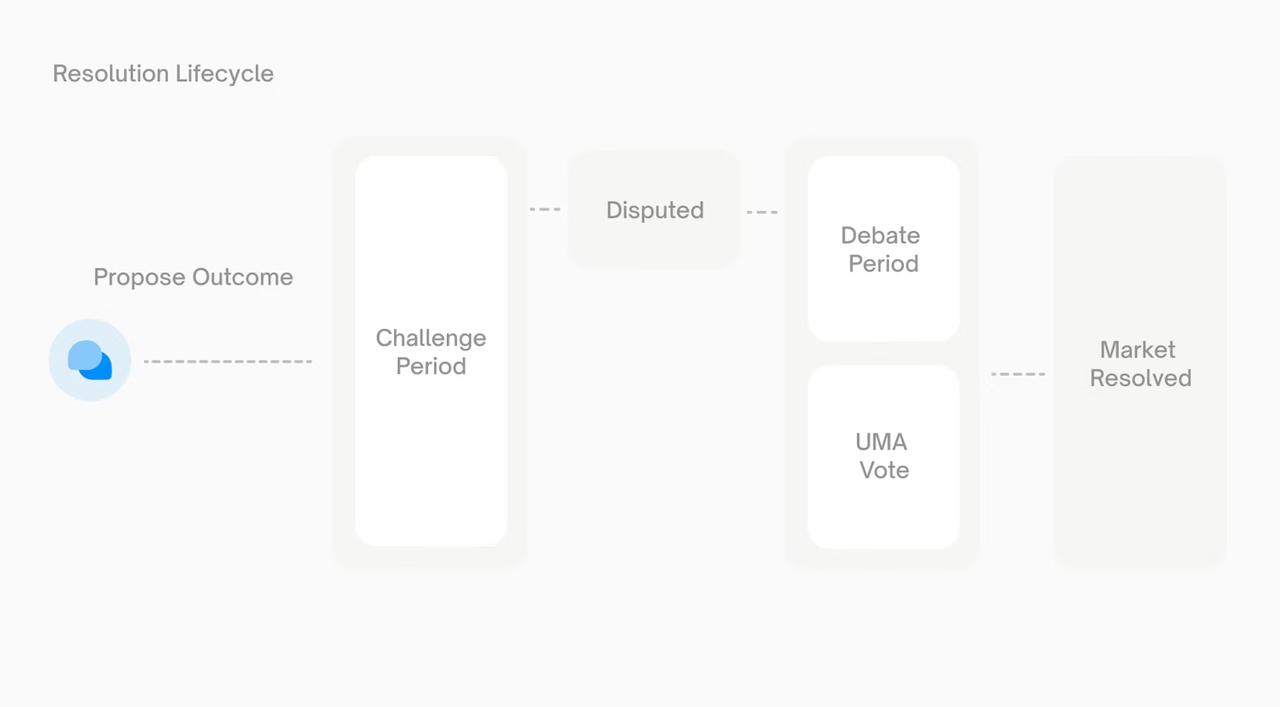
Thanks to the Optimistic Oracle’s assumption-first model, Polymarket can settle most undisputed markets quickly and at low cost, while still providing a robust escalation path for contested cases.
Liquidity Provision and Reward Structure
As an order book based market, Polymarket relies heavily on passive liquidity providers. To support this, it offers a structured liquidity incentive program.
In incentivized markets, the platform defines parameters such as a daily reward pool, maximum spread, and minimum order size. These encourage liquidity providers to place limit orders near the midpoint price, improving depth and trading experience.
Specifically:
-
Each market calculates a midpoint based on the best bid and ask. A defined range around this midpoint, such as plus or minus 4 cents, is considered the eligible spread. Only resting limit orders within this range qualify for rewards.
-
The system tracks both the size and duration of qualifying orders over time, assigning scores to each provider. Rewards are distributed proportionally in USDC at midnight UTC, with a typical minimum payout of 1 dollar.
-
The platform may also introduce sponsored incentives for selected markets, injecting additional rewards to quickly bootstrap early liquidity.
This structure encourages market makers to provide consistent, reasonably priced liquidity rather than simply generating trading volume. As a result, it reduces market impact and improves price discovery.
Systemic Risks and Challenges
Despite its thoughtful design, Polymarket still faces several layers of systemic risk and challenges:
-
Oracle risk: Disputes over subjective events can delay settlement and lock up capital.
-
Manipulation risk: Low liquidity markets can be distorted by large trades, creating misleading signals.
-
Smart contract risk: Vulnerabilities in contracts, bridges, or oracle integrations may lead to fund losses.
-
Regulatory risk: The decentralized nature of the platform creates legal uncertainty across jurisdictions.
For participants, it is more prudent to treat Polymarket as a high-risk, high-uncertainty tool for prediction and information gathering. Risk management, position sizing, and cross-platform verification are essential practices.
Conclusion
From a design perspective, Polymarket combines USDC collateral, an on-chain order book, UMA’s Optimistic Oracle, and a liquidity incentive system into a relatively complete prediction market infrastructure. Funds are held on-chain, prices are formed through user orders, outcomes are determined through a disputable oracle, and liquidity is driven by rewards.
By leveraging blockchain and smart contracts, Polymarket introduces a trustless mechanism for pricing information. This shifts prediction markets from traditional betting and financial tools toward a potential information infrastructure. However, issues such as oracle disputes, uneven liquidity distribution, contract security, and regulatory uncertainty highlight that the system is still evolving and cannot yet be considered fully mature.
FAQs
What does buying a YES share at 0.40 dollars mean? It means the market currently assigns an implied probability of about 40 percent to the outcome. If the event occurs, the share can be redeemed for 1 dollar; otherwise, it becomes worthless.
What is the difference between Polymarket’s order book and an AMM? Polymarket uses a central limit order book where prices are directly determined by user orders and matching, while AMMs use mathematical formulas to quote prices automatically. Order books resemble traditional exchanges more closely and allow finer price granularity and concentrated liquidity.
What happens if someone submits a malicious or incorrect result? Anyone can challenge an incorrect proposal during the dispute window. The dispute escalates to UMA’s verification mechanism, where stakers vote. Malicious proposers or challengers may lose their bonded stake.
How can I earn liquidity rewards as an LP on Polymarket? By placing limit orders near the midpoint within the platform’s defined spread range and maintaining them over time, users can accumulate reward points and receive proportional daily USDC payouts.
How fast is settlement on Polymarket? For undisputed markets, results are usually proposed quickly and go unchallenged, allowing the oracle to finalize them after the dispute window. Settlement typically completes within a few hours to a few days. Disputed cases may take longer.