As blockchain ecosystems mature, tokenomics increasingly functions as a system-level coordination mechanism rather than a simple issuance model. Tokens define who participates, how incentives are distributed, and how value generated by the network is shared.
KAT introduces a model that combines fixed supply, early user prioritization, staged unlocks, and a vote-escrow mechanism (vKAT) that allows participants to influence emissions. This structure reflects a broader shift toward designing token systems that connect liquidity, governance, and real economic activity.
KAT Supply Model and Initial Distribution Structure
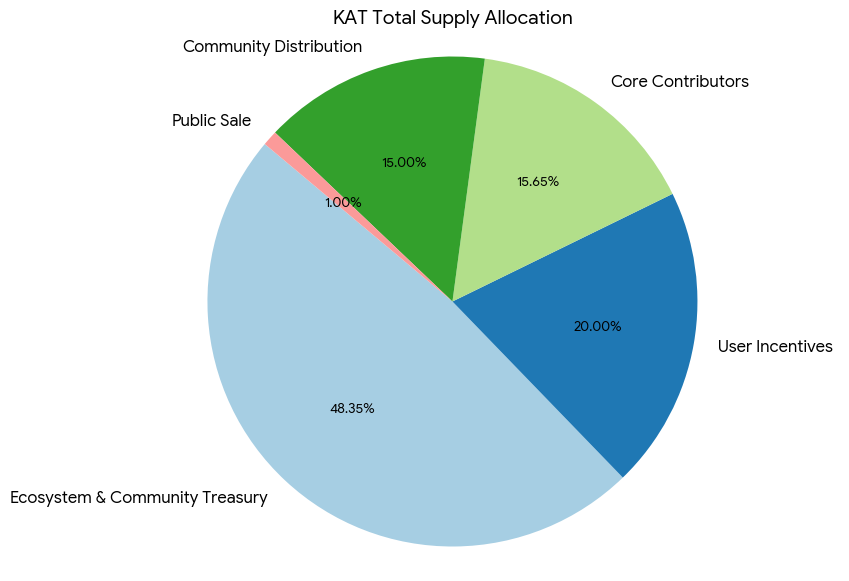
Katana’s KAT token has a fixed total supply of 10,000,000,000 tokens, establishing a non-inflationary ceiling for the network’s economic system.
The allocation is structured to prioritize ecosystem growth and user participation:
-
Ecosystem & Community Treasury (48.35%) The largest allocation is reserved for long-term ecosystem development, liquidity provisioning, and strategic initiatives.
-
User Incentives (20%) Distributed to liquidity providers and users through application-level incentives and participation programs.
-
Community Distribution (15%) Allocated through airdrops and participation-based mechanisms to broaden ownership.
-
Core Contributors (15.65%) Assigned to builders and contributors, subject to multi-year vesting schedules.
-
Public Sale (1%) A limited allocation for open distribution.
A key structural feature is the sequencing of unlocks. User-related allocations are designed to enter circulation earlier, while contributor and treasury tokens are released over four annual tranches following token transferability. This staging influences early ownership distribution and reduces immediate supply concentration.
The token generation event (TGE) took place on March 18, 2026, marking the beginning of token distribution and vesting schedules.
KAT Incentive Mechanisms and Emission Logic
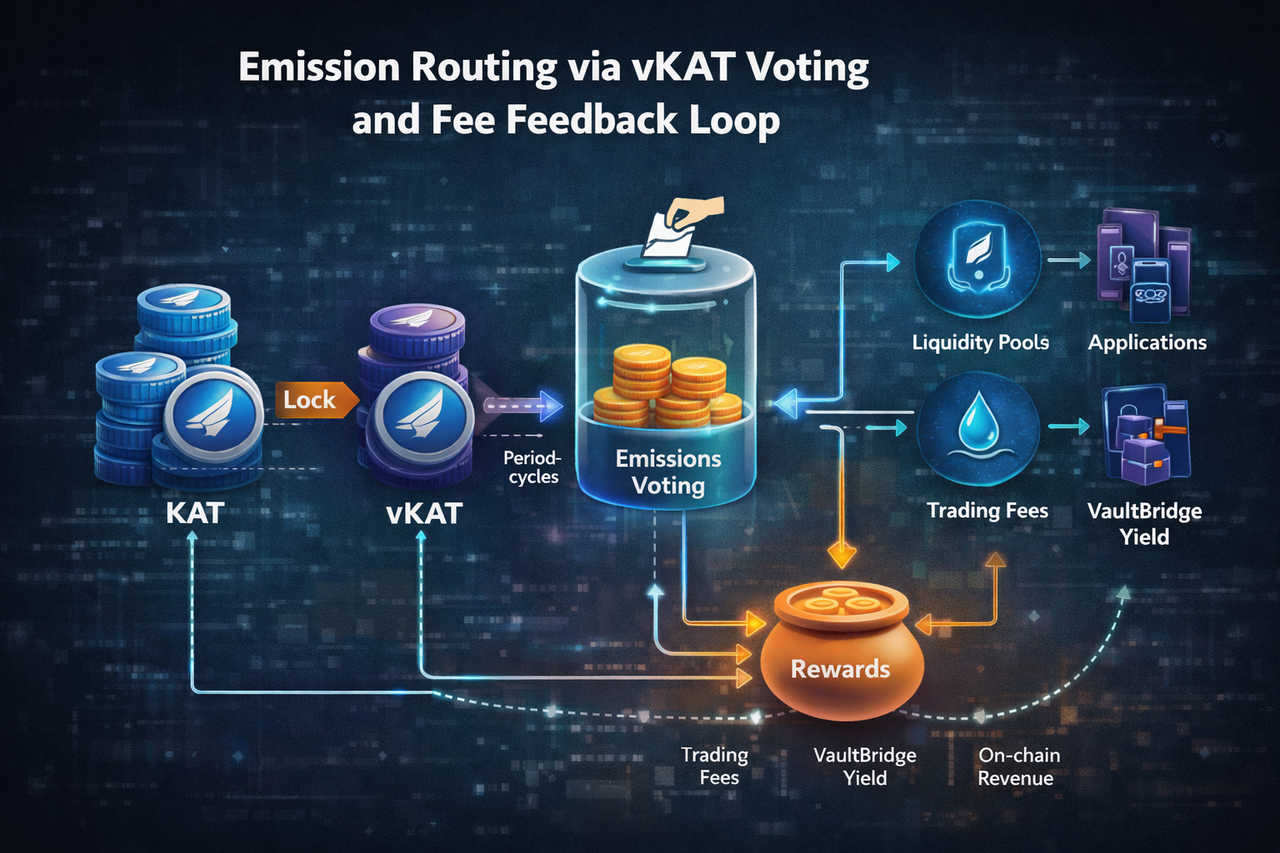
KAT tokenomics is built around a modified vote-escrow (ve) model, where token holders lock KAT to receive vKAT on a 1:1 basis.
This mechanism enables a dynamic incentive system:
-
Holders lock KAT to obtain vKAT.
-
vKAT holders participate in periodic voting cycles.
-
Voting determines how token emissions are allocated across supported liquidity pools and applications.
This structure shifts emission control from a fixed schedule to a participant-driven process. Incentives are directed toward areas that attract liquidity and activity, allowing the system to adapt over time.
In parallel, KAT integrates a real-yield model. Network-generated value such as trading fees, VaultBridge-related yield, and other on-chain revenue can be distributed within the ecosystem. This introduces a feedback loop where productive activity may support ongoing incentives.
The broader objective is to reduce reliance on continuous token emissions by gradually linking rewards to actual network usage.
KAT Lockup Design and Value Capture
Locking is central to KAT’s design, transforming token ownership into governance influence and access to value flows.
When KAT is locked, it is converted into vKAT on a 1:1 basis. This locked form enables participation in emission voting and may provide access to rewards linked to network activity. Unlocking is subject to a 45-day cooldown period, meaning tokens remain illiquid for a defined time after exit is initiated.
This structure serves multiple purposes:
| Function |
Explanation |
| Supply management |
Lockups reduce circulating supply, moderating short-term liquidity pressure. |
| Incentive alignment |
Long-term participants gain greater influence over emission direction through vKAT. |
| Value capture |
Locked holders may receive a share of fees or network-generated yield, depending on system design. |
By linking governance power and rewards to locked positions, the system encourages longer-term participation while stabilizing circulating supply dynamics.
Advantages and Risks of KAT Tokenomics
KAT tokenomics reflects a structured attempt to balance early growth incentives with long-term sustainability. The model combines distribution design, governance mechanisms, and value capture pathways to align participant behavior with network development.
| Category |
Aspect |
Explanation |
| Advantage |
User-first distribution |
A meaningful portion of tokens is allocated to participants, supporting broader initial ownership rather than concentrated insider control. |
| Advantage |
Governance alignment |
Vote-escrow (vKAT) requires token locking, aligning influence with long-term commitment instead of short-term holding. |
| Advantage |
Real-yield integration |
Rewards may be supported by actual network activity, reducing reliance on continuous token emissions if usage grows. |
| Risk |
Treasury concentration |
A large treasury allocation may lead to governance influence being concentrated, particularly in early stages. |
| Risk |
Execution dependency |
The model depends on sustained network activity; without it, emissions may dominate and lead to dilution. |
| Risk |
Liquidity constraints |
Lockups and cooldown periods can limit flexibility and reduce immediate liquidity for participants. |
| Risk |
Governance participation |
If voting participation is low or concentrated, emission control may become less representative and less effective. |
Overall, KAT tokenomics combines incentive alignment and adaptive reward mechanisms with structural trade-offs related to liquidity, governance distribution, and reliance on real network activity.
Conclusion
KAT tokenomics is a network-centered economic framework that combines fixed supply, user-focused distribution, vote-escrow governance, and real-yield integration.
Its design positions the token as a coordination tool rather than a passive asset, linking liquidity, participation, and governance through the vKAT mechanism. Emission routing and fee-based rewards attempt to align incentives with actual network activity over time.
Ultimately, the effectiveness of KAT tokenomics depends on whether the Katana network can generate sustained usage and meaningful value flows. In this context, the token model functions not only as a distribution system, but as an economic structure for organizing decentralized participation.
FAQs
What is the total supply of KAT?
KAT has a fixed total supply of 10,000,000,000 tokens.
What is vKAT?
vKAT is the locked version of KAT, issued on a 1:1 basis, which allows holders to participate in governance and emission voting.
How do KAT incentives work?
Incentives are distributed through emissions that are directed by vKAT holders toward liquidity pools and ecosystem activities.
Is there an unlock restriction?
Yes, unlocking KAT involves a 45-day cooldown period before tokens become liquid.
How does KAT generate value?
Value may come from network activity, including trading fees and VaultBridge-related yield, which can be distributed within the ecosystem.







