AI’s Role in Consumer Activity
In recent years, artificial intelligence has evolved from basic conversation to advanced task execution, including:
- Booking services
- Managing schedules
- Automated purchasing
The next frontier is empowering AI with payment capabilities.
To make this possible, payment networks and blockchain infrastructure providers are joining forces to build secure transaction mechanisms for AI.
Collaboration Spotlight: AI Handles Payments Directly

(Source: Mastercard)
Mastercard, a global payments leader, has partnered with Lobster.cash, driven by Crossmint, to introduce a new payment model. This model allows users to authorize AI affiliates to make purchases on their behalf. The feature will launch on the open-source platform OpenClaw, starting with a test phase before gradually expanding its reach.
Core Mechanism: How Does AI Make Payments Securely?
The primary challenge of enabling AI to use credit cards is ensuring security and control.
This system is built around three core elements:
-
User Consent
AI can only execute transactions with the explicit consent of the user.
-
Payment Network Verification
All transactions are verified and processed using Mastercard’s established network.
-
Cryptographic Proof
Each transaction is cryptographically linked to the user’s approval, guaranteeing authenticity and preventing forgery.
AI operates strictly within an approval framework and cannot spend freely.
What Is Lobster.cash?
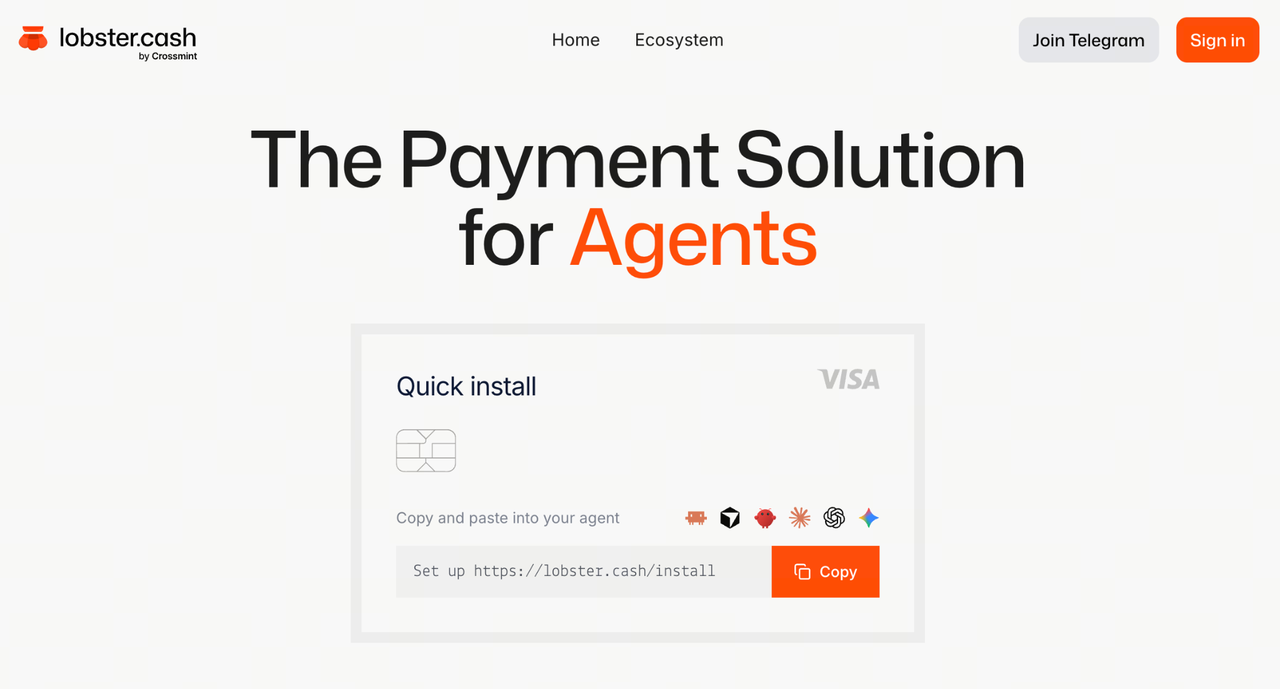
(Source: lobster.cash)
Lobster.cash is a wallet and payment layer purpose-built for AI, enabling intelligent affiliates to autonomously conduct transactions. It supports both traditional credit cards and stablecoins, bridging conventional finance and blockchain assets. The technical architecture integrates multiple systems, including blockchain networks like Solana, stablecoin issuers such as Circle, and advanced payment and identity verification technologies.
Lobster.cash is more than a payment tool—it’s a transaction infrastructure designed specifically for AI. It allows intelligent affiliates to execute payments automatically based on predefined conditions, minimizing manual intervention and accelerating AI’s adoption in commercial and financial applications.
OpenClaw Ecosystem: Use Cases for AI Affiliates
OpenClaw is an open-source platform dedicated to deploying and managing AI affiliates.
Within this ecosystem, AI can:
- Search for products or services
- Make purchasing decisions
- Initiate payment requests
For example: AI can compare prices and place orders directly on your behalf.
This approach is known as Agentic Commerce.
Security and Risk Control
When AI handles payments for humans, risk control remains the top priority.
This system mitigates risk through:
- No direct exposure of credit card information
- Payment activities limited by issuing bank rules
- Full traceability and auditability of all transactions
Ultimately, users maintain full control.
Payment Companies’ AI Strategy
This collaboration is part of a broader industry trend. For instance, Visa has also introduced AI-driven payment frameworks, signaling that future payment systems will increasingly support AI-driven transactions. As AI affiliates become more widespread, building secure financial infrastructure for their use will become essential.
Future Outlook
As these technologies mature, we may see scenarios such as:
- AI automatically restocking household essentials
- Booking services based on user demand
- Managing procurement processes for enterprises
This evolution will transform not only how payments are made, but the entire consumer journey.
Summary
The partnership between Mastercard and Lobster.cash marks the beginning of a new era, where payment activities can be delegated to AI. The critical challenge is not just technological capability, but achieving the right balance between convenience and security. Ultimately, the reliability of AI as a consumer affiliate will depend on the robustness of the supporting infrastructure.







