Meme Launchpad: Explosion and Inflection Point
Over the past year, meme launchpads have become one of the most explosive sectors in the crypto market. Technologically, these platforms have simplified the token issuance process and introduced automated pricing mechanisms—such as bonding curves—that significantly lower the threshold for launching tokens, making “anyone can issue a token” a reality.
This model has resulted in two immediate outcomes:
-
Explosive growth in token supply. In a short period, the market has seen a massive surge in meme assets, far exceeding the issuance pace of traditional crypto projects.
-
A substantial increase in trading activity. The prevalence of short-term speculative behavior has dramatically boosted on-chain transaction frequency, creating an unprecedented high-frequency trading environment.
However, this rapid expansion did not last. Entering 2026, the market began to change noticeably: new capital inflows slowed, user enthusiasm waned, and project life cycles shortened. Data from March directly reflects this turning point.
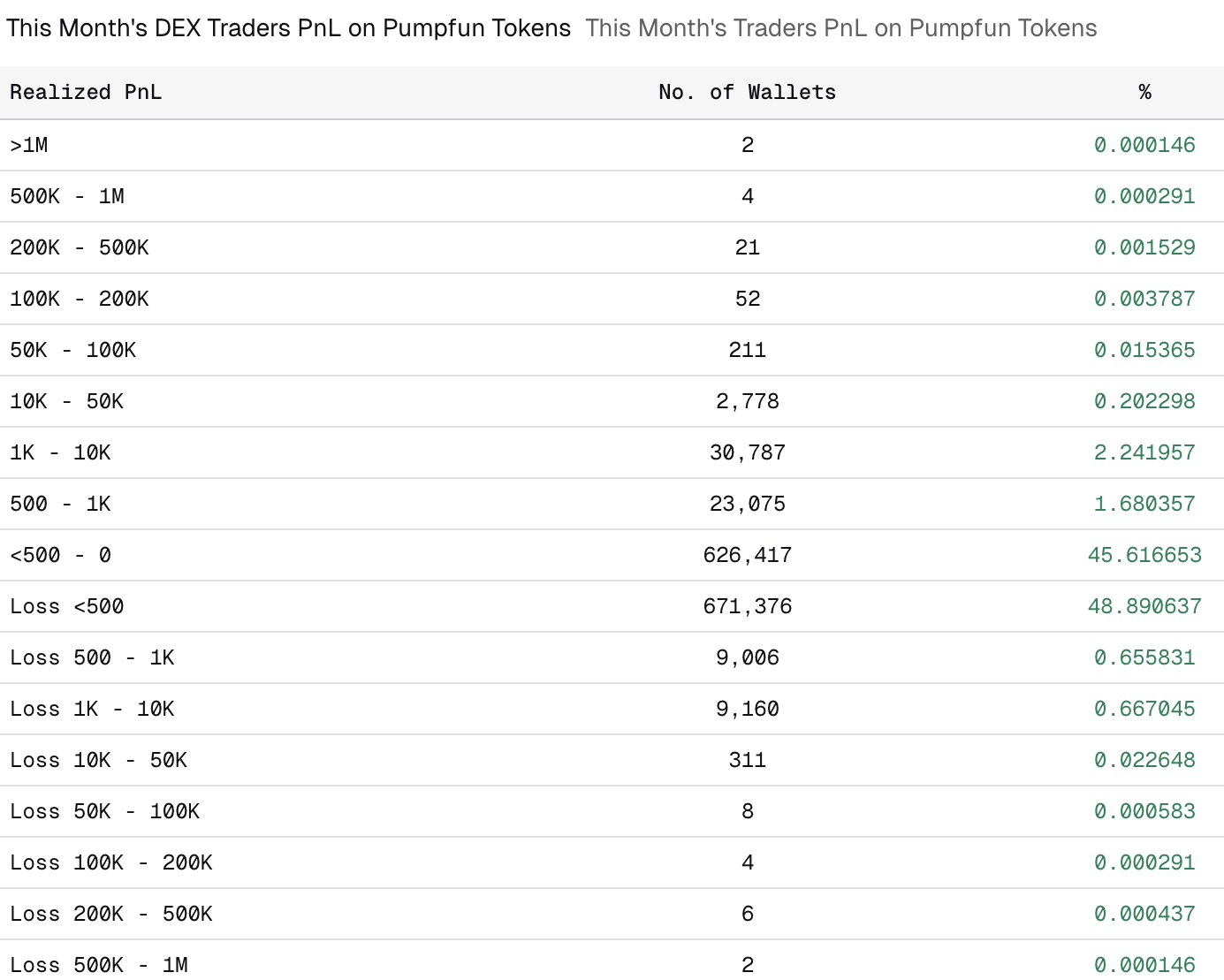
Data Signal One: Over 50% of Traders Are Losing Money
 Source: oladee’s Dune dashboard
From the perspective of user returns, meme launchpads now clearly exhibit a loss-dominated structure.
Recent on-chain statistics show that in the past month:
This marks a shift from the early phase of broad profitability to a landscape where most users lose money. Breaking down the data reveals a classic return distribution:
-
A small group of early participants capture outsized gains
-
Mid-tier users achieve modest profits or break even
-
Most late entrants absorb the losses
This pattern is not random—it’s shaped by market mechanics. Meme assets lack stable intrinsic value, and their price increases rely on continuous capital inflows. When fresh capital dries up, late entrants struggle to generate positive returns.
Viewed this way, “over 50% losing money” is not an anomaly, but the inevitable result as the market matures.
 Source: DeFillama
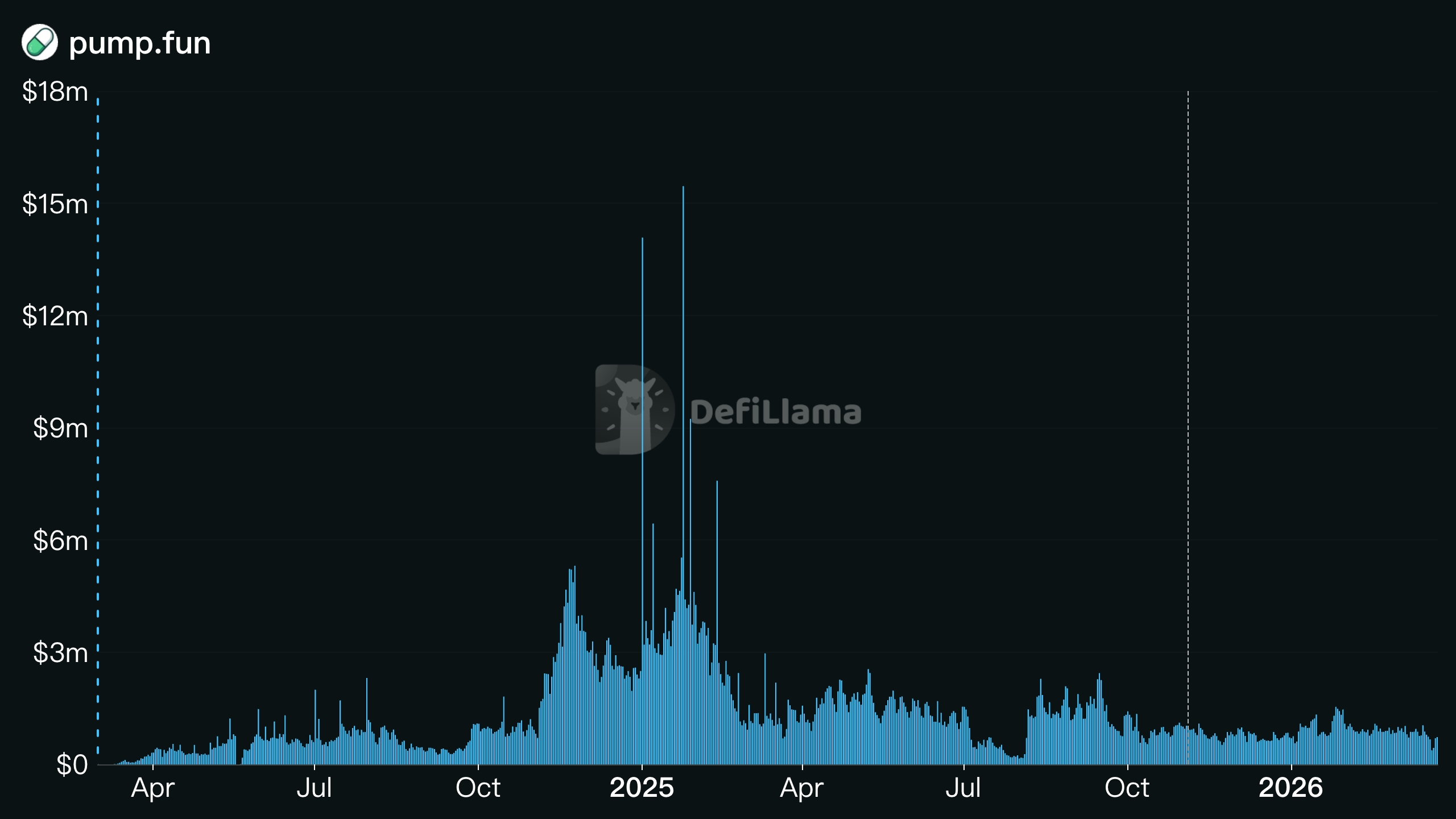
While users are broadly losing money, platforms remain highly profitable. Yet the trend in revenue has shifted.
Currently, meme launchpad revenues show two key traits:
-
Absolute revenue remains high. Leading platforms still generate substantial daily income, demonstrating the model’s strong monetization under high trading frequency.
-
Growth has slowed significantly, with signs of decline. Compared to earlier periods of “tens of millions per week,” current revenue ranges have clearly moved lower.
This shift reflects falling trading activity. As market enthusiasm fades, transaction frequency drops, and platform income naturally declines.
More importantly, this downturn is not isolated—it’s a common trend across the industry. This indicates meme launchpads have moved from a “rapid growth phase” into a period of adjustment.
Structural Contradiction: Revenue vs. User Losses
The most notable feature of meme launchpads today is their internal structural contradiction:
On one hand, more than half of users are losing money. On the other, platforms continue to generate high revenues.
This apparent contradiction stems from fundamentally different profit mechanisms.
Platforms earn primarily from transaction fees and token issuance charges—income that is highly predictable. As long as trading occurs, platforms profit.
User returns, by contrast, depend entirely on price movements. Only when prices rise and users successfully exit can they realize gains.
When the market becomes saturated and price upside is limited, this gap widens, producing the “platforms profit, users lose” dynamic.
Industry Fundamentals: High-Frequency Trading as a Negative-Sum Game
At a macro level, meme launchpads operate much like high-frequency trading markets.
Their core logic can be summarized as:
-
Lowering entry barriers to attract mass participation
-
Accelerating capital turnover through frequent trading
-
Extracting ongoing revenue via fee mechanisms
In this process, platforms extract profits from every transaction, while users redistribute funds among themselves.
Factoring in transaction fees, the system is essentially a negative-sum game:
-
Total capital does not grow
-
Platforms continuously extract profits
-
Users’ aggregate returns are negative
This explains why most wallets show losses in the data.
Liquidity Fragmentation and Intensifying Competition
Beyond the cooling market, shifts in competitive structure are accelerating industry adjustment.
The meme launchpad ecosystem is now highly fragmented:
-
New platforms continue to emerge
-
Competition between chains is intensifying
-
Users and capital are dispersed across multiple platforms
This liquidity fragmentation has several direct effects:
First, trading depth on individual platforms declines. With capital spread thin, single markets struggle to maintain high liquidity.
Second, project life cycles shorten. As attention shifts quickly, individual meme projects find it hard to sustain momentum.
Finally, user profitability becomes harder to achieve. In a fragmented environment, capturing high-return opportunities is increasingly difficult.
Changing User Behavior: From FOMO to Cautious Participation
As the market environment evolves, user behavior is changing.
In the early phase, FOMO (fear of missing out) drove the market. Users rushed in and traded frequently, seeking quick gains.
Now, as losses mount, users are becoming more cautious:
-
Participation frequency is dropping
-
Holding periods are lengthening or users are avoiding participation altogether
-
Standards for project quality are rising
This behavioral shift further dampens market activity, creating a negative feedback loop: less trading → lower income → declining enthusiasm → even less trading.
Platforms are adapting their strategies to these changes.
Early on, their core goal was expansion:
Now, the focus is on retention:
-
Using incentives to reduce user churn
-
Optimizing the trading experience to increase activity
-
Introducing recommendation and screening mechanisms to improve conversion rates
This shift shows platforms recognize the market’s maturity—growth can no longer rely solely on new users.
Trend Outlook: The Next Phase for Meme Launchpads
Based on current data and structure, several predictions can be made for the industry’s future:
-
Competition for Existing Liquidity Will Dominate
With less new capital, platforms will compete for the liquidity already in the market.
-
Revenue Will Become Cyclical
Platform income will depend more on market sentiment, not steady growth.
-
Industry Concentration Will Increase
Leading platforms will further consolidate their positions; smaller platforms will be phased out.
-
User Entry Barriers Will Keep Rising
Only those with superior information and execution skills will achieve stable returns.
Conclusion
March 2026 data reveals a critical reality for meme launchpads:
-
Over half of users are losing money
-
Platforms continue to profit
-
The industry is cooling overall
This marks a shift from the “get-rich-quick myth” to “structural competition.” Meme launchpads won’t disappear, but the logic of participation will fundamentally change—moving from a speculative opportunity for all to a highly competitive market where only a few survive.
The real question is no longer whether opportunities exist, but how to avoid becoming the passive party in a structure where most are destined to lose.