The scale of stablecoin transactions has reached trillions of dollars, yet general-purpose blockchains still face limitations in gas costs, confirmation speed, and network congestion. These constraints continue to limit large-scale adoption in everyday payments and cross-border transfers. Against this backdrop, payment-optimized blockchain infrastructure has become a key development direction.
Plasma is built as a stablecoin payment network to address this need. It focuses on stablecoin payments as its core use case and combines protocol-level subsidies, a customized consensus mechanism, and a modular architecture to enable zero-fee transfers and near-instant finality. This approach aims to provide an on-chain alternative to traditional payment systems.
At the same time, Plasma is positioned as a stablecoin-native settlement layer, differentiating itself from general-purpose or high-performance chains. Its PlasmaBFT consensus, Paymaster gas abstraction, and trust-minimized Bitcoin bridge together form a technical foundation tailored for payment scenarios.
Plasma's Overall Architectural Design
Plasma is designed around three core principles: stablecoin-first architecture, modular high-performance design, and a zero-fee plus customizable gas model.
Stablecoin-first design
At the protocol level, Plasma treats stablecoins such as USDT as primary assets rather than secondary tokens. Through gas subsidies and native support, stablecoin transfers can approach the experience of instant messaging, enabling near-frictionless payments.
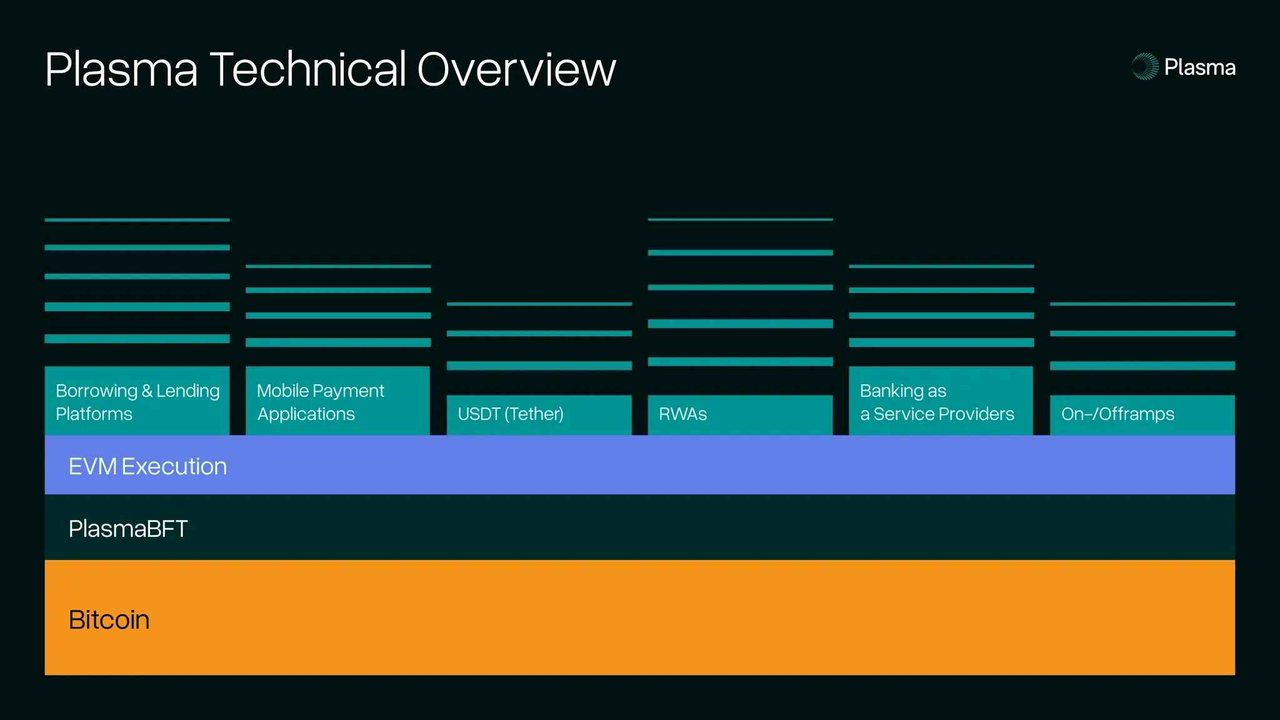
The network adopts a modular architecture that separates consensus through PlasmaBFT, execution through EVM compatibility, and settlement layers. This structure supports throughput above 1000 transactions per second while maintaining flexibility for upgrades and expansion.
Zero-fee and customizable gas mechanism
Through Paymaster contracts, Plasma enables gas sponsorship. Simple transfers are subsidized by the protocol to achieve zero fees, while more complex interactions allow gas to be paid using XPL or stablecoins. This balances user experience with network sustainability.
Core Components of the Plasma Network
Plasma consists of several key modules that together form a complete payment infrastructure:
-
PlasmaBFT consensus layer, responsible for fast transaction agreement
-
Execution layer with EVM compatibility, supporting smart contracts and DeFi applications
-
Paymaster module, enabling gas abstraction and fee sponsorship
-
Cross-chain bridge module, introducing liquidity from Bitcoin and other chains
These components operate together to create a closed-loop system where payments function as an integrated service.
| Component |
Function Description |
Technical Characteristics |
| PlasmaBFT Consensus |
Responsible for block production and transaction confirmation |
Sub-second finality, driven by PoS staking |
| EVM Execution Layer |
Handles smart contract calls and state updates |
Fully EVM-compatible, supports Solidity |
| Paymaster Module |
Enables gas fee sponsorship and flexible payment options |
Zero-fee USDT transfers, supports stablecoin-based gas |
| Native BTC Bridge |
Maps BTC to pBTC for cross-chain usage |
Trust-minimized, non-custodial design |
| Node Network |
Ensures validation and data availability |
Decentralized validators with reward and penalty mechanisms |
Stablecoin Payment Transaction Flow
Within the Plasma network, a stablecoin payment is typically completed within seconds through the following process:
-
The user initiates a USDT transfer without needing to hold a gas token
-
The Paymaster automatically intervenes and pays the transaction fee
-
The transaction enters the mempool and awaits inclusion in a block
-
Validators confirm the transaction through PlasmaBFT consensus
-
A block is produced and finality is achieved
-
The recipient receives the funds immediately and can reuse them
This process removes the need for intermediary clearing institutions and achieves atomic on-chain settlement.
Plasma Settlement and Clearing Mechanism
Plasma combines clearing and settlement into a single on-chain operation, significantly improving efficiency. Its key characteristics include:
-
Atomic settlement, where transactions settle instantly without T+1 or T+2 delays
-
Deterministic finality, where confirmed transactions cannot be reversed
-
Programmable payments, supporting batch transfers and conditional logic
This structure is particularly suited for cross-border payments and high-frequency business-to-business settlement.
Plasma's performance advantages come from multiple layers of optimization.
First, the Paymaster mechanism enables zero-fee transfers by subsidizing gas, lowering the barrier to entry for users. Second, PlasmaBFT consensus achieves high throughput and sub-second block times while maintaining security.
In addition, the execution layer is optimized specifically for stablecoin transactions, reducing the cost of state updates and enabling parallel processing, which further improves efficiency. The fee model is also designed to be predictable, allowing the network to maintain low costs even during peak usage.
Cross-Chain and Multi-Stablecoin Support
Plasma is designed to support multiple assets and cross-chain expansion:
-
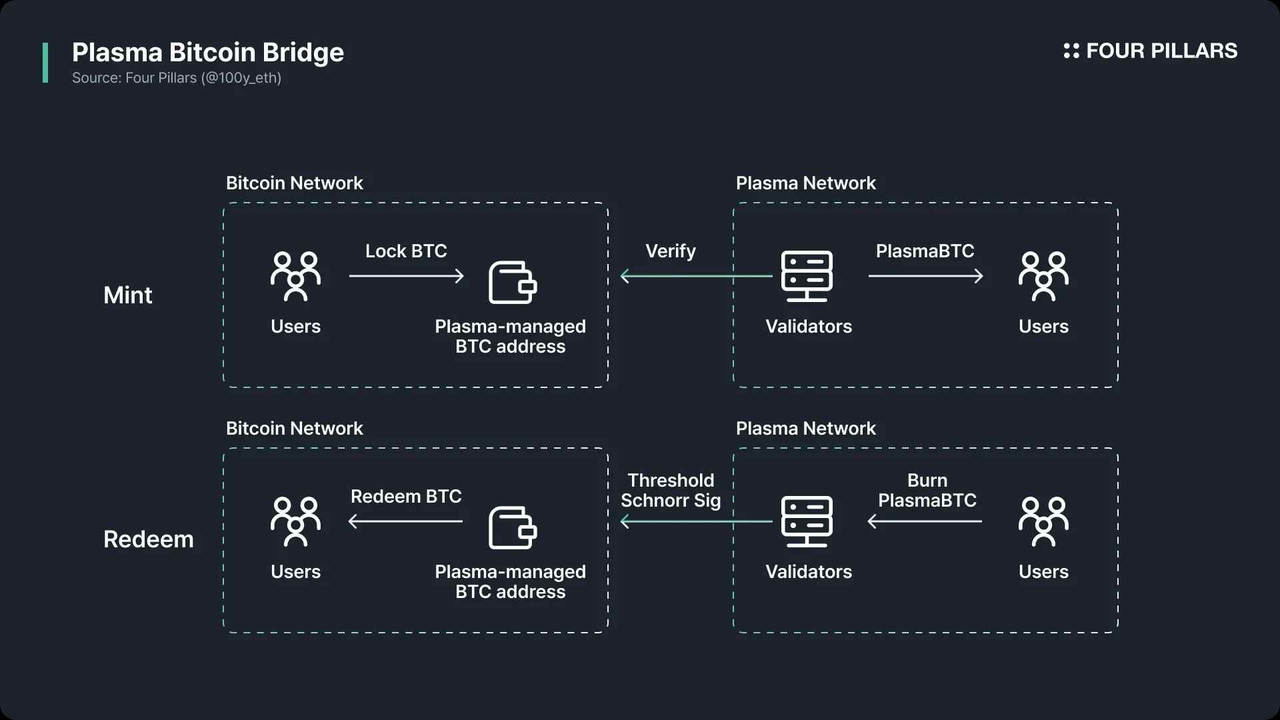
A native Bitcoin bridge maps BTC into pBTC for on-chain financial use
-
Support for major stablecoins such as USDT and USDC
-
Compatibility with standard cross-chain protocols for asset inflow
This multi-asset design allows Plasma to support not only stablecoin payments but also Bitcoin-based financial activity on-chain.
Source: Four Pillars
Security Mechanisms and Risk Management
In terms of security, Plasma applies multiple layers of protection:
-
PoS staking and penalty mechanisms to regulate validator behavior
-
PlasmaBFT providing Byzantine fault tolerance
-
Independent audits and multi-signature governance for core modules
-
Support for compliance extensions such as KYC and AML where required
These features allow the network to maintain financial-grade security while operating at high performance.
Conclusion: The Core Strength of Plasma Architecture
Plasma combines a stablecoin-native design, high-performance consensus, and gas abstraction to create a blockchain infrastructure optimized for payments. Compared with general-purpose blockchains, it offers advantages in cost, speed, and user experience.
At the same time, its modular architecture, Bitcoin bridge, and EVM compatibility provide flexibility for future expansion, positioning Plasma as a potential foundational layer for on-chain payments and settlement.
FAQs
What are Plasma's block time and finality characteristics?
PlasmaBFT enables block times under one second and near-instant finality, making it suitable for real-time payments and merchant settlement.
How does Plasma achieve zero-fee transfers?
Through the Paymaster mechanism, gas fees are sponsored by the protocol or ecosystem participants, allowing users to complete simple stablecoin transfers without paying fees.
What cross-chain assets does Plasma support?
Plasma natively supports BTC through a pBTC bridge, as well as stablecoins such as USDT and USDC, and can integrate additional assets through standard bridging protocols.
What consensus mechanism does Plasma use?
Plasma uses PlasmaBFT, a PoS-driven Byzantine fault-tolerant mechanism combined with staking penalties to ensure both performance and security.
What payment scenarios is Plasma suited for?
It is suitable for cross-border remittance, merchant payments, micro-transactions, batch settlement, business-to-business clearing, and on-chain payroll.







