As the blockchain ecosystem has evolved from single-chain structures into a multi-chain landscape, the need for enterprises to share data and assets across different blockchains has grown significantly. Traditional cross-chain technologies tend to focus on asset bridging, while Quant introduces a unified interoperability layer that allows applications to operate across systems without requiring migration or major restructuring of existing infrastructure.
From a broader fintech perspective, Overledger is more than just a cross-chain solution. It represents part of a multi-ledger financial infrastructure. Centered around the MApps multi-chain application framework, the Multi-Ledger Rollup architecture, and the Network of Networks model, Quant is building a new architectural paradigm for cross-chain financial systems.
Core Concepts of the Overledger Network
Overledger, as Quant’s core technology platform, is designed to connect different blockchains with traditional financial systems. Unlike conventional blockchains, Overledger is not an independent chain, but an interoperability layer that operates across multiple blockchains.
Through a unified API framework, Overledger allows developers to build cross-chain applications without needing to understand the technical details of each individual blockchain. This significantly lowers development barriers, enabling enterprises to deploy blockchain solutions faster and achieve system interoperability more efficiently.
Overledger also supports multi-chain application execution. A single application can connect to multiple blockchains simultaneously, for example executing transactions on a public chain while storing data on a private chain. This architecture increases flexibility and supports the development of multi-chain financial systems.
As enterprise demand for interoperability continues to rise, Overledger is increasingly becoming a critical layer connecting traditional finance with blockchain technology.
Source: Medium
Quant’s Multi-Layer Blockchain Architecture
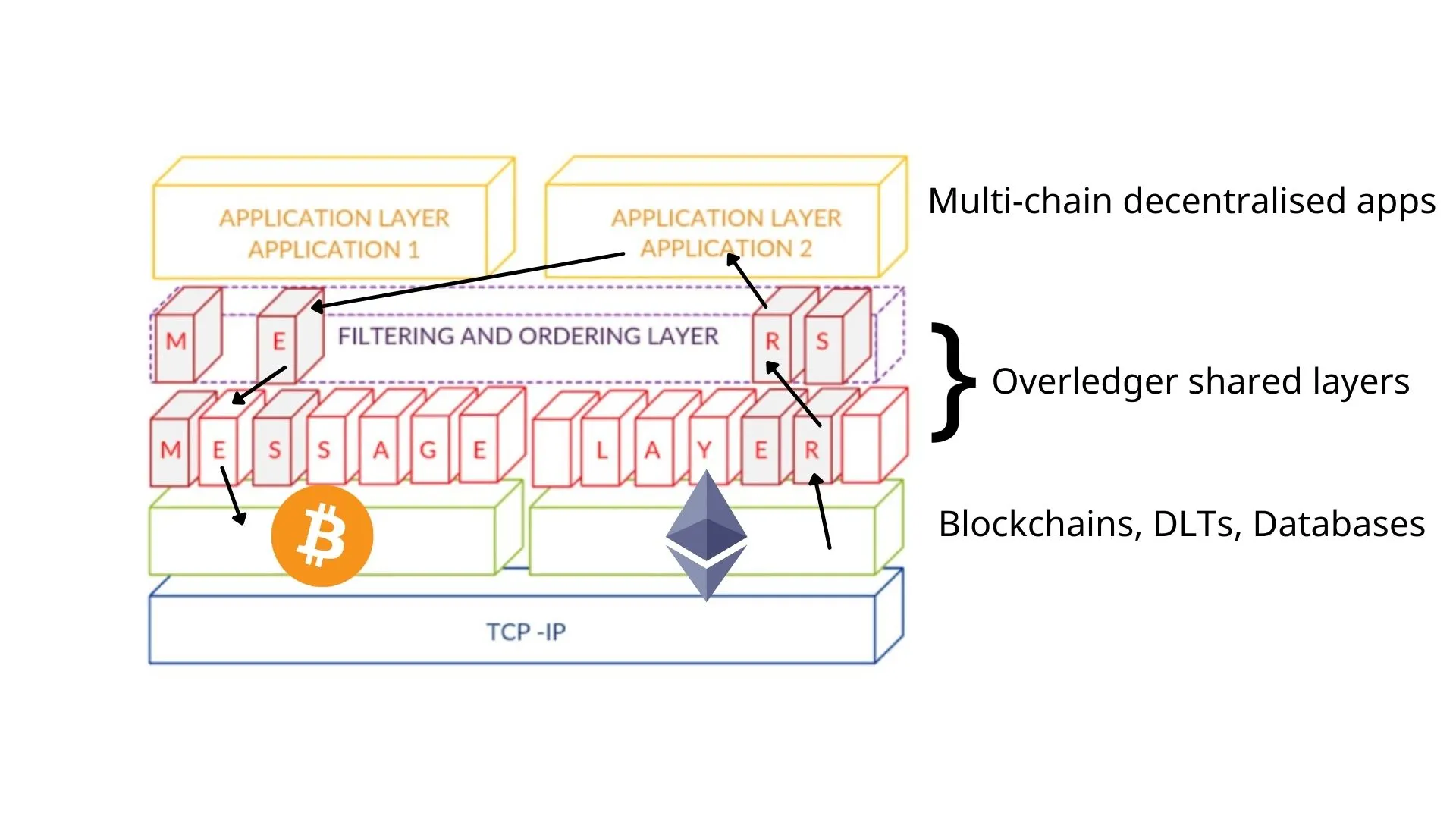
Quant adopts a multi-layered architecture that enables different systems to operate together seamlessly. This structure generally consists of the application layer, the interoperability layer, and the blockchain layer.
At the application layer, enterprises can deploy financial applications such as payment systems, asset tokenization platforms, or multi-chain DeFi solutions. These applications connect to various blockchain networks through Overledger.
The interoperability layer, formed by Overledger, is responsible for cross-chain communication and data transformation. It standardizes data formats across blockchains and executes cross-chain operations.
The blockchain layer includes both public and private chains, such as internal ledgers used by financial institutions, public blockchain networks, and enterprise systems. Through this layered design, Quant creates a multi-ledger interoperability network that allows different systems to function within a unified environment.
This structure is particularly valuable for financial institutions, which often rely on multiple systems and networks simultaneously.
How Overledger Connects Different Blockchains
Overledger connects blockchains and enterprise systems through an API gateway. When an application sends a request, Overledger interprets it and routes it to the appropriate blockchain.
Unlike traditional cross-chain bridges, Overledger does not rely on asset locking or wrapped tokens. Instead, it focuses on interoperability of data and logic, reducing cross-chain risks and making it more suitable for enterprise environments.
Overledger also supports cross-chain transaction execution. For example, an application can execute a smart contract on one blockchain while storing data on another. This structure is often referred to as a multi-ledger execution model.
By enabling this type of connectivity, Quant allows cross-chain communication while preserving the independence of each blockchain, improving overall scalability.
MApps: The Multi-Chain Application Model
Quant introduces the concept of MApps, or multi-chain applications, which are designed to operate across multiple blockchains. Unlike traditional single-chain applications, MApps can simultaneously utilize resources from different blockchain networks.
For example, a financial application could store assets on a highly secure chain while executing transactions on a high-performance chain. This architecture improves both efficiency and security.
MApps are also well suited for enterprise financial applications. Banking systems can connect to multiple payment networks and blockchains, enabling unified financial services.
As the multi-chain ecosystem continues to expand, MApps have become a key component of Quant’s architecture, driving the development of cross-chain applications.
Overledger vs Traditional Cross-Chain Bridges
Traditional cross-chain bridges primarily focus on transferring assets between blockchains. Overledger, by contrast, emphasizes system interoperability. Bridges typically require assets to be locked and represented as wrapped tokens, which can introduce security risks.
Overledger avoids this model by using API-based interoperability, eliminating the need for asset locking. This enhances security and aligns better with enterprise requirements.
Additionally, cross-chain bridges often connect only a limited number of blockchains, whereas Overledger can integrate multiple systems, including enterprise networks and financial infrastructure.
For this reason, Overledger is better understood as enterprise-grade interoperability infrastructure, while cross-chain bridges function mainly as asset transfer tools.
Enterprise Access Solutions in the Overledger Ecosystem
Quant provides several enterprise-focused products that enable institutions to integrate with the Overledger network, including:
Quant Flow
Quant Flow is an API platform for programmable payments, allowing banks and payment institutions to automate financial processes. It supports event-driven payments, risk management, and compliance controls.
It also enables automated account workflows, helping institutions manage complex fund movements more efficiently.
QuantNet
QuantNet is designed for tokenized asset settlement. Financial institutions can use it to transfer digital assets across different systems.
It is built on the ISO 20022 standard, allowing different financial systems to communicate using a unified messaging format. This reduces integration costs and improves interoperability.
Quant Fusion
Quant Fusion represents the next generation of Quant’s interoperability architecture, aimed at connecting public blockchains with permissioned networks. It consists of two core components:
Multi-Ledger Rollup
Multi-Ledger Rollup is an advanced rollup architecture that enables execution and settlement across multiple Layer 1 blockchains simultaneously. It combines:
-
The transparency and decentralization of public chains
-
The privacy and performance of private chains
-
Enterprise-grade access control
This architecture allows multiple blockchains to operate within a unified environment, forming the foundation for multi-chain financial systems.
Network of Networks
The Network of Networks model allows participants to connect their own blockchains or nodes to the Fusion network. Users can define access permissions and control how data is shared.
This creates a modular blockchain network where different systems can interoperate while maintaining privacy and security.
In addition, Fusion supports:
These mechanisms further expand Quant’s interoperability ecosystem.
PayScript
PayScript is a financial automation tool provided by Quant that allows enterprises to define rules for fund flows.
It supports:
This enables organizations to implement financial automation without complex programming.
Conclusion
Quant’s Overledger network is an enterprise-grade cross-chain interoperability layer that connects multiple blockchains and financial systems through APIs. With products such as Quant Flow, QuantNet, and Quant Fusion, Quant is building a comprehensive multi-chain financial infrastructure.
As the multi-chain ecosystem continues to evolve, the demand for interoperability is increasing. By providing a unified solution through Overledger, Quant enables enterprises to operate across multiple blockchains and supports the continued development of digital financial systems.
FAQ
Is Overledger a blockchain?
No, Overledger is not a blockchain. It is an interoperability layer that connects multiple blockchains.
What is the relationship between Quant Fusion and Overledger?
Fusion is a multi-chain execution framework built on top of Overledger.
What are MApps?
MApps are multi-chain applications that run across multiple blockchains.
Does Quant support enterprise systems?
Yes, Quant is specifically designed for enterprise-level interoperability solutions.
What is the role of the QNT token?
QNT is used to pay network fees and for node staking.